


con-block-row-bgcolor
#F8F8F8

Content management systems: Software buyer’s guide.

Six must-have capabilities for your CMS.

#F8F8F8

Content management software: Selecting the right CMS.

Discover what an end-to-end CMS software can do for your organisation and the most critical features to look for when considering an enterprise content management system (CMS). In this guide, we’ll walk you through the six must-have capabilities of a CMS and why they matter.

From improving site performance metrics to driving omnichannel experiences and scaling content creation, you'll learn how a composable architecture helps you to create optimised, performant sites across audiences and surfaces.

Running enterprise websites can come with unique operational challenges. Publishing and managing content at that scale can be overwhelming and slow without the right content management system (CMS) in place. Your CMS must provide smooth workflows and governance to enable hundreds of individuals to create, manage and publish millions of pages. Moreover, it needs to keep this massive content base compliant with brand guidelines, local laws and security regulations. This is true regardless of whether you use traditional, headless CMS or responsive web design models.

Discover the six must-have capabilities when selecting content management system software.

1. Boost conversion rate with improved page load speed.

When it comes to web performance, even slight delays in page load times can negatively affect organic rankings, page views, site engagement and conversion rates. That’s why it’s crucial to have a CMS that enables you to improve page load times and responsiveness.

An edge architecture CMS boosts your site performance.

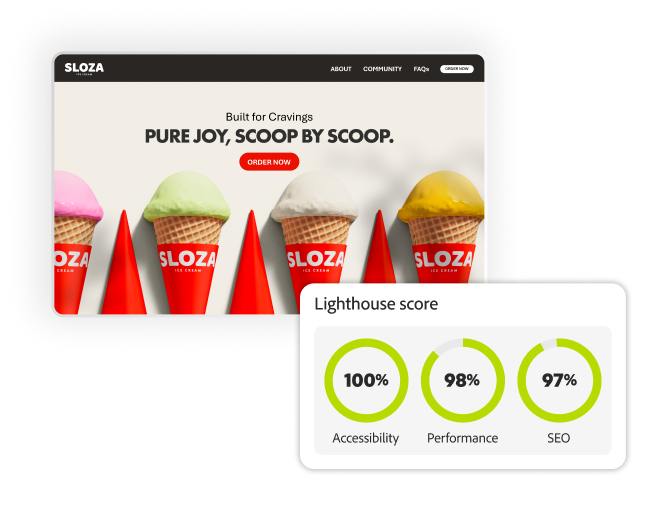
An edge architecture CMS is a headless CMS designed to deliver fast and responsive experiences across your digital platforms. Edge architecture facilitates data processing by utilising the outermost edges of the network, which are closest to where the experience is consumed. This contributes to healthy core web vitals and high Google Lighthouse scores.

Team needs
Key CMS Capabilities
A fast website for lower bounce rates and higher SEO rankings
Phased rendering so the most prominent parts of each page load first
Minimal delays in content loading, even with design or code updates
Persistent caching for quicker access to frequently used elements
Real-time insights to ensure your pages are loading properly
Real-user monitoring that tracks page load times and user interactions and alerts you to performance issues
#F8F8F8

Customer spotlight

With Edge Delivery Services in Adobe Experience Manager Sites, Volvo Trucks boosted its mobile performance score from 35 to 100 and increased its visibility score from 2.5% to 43%. Merative improved its web performance score from 34 to 100 and reduced its page load speed from 10.9 to 1.6 seconds.

Explore site performance features

2. Scale content creation.

An optimal CMS will empower your content contributors to easily create, edit and publish content, providing flexibility for marketers with or without CMS expertise to manage content and pages across multiple locations.

https://main--da-bacom--adobecom.aem.live/assets/icons/resources/sdk/how-to-select-the-right-content-management-system/filetext.svg

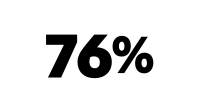
The increasing speed of digital business requires marketers to publish content at a faster pace than ever. 53% of senior executives using generative AI report significant improvements in team efficiency, while 50% report significantly faster content ideation and production.

Source: Adobe

How your CMS can turn everyone into a content expert.

With familiar, easy-to-use authoring tools, teams can accelerate the editing and publishing process, allowing content to scale across teams, regions and channels.

Team needs
Key CMS capabilities
The ability to create, edit and publish webpages with preferred tools
Document-based authoring to create and edit webpages in familiar tools like Microsoft Word and Google Docs
A method for non-technical users to build and edit content without developer help
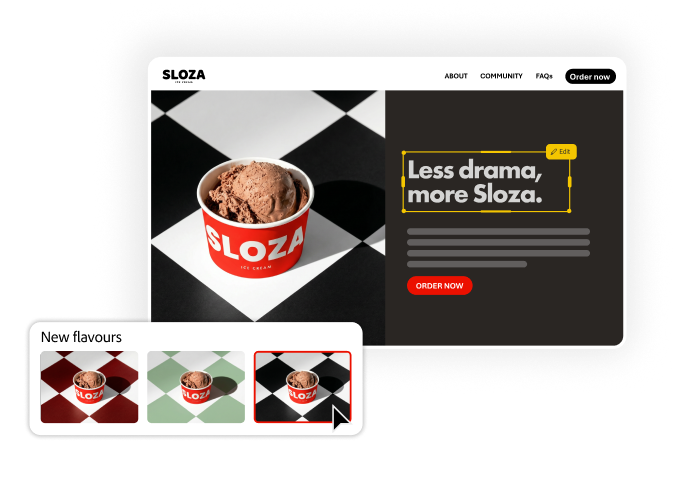
Drag-and-drop templates and a visual editor for building and editing webpages with a live preview
An integrated way to manage all digital properties, including regional and language-specific sites
A centralised platform that controls region-specific mobile and web properties while adhering to brand guidelines and overall governance policies
The ability to translate content to different languages and deliver regional versions of website in just a few clicks
Automated language translation for copy and image metadata integrated into the CMS
#F8F8F8

Customer spotlight

Pethealth Inc. used Experience Manager Sites to combine the strengths of its five brands into a single, cohesive content ecosystem, all while publishing content 82% faster and doubling its marketing productivity.

Explore content creation features

3. Accelerate A/B testing to improve conversion rate optimisation.

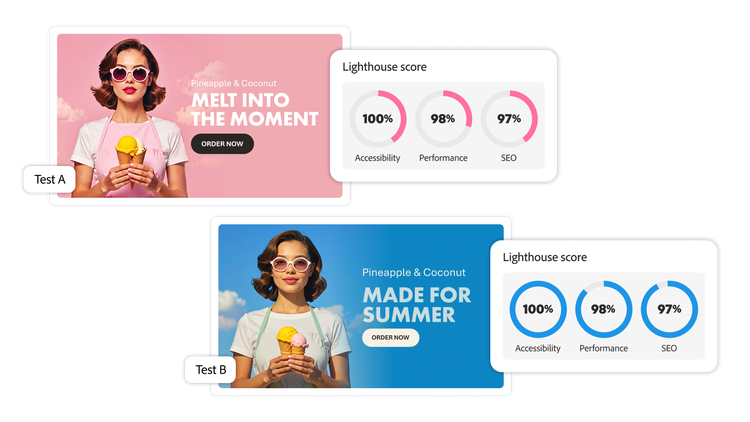
A/B testing is an experiment in which marketers split their audience and create several versions of a variable in a campaign to test each variable’s performance. A CMS that enables teams to efficiently build and run A/B tests without relying on third-party systems or extensive collaboration across teams is critical for gaining insights quickly.

https://main--da-bacom--adobecom.aem.live/assets/icons/resources/sdk/how-to-select-the-right-content-management-system/devicedesktop.svg

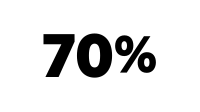
Ecommerce sites that run successful A/B tests have seen a 50% increase in revenue per unique visitor.

Source: VWO

How your CMS can optimise A/B testing.

A/B testing for a single element or page helps identify the most effective content strategies and components. By optimising their content creation efforts based on performance insights, organisations can maximise the return on investment (ROI).

Team needs
Key CMS capabilities
Testing and optimisation features that don’t rely on specialised teams
Built-in A/B testing that marketers can set up in minutes
The ability to find the best performing experiences to maximise content’s ROI
Full-page experimentation to test page functionality, design and content against specific audience segments — by location, device type and new or returning visitors
A deep understanding of the content that excels and the content that underperforms
Analytics based on real-user monitoring that deliver both page- and component-level insights with results that are easy for the team to access

4. Enable seamless omnichannel experience management.

A CMS should be built for omnichannel capabilities, enabling teams to create, manage and deliver rich content across all digital touchpoints. Without a unified CMS, delivering content across channels isn’t scalable and requires heavy support from IT. As a result, experiences become inconsistent and generic.

https://main--da-bacom--adobecom.aem.live/assets/icons/resources/sdk/how-to-select-the-right-content-management-system/community.svg

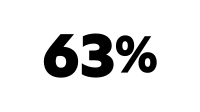
54% of customer-obsessed companies experience better customer loyalty and improved retention from omnichannel efforts and current customers spend 67% more on average than new customers. This makes effective omnichannel experiences critical for maximising retention and lifetime value.

Source: SAP Emarsys

What your CMS needs to support omnichannel digital experiences.

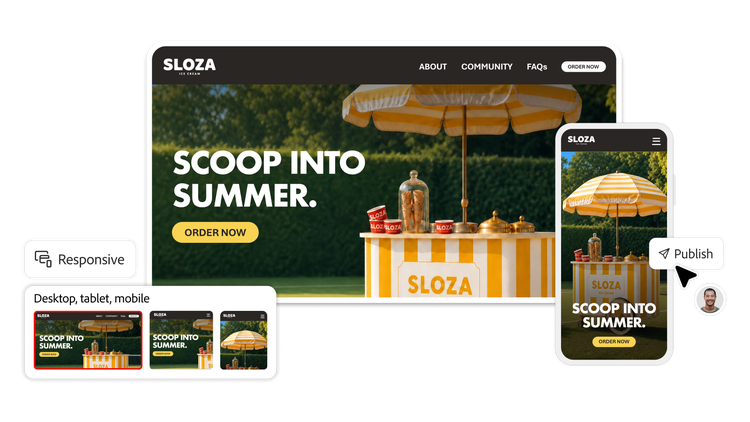
To deliver engaging cross-channel experiences, your CMS must include a consistent design system, reusable content components, direct access to governed assets and responsive design tools. With these features, you can empower your entire team to build connected experiences across your digital properties, eliminating the need to repeat tasks on each channel.

Team needs
Key CMS capabilities
A solution for non-developers to edit and publish content on any channel
Editable drag-and-drop components in a WYSIWYG interface, with live preview
The ability to keep content brand-compliant and consistent across customer touchpoints
Pre-configured components like text, image and responsive grid columns to create and manage on-brand page templates
Fast ways to create content so marketers never have to start from scratch
A complete library of assets and templates, as well as globally consistent design systems
The means to reuse and adapt content efficiently to save time on updates and to minimise errors
Reusable components that can be applied to multiple pages and that automatically update when changes are made to the master

5. Stay flexible with a headless, hybrid and composable CMS.

IT and development teams using outdated CMS solutions are creating a content maze where each channel has its own isolated repository. Content must be manually created for each channel, which places a significant drain on time, energy and resources, resulting in inconsistent and disrupted customer experiences. The right CMS will solve these issues out of the box with an easy-to-use platform for publishing content to any front end of your choice, whether you’re using a headless or hybrid model. A hybrid approach provides developers with a flexible and adaptable system, while marketers benefit from an intuitive interface to shape how content is presented across various channels.

How to design your CMS for tech stack flexibility.

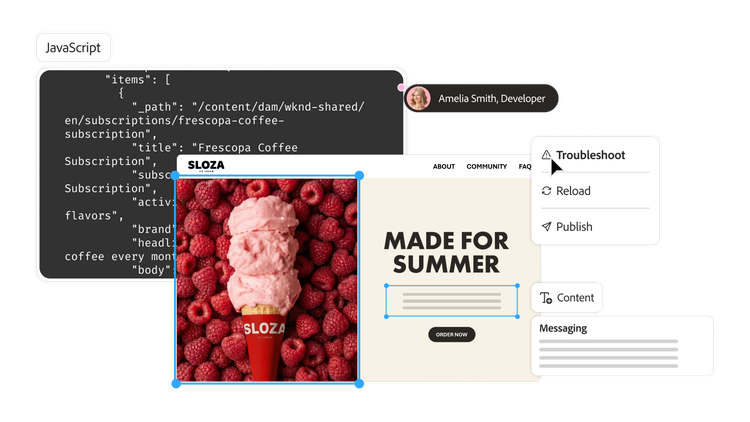
A CMS should be able to cater to a headless, traditional or hybrid delivery approach, allowing you to manage cross-channel content in a central hub. Teams can publish content across all front-ends — including single-page apps, mobile apps, IoT and more.

Headless delivery
Traditional delivery
Hybrid delivery
Content is stored and managed separately from its user-facing application, so it can be delivered to multiple platforms and devices without being tied to a single front-end system.
Content and its presentation are integrated. Traditional designs are typically optimised for delivery on a specific platform.
Content delivery is flexible when headless and traditional approaches are combined. A hybrid approach may maintain traditional delivery for specific use cases.
Organisations are also seeking composability in a CMS, which enables assets such as images, text or multimedia content to be updated, modified and assembled in a way that seamlessly adapts to various platforms. Editing a component, such as a web banner or product image in a central location improves operational efficiency. The changes are made instantly, everywhere the asset is used.
Team needs
Key CMS capabilities
The ability to make and preview changes to all content within the context of the design experience and in real time
Real-time preview and editing, regardless of the front-end framework or rendering location
The means to reuse and deliver content to all your digital properties
Modular, channel-agnostic content creation for creating once and publishing to any digital surface
A way to simplify content access for developers, ensuring speedy, app-like experiences across platforms
A query language designed for APIs to deliver content fragments to client applications
Integration with in-house and third-party applications without incurring infrastructure overhead
Pre-defined application API endpoints that can be used to customise extensions and scale faster
https://video.tv.adobe.com/v/332865?quality=9&end=nothing&learn=on&captions=eng | watch

6. Develop high-performing web and app experiences quickly.

Predefined application API endpoints can be used to customise extensions and scale web and app experiences quickly and efficiently. Your CMS should make it easy for developers to launch new web and app experiences with an optimised starting point and compatibility with preferred frameworks to maximise efficiency. Suppose developers are bogged down by long development cycles. In this case, web functionality is critical given that the most significant current competency gaps are in digital marketing, data and analytics, proving ROI and data privacy and compliance.

What your CMS needs for faster web and app development.

The best approach allows authoring, designing and coding to occur in parallel — unlike the traditional linear development process where various stages occur sequentially which restricts flexibility and speed in the development process.

Team needs
Key CMS capabilities
Customisable starting points for developers to build faster
Optimised boilerplate code to accelerate development, minimise unnecessary code and ensure faster page load speeds
Faster development cycles with fewer dependencies
A flexible development approach for development where content, development and design work in parallel rather than with dependencies on one another
The ability for distributed teams to validate code changes with production content during the development process
Auto-created code preview to let developers preview environments for every source code branch
The capability to edit and manage single-page applications (SPAS) easily without coding
Drag-and-drop layout editor and live preview features to empower marketers to make changes on their own
#F8F8F8

Edge Delivery Services Spotlight

Through Edge Delivery Services, Adobe’s engineering team is now able to deliver features to Adobe.com 2.5 times faster.

Watch the video to hear our story

Explore accelerated development features

Adobe Experience Manager Sites checks all the boxes.

The best CMS for your organisation is the one that empowers your marketers and developers to create high-performing content across any digital property — from web to mobile to apps.

Experience Manager Sites is an industry-leading CMS that dramatically improves the speed at which you can build, author, publish and load pages across devices and channels, enabling you to keep pace with the speed of digital business. Ensure your organisation stays ahead with our best-in-class CMS features and proven leadership in the industry.

Learn more about how Adobe Experience Manager Sites can help you to maximise your web performance.

https://main--da-bacom--adobecom.aem.live/fragments/resources/cards/thank-you-collections/experience-manager-sites