Accelerating trend-to-campaign execution with agentic workflows.

Adobe for Business Team

09-08-2026

Today, customer interests shift rapidly, and engagement patterns evolve across channels, causing new trends to rise and fade within days. While most organizations can spot these trends, they often struggle to act quickly. With the increase in the number of digital channels, reaching customers where they are is more difficult than ever. Now, traditional workflows can’t keep up with the volume of signals that must be captured and acted upon in real time. To stay relevant, brands must shorten the time between insight and execution, enabled by AI trend analysis and agentic workflows.

The journey from trend detection to campaign launch is often too slow. Momentum is lost across multiple handoffs, including planning, creative production, asset approvals, and cross-channel activation. By the time your campaigns reach the market, the opportunity may already be gone. Adobe reports, in a survey of 150 marketing leaders, that 84% of organizations missed at least one marketing opportunity last quarter because their workflow couldn’t respond in time, and 29% missed six or more.

To reduce idea-to-market latency, teams need faster, more connected ways of working. This is fueling interest in agentic AI-driven workflows. These AI systems coordinate actions across content operations, allowing you to respond at the speed of the market. They monitor signals, surface insights, and streamline campaign execution in a continuous loop. The result is a more proactive, insight-driven approach to marketing that helps you capitalize on opportunities while they still matter.

To understand how these intelligent workflows connect people, tools, and processes, let’s explore the key concepts behind them.
Why traditional trend monitoring falls short.

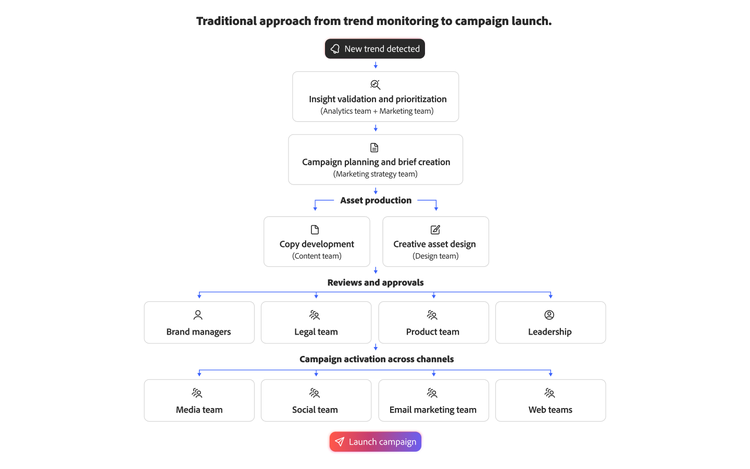
Flow chart showing the traditional approach from trend monitoring to campaign launch, with each downstream stage adding complexity and delays.

Effective marketing depends on timely trend monitoring, but many organizations still manage this process through a mix of static dashboards, periodic reporting, and manual performance analysis. As a result, monitoring is often reactive rather than proactive. This limits a team’s ability to identify shifts in audience behavior, campaign performance, or market conditions as they happen.

Moreover, because multiple teams are involved, insights must then move through validation, analysis, planning, and approval before any action can be taken. These workflows are often fragmented, causing delays. Delays are further compounded by content development, review cycles, channel distribution, and campaign deployment bottlenecks.

As the impact compounds throughout the marketing lifecycle, it can take days or even weeks to translate insights into live campaigns. With each handoff adding time, the value and relevance of high-priority signals steadily diminish.

The gap between trend detection and campaign launch is shaped by numerous processes, stakeholders, and decision points. The major operational bottlenecks across these stages include:

Today's marketing challenges are increasingly operational rather than informational. Most organizations have access to more data, insights, and market signals than ever before, but the real differentiator is how quickly they are translated into actions that benefit their customers.

How to scale responsive marketing with agentic workflows.

Responsive marketing at scale depends on your team’s ability to continuously sense, adapt, and execute. Agentic workflows provide the foundation to do this effectively. AI agents can be configured to execute a multi-step process of monitoring signals, coordinating tasks, and suggesting next steps. Humans can then decide on the next prudent course of action.

Broadly, agentic AI supports responsive marketing in the following way:

1. Connecting engagement signals with campaigns.

Responsive marketing starts with visibility. To act quickly, teams need a centralized view of all the data captured across every touchpoint. Agentic workflows help bring together signals from:

By continuously monitoring and connecting these data sources, AI agents can identify meaningful opportunities to optimize campaigns, refine marketing strategies, or launch new initiatives. Instead of manually piecing together insights from multiple reports, you gain a unified view that supports faster, more confident decision-making.

2. Accelerating creative iteration.

Once an opportunity is identified, execution speed becomes critical. Waiting days or weeks to develop and refine campaigns can mean missing the moment entirely. With agentic workflows, your team can rapidly produce and optimize messaging, creative assets, channel-specific content, and personalized experiences. AI agents can assist throughout the creative process, from generating initial concepts to recommending refinements based on performance signals.

3. Producing campaign variations at scale.

Campaigns require content to be adapted across regions, formats, platforms, and audience segments. Managing this volume can quickly become a bottleneck.

Agentic content workflows help orchestrate this process at scale. They can help generate creative variations, tailor messaging to different audiences, and prepare channel-specific assets while maintaining consistency with campaign goals and brand guidelines. This allows you to expand reach and relevance without significantly increasing production workloads.

4. Streamlining review and approval workflows.

Even when insights and creative assets are ready, campaign execution can be slowed by fragmented approval processes and collaboration challenges. Agentic systems help reduce friction through:

As marketing ecosystems become more complex, your ability to coordinate people, processes, and technology at scale matters more than ever.

How to maintain brand consistency in agentic workflows.

Agentic systems can accelerate execution, but speed should not come at the expense of quality or trust. Strong guardrails are essential to ensure every marketing campaign maintains brand integrity. Human oversight remains equally important to keep campaigns aligned with business objectives, organizational values, and customer expectations.

When agentic workflows are built on a foundation of well-defined standards, including brand guidelines, approved messaging frameworks, content governance policies, and review and approval processes, it enables you to:

Marketing and analytics teams need to evolve beyond insight generation and adopt governance frameworks that verify AI-generated findings, measure confidence, and ensure recommendations meet the standards required for high-impact business decisions.

Ultimately, responsive marketing is about scaling execution responsibly. The most effective teams recognize that agentic AI in marketing is an enhancement, not a replacement, of human judgment.

Enterprise use cases for AI trend analysis and agentic execution.

AI trend analysis helps enterprises move beyond observation and operationalize insights faster. Out of 3,000 surveyed executives and practitioners in customer experience roles, 63% expect agentic AI to give teams more time for strategic and creative work. This will allow enterprises to make faster, more informed decisions while focusing on higher-value activities.

The following use cases demonstrate how agentic AI powers the key marketing functions.

1. Campaign performance optimization.

Your team can proactively monitor campaign performance and detect early signs of declining engagement, conversion, or content effectiveness. Using agentic AI-powered insights, teams can quickly refresh messaging, update creative assets, and launch new variations before performance issues have a broader impact.

Illustrative scenario: A software company identifies a decline in trial-to-subscription conversions for a product. By detecting the trend early, the marketing team can adjust campaigns based on top-performing content themes and generate new variations for testing, before pipeline impact becomes significant.

2. Content trend analysis.

By identifying emerging themes, conversations, and content patterns across digital channels, you can stay aligned with evolving audience interests. Furthermore, you can proactively adjust campaigns and editorial strategies rather than reacting after trends peak. This approach also improves search visibility by helping you publish content that matches emerging search intent and trending topics.

Illustrative scenario: A media and entertainment company identifies growing consumer interest in short-form educational content. This finding leads the marketing team to create a targeted video series that capitalizes on increasing audience demand.

3. Audience engagement monitoring.

Shifts in customer behavior often appear first in engagement data. With agentic AI, you can surface changes in how audiences interact with content, campaigns, and channels. This helps you refine targeting, messaging, and experiences in real time.

Illustrative scenario: A healthcare provider notices that patients engage more frequently with preventive care content than treatment-related materials. This prompts marketers to adjust outreach campaigns while improving patient engagement.

4. Regional and seasonal campaign adaptation.

Audience preferences can vary significantly by market, region, and season. Agentic workflows help you detect these differences early and adapt creative assets, offers, and messaging to meet seasonal and contextual demand, without slowing campaign execution.

Illustrative scenario: A global food and beverage company identifies increased demand for seasonal flavors in one region while health-focused products trend in another. They quickly tailor offers and creative assets for each market, improving campaign effectiveness and local relevance.

These use cases show how agentic AI helps enterprises respond to constant seasonal and cultural changes with greater speed and precision.

The future of responsive marketing in the AI era.

As customer behaviors, cultural moments, and market signals become more dynamic, your ability to connect intelligence with action across the entire marketing ecosystem is critical. Agentic AI helps orchestrate insight generation, creative production, approvals, and campaign activation. The result is an operating model that can continuously identify change, make initial suggestions, and allow humans to make the final decision on the next best step to take.

Agentic workflows reduce dependence on periodic campaign planning and enable continuous strategy optimization. As a result, marketing becomes an always-on function that keeps pace with how quickly the market changes. Ultimately, when change is constant, responsiveness is a competitive advantage.

Explore how Adobe GenStudio empowers your team to accelerate campaign execution with AI-powered content workflows.

https://business.adobe.com/fragments/resources/cards/thank-you-collections/genstudio