Today, customers can encounter a brand inside Google AI Overviews, ChatGPT, Perplexity, Microsoft Copilot, Gemini, and other AI-powered experiences before they visit a website. A brand may be mentioned in an answer, cited as a source, included in a recommendation, compared with competitors, or summarized in a way that shapes a user’s perception.
Key performance indicators (KPIs) change based on campaign, business goal, and industry. Rankings, impressions, traffic, and conversions still matter, but they do not capture every way a brand is discovered, evaluated, or trusted.
That creates a new measurement challenge for marketing leaders. AI search can build visibility, authority, and consideration without producing an immediate click. To understand performance in this environment, teams need KPIs that measure not only website performance, but also how their brand appears inside AI-generated answers.
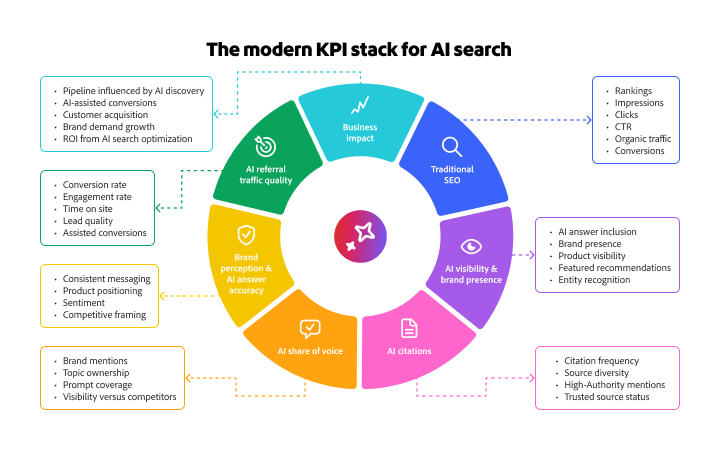
The new search KPI framework expands beyond rankings and traffic to include AI visibility, citations, share of voice, brand sentiment, referral quality, and business impact.
Traditional search metrics are still essential. Rankings, impressions, clicks, click-through rate, organic sessions, conversions, and revenue help teams understand how content performs once it appears in search and brings users to the site.
But AI search changes what happens before that measurable visit. When AI systems generate answers directly, users may compare products, ask for vendor shortlists, summarize topics, or evaluate recommendations without clicking through to a website. In those moments, a brand can shape perception without creating a traditional analytics session.
In this scenario, click-based reporting falls short as it doesn’t tell the full story. A brand may lose clicks on some informational queries while gaining visibility in AI-generated answers. Another brand may continue earning organic traffic, while not appearing when AI systems recommend solutions in its category. Search measurement now needs to capture both website activity and the influence that happens before a visit.
The new KPIs of search.
anchor
the-new-kpis-of-search
Today, measuring performance must include more than rankings, impressions, and click-through rates. Marketing teams also need to understand whether their brand appears in AI-generated answers, whether their content is cited, how accurately they are represented, and whether that visibility contributes to business revenue.
This expands search measurement beyond traffic-based KPIs into a broader set of indicators, including:
AI visibility and brand presence
Citations and source attribution
AI share of voice
Brand sentiment and answer accuracy
AI referral traffic and engagement quality
Business impact and revenue contribution
The shift is from measuring clicks alone to measuring how brands are surfaced and interacted with across AI-driven discovery environments. The most important metrics to watch are the ones that connect AI visibility to brand influence, competitive position, and revenue.
Measuring AI visibility and citations.
AI visibility measures how often a brand appears in AI-generated answers in Google AI Overviews and across platforms like ChatGPT, Gemini, Perplexity, and Microsoft Copilot. Citations are more specific. Visibility is when the brand appears in an answer. Citations are when the brand’s owned content is being used as a supporting source. Both matter, but they signal different things. Mentions show that the brand is present in AI-driven discovery. Citations suggest that the content is accessible, useful, and trusted enough to support the answer.
Visibility and citations can vary by platform, topic, and prompt type. A brand may appear often in ChatGPT responses for one topic but be absent from Google AI Overviews for a related query. It may earn citations for educational content but appear less often in high-intent product recommendations.
To measure this, teams should track AI visibility score (prompt-level visibility and topic-level visibility), AI-generated brand mentions, and AI citation frequency and share. Together, these metrics show where the brand is appearing, where its content is being used, and where stronger content or authority is needed.
Measuring AI share of voice and brand perception.
AI share of voice measures how prominently a brand appears compared with competitors across AI-generated answers. This matters because AI systems choose a short list of brands, vendors, products, or sources to be included in an AI answer. If a competitor appears consistently in those answers and your brand does not, a customer may miss your brand before they ever reach a search results page.
Share of voice helps teams evaluate competitive presence across priority topics and intents. A brand may appear in broad informational answers, but be missing from recommendation prompts, comparison queries, or category-specific questions. Those gaps can reveal where content, positioning, or authority needs to improve.
However, visibility alone is not enough. Brands also need to understand how they are being represented. AI-generated answers may summarize capabilities, compare products, explain use cases, or describe who a solution is best suited for. If that information is outdated or inaccurate, visibility can put a brand’s reputation at risk.
To measure AI share of voice, teams should track competitor mention share, category-level share of voice, share of favorable mentions, comparative sentiment, answer accuracy, positioning alignment, narrative consistency, hallucination or misinformation rate, and outdated information rate. These KPIs help CMOs understand not only whether the brand is present, but whether it is being represented accurately and competitively.
Connecting AI visibility to traffic and business impact.
AI visibility and citations are important performance indicators, but it’s important to understand how AI-driven discovery connects to measurable outcomes. AI referral traffic provides one bridge between answer visibility and website performance.
AI referral traffic measures users who arrive from AI assistants or AI-generated answer experiences. These sessions show which platforms send visitors, which cited pages attract clicks, how users engage after landing, and whether that traffic contributes to conversions.
Referral traffic has limits because it only captures users who click through to owned properties. Many AI-influenced journeys may not produce an immediate session. A user might discover a brand in an AI-generated answer, search for it later, visit directly, or convert through another channel. This makes multi-touch attribution important.
To measure business impact, teams should evaluate visibility, citations, mentions, share of voice, and sentiment alongside downstream metrics such as AI referral sessions, AI-referred users, engagement rate, time on site, assisted conversions, revenue from AI referral traffic, AI-influenced leads, and conversion rate by AI source.
This combined view helps marketing leaders understand whether AI search visibility is simply generating exposure or contributing to awareness, consideration, leads, and revenue.
Building an AI search KPI dashboard.
anchor
building-an-ai-search-kpi-dashboard
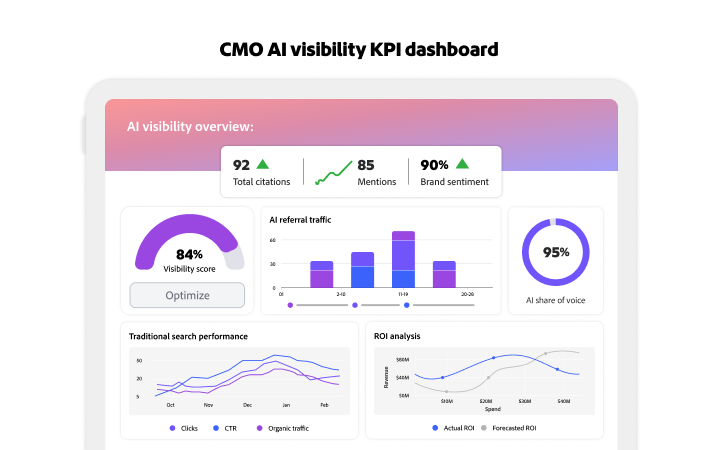
Once teams define the KPIs that matter for the business, the next step is organizing them in a way that supports decision-making. A dashboard should do more than report on every available metric. It should illustrate where the brand is visible, where its content is being cited, how other brands are being cited, and whether AI-driven discovery is contributing to measurable outcomes.
That requires a combined view of traditional SEO performance and AI visibility metrics. Rankings, impressions, clicks, traffic, and conversions still provide important context, but they should be evaluated alongside AI search KPIs.
An AI search dashboard can be organized into five sections:
Traditional search performance
AI visibility and citations
Share of voice
Brand perception and answer quality
AI referral traffic and business impact
The dashboard should also include trend views by platform, topic, region, audience, and time period. AI visibility can change as platforms update their systems, other brands publish new content, or customer search behavior shifts. Tracking trends over time helps teams distinguish one-time or seasonal fluctuations from meaningful changes in search trends and performance.
How teams can use AI search KPIs to improve performance.
Measurement is only useful when it helps teams decide what to improve next. Once marketers understand where the brand appears, where it is cited, and how it is represented, they can start to connect that visibility to business outcomes. At that point, AI search KPIs can inform content strategy, planning, and conversion optimization.
Low visibility for priority topics may point to gaps in content coverage, topical authority, or customer journey alignment. Low citation rates may suggest that existing content needs improved structure, stronger sourcing, updated information, or more direct answers to high-intent questions. Technical accessibility also plays a role because AI crawlers need to be able to discover and interpret the content before they can use it.
Perception metrics provide different insights. If AI-generated answers describe the brand inaccurately, rely on outdated information, or frame competitors more favorably, teams may need to clarify product messaging, update key pages, or strengthen consistency across owned and third-party sources. If competitors rank for recommendations, citation data can show which sources and claims are shaping those answers.
Traffic and engagement metrics help connect AI visibility to a visitor’s landing page user experience. High AI referral traffic with a small number of conversions may indicate that landing pages are not matching the expectations created by AI-generated summaries or recommendations. In that case, the opportunity is not only to earn more visibility, but to make the post-click user experience more relevant.
AI search KPIs help teams identify where visibility is being earned, where trust is being built with customers, where brand perception needs attention, and where AI-driven discovery can be turned into measurable business value.
Measure your brand’s AI search presence.
anchor
measure-your-brands-ai-search-presence
AI search has expanded the role of search from a traffic channel to a discovery and influence channel. Customers may encounter a brand in an AI-generated answer, evaluate it against competitors, form an impression, and return later through another path. That influence may not always appear as a direct click, but it can still shape awareness, trust, and demand.
The new KPIs of search help marketing teams measure that broader impact. For CMOs and digital marketing leaders, the next stage of search measurement is not about choosing between traditional SEO metrics and AI visibility metrics. It is about bringing them together into one framework that reflects how their intended audience discovers, evaluates, and chooses brands.
Adobe Brand Visibility can help teams understand and improve how their brands appear across emerging AI-driven discovery experiences. For broader search performance monitoring, Semrush can also support competitive visibility analysis, brand presence tracking, and ongoing measurement across traditional and AI-influenced search environments.
See how Brand Visibility measures your presence across AI answers.