Marketing teams need to respond to customer needs in the moment and personalize their experiences to stand out from competitors. Responding to customer needs depends on digital marketing workflows that move campaign content smoothly from planning to production.
When teams are waiting for completed briefs, approvals, or performance insights, campaigns lose velocity. It limits their ability to create, review, personalize, and localize at scale. As a result, enterprises struggle to adapt content and respond to opportunities across channels.
Improving campaign velocity starts with identifying where that friction occurs within a content workflow. A workflow audit can identify the root cause of each recurring delay, helping teams determine the right response to fix the bottleneck. This could include a process change, stronger governance, accessible data, additional resources, or generative AI to support a workflow across the campaign lifecycle.
This article provides a practical framework for diagnosing content workflow bottlenecks, tracing their underlying causes, and removing them from campaigns.
In this blog, we’ll explore:
What are content workflow bottlenecks.
A content workflow connects people, processes, tools, and information needed to move a campaign idea to market. In a workflow, a bottleneck occurs when work repeatedly slows, stalls, or requires rework, preventing teams from launching, adapting, or optimizing campaigns efficiently. Since each stage of the workflow relies on timely inputs and decisions from the previous one, a recurring delay rarely remains contained.
Consider a marketing team that enters production for a seasonal campaign before the brief fully defines the audience, formats, or delivery requirements. The creative team pauses for clarification, which delays the review window. Conflicting feedback from several stakeholders further delays approvals, leaving the regional team with even less time to adapt assets for localization. What first appears to be a production delay can ultimately be traced back to an incomplete brief.
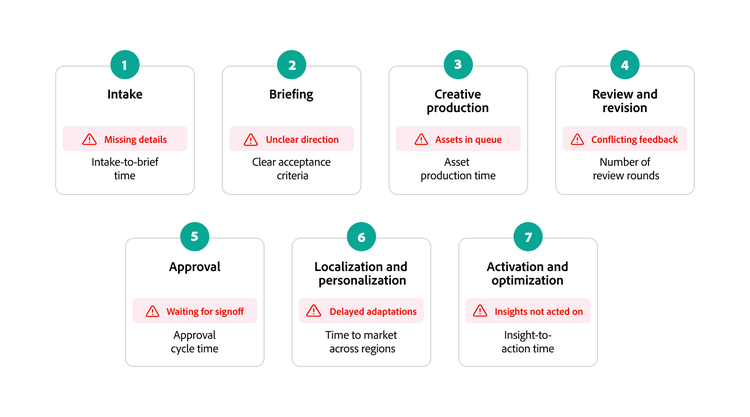
This chain of events can vary across teams, but recurring bottlenecks often leave familiar signs:
- Briefs repeatedly return for clarification.
- Assets accumulate in production queues.
- Late or conflicting feedback extends reviews.
- Context is lost during handoffs.
- Performance insights arrive too late to support timely action.
These signals show where workflow continuity is breaking, but they do not always reveal why. Repeated revisions, for example, could stem from unresolved strategy, while approval delays may point to unclear stakeholder decision-making authority. A fragmented workflow can make these relationships harder to see when work, context, and feedback are spread across tools and teams.
This is why a bottleneck audit within the broader content supply chain must focus on where campaign work waits, moves backward, or loses the context needed to progress, and then trace these visible delays to their underlying causes. This requires teams involved in workflows to document how long each step of a campaign takes.
Why diagnosing workflow bottlenecks matters.
Workflow bottlenecks do more than delay individual tasks. When one stage consistently holds up the next, the effects ripple across the campaign workflow, leaving teams with less time to optimize campaigns and respond to customer needs.
Advanis surveyed 150 marketing leaders and practitioners across five countries for Adobe’s State of Marketing in an AI-Driven World 2026 report. In the study, 84% of organizations said they missed at least one marketing opportunity in the previous quarter because their workflows could not respond in time. Although 90% could support rapid or high-frequency campaign cycles, 69% reported that doing so was challenging, caused strain, or was not possible at all.
These findings suggest that speed alone becomes difficult to sustain when the underlying workflow cannot keep pace. As campaign frequency and content demand grow, teams need clear ownership, reliable data, structured processes, and proportionate governance before they can scale content workflows.
How to assess workflow bottlenecks.
Once teams know where work is slowing, the next step is to understand what is creating the constraint. Bottleneck analysis traces campaign content through the workflow so teams can separate the visible delay from its root cause. A reliable diagnosis includes four steps.
Step 1: Map the current workflow.
Document the path from campaign request to post-launch optimization. At each stage, record the required input, owner, system, completion rule, handoff, and dependencies. This map exposes unnecessary transfers and waits for information or sign-off, creating a baseline to improve.
Step 2: Measure where work slows.
With a map in place, compare active work time with wait time. Measure cycle and queue times, review rounds, approval lag, rework hours, missed service-level agreements, asset production time, and insight-to-action time across campaigns, asset types, and markets. AI can surface friction points in workflow data, while human context explains each delay.
Step 3: Find the root cause.
Once the measurements show where work slows, the next step is understanding why. A late asset may reflect changing scope or missing source material, while approval lag may point to unclear stakeholder decision-making authority or competing interests across teams. Separating the symptom from its cause keeps the response focused on resolving the constraint.
Step 4: Classify the bottleneck and assess AI fit.
Once the cause is clear, classify the issue as process-, governance-, data-, or resource-related. Then assess AI fit separately. This classification identifies what needs to change and whether generative AI is an appropriate solution.
How generative AI helps identify bottlenecks.
When teams can diagnose the cause behind bottlenecks, they can select the appropriate operational response to see where generative AI could help. AI-powered workflows support execution once an operational foundation is in place.
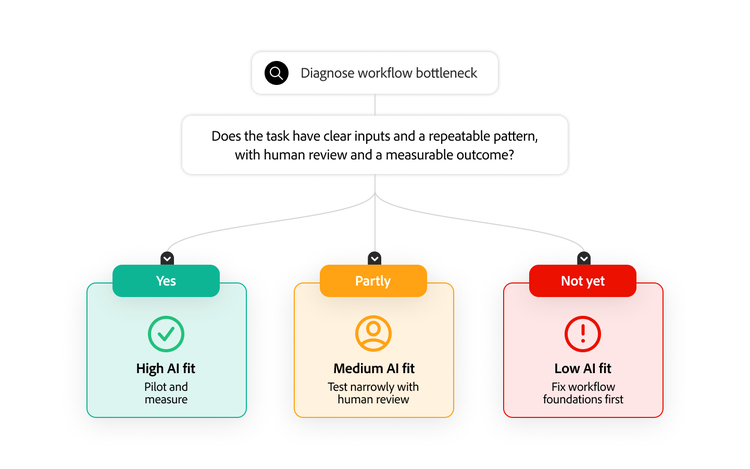
Generative AI is most useful when a bottleneck involves repeatable work with clear inputs, human review, and measurable outcomes. When the underlying cause is unclear ownership, weak governance, unresolved strategy, or inaccessible data, teams need to strengthen that workflow foundation before introducing automation.
Teams can determine whether a task is ready for generative AI using the prioritization model:
- Strong AI fit. The inputs and outputs are well defined, and the result is easy to review and measure. Pilot the task and track the outcome.
- Semi-strong AI fit. The task is partly repeatable but includes exceptions or judgment. Test it narrowly with human review.
- Weak AI fit. The task depends on strategic decisions, unclear ownership, weak governance, inaccessible data, or high-risk judgment. Strengthen the relevant workflow foundation before considering AI.
This prioritization model helps teams start with strong AI fit tasks where results can be measured quickly. Adobe GenStudio can support repeatable tasks such as on-brand content generation and asset adaptation.
How to remove campaign bottlenecks across the workflow.
Identifying and removing bottlenecks at scale is complex. Today, only 7% of organizations have embedded AI in their workflows and are delivering measurable impact. This suggests that while teams are experimenting with AI, few have operationalized it across recurring workflow breakpoints.
Workflow bottlenecks can emerge at every stage of the campaign lifecycle, whether through cross-team handoffs, approval delays, limited data availability, or fragmented processes. Understanding where these dependencies or blockers occur is key to determining which issues require operational changes.
Let’s explore how bottlenecks appear across different workflow stages, along with the role generative AI can play in helping teams address them.
Intake bottlenecks.
Campaign work can stall before it begins when requests arrive with missing information, unclear priorities, unclear processes, or scattered context. Track the complete-on-first-submit rate, intake-to-brief time, clarification requests, and rerouted submissions.
How generative AI helps:
Standardizing required fields and routing gives each request a dependable starting point, after which generative AI can summarize and classify requests, flag missing information, and draft an initial workback plan for human review.
Content brief bottlenecks.
A complete request can still create delays when campaign strategy does not translate into clear direction.
How generative AI helps:
When content briefs have an unclear audience, channel, messaging, or measurement decisions, teams need to address those gaps first. Once the direction is clear, generative AI can help structure a brief draft and check it against required inputs. Human teams should always validate any AI-generated outputs and provide feedback to developers who trained the AI model.
Creative production bottlenecks.
Production slows when teams cannot create enough assets, formats, or variations to meet campaign demand. Measure production queue time, asset production time, output volume, asset reuse, and brand-related rework.
How generative AI helps:
With generative AI, teams can deliver more campaign content without proportionally increasing production effort. Performance marketing agency KINESSO faced similar production pressure while helping Amazon Fresh extend its Christmas campaign. Using Adobe Firefly Custom Models trained on approved brand imagery, the team produced 262 unique images with a 93% faster turnaround than previous production processes, while designers retained creative control and the brand’s visual identity.
Review and revision bottlenecks.
Assets remain in review when feedback is late, vague, scattered, or contradictory. Track review rounds, comments per asset, conflicting comments, time in review, and rework hours.
Frequent conflict often signals unclear criteria or the absence of a single feedback owner.
How generative AI helps:
Clear review criteria and a simple process create a more controlled process. Within that structure, generative AI can organize comments and surface recurring themes, while humans retain control of creative judgment.
Approval bottlenecks.
Approval covers final signoff on governance, compliance, or risk. Track approval cycle time, missed service-level agreements, queue time by approver group, and reapproval after minor edits.
Persistent delays often indicate unclear decision-making authority or a complicated process that could be simplified.
How generative AI helps:
Clear decision rights and risk-based approval paths become more important when scaling marketing campaigns. Workflow automation can handle routing and reminders, while generative AI can summarize changes or flag material for specialist review, keeping final approval with a human.
Localization and personalization bottlenecks.
Adaptation slows when regional work starts late. Additionally, localization stalls if teams cannot access approved assets, audience data, or market guidance. Measure adaptation cycle time, time to local launch, and number of regional review rounds.
Localization involves much more than translation, so regional experts still need to validate cultural relevance, accuracy, brand consistency, and compliance.
How generative AI helps:
Generative AI can support first-pass localized or personalized versions within specified guardrails. The impact becomes clearer in real-world applications. Adobe marketers in Latin America faced a similar challenge when adapting content into Spanish and Portuguese. Using Adobe GenStudio for Performance Marketing, the teams customized core assets for regional audiences within established brand guardrails. As a result, asset localization time fell by 75%, helping email campaigns launch weeks faster.
Activation and optimization bottlenecks.
Approved assets can stall before launch when channel handoffs are incomplete, while performance data may arrive too late to guide the next creative decision. Track approval-to-launch time, activation failures, creative refresh frequency, and insight-to-action time.
These delays often reflect manual handoffs, disconnected performance data, or unclear ownership of the feedback loop.
How generative AI helps:
Once teams address those issues, generative AI can adapt approved assets for channels, summarize performance, and recommend the next variation for human review. A recent Adobe use case shows how this can work in practice. After a five-touch Adobe Creative Cloud onboarding email journey underperformed, the lifecycle marketing team revised its messaging strategy and developed more precise audience profiles. The team used Adobe GenStudio for Performance Marketing with approved images and brand guidelines to develop new variations, reducing content creation time by 96%, from 27 days to one day. The full campaign launched in six days, and click-through rates rose by 84% quarter over quarter.
Each stage of the bottleneck, from intake and briefing to localization and optimization, depends on clear handoffs from its previous stage to keep the campaign work moving. Mapping these connections can help teams understand where bottlenecks appear, find their underlying cause, and choose the right operational fix to improve the campaign workflow.
Launch more campaigns with an efficient workflow.
Fixing bottlenecks does more than speed up campaign delivery. It establishes a baseline for improvement and addresses underlying issues in process, governance, data, or resources. Identifying and resolving them helps teams improve workflow efficiency, reduce unnecessary delays, and launch consistent campaigns quickly.
As content demand grows, teams also need a scalable way to support recurring content production tasks. When applied to the right workflows, generative AI can help reduce repetitive work, accelerate content creation, and improve operational efficiency while keeping people in control of strategic decisions and review processes.
Adobe GenStudio helps enterprise teams accelerate campaign content creation, generate on-brand variations, and streamline performance-driven marketing workflows with generative AI.
Request a demo to explore Adobe GenStudio to see how it can help make content workflows more efficient for marketing campaigns.
Recommended for you
https://business.adobe.com/fragments/resources/cards/thank-you-collections/genstudio