
The future of digital government in the United Kingdom: What Adobe's latest index reveals.
Digital government in the UK is being reshaped by technological change, institutional reform and evolving citizen expectations.
Adobe's Digital Government Index for the United Kingdom examines how effectively agencies and departments are responding to this changing environment. The results highlight where digital performance is improving, where delivery challenges persist, and how outcomes-based delivery, digital cohesion and discoverability are shaping the next stage of digital government maturity.
The findings show how leading public sector organisations are connecting discovery, continuity and completion to create more effective digital service experiences.
Adobe foreword.
Digital government in the United Kingdom is undergoing a significant transformation as policy priorities, legislation, and institutional structures are reshaped. In July 2026, under the guidance of a new government, the department responsible for the UK’s digital reform initiatives, including the roadmap for modern digital government, the CustomerFirst programme, and the GOV.UK Chat AI assistant was dissolved, with its duties divided among three new agencies. The initiatives themselves remain in place, with responsibility moving to the expanded Department for Digital, Culture, Media and Sport (DCMS) following the transfer of the Government Digital Service. This coincided with the cancellation of the previous government’s planned national digital ID scheme, a widely debated proposal.
Organisational reform is only part of the picture. Legislative initiatives such as the Data (Use and Access) Act 2025 and the proposed introduction of the NHS single patient record under the Health Bill 2026, continue to rapidly redefine priorities across government. Yet these changes are moving faster than the capabilities of current technology, and nearly one- third of central government IT is classed as legacy. Lost productivity from those ageing systems is estimated at 4-7% of annual public sector spending, a gap that reform programmes have yet to close.
For UK public sector departments and agencies, the operational challenge is less “how do we transform” and more “how do we keep pace". That’s because organisations are busy responding to new statutory obligations, a reorganised centre of government, and rising citizen expectations, all while carrying technical debt that successive reviews have flagged but not resolved. It means that continual adaptation is replacing steady transformation.
As with governments globally, meeting accessibility obligations under WCAG remains an ongoing requirement. All digital properties, including websites and apps, must meet content and design standards to ensure that everyone can access and use public services. At the same time, AI is changing how people discover information, navigate services, and interact with government online. As more people turn to AI and search tools for answers, maintaining a clear and trusted source of official information becomes more important to citizen outcomes and public trust.
To reflect this changing environment, the Digital Government Index benchmark includes a new AI Readiness measure in 2026, which evaluates the extent to which government websites and other digital properties are prepared for a landscape in which AI increasingly influences how information is found and accessed.
Against this backdrop, this 2026 edition of Adobe’s Digital Government Index for the United Kingdom examines how effectively government digital services are responding to a more complex and rapidly changing operating environment.
In the UK, and around the world, the public sector is being asked to balance multiple priorities —– to modernise ageing technology, meet shifting regulatory obligations and improve service delivery, while also preparing for new patterns of discovery and engagement. The challenge is no longer to simply improve individual services, but to ensure people can find, trust, and complete the interactions they need across an increasingly complex digital ecosystem.
The results reveal both the progress already underway and the constraints that continue to limit digital performance across government. We encourage leaders to use the findings as a guide for setting priorities, addressing capability gaps, and identifying the practical steps that will strengthen digital outcomes for the public.

Brian Chidester
Key Insights
The next opportunities for digital government.
Drawing on four years of data collection, Adobe’s Digital Government Index (DGI) for the United Kingdom provides a long-term view of how digital services are delivered and experienced across departments and agencies. This inaugural report builds on a global body of DGI research and shows that while digital government capability continues to mature, several emerging challenges are shaping the next phase of service delivery.
The findings point to three connected opportunities for digital government: making trusted information more discoverable, creating greater continuity across service journeys, and helping citizens complete the tasks and outcomes they set out to.

Trusted AI Visibility

Connected Journeys

Outcome Delivery
The Digital Government Index.
Understanding how and why digital delivery performance is measured.
The DGI assesses how effectively public sector organisations deliver digital services, helping decision makers track progress, identify gaps, and prioritise investment. It scores Customer Experience, Site Performance, and Digital Self–Service out of 100, drawing on user testing, technical analysis, and third–party data, then combines the results into a single, equally weighted Index score that benchmarks digital maturity.
As part of the 2026 global DGI program, Adobe introduced an AI Readiness measure to assess how effectively government information can be discovered, interpreted, and surfaced by AI systems and large language models (LLMs).
Foundational digital maturity

Customer Experience

Site Performance

Digital Self-Service
Digital enablers

AI Readiness
** New in 2026 **
The 2026 DGI Results
Progress has slowed but digital maturity remains strong.
The 2026 results show that digital government performance across the United Kingdom remains significantly stronger than it was three years ago. While the overall DGI score eased slightly from 75.7 in 2025 to 74.2 in 2026, the result remains well above 2023 and 2024 levels, reflecting the sustained progress made in recent years.
2026 DGI Score
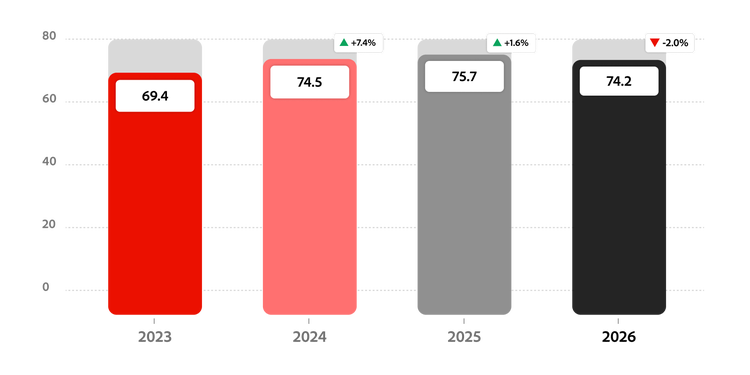
The results suggest the UK public sector now needs to consolidate the gains made in previous years. After two consecutive annual improvements, the slight easing in 2026 points to the challenge of sustaining progress from a higher base.
With individual agency scores ranging from 69.8 to 78.4, future progress will depend on both consistent delivery across government and making services and information easier to find in the channels people increasingly use, including AI-powered search and assistants. This makes discoverability an emerging priority, requiring service information to be structured, clear, and machine-readable so it can be surfaced accurately wherever people begin their journey.
DGI maturity scale

The maturity scale reflects current capabilities rather than an endpoint. As expectations and technologies develop, the concept of high performance also evolves. Greater maturity indicates an ability to adapt and enhance, which involves integration, team alignment, and continuous refinement of service design.
Across Adobe’s multi-year global DGI Series, we’ve seen common traits emerge among leading agencies. High DGI performers place as much emphasis on service and experience design as they do on technology implementation. This strategy emphasises accessibility and usability, demonstrated through shared infrastructure, integrated governance, embedded measurement tools, and a strong focus on realising positive citizen outcomes.
Results across the index pillars.
Customer Experience
2026 DGI Customer Experience score
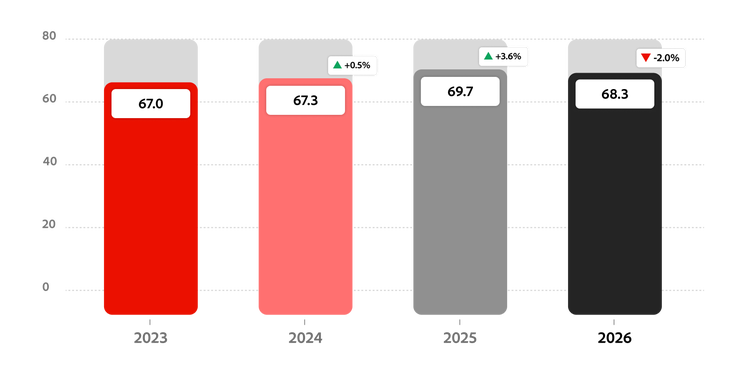
What it measures: User experience across mobile and desktop service interactions.
National result: CX fell from 69.7 in 2025 to 68.3 in 2026, interrupting the gradual lift recorded over the previous two years. The score remains above the 2023 result, but the downward shift suggests recent gains may be difficult to sustain as expectations for simple, seamless digital interactions continue to rise.
Site Performance
2026 DGI Site Performance score
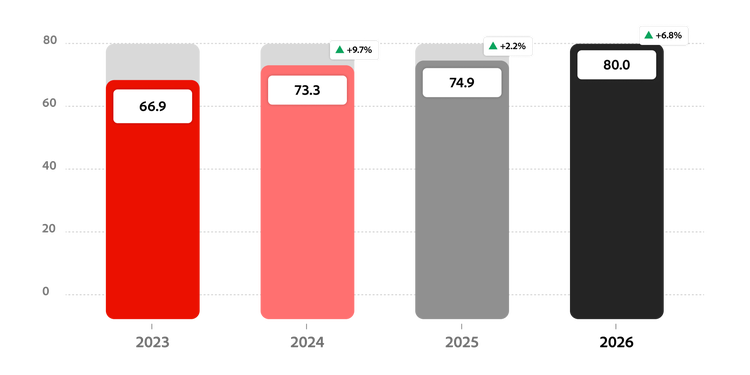
What it measures: Website speed, authority, and overall health.
National result: Site Performance was the only measure to improve in 2026, rising from 74.9 to 80.0 and extending the upward trend recorded since 2023. The lift was driven by faster desktop speed and improved site health, suggesting government websites are becoming more technically robust with fewer underlying site and domain issues.
Digital Self-Service
2026 DGI Digital Self-Service score
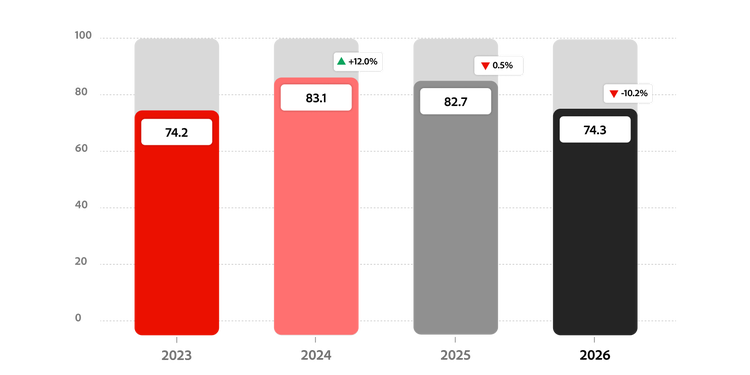
What it measures: Accessibility conformance, language translation availability, and content readability.
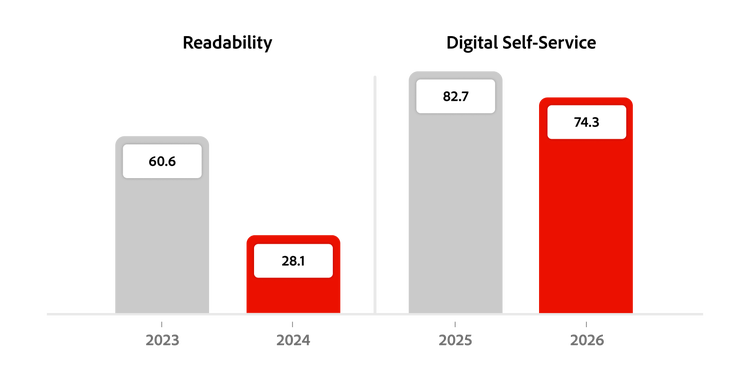
National result: Digital Self–Service recorded the largest decline in 2026, falling from 82.7 to 74.3 and returning close to its 2023 position. This has been pulled down by a sharp deterioration in readability across many agency sites. This suggests that while accessibility and translation capability may still be supporting self-service, content density and declining clarity could be making it harder for some users to understand information and complete tasks online. As services become more complex, content plays an increasingly important role in helping people determine what applies to their circumstances and what they need to do next.
AI Readiness Spotlight
The changing path to public services.
AI has changed how people find and access public services, moving discovery beyond search engines and into AI-generated responses. As a result, visibility increasingly depends on whether official government information can be understood, trusted, and surfaced by AI systems. This shift also introduces new risks around information integrity, as inaccurate or misinterpreted responses can undermine public trust.
To assess how prepared government organisations are, the AI Readiness benchmark measures three interconnected capabilities: Trust & Authority, Technology Structure & Discoverability and Brand & Content Relevance.
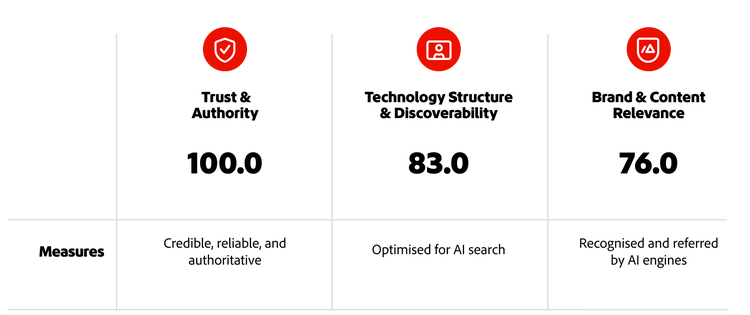
The scores suggest that the government has many of the right foundations in place. Trust and Authority recorded the strongest result, indicating that official government information remains a highly credible source. Technology Structure & Discoverability also performed well, reflecting generally strong technical foundations that help AI search tools find government content. Brand & Content Relevance was comparatively weaker. This highlights the challenge of ensuring AI systems select and connect authoritative information to government services when people seek information through AI interfaces.
Like the broader foundations of digital government, AI Readiness is not a fixed state. The technology, platforms and user behaviours that shape AI discovery continue to evolve, requiring departments and agencies to adapt alongside them.
What the results signal.
Looking beyond individual scores, a broader picture begins to emerge. The results point to three areas where stronger digital performance can deliver the greatest benefit for both the public and the government.
Trusted government information must remain visible in AI discovery.
The UK has entered the AI-assisted information era from a position of relative strength. Official information is widely trusted and technically well- positioned to be discovered. But strong foundations do not automatically guarantee that official information will be cited or connected back to government sources when found via AI tools, including AI-generated search overviews.
As AI becomes a more common way for people to access government information, authority alone is no longer enough. Trusted information must remain connected to citizen decisions and pathways to service when those interactions take place beyond government-owned channels.
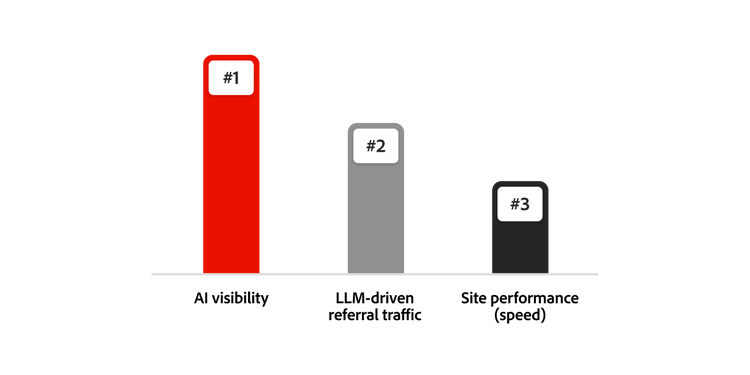
Priority Metrics for Improving AI Readiness
What this means.
While search engines remain a preferred starting point for many, our Customer Experience research shows people report greater confidence in AI-generated answers when they cite or link to official government sources. This pattern is particularly evident for topics such as passports and taxation, where GOV.UK is more frequently referenced in AI responses. Confidence is lower for areas where official government sources are cited less consistently. This creates an opportunity to convert government authority into greater visibility and clearer pathways to services or the next step. In turn, that requires a greater focus on how official information is structured and presented.
What to do.
- Measure visibility, attribution, and conversion. Track whether official content is being surfaced, cited clearly, linked back, and leading people to the right next step, rather than relying only on whether it can be crawled or recognised.
- Optimise content for AI retrieval and citation. Prioritise pages that answer common, consequential service questions, and make those answers easier for AI systems to identify, summarise, and cite.
- Improve relevance for complex citizen questions. Review whether priority pages directly answer the questions people are likely to ask through search and AI tools, especially around eligibility, evidence, and deadline.
- Make key answers reusable across channels. Manage high-priority service information as structured, governed content that can be consistently surfaced across websites, search, AI assistants, forms, and support channels.
- Create clear routes back to official services. Ensure AI-visible content points toward the next action, whether that is applying, checking eligibility, signing in, or continuing through GOV.UK or a departmental service.
- Keep service content extractable and actionable. Avoid burying essential information in long pages, PDFs, inaccessible formats, or fragmented content paths, particularly where people need to make decisions or complete tasks.
Digital services need to support connected citizen journeys.
The UK public sector has made significant progress towards a more consistent digital front door through GOV.UK and broader service transformation efforts. However, the 2026 results suggest connected delivery remains a work in progress.
Site Performance improved in 2026, with government websites becoming faster and more robust. But Customer Experience and Digital Self-Service both declined, showing that better website performance is only part of uplifting the experience for users. The disconnect becomes clearer when viewed through the lens of the service journey. People are unlikely to interact with government through a single website or channel. They may begin with a search engine or an AI-generated answer, and continue through GOV.UK, move to a departmental service, switch devices, authenticate their identity, seek support, and return later to complete a task.
2026 customer service journey results
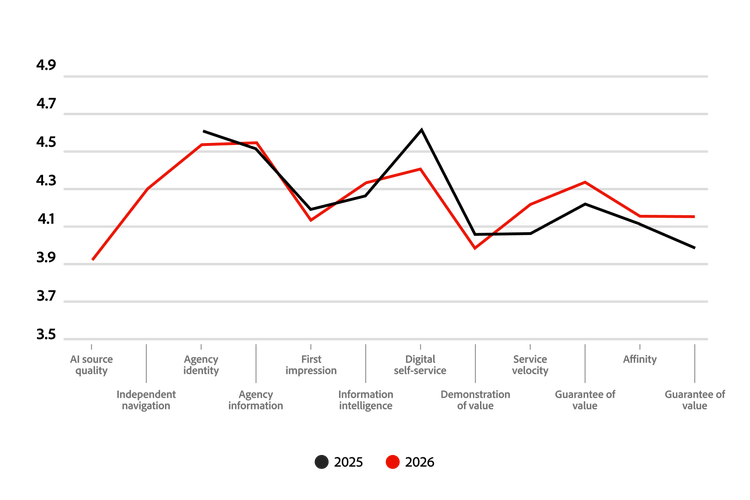
Service users experience these interactions as a single journey, while government often delivers them as a series of separate transactions. The DGI results show that friction occurs at key points. Lower scores in AI source quality suggest users are immediately met with a frustrating or misleading discovery experience. Later- stage dips, including service velocity and demonstration of value, show indicate the experience becomes harder as users move toward completion.
When context is lost between channels, information must be re-entered, or support is not available at the right moment, friction increases. Even services that are technically strong and easy to find can feel disconnected when they don’t recognise, support, and guide users across the full journey.
As expectations continue to rise, continuity is becoming as important as capability. Navigation, identity, support, personalisation and next-step guidance are no longer separate digital improvements. Together, they determine how easily people can move through government services and maintain momentum towards an outcome.
What this means.
The front door to UK public services is evolving. As digital journeys become more complex, departments and agencies need to think beyond individual touchpoints and focus on how the overall experience holds together from start to finish.
What to do.
To create more connected service journeys, departments and agencies should focus on the points where people are most likely to lose context, repeat effort, or disengage altogether.
- Design around priority journeys, not individual pages. Focus on how people move across services and channels, with clearer guidance between each stage of the journey.
- Improve continuity across GOV.UK, departmental sites, mobile experiences, and assisted channels. Strengthen sign-in experiences, navigation, and next-step support so interactions feel connected rather than discrete.
- Use governed AI-assisted support to maintain momentum. Deploy AI where it can help citizens understand options, resolve common blockers, and continue confidently through the journey.
- Align front-end experience with back-end operations. Website and interface improvements only translate into better outcomes when supported by connected data, identity, and workflow infrastructure.
Performance spotlight – HM Passport Office
HM Passport Office deploys a ‘digital-by-default’ passport application process, designed to eliminate bureaucratic friction and support more of the journey in one place. Users can check photo requirements, submit updates, and track progress through a clear digital process, reducing the points where context can be lost or where people are unsure of what to do next.
Performance spotlight – British Army Recruitment
The British Army identified its recruitment journey as an opportunity to improve candidate engagement and increase successful applications. With the process taking 6–9 months and critical drop-out points along the way, the Army recognised the need to digitise and create a more connected experience. By focusing on priority use cases, the aim was to reduce friction, maintain momentum, and better support applicants through to completion.
Digital services must be designed around outcomes.
The 2026 results point to a higher bar for digital government. Even when people find the information they’re looking for and reach an online service, they must still understand their options, make informed decisions, and complete their intended task.
Digital Self-Service recorded the largest decline of any measure in 2026, driven by notably weaker readability across most assessed sites. Yet Site Performance improved, showing the issue is not simply technical and that faster, healthier websites do not automatically make services easier to complete.
The results point to a growing gap between providing information and enabling action. Many public services involve complex eligibility requirements, evidence obligations, deadlines, or consequences for getting a decision wrong. When users struggle to interpret information, understand next steps, or determine what applies to their circumstances, digital channels are less able to deliver their intended impact.
Digital Self-Service and Site Performance Comparison (2025 vs. 2026)
What this means.
Public sector efforts must focus on helping people complete what they set out to do by providing clear instructions and information around requirements, next steps, and providing support where needed.
What to do.
To improve service utilisation and completion rates, government departments and agencies should strengthen the parts of the service experience where understanding, confidence, and action are most at risk.
- Use personalised support at decision points. Provide prompts, guidance, or assisted support where people are most likely to hesitate, abandon a task, or choose the wrong pathway.
- Improve readability on priority services. Start with content that carries the greatest risk of confusion or drop-off, such as eligibility criteria, evidence requirements, rules, or obligations.
- Provide clear guidance and next steps. Help users understand what applies to them, what they need before they begin, what happens after submission, and where to get support if required.
- Design forms and workflows around completion. Reduce unnecessary steps, make errors easier to resolve, and ensure people can save, return, and complete tasks without starting again.
- Measure task completion, not just traffic. Track abandonment, time to complete, error rates, and assisted-channel demand to understand where services are failing to convert access into outcomes.
Performance spotlight – National Health Service (NHS)
The NHS recorded a higher readability score than most other agencies. It improves readability through clear content standards that encourage the use of plain English, shorter sentences, and well-structured information. By reducing unnecessary complexity, the NHS makes important health information easier for a broader range of people to understand and act on.
The anatomy of best-in-class digital government service delivery.
No single assessed agency currently excels across all DGI dimensions and capability measures that indicate leading and experience–driven public service delivery. Top performers across markets demonstrate how strong foundations, cross–government connectivity, and capabilities that enhance user experiences can deliver better outcomes at scale.
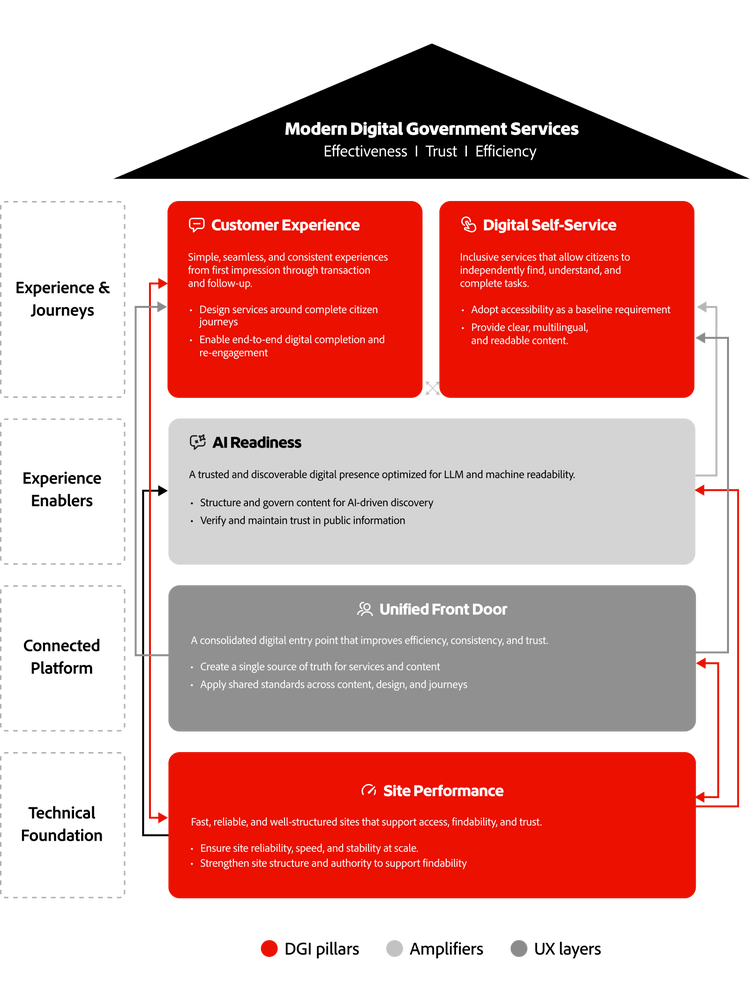
The roadmap to maturity and higher DGI scores.
Government departments and agencies can improve digital services by building capability over time. While the destination is shared, different functions contribute in different ways. The roadmap below outlines how key government roles can help progress efforts from foundational practices to scaled and optimised delivery.
Digital, data, and technology leaders
Responsible for enterprise architecture, shared services, digital platforms, data, and cost to serve

Foundation

Scale

Optimise
Outcome
Deliver seamless public service through an integrated, AI-ready digital foundation.
Deliver seamless public service through an integrated, AI-ready digital foundation.
Audit digital performance, WCAG compliance, AI discoverability, and platform maturity.
Consolidate CMS and forms capabilities onto shared platforms.
Strengthen unified digital ‘single front door’ for services.
DGI Signal
Fragmented platforms limit consistency, measurement, and AI discoverability.
Fragmented platforms limit consistency, measurement, and AI discoverability.
Identify duplicate CMS, forms, chatbot, and workflow platforms.
Establish HTML-first, accessibility and structured content standards.
Centralise monitoring of performance, accessibility, SEO, AI discoverability, and user experience.
Priority Action
Audit platform portfolio and prioritise integration and shared digital capabilities.
Audit platform portfolio and prioritise integration and shared digital capabilities.
Quantify the volume of PDF-based services.
Stand up shared services for SSO, notifications and workflows.
Shift funding from one-off projects to continuous digital service optimisation.
Program and service owners
Responsible for applications, enrolment, service delivery, case management, and citizen outcomes
Foundation
Scale
Optimise
Outcome
Increase digital service completion and reduce friction across priority service journeys.
Increase digital service completion and reduce friction across priority service journeys.
Identify manual or paper-based services.
Replace PDFs with digital forms that support completion, signature and submission.
Automate intake and case routing.
DGI Signal
People judge digital services by how easily they can find, start, and complete high-value tasks.
People judge digital services by how easily they can find, start, and complete high-value tasks.
Measure abandonment, processing delays, and service bottlenecks.
Enable end-to-end digital workflows with no offline steps
Integrate services, identity and personalisation capabilities across systems and agencies.
Priority Action
Identify drop-offs in priority service journeys and use personalisation to increase completion.
Identify drop-offs in priority service journeys and use personalisation to increase completion.
Quantify call-centre and in-person demand.
Track completion rates and time to resolution as core metrics.
Track completion rates and time to resolution as core metrics.
Accessibility, compliance, and communications
Responsible for WCAG compliance, readability, language access, content governance, and public trust
Foundation
Scale
Optimise
Outcome
Ensure equitable access to digital services while maintaining compliance.
Ensure equitable access to digital services while maintaining compliance.
Run a WCAG audit of priority pages and documents.
Remediate priority pages and documents for compliance.
Embed accessibility, compliance and readability into publishing workflows.
DGI Signal
Compliance alone does not guarantee accessibility or usability.
Compliance alone does not guarantee accessibility or usability.
Identify readability, language and accessibility gaps.
Convert high-traffic PDFs into accessible HTML experiences.
Scale multilingual and multi-format content delivery.
Priority Action
Supplement compliance testing with real user feedback to identify barriers.
Supplement compliance testing with real user feedback to identify barriers.
Flag high-risk services, including benefits and healthcare.
Rewrite priority content using plain-language principles.
Use AI-assisted translation and readability tools with governance and human review.
What’s next.
Drawing on four years of evaluation, this first published UK report offers a long-term view of how digital government services are evolving, and what needs to happen next. The results show steady progress in digital maturity but also make clear that the next phase of improvement will depend on how well departments can connect capability, ownership, and delivery across the full- service journey.
We partner with government departments and agencies to embed the index framework and strengthen ownership across the end-to-end service journey. By leveraging AI Readiness as a digital enabler, we help build the digital maturity required to deliver services that meet public needs — today and in the future.
To understand how your benchmarking results compare and to discuss specific opportunities, please contact Simon Murray at smurray@adobe.com for a preliminary discussion.
Methodology.
Adobe's Digital Strategy Group conducted the UK analysis for the annual Digital Government Index in 2026. The analysis covered the official portals of seven government departments and agencies. Each of the three foundational digital maturity dimensions was assigned a score between 0 and 100, with the average producing the overall DGI score.
- Customer Experience: User testing was conducted with 140 citizens, aged between 18 and 65 years, using a structured script to evaluate mobile and desktop experiences across 10 categories.
- Site Performance: Third–party tools, such as Google PageSpeed and Semrush, were employed to measure the cross–device speed, performance, and functionality of 7,000 pages across seven portals.
- Digital Self-Service: Manual analysis, supported by third–party tools such as Axe DevTools and Web FX, was undertaken to assess the accessibility and inclusion.
The team also analysed an additional digital enabler using the following methods:
- AI Readiness: Tested websites on eight metrics including domain authority, source quality, AI visibility, crawlability, AI content visibility, brand recognition, AI search health, and LLM referral traffic, using third–party tools, including Semrush, Similarweb, HubSpot, Google Trends and Gushwork’s AI Search Grader.
Title
Insights from the Digital Government Index.
cardDate
2026-11-13
cardImage

CardDescription
See where UK digital government is gaining ground and where service delivery must adapt next.
primaryTag
caas:content-type/report
Tags
caas:content-type/report, caas:industry/government