Strategy
Clear AI vision with ownership and investment commitments.





For The State of AI Readiness in Industrial Manufacturing study, we surveyed executives to understand how industrial manufacturers are adopting AI across marketing and customer experience workflows, where progress is getting stuck and what operating-model practices can help organisations move from individual deployments to repeatable scale.
Industrial manufacturing no longer needs to ask whether AI belongs in the commercial engine. Respondents report activity at every stage from exploration to transformation, while use cases are emerging across customer engagement, demand planning, service and operations. The harder question is how to move from individual deployments to repeatable scale.
This challenge extends beyond technology. AI must advance with the people, processes, data and governance needed to support it. Industrial manufacturers also coordinate across global markets, complex distributor and channel structures and rising customer expectations. This baseline complexity is distinct from the caution created by AI itself.
That caution can be rational. AI can touch engineering-heavy, documentation-sensitive, safety- and compliance-bound workflows, where errors may create regulatory, reputational or operational exposure. Progress, therefore, depends on clear ownership across demand generation, channel and aftermarket; genuine partnership between business and IT; and measurement established before deployment. Fragmented technology estates can make that coordination harder.
The research shows where operating model gaps are concentrated and identifies behaviours more common among the global cross-industry Leaders. Read this report as a benchmark, not a forecast. Its purpose is to help executives assess what the operating model can support and decide what to build next.

Jonathan Burdette
This report draws on global research conducted by Incisiv on behalf of Adobe.


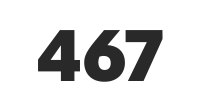
respondents formed the active industrial manufacturing respondent base. They reported a current state of AI adoption in marketing and customer experience workflows across five stages: exploring, piloting, deploying, expanding and transforming.
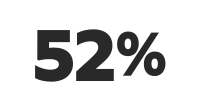
of respondents held positions at the vice president level or above, within the industrial manufacturing cohort.
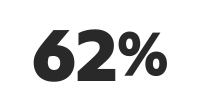
MARKETS COVERED
Markets covered were Australia and New Zealand, Central Europe, India, Japan, Latin America, the Middle East, North America, Southeast Asia, South Korea, the United Kingdom and Ireland and Western Europe.
Each organisation was assessed across six operating model pillars and scored on a scale of 1 to 5. The six scores were combined into an operating model maturity (OMM) composite.
Strategy
Clear AI vision with ownership and investment commitments.

Structure
Dedicated AI ownership with budget authority.

People
Roles and culture evolving for an AI-enabled environment.

Governance
Risk frameworks calibrated for AI velocity.

Technology
Infrastructure built for scale, not just pilots.

Workflows
AI embedded into how work is actually done.
To qualify as a Leader, an organisation had to meet two criteria: achieve an OMM composite above the top-quartile threshold of 3.27 and operate at the expanding or transforming stage of AI deployment. Unless otherwise stated, “Leaders” refers to the global cross-industry cohort of 342 respondents whose organisations met the Leader criteria, representing 6% of the 5,323 active respondents.
These organisations have established the ownership, governance, measurement and ways of working needed to make AI deployment repeatable and sustainable. The Leader designation is based on measured operating-model maturity and deployment stage, providing a consistent view of how more mature AI operators organise and run their programmes.
Of the industrial manufacturing respondents,
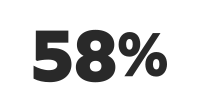
Are at the piloting or deploying stage, forming the frozen middle.
AI is active within individual functions, but scaling across demand generation, channel engagement, aftermarket service and supporting systems remains difficult. This concentration should not be read simply as a lack of ambition or readiness. Documentation-sensitive, safety- and compliance-bound workflows create legitimate caution, while global operations and multi-tier channel structures add coordination complexity.
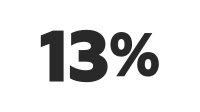
Have a formal AI owner with a defined title and budget authority.
Elsewhere, accountability is part-time, committee-led, assigned on a project-by-project basis or absent. When an initiative requires customer data, distributor participation, technical content and compliance review, no individual function may have the authority to resolve competing priorities or make a binding decision.
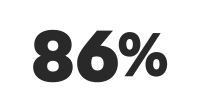
Operate in siloed, transactional or consultative business-IT relationship modes.
Sequential handoffs are compounded by fragmented technology estates built through years of independently procured solutions and, in some organisations, merger and acquisition activity. Shared objectives and key results (OKRs) can improve coordination, but they cannot replace the architectural work required to connect customer, channel, service and operational data.
The 342 Leaders identified across the broader cross-industry sample show five operating-model behaviours that are relevant to industrial manufacturing:

Leaders are 7.2 times more likely to have a formal AI owner with the title, mandate and budget authority to work across functions.

44% of Leaders measure return on investment (ROI) comprehensively, compared with 7% of the active industrial manufacturing respondent base.

81% of Leaders operate at the Collaborative or Integrated level, compared with 14% of the active industrial manufacturing respondent base.

44% of the active industrial manufacturing respondent base reports blame or repeated failure when AI initiatives underperform. Among Leaders, the figure is under 1%.

42% of Leaders identify finding and empowering internal champions as the people or culture action with the greatest impact on their ability to scale AI.
Part One
Most industrial manufacturing respondents are in the piloting or deploying stages.
58% of respondents are in these two stages, forming a frozen middle in which AI is active but has not yet reached repeatable deployment across the operating model.
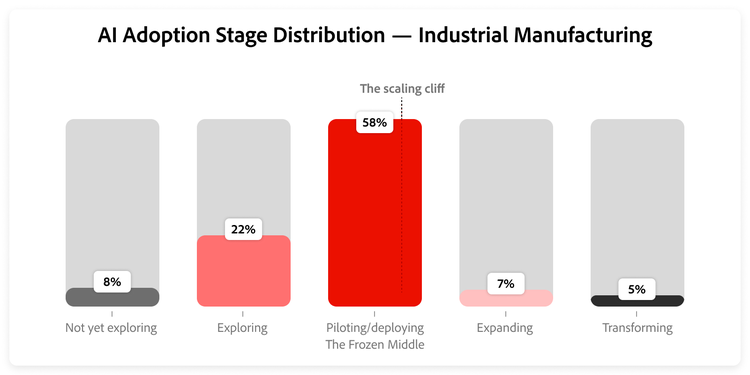
Industrial manufacturing respondents are adopting AI, with activity concentrated midway through the journey. Across the cohort, 58% are in the piloting or deploying stages, forming the frozen middle. Account intelligence, distributor content and aftermarket engagement can operate within individual functions without becoming repeatable across the commercial model.
Caution in this environment can be rational. Generative AI can touch engineering-heavy, documentation-sensitive, safety- and compliance-bound workflows, where errors may create regulatory exposure. In some markets with few dominant competitors and limited growth, a misstep that costs customer trust or market share can be difficult to recover. Global operations and multi-tier channels add coordination complexity.
This concentration reflects more than isolated deployment schedules. Scaling requires channel, service, data, risk and technology teams to align across boundaries not designed for rapid iteration. Without authority across those seams, decisions about data rights, integration and risk are deferred. Ownership becomes the issue to examine.
Only 13% of active industrial manufacturing respondents report formal AI ownership.
Most of the active respondent base reports part-time, committee-led, ad hoc or unassigned accountability rather than an owner with a formal title and budget authority.
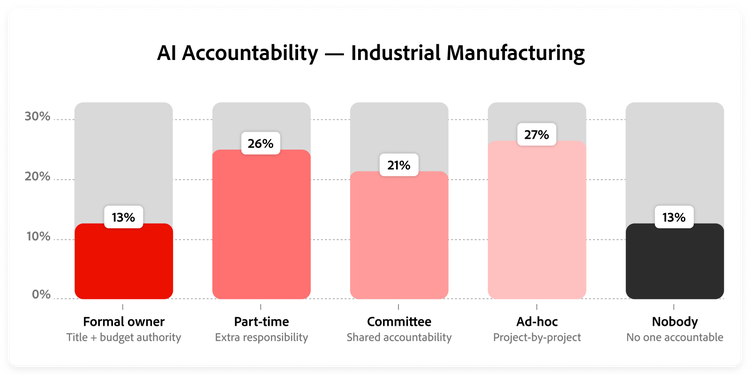
Among the 467 active industrial manufacturing respondents, 13% report that their organisation has a dedicated AI owner with a formal title and budget authority. Others describe accountability as part-time, committee-led, ad hoc or absent. Assigned responsibility does not necessarily include authority to set priorities, commit funding or resolve conflicts across functions.
Commercial AI initiatives often cross demand generation, distributor management, aftermarket service, data and technology. An account-based marketing programme may need install-base telemetry, distributor customer relationship management access and technical content inputs. When authority ends at each function’s boundary, decisions about data use, integration and campaign priorities pass through several owners without one person being able to make a binding call.
The effect extends beyond approval. Fragmented accountability leaves use cases exposed during formal review because ownership of the data, systems, risk and commercial outcome remains unsettled. This leads directly to the point of pressure: how proposed ideas move into production.
For industrial manufacturing respondents, only 13 of every 100 AI use case requests reach production.
Among the active respondent base, the median reported production launch rate is 13 out of every 100 requests, following IT, security, integration and budget review.
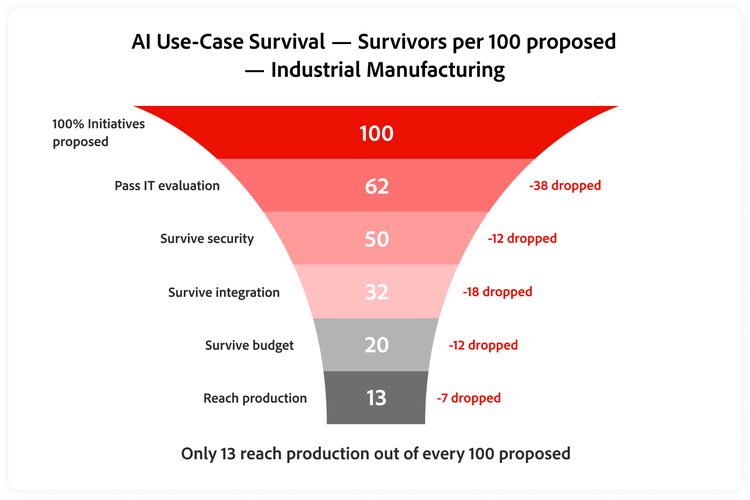
Across the active industrial manufacturing respondent base, the use-case funnel narrows sharply: a median of 13 out of every 100 requests reaches production. The largest reduction occurs at the initial IT evaluation, followed by security, integration and budget review. Each gate serves a legitimate purpose, but their cumulative effect shows how difficult it is for an idea to survive the full path.
Commercial value is one of several considerations. Reviews may focus on system compatibility, data access, security, compliance and budget before customer or commercial value can be tested. A use case spanning customer relationship management systems, distributor portals and manufacturing execution systems can be stopped by ownership or integration constraints even when its business case remains promising.
The funnel exposes unresolved accountability. When data rights and system ownership remain unsettled, ideas enter review with questions no function can resolve. The next finding examines how business and IT shape that process.
86% of active industrial manufacturing respondents report siloed, transactional or consultative business-IT relationships.
Sequential handoffs reflect long technology and capital cycles and can be compounded by fragmented systems accumulated through independent technology purchasing.
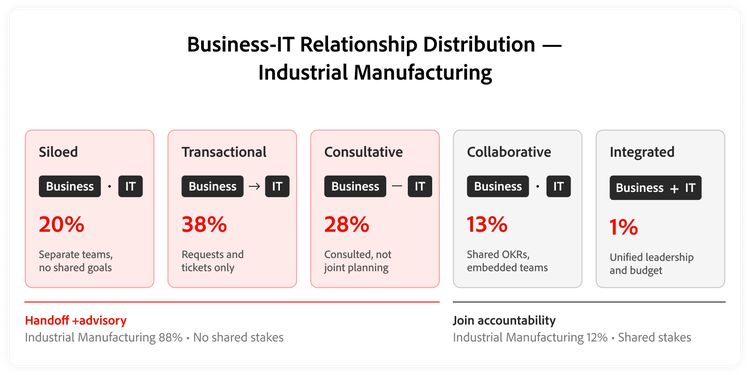
Among the active industrial manufacturing respondent base, 86% characterise the business-IT relationship as siloed, transactional or consultative. In these modes, business teams may define the request before IT becomes involved, leaving IT with sole responsibility for delivery. That cadence can suit long enterprise resource planning, manufacturing execution system and controls upgrade cycles, but AI-driven commercial workflows require faster iteration and shared accountability.
The handoff reflects more than a legacy operating design. Years of point solutions purchased independently, sometimes through merger and acquisition activity, can leave customer, distributor, service and operational data spread across disconnected systems. This accumulated technical debt makes integration genuinely difficult and creates a practical ceiling on what the current infrastructure can support.
Shared objectives can improve alignment, but cannot resolve architectural fragmentation alone. The working relationship and underlying data environment jointly shape whether deployment becomes repeatable. Until both evolve, measurement remains fragmented, leading to the final finding.
Only 7% of active industrial manufacturing respondents report comprehensive AI return on investment measurement.
Basic measures can provide useful evidence of adoption and delivery, but they do not establish whether AI changed a customer or commercial outcome.
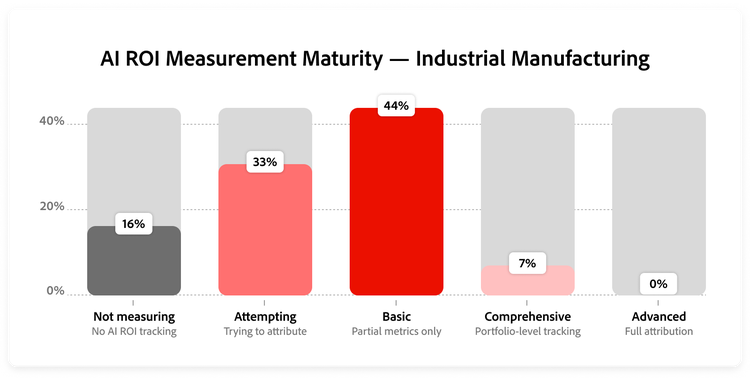
Among the active industrial manufacturing respondents, only 7% report a comprehensive return-on-investment framework. Most respondents report basic metrics, are attempting measurement but struggling or are not measuring. This indicates that measurement is present in many programmes, but often stops before establishing a customer or commercial outcome.
Basic measures can confirm that a tool was used, an audience was segmented or a campaign ran. These are practical measurement choices, particularly when data is distributed across markets, channel partners and service systems. However, they cannot show whether AI improved pipeline conversion, distributor sell-through, or service-contract renewal.
The measurement window narrows after deployment. Once an AI-driven programme is live, its contribution can be difficult to separate from demand conditions, inventory positions and service capacity. Without a pre-deployment baseline, executives have less evidence for deciding whether to extend or fund the programme. This gap sets up the Leader behaviours examined next.
Part Two
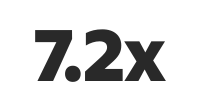
Across the global cross-industry Leader cohort, formal AI ownership with title and budget authority is 7.2 times more common than among the active industrial manufacturing respondent base. Only 13% of that base reports this level of ownership. The comparison highlights the difference between assigning responsibility and giving someone authority to act across functions.
In industrial manufacturing, commercial AI initiatives can span demand generation, distributor management, aftermarket service, data, technology and risk. A formal owner provides a point for resolving conflicts over priorities, funding, data access and acceptable risk when no individual function controls the full workflow.
Formal ownership does not remove integration constraints, regulatory review or deployment failure. It clarifies who is accountable for responding to them. That owner can keep the commercial outcome visible, establish measurement expectations and carry lessons from one deployment into the next. For industrial manufacturing respondents, this is the foundation for the remaining Leader behaviours.
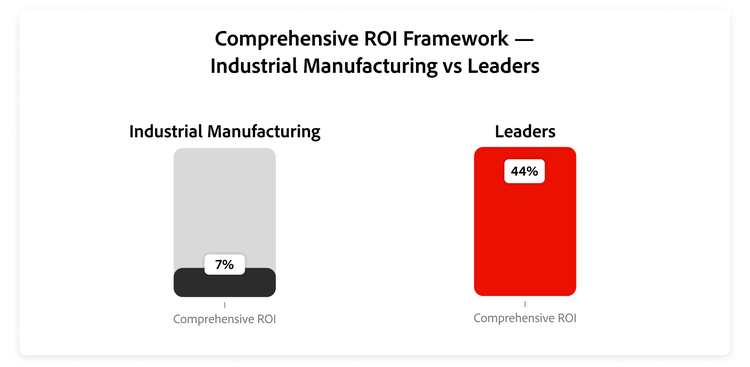
Across the cross-industry Leader cohort, 44% report a comprehensive return on investment framework, compared with 7% of the active industrial manufacturing respondent base. The difference concerns more than reporting. Comprehensive measurement links deployment to a defined customer or commercial outcome and establishes how that outcome will be assessed.
For industrial manufacturing, this may mean setting baselines for pipeline conversion, distributor sell-through, service-contract renewal or content performance before deployment. Agreement is also needed on attribution across markets, channel partners and service cycles. The active respondent base has not yet built this discipline consistently, with most reporting basic measurement, difficulty measuring or no measurement.
Day-one measurement does not remove long sales cycles or external factors that affect results. It gives teams an agreed baseline for interpreting them. That evidence can guide whether a programme should be adjusted, extended or stopped, while helping the organisation carry learning from one deployment to the next.
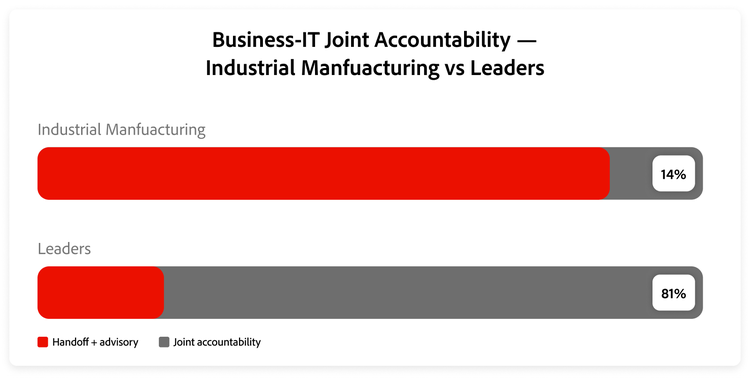
Across global cross-industry Leaders, 81% report collaborative or integrated business-IT relationships, compared with 14% of the active industrial manufacturing respondent base. In these modes, business and IT share accountability for outcomes rather than limiting their relationship to requests, advice or delivery.
For industrial manufacturing, genuine partnership begins before a use case enters development. Commercial, data, technology, security and compliance teams shape the brief together, agree on the customer or commercial objective and identify integration constraints early. Most active respondents have not yet reached this relationship model, leaving shared decisions to be resolved later in the process.
Partnership does not consolidate fragmented architecture or remove regulatory risk. It changes how teams respond to those constraints. Shared objectives keep both sides engaged through scoping, deployment and measurement, while joint accountability reduces the chance that unresolved issues are passed between functions. This gives industrial manufacturing initiatives a more stable basis for continuous iteration and learning.
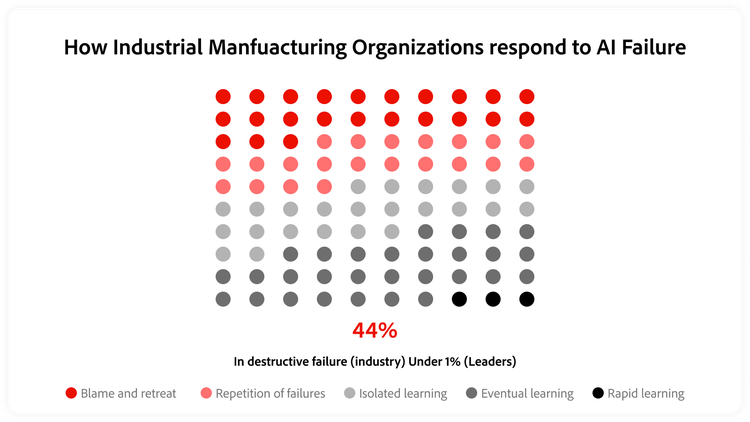
Among the active industrial manufacturing respondent base, 44% report that AI underperformance leads to blame and retreat or repetition of failure. Among the global cross-industry Leaders, the figure is under 1%. This difference does not suggest that Leaders avoid barriers or failed initiatives. They report a different response.
Industrial manufacturing programmes often operate across long sales cycles, annual distributor plans and equipment service schedules. When an account model or engagement workflow underperforms, teams may face pressure to continue without examining the cause. If learning remains within one function or market, another team can carry the same assumptions into its next deployment.
A learning culture makes underperformance available for structured review. Leaders are more likely to respond through rapid or eventual learning rather than blame or repetition. This approach does not lower the stakes involved. It helps teams identify what changed, preserve useful evidence and adjust the next deployment.
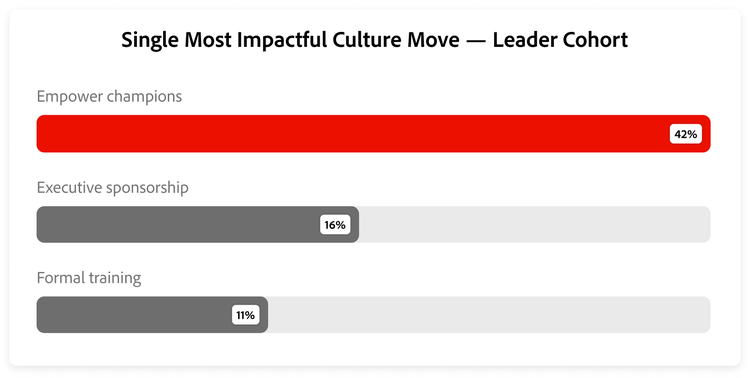
Among global cross-industry Leaders, 42% identify empowering internal champions as the people or culture change with the greatest impact on scaling AI. This exceeds executive sponsorship at 16% and formal training at 11%. The pattern points to the value of practitioners who can show how AI changes real work.
In industrial manufacturing, champions may emerge in demand generation, channel marketing, aftermarket service or content operations. Their influence comes from demonstrating a result in a workflow, market or partner environment. That practical evidence can make adoption more credible than a general message delivered from the centre.
Champions do not replace formal ownership, shared governance or technical support. They need permission, time, recognition and cross-functional reach to extend learning beyond one team. Industrial manufacturing respondents report challenges moving from individual to shared practices. When champions are empowered, they can surface friction early, share evidence and help teams respond to setbacks.
Each move reflects behaviour more common among global cross-industry Leaders and builds on existing investments.
Conclusion
Most industrial manufacturing respondents report active AI adoption across marketing and customer experience workflows, but activity remains concentrated in piloting and deploying. Moving beyond that concentration requires more than additional tools. It requires an operating model that can coordinate decisions across commercial teams, channel partners, technology, data, risk and compliance.
The cross-industry Leader benchmark points to a connected set of behaviours: formal ownership, measurement established before deployment, shared business-IT accountability, structured learning and empowered practitioners. These behaviours do not remove integration constraints, regulatory exposure or the complexity of global channel operations. They give organisations a clearer way to respond.
The practical next step is to apply this model to one priority commercial or customer experience use case. Name the accountable owner, define the outcome and baseline and map the data, architecture and governance dependencies before deployment. That discipline creates a stronger basis for deciding what to scale, what to change and where further investment is justified.
Adobe empowers organisations to create impactful digital experiences. Our portfolio of customer-experience products and services helps businesses put every interaction in context, understand what each customer needs right now and design and deliver digital experiences that build loyalty and drive growth. Visit adobe.com to know more.
Incisiv is an industry insights and strategy firm combining close to a decade of industry trend data with primary research, messaging architecture and content development to help enterprises navigate transformation, evaluate solutions and unlock growth. Visit incisiv.com to know more.