
Strategy
Clear AI vision with ownership and investment commitments.



Most life sciences organisations have moved AI past exploration, but few have built the operating model that makes deployment repeatable. This report examines what holds that progress back and what the Leaders do differently.
Artificial intelligence (AI) is shaping how life sciences respondents approach content, engagement, data and operational workflows. The opportunity extends across interactions with customers and healthcare professionals and the teams that create, review, deliver and measure those experiences. Our research asks whether ownership, governance, measurement and ways of working are developing at the same pace as adoption.
AI initiatives often begin within individual functions, each with its own objectives, data, systems and responsibilities. Commercial teams may focus on engagement and content, while medical, scientific, technology and operational teams contribute expertise. Legal, privacy, regulatory, compliance, security, quality and safety partners provide essential oversight. When these groups follow separate decision processes, initiatives become harder to evaluate, connect and extend.
The research points to an operating model issue. Repeatable deployment requires accountable ownership, agreed measures, effective collaboration, shared learning and practitioners who can help colleagues adopt new ways of working. These foundations must preserve scientific accuracy, privacy, security, accessibility, responsible governance, human oversight and specialist authority.
This report examines five behaviours more common among global cross-industry Leaders. They give life sciences executives a practical framework for strengthening AI execution while maintaining the review and oversight appropriate to each workflow.

Matte Merritt


MARKETS COVERED
Central Europe, Latin America, North America, the United Kingdom and Ireland and Western Europe.
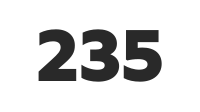
The 342 AI Leaders referenced in this report come from the full study population of 5,633 executives across 12 industries. This is a global, cross-industry cohort rather than a group specific to life sciences. It provides the benchmark used to compare life sciences findings.
Each organisation was assessed across six operating model pillars, with every pillar scored on a scale of 1 to 5. The six scores were combined into an operating model maturity (OMM) composite.
Strategy
Clear AI vision with ownership and investment commitments.

Structure
Dedicated AI ownership with budget authority.

People
Roles and culture evolving for an AI-enabled environment.

Governance
Risk framework calibrated for AI velocity.

Technology
Infrastructure built for scale, not just pilots.

Workflows
AI embedded into how work is actually done.
To qualify as a Leader, an organisation had to meet two criteria: achieve an operating model maturity composite above the top-quartile threshold of 3.27 and operate at the expanding or transforming stage of AI deployment. Applying the criteria identified 342 Leaders across 12 industries, equivalent to 6% of the 5,323 active respondents.
The designation represents advanced deployment combined with stronger operating model maturity. It is not specific to life sciences and does not establish causation. Unless otherwise stated, Leader comparisons refer to this global cross-industry cohort.
Life sciences respondents are moving AI beyond early exploration, but the operating model supporting that activity has not developed evenly. Ownership remains limited, measurement is often basic and business and information technology teams frequently work through sequential relationships. This report examines those gaps and the behaviours more common among the global cross-industry Leaders.

of the active life sciences respondent base is in the Frozen Middle, concentrated at the piloting and deploying stages. AI is active, but many respondents have not reached expanding or transforming. The finding does not show that organisations have stalled over time. It indicates where adoption is currently concentrated and where the requirements for repeatable execution become more demanding.
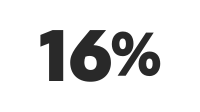
of life sciences respondents report that their organisations have a formal AI owner with a defined title and budget authority. Elsewhere, responsibility may be distributed across functions, committees or individual projects. That can leave teams accountable for separate parts of an initiative with no single owner able to set priorities, allocate resources and coordinate decisions across the work.
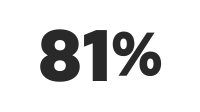
of life sciences respondents describe business and information technology relationships as siloed, transactional or consultative. These models rely on separate requests, advice and sequential handoffs rather than shared accountability. AI initiatives that depend on connected content, data, technology, measurement and appropriate specialist review require earlier collaboration and clearer joint outcomes.
The 342 global cross-industry Leaders combine stronger operating model maturity with operation at the expanding or transforming stage. Five behaviours are more common among this cohort. These comparisons provide a benchmark for life sciences respondents but do not establish that an individual behaviour caused stronger performance.

Leaders are 5.7 times more likely to have a formal AI owner with a defined title and budget authority. The role provides accountability across the programme while preserving the decision rights of medical, scientific, regulatory, privacy, safety and other specialist functions.

44% of Leaders measure return on investment comprehensively, compared with 8% of life sciences respondents. Leaders define intended outcomes, baselines and evaluation methods before deployment, when teams can still agree on what success should mean.

81% of Leaders operate at the collaborative or integrated level, compared with 19% of life sciences respondents. Business and technology teams participate when work is defined and share accountability for delivery and the intended outcome.

34% of life sciences respondents report destructive failure patterns involving blame or repeated mistakes. Among Leaders, the figure is under 1%. Leaders are more likely to examine underperformance and apply what they learn to later work.

42% of Leaders identify finding and empowering internal champions as their most impactful culture action, ahead of executive sponsorship at 16% and formal training at 11%. These practitioners help colleagues evaluate proven approaches in a relevant working context.
PART ONE
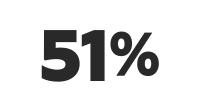
60% of the active life sciences respondent base is in the Frozen Middle, with AI underway but broader, repeatable execution still limited.
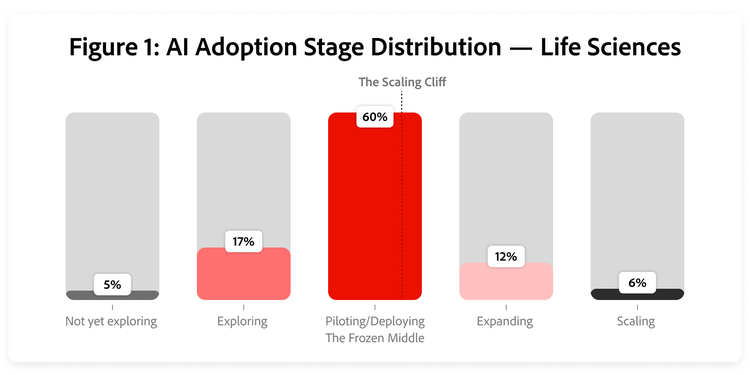
Life sciences respondents are adopting AI one use case and workflow at a time. Activity may begin in content, engagement, analytics or operations, each with its own objectives, data, systems and review requirements. This creates progress within functions without necessarily creating a repeatable enterprise approach.
The Frozen Middle describes 60% of life sciences respondents at piloting or deploying. These stages show that AI has moved beyond exploration, but they do not indicate how long respondents have remained there. The finding identifies a concentration in deployment stages rather than a time-based stall.
Moving beyond this concentration requires teams to connect decisions that pilots can leave unresolved. Accountable ownership, data access, agreed measures and clear decision rights help business, technology and oversight partners evaluate which initiatives should continue, change or expand. For life sciences respondents, progress also depends on preserving scientific accuracy, privacy, security, accessibility, human oversight and the authority of specialist functions.
Without a named owner, responsibility can be distributed across functions without clear authority over priorities, funding and coordination.
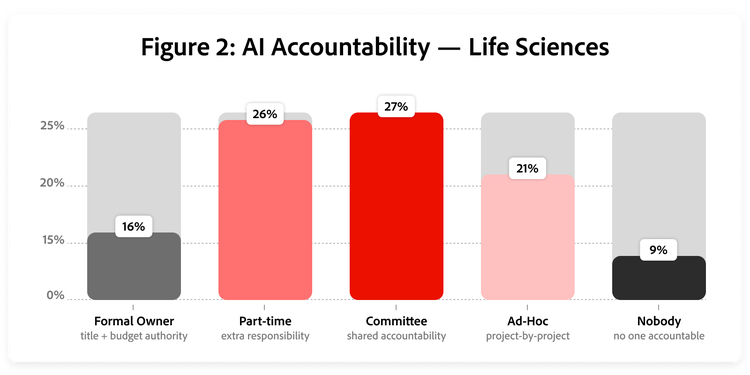
AI initiatives in life sciences can involve commercial, medical, scientific, data, technology, operations and oversight teams. Each may be responsible for a different decision or stage of delivery. When accountability is distributed across these groups, teams can struggle to resolve competing priorities, allocate resources or decide which initiatives should advance.
Only 16% of life sciences respondents report that their organisations have a formal AI owner with a defined title and budget authority. Elsewhere, responsibility may be part-time, committee-led or assigned project by project, leaving decisions dependant on agreement among teams with different mandates and priorities.
Formal ownership should establish accountability for priorities, funding, coordination and results. It should not give one executive unilateral authority over medical, scientific, regulatory, legal, privacy, security, quality or safety judgements. The owner must instead bring partners into decisions, clarify who has authority at each point and keep work moving within governance appropriate to the use case.
The largest reduction occurs during compliance and validation review, showing why feasibility, value and oversight must be considered together.
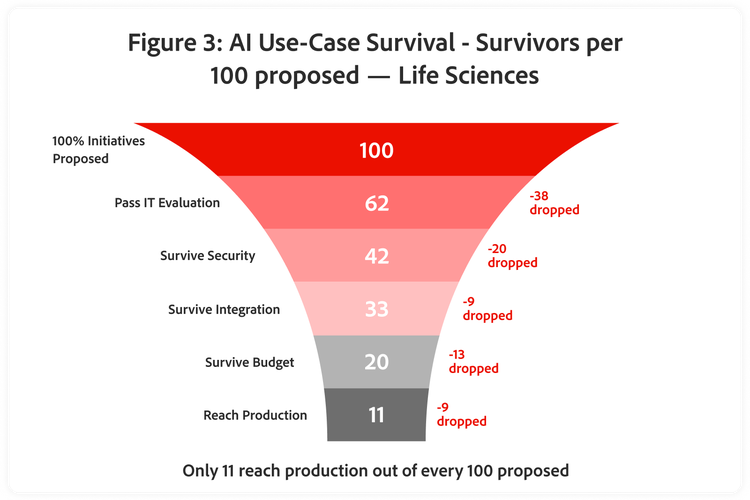
Moving an AI use case from idea to production requires decisions across business, technology and oversight teams. The life sciences funnel follows use cases through initial evaluation, compliance and validation review, security assessment, integration, budget approval and production launch. Each stage tests whether work is ready to continue.
Out of every 100 AI use case requests, life sciences respondents estimate that 11 reach production. The largest reduction occurs during compliance and validation review. The result does not make oversight an obstacle. It shows that feasibility, evidence, data, governance, risk and approval requirements need consideration.
A stronger process brings together the people responsible for intended value, technical delivery and specialist review together during ideation. They can identify required data, establish system ownership, define evaluation criteria and determine which approvals apply before a proposal reaches formal review. This helps teams assess feasibility and value together without weakening scientific, medical, regulatory, privacy, security, quality or safety requirements.
81% operate through Siloed, Transactional or Consultative relationships rather than models built around shared accountability.
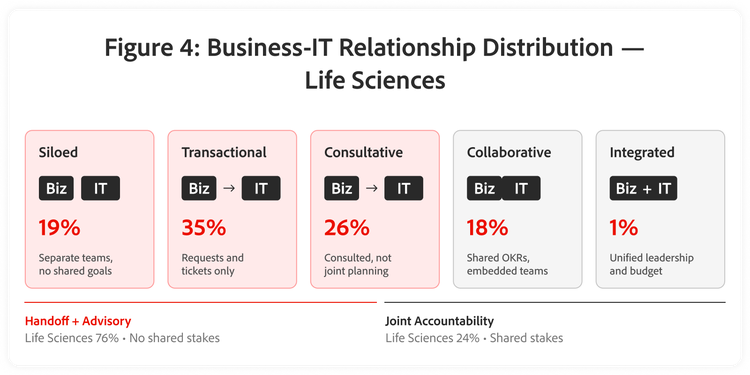
AI initiatives require business teams to adjust content, engagement or operational decisions as evidence develops. Technology teams must adapt data, systems, integrations and controls alongside them. Sequential handoffs make coordination harder.
81% of life sciences respondents describe business and information technology (IT) relationships as siloed, transactional or consultative. In these models, business teams may submit requests and IT may deliver systems or advice without sharing accountability for outcomes. Issues can move between functions through queues, reviews and approvals.
Collaborative and integrated relationships begin earlier. Business, technology, data and relevant oversight partners define the use case together, agree on what success means and identify constraints before development advances. Shared objectives and key results can maintain joint accountability through delivery and measurement. For life sciences respondents, this approach helps teams resolve data, integration, privacy, security, scientific, regulatory and operational questions while the work is being shaped rather than after one function has handed it to another for review and final approval.
Most life sciences respondents report basic measurement, leaving intended outcomes difficult to assess and compare.
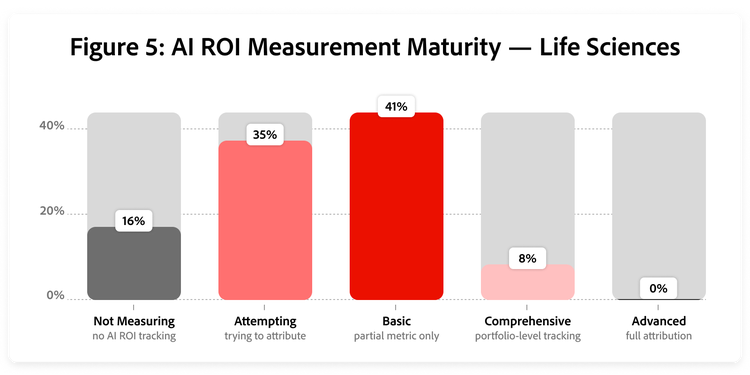
As AI becomes part of life sciences workflows, teams need to measure more than activity. They may track content produced, requests processed, audiences reached or time saved. These measures can show adoption and efficiency, but they do not establish whether the initiative improved the intended business, workforce, operational, customer, healthcare professional or patient-related outcome.
Stronger measurement begins before deployment. Teams define the intended outcome, record a baseline and agree on how results will be evaluated. Depending on the use case, measures may address engagement, content performance, process quality, productivity, cost or another approved outcome. Scientific, medical, regulatory, privacy, security, accessibility and safety requirements should be incorporated at launch where relevant rather than treated as separate from evaluation.
Pre-deployment measurement protects the original comparison. Once a workflow changes behaviour, timing or output, the baseline may be difficult to reconstruct. Clear measures give executives evidence for deciding which initiatives should continue, change or expand.
PART TWO

AI work in life sciences can cross content, engagement, data, technology, operations and specialist review. Part-time owners, committees and ad hoc project leads may coordinate tasks without authority to resolve competing priorities or allocate resources across the programme. Decisions can remain open while teams continue working within their own mandates.
Leaders are 5.7 times more likely to have formal AI ownership with a defined title and budget authority. A named owner can set priorities, align funding, establish shared measures and coordinate decisions across participating functions. This accountability also supports operating model practices. Leaders are more likely to work through collaborative business-technology relationships and to measure return on investment comprehensively from the start of deployment.
The role should be organisation-neutral and broad enough to connect business, technology, data and governance partners. Its authority covers priorities, resources, coordination and results. It does not replace the authority of medical, scientific, clinical, regulatory, legal, privacy, security, quality or safety teams. Reporting lines and review processes can remain.
44% of Leaders measure return on investment comprehensively, compared with 8% of life sciences respondents.
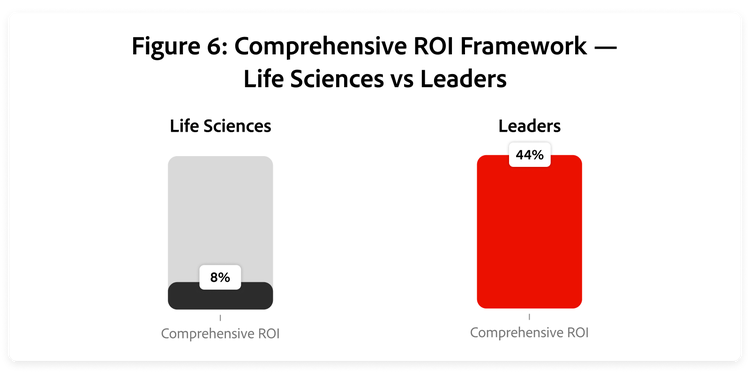
Leaders establish measurement before deployment decisions are finalised. 44% have a comprehensive return on investment framework, compared with 8% of life sciences respondents. Measurement is established across the Leader cohort, while a share of life sciences respondents reports no measurement. This gives Leaders earlier evidence for funding, prioritisation, expansion or redesign decisions.
Before an initiative launches, teams define the intended outcome, record a baseline and agree on how performance will be evaluated. Measures should fit the use case and may address engagement, content effectiveness, process quality, productivity, cost, workforce experience or another result. Business, data, technology and specialist teams should agree what evidence will support decisions to continue, change or expand.
Timing matters because the baseline can disappear once a workflow changes. New content, engagement patterns, operational steps or decision processes can alter the conditions teams intended to compare. Recording the starting point and evaluation method before launch helps executives interpret results responsibly without presenting activity measures as business, scientific, medical or patient outcomes.
81% of Leaders operate at the collaborative or integrated level, compared with 19% of life sciences respondents.
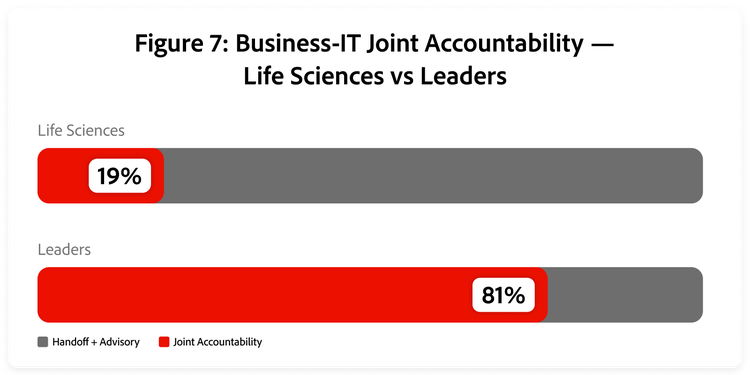
AI-supported work in life sciences can depend on content, data, workflow and technology systems managed by different teams. A sequential relationship creates friction whenever requirements, evidence, access or measurement must move between functions. Siloed and transactional models separate the work, while consultative relationships involve advice without shared accountability for the outcomes.
Among 342 global cross-industry Leaders, 81% operate at the collaborative or integrated level, compared with 19% of life sciences respondents. Leaders involve business, technology, data and relevant partners when the initiative is defined. They develop scope together rather than transferring a completed request.
Shared accountability continues through delivery, review and measurement. When teams carry the same objectives and key results, build decisions, governance requirements and evaluation all move in one direction. For life sciences organisations, genuine partnership means bringing specialist functions into the work at the point their authority and expertise are needed, while keeping responsibility for intended outcomes visible across the team.
34% of life sciences respondents report destructive failure patterns involving blame or repetition. Among Leaders, the figure is under 1%.
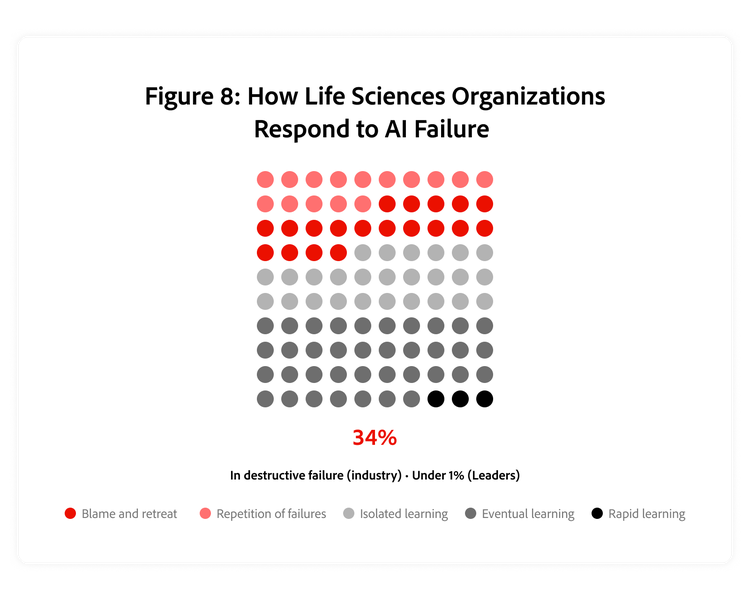
AI initiatives do not always perform as expected. In life sciences, teams may be working within fixed planning, review or delivery cycles, making it tempting to move forward without examining what underperformed. When responsibility is assigned defensively or the same mistake is repeated, the organisation loses evidence that could improve the next deployment or workflow decision.
34% of life sciences respondents report destructive failure patterns involving blame or repetition. Among 342 global cross-industry Leaders, the figure is under 1%. The comparison shows that Leaders are more likely to treat underperformance as information to examine, share and apply rather than as an event to conceal or repeat in subsequent AI work.
A learning culture becomes visible in regular operating reviews. The AI owner creates time for teams to identify what happened, why it happened and what should change. Relevant medical, scientific, regulatory, privacy, security, quality or safety partners can help to distinguish a correctable delivery issue from a concern requiring controls or escalation. Lessons can then inform later work.
42% of Leaders identify finding and empowering internal champions as their most impactful culture action.
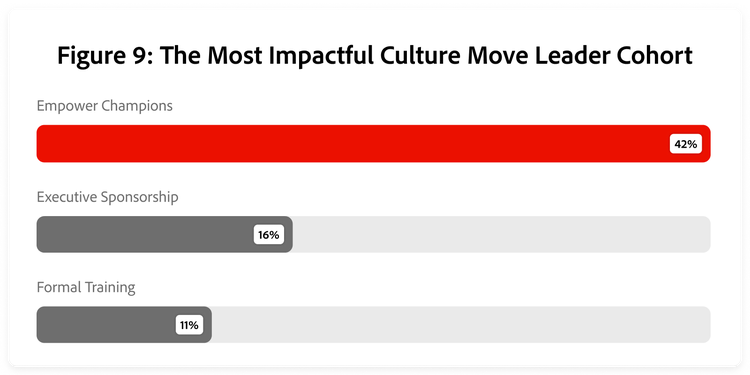
People are more likely to adopt AI when they see a colleague apply it effectively in familiar work. In life sciences, that practitioner could work in content, engagement, analytics, operations, technology, medical, scientific or another function. Credibility comes from showing a useful approach within a recognisable workflow and appropriate governance.
42% of Leaders identify finding and empowering internal champions as their most impactful culture action, ahead of executive sponsorship at 16% and formal training at 11%. Leaders give proven practitioners recognition, support and permission to help an adjacent team evaluate and adapt an approach. Influence grows through demonstrated results rather than through title.
Champions do not replace ownership, training or specialist review. They connect those structures to work by documenting what worked, explaining where it may apply and identifying where conditions differ. Leaders can support them with time, a budget, access to expertise and clear boundaries. For life sciences respondents, this helps adoption spread through evidence while maintaining the oversight each use case requires.
These actions translate the Leader behaviours into practical steps for life sciences executives. They build on existing business, medical, scientific, data, technology and governance capabilities rather than requiring a wholesale organisational redesign.
Life sciences respondents have moved AI beyond early exploration, but adoption alone does not create repeatable execution. The research points to a more practical requirement — an operating model that connects ownership, measurement, collaboration, learning and adoption across the teams responsible for value, delivery and oversight.
The global cross-industry Leaders offer a useful benchmark. They are more likely to appoint a formal owner, define success before deployment, share accountability across business and technology, learn from underperformance and empower proven practitioners. For life sciences executives, these behaviours matter when they are applied with scientific accuracy, privacy, security, accessibility, equity, responsible governance, safety and human oversight appropriate to each use case.
The next step is to choose one priority workflow and make its operating decisions explicit before further investment: name the accountable owner, identify the teams with specialist authority, establish the baseline and intended outcome and agree how delivery, review and learning will work. That creates a disciplined starting point for deciding whether the initiative should continue, change or expand.
Adobe empowers organisations to create impactful digital experiences. Our portfolio of customer-experience products and services helps businesses put every interaction in context, understand what each customer needs right now and design and deliver digital experiences that build loyalty and drive growth. Visit adobe.com to know more.
Incisiv is an industry insights and strategy firm combining close to a decade of industry trend data with primary research, messaging architecture and content development to help enterprises navigate transformation, evaluate solutions and unlock growth. Visit incisiv.com to know more.