Unified Modeling | Adobe Marketing Campaign Analytics
.

Adobe Marketing Campaign Analytics Features

Unified modeling

Connect all your marketing data and measure every channel’s incremental impact through a single, consistent view of performance, powered by patent-pending technology that unifies marketing mix modeling and multi-touch attribution in one model you control.

Data foundation and governance

Connect, harmonize, and govern your marketing data on the Adobe CX Analytics data foundation to give every model the full picture.

  • Data ingestion. Bring in paid, owned, and earned data from advertising, commerce, CRM, and database platforms through a library of integrations and APIs, ready for analysis as soon as it arrives.
  • Paid media integrations. Sync campaign and spend data automatically from supported paid media platforms with prebuilt connectors, keeping reporting current without repeated setup.
  • Business context and factors. Add external factors — like stock price movements or unemployment rates — and internal factors — such as price changes, promotions, or brand awareness surveys — to separate their effect from marketing's.
  • Data harmonization. Align data fields, channels, and touchpoints across sources, so results mean the same thing to each team that reads them.
  • Data governance. Use Adobe Experience Platform data governance to label sensitive data, set usage policies and role-based permissions, and get alerts when someone tries to break a policy.
In-product screen of marketing channel results.
Two charts using bidirectional transfer to populate data.

Unified measurement framework

Combine aggregate and event-level measurement in one causal AI model — from your full channel mix down to individual touchpoints.

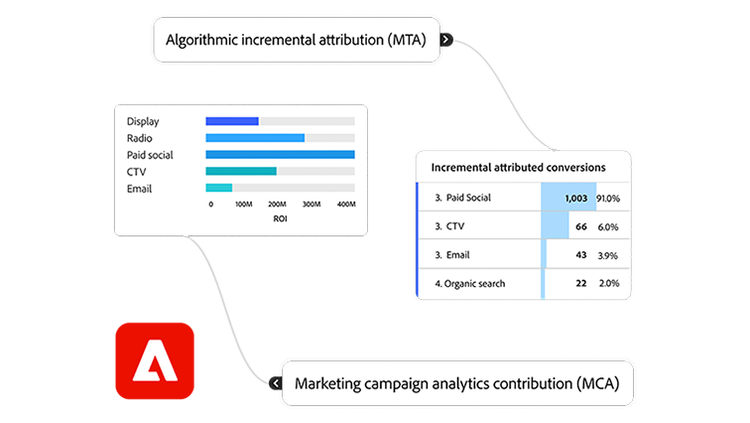
  • Marketing mix modeling. Understand how each channel drives results from aggregated data, including offline channels, with a privacy-first approach.
  • Multi-touch attribution. Move beyond last-touch attribution to see the incremental impact of each touchpoint across the customer journey with native access to event-level data across CX Analytics.
  • Multiplicative regression model. Capture how channels work off each other — from cross-channel synergies to diminishing returns — so channel ROI and budget forecasts reflect how your mix performs together.
  • Priors. Add knowledge from previous modeling or independent studies to help calibrate the model and keep results stable.
  • Full-funnel measurement. Model an upper-funnel goal like brand awareness alongside downstream conversions, so the tactics that build demand get credit for the sales that follow.

On-demand model configuration

Keep forecasts accurate as you scale by customizing models to your business goals and refining them over time.

  • Model management. Build, train, score, and publish models in one self-serve workflow — then manage them as business needs and market conditions evolve.
  • Model assumptions. Choose the touchpoints, date ranges, and factors each model includes, and adjust how the model handles carryover, saturation, and seasonality to reflect real-world conditions.
  • Model variations. Create separate model versions to reflect different outcomes, such as revenue, units sold, or leads, reusing the same data and setup.
  • Speed and agility. Rerun, retrain, or rescore any model whenever you need to, and add new regions and business lines without redoing the data work.
Model assessment results.

Model transparency

Check how well each model fits your data before anyone acts on its results — and have the numbers ready when leadership asks.

  • Actual vs. predicted. See actual, predicted, and residual results side-by-side to spot where the model fits and where it misses.
  • Fit metrics. See R², MAPE, and RMSE in one view — the standard measures data scientists use to judge model fit.
  • Training fit metrics. Review training fit metrics that show how well models learn from historical data, helping teams assess model stability and suitability before relying on results.

Learn how to use unified modeling features.

Find what you need in Experience League, our vast collection of how-to content — including documentation, tutorials, and user guides.

Learn more

Let’s talk about what Adobe Marketing Campaign Analytics can do for your business.

Get started

Marketer with channel contribution results and AI recommendation for future spend.


New message from advisor