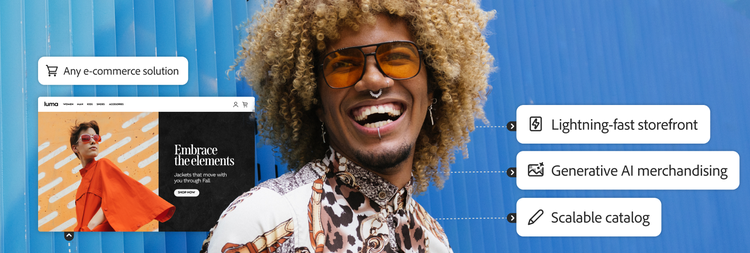
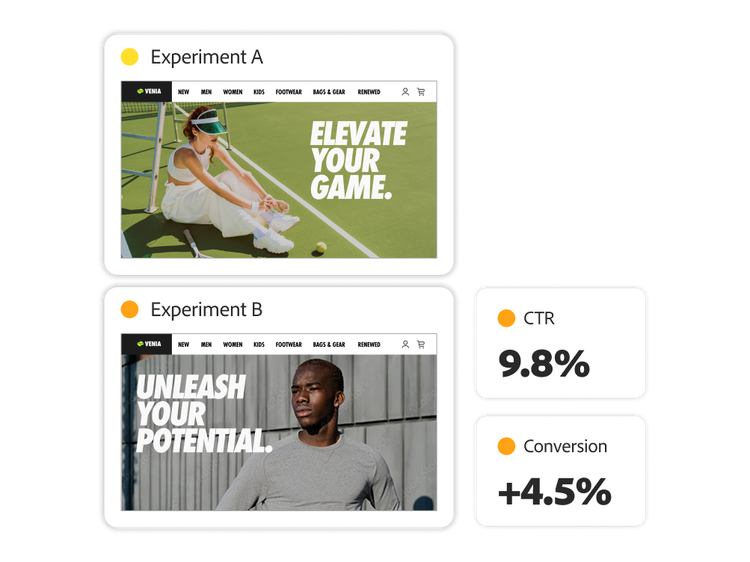
Adobe Commerce Optimizer enables organizations to improve ecommerce site traffic and conversion rates with a high-performance storefront, catalog, and merchandising capabilities that work with any ecommerce platform. Optimize shopping experiences with GenAI-powered content creation, A/B testing, flexible catalog management, and AI-powered merchandising without the disruption of migrating from existing, deeply embedded commerce solutions.
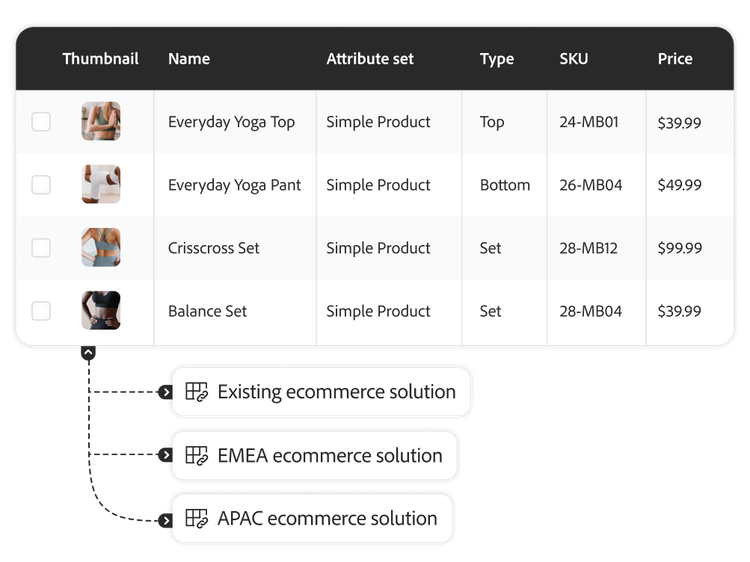
Yes, Commerce Optimizer can ingest multiple sources of catalog data from ecommerce solutions, Enterprise Resource Planning (ERP) systems, Product Information Management (PIM) systems, and other sources to deliver a unified storefront experience and branding across multiple back-end solutions. Once customers select products and are ready to check out, Adobe Commerce Optimizer hands off the order to the existing ecommerce platforms for processing.
No, we understand that customers may have already deployed a headless commerce experience and provide options for integrating Commerce Optimizer into your existing headless architecture. Commerce Optimizer is an API driven solution, meaning that integrations can be performed via API’s or with our Commerce accelerator capabilities called Drop-ins.
Learn more about Drop-ins here.
Adobe Commerce Optimizer offers site browsing, content authoring, and delivery capabilities in Storefront Builder, and does not require Adobe Experience Manager Sites. Existing Experience Manager Sites customers may use that product to author content for their Storefront.
Organizations use Commerce Optimizer to modernize and unify storefronts across legacy ecommerce systems and to create non-transactional catalog sites. They also use the solution to gain a robust catalog that supports new business models, multi-brand, and multi-geography deployments, and to streamline the integration of catalog data into Adobe Experience Manager Sites for use in commerce experiences.
Yes, Adobe Commerce Optimizer is designed to support massive catalogs with over 250M SKUs and 30,000 price points per SKU. Enterprise-wide promotions can be launched across millions of SKUs in hours and flexible data modeling enables businesses to manage multiple business lines, regions, or price books from a central catalog.