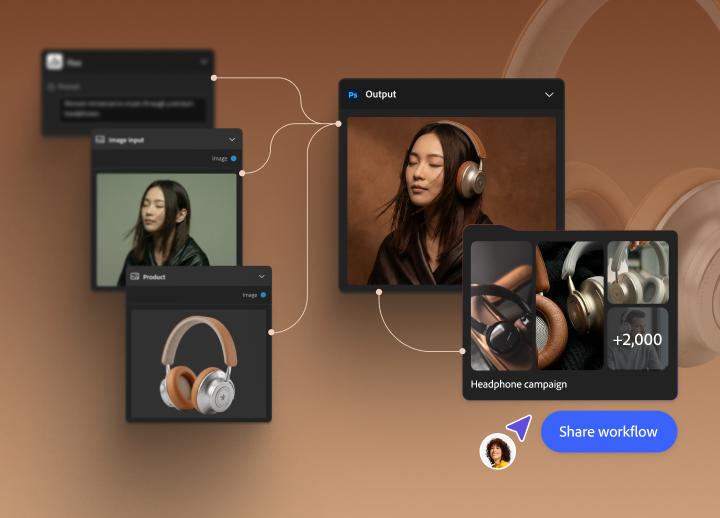



Build and scale reusable creative workflows.

Visualize the idea first.

Every hero visual starts with a direction, not a deliverable.

Adobe Firefly Boards gives teams an infinite, AI-powered canvas to generate, collect, and organize concepts, references, and styles side by side, something tangible for stakeholders to react to.

Aligning on one clear vision before production cuts rework, accelerates approvals, and helps teams move into production with confidence.
Build the hero visual once.

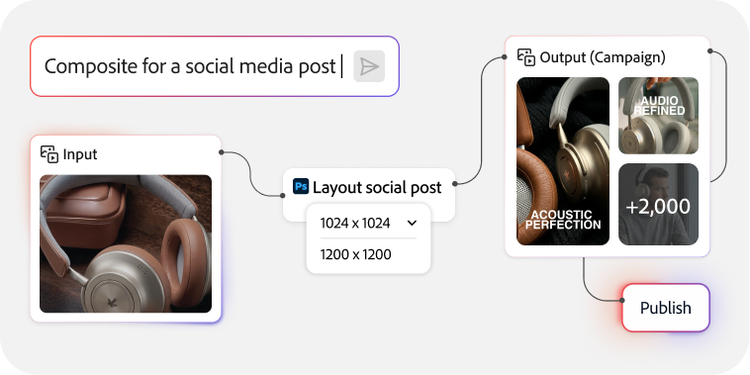
A hero visual is more than a single action and involves generation, compositing, and refinement in sequence.

Adobe Firefly Graph for Enterprise unites the entire process on a single canvas, connecting each step into a repeatable workflow. Combine AI generation with professional editing into a process designed to deliver more consistent results, enabling creative professionals to build it once, reuse it every time, and skip rebuilding for each project.

The result? Teams spend less time recreating workflows and more time creating new work.

Scale expertise across teams.

Expertise makes the most impact when it scales.

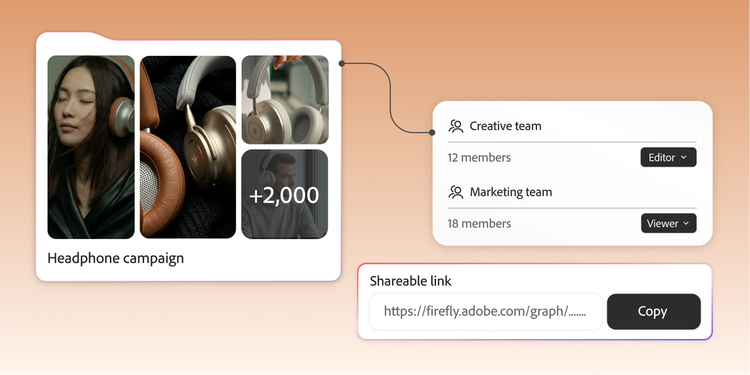
Save a finished graph as a standardized system anyone can use, so every project starts with a proven foundation, not a blank canvas. Junior designers, regional teams, and partners follow the same workflow to help keep output on-brand without rebuilding workflows from scratch.

The payoff: faster production, consistent execution, and high-quality workflows across every team.

Questions? We have answers.

What is a reusable creative workflow and how does it work in Adobe Creative Cloud for enterprise?

A reusable creative workflow is a repeatable way of producing content using shared assets, approved templates, and structured collaboration so teams do not have to rebuild the same process each time. In Creative Cloud for enterprise, these reusable workflows are supported through shared libraries, projects, brands, and workflow templates that help teams organize assets, stay on-brand, and reuse proven creative methods across campaigns and deliverables.

What business problems do reusable workflows solve for enterprise teams?

For enterprise teams, reusable workflows help solve recurring business problems such as duplicated effort, inconsistent output, slow handoffs, avoidable rework, and overreliance on individual experts. From a creative operations perspective, they help organizations standardize how assets are created and reused, so teams can move faster, maintain consistency, and reduce the operational drag that comes from fragmented creative processes.

Why do design operations leaders care about repeatability in creative workflows?

Design operations leaders care about repeatability because it makes creative output more predictable across teams, timelines, and markets. When workflows are repeatable, teams can rely on shared assets, approved structures, and consistent handoff patterns instead of recreating work from scratch, which is why repeatability is a core concern for both design operations and broader creative operations teams trying to scale quality efficiently.

How do workflow templates help enterprise creative teams scale?

Workflow templates help enterprise creative teams scale by providing a common starting point for recurring work, enabling them to produce on-brand outputs without rebuilding layouts, structures, or asset sets every time. In practice, this helps creative operations teams move faster on repeat deliverables, such as campaign assets, localized content, and even hero image adaptation workflows, while improving consistency and reducing production friction.

Can junior designers and regional teams run complex creative workflows without specialist expertise?

In Creative Cloud for enterprise, shared libraries, templates, and locked layers help junior designers and regional teams work within guardrails, making reusable workflows more accessible without expecting every contributor to recreate expert-level decisions from scratch.

How do reusable workflows support both speed and creative quality?

Reusable workflows support speed by removing repetitive setup and helping teams start from proven assets, templates, and structures instead of starting over each time. They support quality by preserving approved brand elements, reducing inconsistency, and making it easier for teams to produce polished work designed to deliver more consistent results. Whether that means scaling campaign variations or adapting a flagship hero image across channels, those standards stay consistent.