Developers may need implementation guidance, governance resources, integration documentation, and configuration best practices.



Customer enablement is the process of equipping customers with the knowledge, guidance, and resources they need to achieve value after purchase.
Unlike customer support, which helps resolve issues, or customer success, which focuses on business outcomes, customer enablement provides the foundation needed to reach those results. It helps customers understand how products fit into their workflows, build proficiency over time, and adopt the capabilities that matter most to achieve their goals. As products become more sophisticated and competition increases, effective customer enablement, increasingly powered by AI, helps organizations move beyond initial product access and turn technology investments into sustained business value.
Enterprise software can offer extensive features and capabilities. But the real challenge lies in helping customers translate those capabilities into measurable value. After software is purchased, customers still need to learn new workflows, build product expertise, and understand which features are most relevant to their goals.
For organizations managing increasingly complex platforms, customer enablement plays a critical role in turning product access into meaningful adoption. It gives customers the right guidance, knowledge, and support to move beyond initial usage and apply products in ways that drive concrete business outcomes.
As products, user roles, and customer expectations continue to evolve, traditional enablement approaches must change. Onboarding sessions, documentation libraries, training portals, and periodic customer check-ins remain important, but they do not always provide the level of personalization, responsiveness, or scale that modern enterprises require. As a result, businesses are turning to AI.
Enterprises aligned with this shift are investing heavily in AI-powered enablement. According to Adobe’s 2026 AI and Digital Trends in Customer Engagement Report, which surveyed 3,000 global executives and practitioners:

of organizations expect agentic AI to directly handle at least half of all post-purchase support interactions.
However, ambition alone is not enough. To scale AI-powered customer enablement successfully, businesses must also address foundational challenges related to data readiness, governance, operational processes, and infrastructure.
Let’s explore how AI supports enablement across the post-sale journey. We'll also examine what organizations need to translate their AI ambition into a practical strategy that helps customers achieve value with greater confidence.
In B2B SaaS environments, product adoption is a complex process. Enterprise software often includes a wide range of features, workflows, and integrations designed to meet the needs of different users. Administrators, practitioners, managers, and executive stakeholders may all interact with the same platform in different ways, each with their own goals, responsibilities, and measures of success.
Adoption can also extend across departments, teams, and business units. Organizations must support a range of people as they learn new capabilities, incorporate products into everyday workflows, and apply those capabilities to real business needs.
This is where customer enablement becomes essential.
Effective enablement helps customers build confidence, develop proficiency, and gain a deeper understanding of how a specific product supports their objectives. Rather than treating adoption as a one-time milestone, enablement supports an ongoing process from initial product access to sustained and valuable usage.
Product adoption usually progresses through three stages:
1. Product access: The customer gains access to the platform and begins familiarizing themselves with its core capabilities, interfaces, and workflows. At this stage, customer enablement helps reduce friction through onboarding resources, implementation guidance, and role-specific support that helps users get started with confidence.
2. Active usage: The customer regularly engages with relevant features and incorporates the product into day-to-day activities and business processes. Customer enablement reinforces adoption by helping users build proficiency, discover relevant capabilities, and understand how different workflows support their goals.
3. Value realization: The customer consistently applies the product in ways that support strategic goals, improve operational performance, and solve real business challenges. Here, customer enablement helps customers go beyond routine usage by connecting product capabilities to outcomes and long-term success.
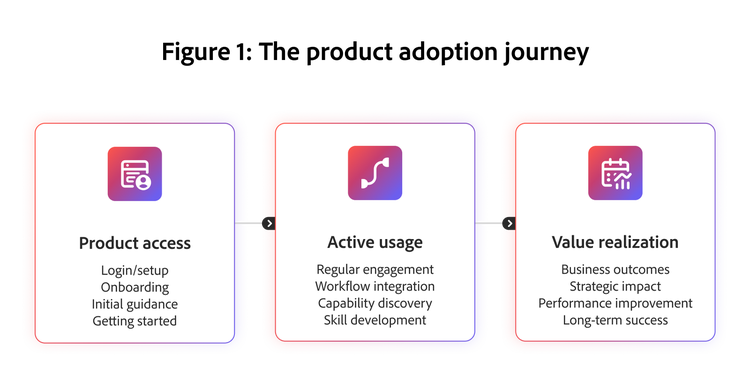
A customer logging into a platform regularly is very different from a customer using the right capabilities, completing high-value actions, and achieving meaningful results.
For example, a global marketing team may invest in a customer data platform and train employees to use it. Gaining access to the platform is just the first step. Regularly using its dashboards and workflows demonstrates usage. But true adoption happens when teams consistently apply those capabilities to improve audience targeting, campaign performance, or customer engagement.
Many organizations invest considerable effort in helping customers reach the access and usage stages. But a strong customer enablement strategy can help them gain full value.
Find out how Adobe Learning Manager turns customer education into a scalable driver of adoption, retention, and growth.
Helping customers achieve value is not a linear process. Different stakeholders often require different levels of guidance, and adoption needs can change as business priorities evolve.
This is where traditional enablement approaches can start to fall short. Documentation libraries, training resources, onboarding programs, and periodic outreach remain important. But they are often difficult to personalize across large customer bases or adapt to changing customer needs in real time.
AI helps enterprises address these challenges more effectively. Rather than delivering the same resources to every user, AI can identify patterns, adapt guidance based on context, and connect customers with the information, education, or support most relevant to their needs. This allows businesses to make customer enablement more personalized, responsive, and scalable across the post-sale journey.
From onboarding and in-product guidance to self-service knowledge and customer education, AI can help organizations deliver the right support at the right time while creating clearer paths to adoption and value realization.
The onboarding experience often shapes how customers perceive a product. Yet in enterprise environments, onboarding can be difficult to standardize. Different users enter the platform with different responsibilities, levels of expertise, and expectations, while implementation timelines and business priorities can vary significantly from one organization to another.
Traditional onboarding programs typically rely on predefined journeys that deliver the same resources, training materials, and guidance to broad groups of users. This approach may not always provide the level of relevance customers need to become adept and productive quickly.
AI helps make product onboarding more adaptive to each customer's needs. By analyzing factors such as user roles, product usage patterns, onboarding progress, and common points of friction, AI can help surface the most relevant resources, training modules, and next steps for different users.
To list a few role-based examples:
Developers may need implementation guidance, governance resources, integration documentation, and configuration best practices.

Marketing analysts may benefit from workflow-specific training, feature recommendations, and guidance tailored to their day-to-day responsibilities.

Executives may require onboarding experiences focused on reporting, outcomes, and measuring business success.
As onboarding progresses, AI can identify where customers are succeeding, where they may be struggling, and what actions are most likely to help them move forward. Rather than following a fixed onboarding path, organizations can adapt guidance based on actual product interactions and evolving customer needs.
In situations where onboarding challenges indicate a higher risk of stalled adoption, businesses may use these signals to proactively involve customer success teams and provide additional support before small issues become larger barriers to adoption. This allows customers to focus on building the knowledge and skills needed to effectively use a product.
Traditional customer enablement often exists outside the product itself. Customers may need to search documentation, browse B2B customer support portals, attend training sessions, join webinars, or connect with customer success enablement teams to find the information they need. While these resources remain important, they often require customers to step away from their work to get the answers or guidance they're looking for.
AI-powered enablement takes a different approach, embedding guidance directly into the product experience. This makes support more immediate, relevant, and easier to act on.
Here are some ways enterprises can use AI to support enablement:

In-platform guidance through key workflows.

Adaptive tooltips that surface relevant information based on user behavior.

Contextual answers to questions without requiring customers to leave the application.

Product walkthroughs tailored to a user's role, goals, or level of experience.

In-app recommendations that highlight relevant features, resources, or next steps.

Behavior-triggered nudges that encourage customers to complete important actions or revisit underused capabilities.
For example, instead of showing every new user the same walkthrough, AI may detect that a user is repeatedly accessing a reporting dashboard but not exporting insights or acting on the data. Rather than offering generic guidance, the platform can surface a short tooltip, recommend a relevant tutorial, or guide the user through the next steps needed to complete that specific task.
The result is an enablement experience that evolves alongside customer behavior. Customers receive guidance when it is most relevant, organizations gain better visibility into adoption barriers, and users can move through workflows with more ease and fewer interruptions.
Delivering relevant training at scale becomes increasingly difficult as products become more sophisticated and customer expectations change.
Different users have different levels of knowledge, and their learning needs often evolve as they prioritize new capabilities or take on new responsibilities. AI helps organizations make customer education more targeted and adaptive by aligning learning experiences with individual needs and product behaviors.
AI can support customer success and education through:

Personalized learning paths aligned to customer roles and objectives.

Course recommendations based on product usage, adoption patterns, and learning history.

Knowledge gap identification that highlights areas where additional training may be beneficial.

Connections between training and adoption data to understand which learning activities support successful product usage.

Continuous content optimization that helps keep learning materials in line with evolving products and features.
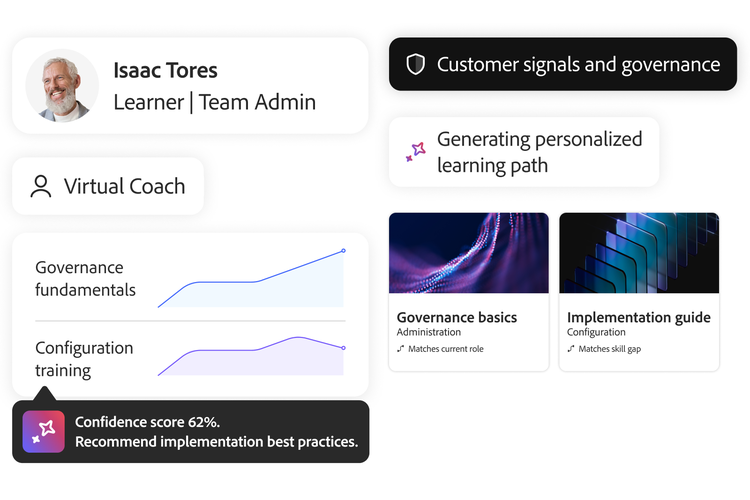
Nowadays, customers expect fast access to answers without having to wait for support or specialist assistance. AI-powered knowledge assistants can help meet this expectation, but in technical B2B SaaS environments, accuracy is as important as speed.
A hallucinated setup step, incorrect API instruction, or inaccurate integration recommendation can create operational risk, delay implementation, and undermine trust. For customer enablement, AI should not improvise where it isn’t required to. Instead, it should help customers retrieve, understand, and apply information that has already been validated.
Effective AI-powered knowledge systems typically rely on:

Verified product documentation as the primary source of truth that is updated quarterly.

Summarization of approved knowledge rather than open-ended content generation.

Source links and citations that help customers verify information independently.

Release notes, technical documentation, and approved guides to maintain consistency and accuracy.

Escalation paths to human experts when questions fall outside validated knowledge sources.
For example, instead of allowing an AI assistant to generate a configuration workflow from scratch, the system can retrieve information from approved documentation, release notes, and verified setup guides. If the required information is unavailable or incomplete, the customer can be directed to a support specialist, implementation consultant, or subject matter expert for additional assistance.
This approach allows organizations to scale self-service support while maintaining the accuracy, governance, and trust required for enterprise software adoption.
Beyond onboarding, education, and product adoption, customer enablement can provide valuable signals showing whether customers are progressing toward successful outcomes or encountering barriers that may affect long-term engagement.
When customers stop learning, stall skill-building, or struggle to complete important tasks, it often points to deeper adoption challenges. AI can help enterprises interpret these signals at scale.
For example, instead of waiting for a renewal risk to emerge, AI models can estimate the likelihood of drops in usage, predict churn, analyze account health scores, identify hindered onboarding, or uncover repeated workflow errors and trigger targeted enablement activities. It empowers enterprises to change their approach and suggest additional training, guided workflows, relevant documentation, or proactive outreach.
The same behavioral signals that identify struggling customers can also reveal opportunities for growth. Customers who consistently learn new skills relevant to a product, complete trainings, and expand usage across teams often demonstrate readiness for deeper engagement with a product.
Organizations can use predictive AI to identify:

Users who have mastered their current feature set.

Accounts approaching usage limits.

Teams that regularly rely on advanced workflows.

Customers likely to benefit from premium modules or additional capabilities.

Segments ready for advanced training, certification programs, or next-tier functionality.
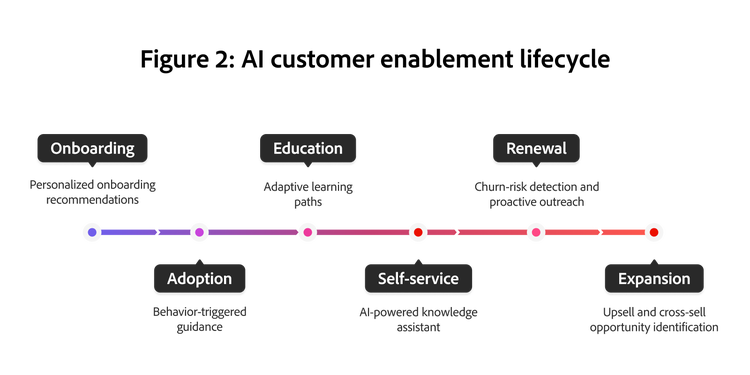
Some AI approaches help customers find and understand information, some identify adoption risks and opportunities, while others automate actions and deliver proactive support. Understanding these different roles can help enterprises apply AI more effectively across the customer journey.
Successful AI customer enablement requires more than adding chatbots, learning tools, or product guidance into existing workflows. The most effective strategies connect customer lifecycle stages, product behavior, trusted content, and business outcomes so AI can support adoption, retention, and growth in a coordinated way.
Here are four pillars of an effective AI-powered customer enablement strategy:

Map enablement to the customer lifecycle.
Enablement maps to key customer lifecycle stages, including onboarding, product adoption, customer education, self-service support, renewal, and expansion. This helps organizations identify where guidance is needed, how AI can help customers, and what success looks like at each stage.

Use product behavior to trigger enablement.
Product behavior should play a central role in enablement decisions. Signals such as changes in workflow usage, increased support outreach, learning engagement, and role-specific actions can help determine when customers need support and what type of guidance is most relevant.

Ground AI in trusted product content.
AI should be grounded in trusted product content. Retrieval-augmented generation (RAG), canonical documentation, approval workflows, and governance processes help ensure that recommendations remain accurate, explainable, and consistent with approved product information.

Measure enablement beyond completion rates.
Enablement effectiveness is measured using business outcomes rather than completion rates alone. Metrics such as time to value, feature adoption, customer health, learning engagement, churn risk, renewal readiness, and expansion propensity provide a more meaningful view of long-term success.
Customer enablement at enterprise scale often reaches well beyond direct product users. As organizations grow, enablement extends across teams, business units, implementation partners, consultants, and other stakeholders who influence product adoption and long-term success.
To scale effectively, enterprises need enablement programs that can deliver relevant guidance to different audiences while maintaining consistency across the customer lifecycle. AI helps by adapting content, recommendations, and learning experiences based on a user's role, responsibilities, goals, and level of engagement.
Beyond customer teams, other customer-facing stakeholders such as partners, implementation specialists, and consultants also require access to product information, training, certifications, and support resources that help them provide successful guidance.
For example, Adobe's unified Digital Experience Partner Program helps businesses centralize these enablement activities. Through the AI-enabled Partner Experience Hub (PxHub), partners can access onboarding resources, enablement content, product information, education programs, events, and benefits management within a unified environment.
PxHub helps surface the most relevant resources based on a partner's role, focus area, and stage of growth. Rather than requiring users to navigate extensive resource libraries, the platform can help connect the partner ecosystem with the content, learning opportunities, and tools most relevant to their objectives.
Customer enablement means more than just faster support or better onboarding. In B2B SaaS environments, it helps enterprises make complex products easier to adopt, safer to use, and more likely to deliver measurable customer value over time.
AI helps customer enablement feel more embedded and relevant. Instead of searching for answers, attending separate training sessions, or navigating extensive documentation, customers can get guidance while engaging directly with the product. From onboarding and in-product assistance to personalized education and behavioral nudges, customers receive support when and where they need it most.
Additionally, AI makes customer enablement more trustworthy. As businesses scale self-service experiences, accuracy becomes just as important as accessibility. Grounding AI in approved documentation, verified product knowledge, and governed guardrails helps ensure customers receive consistent guidance they can act on with confidence.
Finally, AI connects customer enablement more closely to business outcomes. It helps organizations identify customers who may need additional support, recognize those ready to expand their use of a product, and better understand the behaviors that contribute to long-term realized value.