

AI for data analysis and insights: Turning information into intelligence.
Explore how AI can support analytics workflows and requirements for generating trusted outputs.

JUMP TO SECTION
How predictive, generative, and agentic AI improve data analytics
How to strengthen the path from data to insight with AI
How enterprises apply AI-driven insights
How explainable AI builds confidence in enterprise decision-making
How human-in-the-loop governance supports AI analytics
What is AI for data analysis and insights?
AI for data analysis and insights is the use of AI systems to process, analyze, and explain data so teams can identify patterns, understand performance, and make better decisions. It can support tasks such as data preparation, anomaly detection, forecasting, natural language querying, visualization, and insight generation. By reducing manual effort and accelerating access to analysis, AI helps with broader use of insights across the enterprise.
Different AI approaches contribute to this process in different ways. Generative AI helps teams explore data, explain results, and communicate findings. Predictive AI helps estimate likely outcomes and evaluate future scenarios. Agentic AI helps monitor information, investigate changes, and surface signals that may require attention. Together, they help enterprises translate information into understanding, foresight, and action.
Data may be more accessible than ever, but access alone is not enough for uncovering the complete picture. Organizations can track thousands of metrics across customers, campaigns, products, and operations, and still struggle to connect those signals to clear business decisions.
Slow reporting cycles, limited analyst capacity, fragmented data sources, and difficulty turning dashboards into clear next steps continue to create friction between analysis and execution.
AI-powered data analytics is changing how enterprises approach this challenge. Instead of relying solely on dashboards and reports, you can now explore data through natural language, uncover patterns across complex datasets, anticipate likely outcomes, and generate explanations that make findings easier to understand and share.
This guide explores how organizations can use generative, predictive, and agentic AI to support the journey from data to insight, and how enterprise teams can build more transparent and decision-ready analytics capabilities.
How predictive, generative, and agentic AI improve data analytics.

AI makes insight generation more interactive, contextual, and accessible across the business. It can support multiple stages of the analytics workflow, helping teams improve data quality, identify meaningful patterns, anticipate future outcomes, and communicate findings more effectively.
Across different business functions and industry use cases, the objective remains the same — turning growing volumes of data into insights that help teams make the right decisions. But different AI approaches are used to solve specific problems, answer different questions, and support multiple stages of the analytics workflow.
A marketing leader looking to understand a performance trend, a data science team building forecasts, and a business analyst investigating an unexplained change may all be using AI, but not in the same way. It is important to match the right approach to the right analytical task.
At a high level, each helps with:
https://main--da-bacom--adobecom.aem.page/assets/icons/ai/data-and-insights/predictive-ai.svg

Predictive AI:
Estimating likely future outcomes, identifying risks or opportunities, and supporting scenario planning based on historical and current data.
https://main--da-bacom--adobecom.aem.page/assets/icons/ai/data-and-insights/generative-ai.svg

Generative AI:
Generating explanations, summaries, visualizations, and analytical outputs from data.
https://main--da-bacom--adobecom.aem.page/assets/icons/ai/data-and-insights/agetic-ai.svg

Agentic AI:
Monitoring information, investigating changes, and coordinating analytical workflows within defined guardrails and human oversight.
These AI technology pillars expand how organizations generate, consume, and act on information.
The table below compares how these approaches support enterprise analytics and where each delivers the greatest value.
How to strengthen the path from data to insight with AI.

Most organizations encounter predictive, generative, and agentic AI capabilities through day-to-day analytics activities. Understanding how they support the path from data to insight helps clarify where different approaches create the greatest business value.
Rather than functioning as a single capability, AI supports multiple stages of the analytics workflow. These capabilities form a connected process that spans data preparation, exploration, pattern identification, insight communication, and forecasting.
Establish standards with data preparation and quality checks.
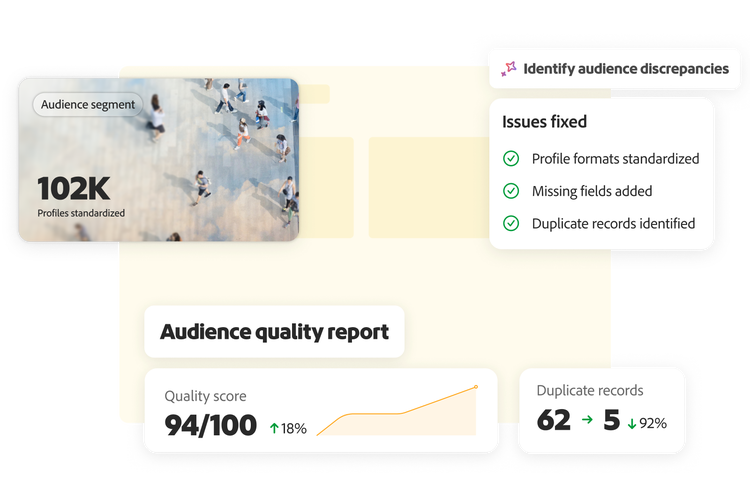
Viable outcomes depend on reliable data. Incomplete and inaccurate records, duplicate entries, and integration issues can distort analysis long before a report reaches a business user. AI can help organizations identify and resolve common data quality issues across large datasets. For example, AI models can detect anomalies in source data, flag missing or incorrect values, and identify duplicate records.
AI can also support broader AI data management and AI data integration efforts by helping teams discover relationships between datasets, classify information, and improve data accessibility across analytics workflows. This gives organizations the ability to create AI-ready data environments from fragmented data sources and govern data more responsibly.
Simplify interactions through natural language querying.
Traditional analytics often requires you to navigate dashboards, build detailed reports, or write database queries to find answers. Natural language querying lowers that barrier by allowing users to interact with data using conversational prompts.
Instead of searching across multiple reports and complex interfaces, you can ask questions such as “What customer engagement metrics changed after we launched a new onboarding experience?” or “Which marketing channels do the highest-value customers come from?”
AI can translate these natural language requests into analytical queries and surface relevant findings in a format that is easy to understand. This allows marketing, customer experience, and creative teams to self-serve analytics without relying solely on SQL queries and predefined dashboards. It also reduces the time the entire process takes, so you can respond more quickly to changing customer needs and market demands.
Surface patterns, anomalies, risks, and emerging signals.
AI can scan large datasets to detect unusual spikes, drops, correlations, or outliers that take time to identify through manual review. It becomes particularly useful for monitoring performance across channels, campaigns, customer journeys, products, or operational processes.
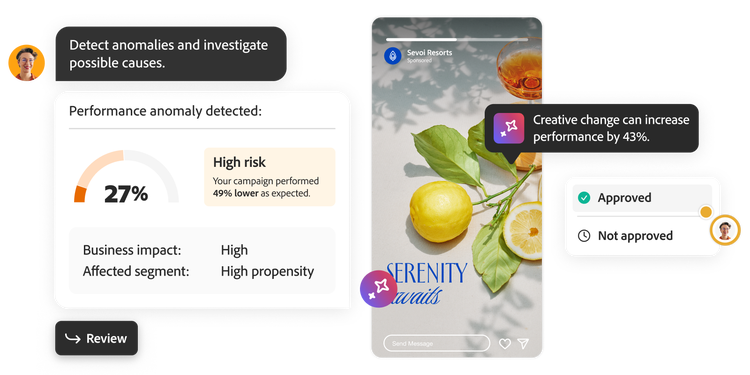
AI-powered anomaly detection helps teams prioritize which signals deserve closer attention and which findings should be validated before action is taken. For example, a marketing team may notice an unexpected decline in conversions shortly after launching a campaign. Agentic AI can flag the change, identify affected audience segments, and compare performance against historical benchmarks.
Explain findings and communicate insights with AI.
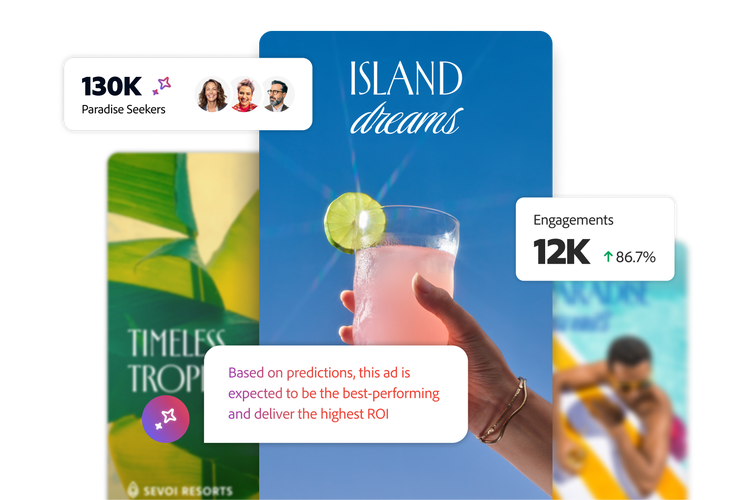
Generative AI enables you to transform analytical outputs into visual and narrative formats tailored to different audiences. This includes recommending appropriate charts for a dataset, generating dashboard summaries, creating captions for data visualizations, translating technical findings into plain-language explanations, and enabling conversational interactions that help users explore insights and generate reports as questions arise.
For example, an executive team may need a high-level summary of key business trends, a customer support team may need to extract conversational insights, while an analytics team may require a more detailed breakdown of contributing factors. Using generative AI for data visualization can help tailor outputs for each while preserving visibility into the underlying data.
Combined with human analyst expertise, AI helps make insights easier to interpret, discuss, and act on, across the organization. By translating analytical outputs into business language, it helps close the gap between technical teams and decision-makers and enables them to create reports on demand.
Anticipate outcomes with predictive insights and forecasting.
While analytics helps organizations understand past performance, predictive AI focuses on what may happen next. Teams can use forecasts to evaluate how trends may evolve and what impact they could have on business outcomes.
This might involve estimating demand shifts, identifying customers who may churn, forecasting product campaign performance, or evaluating different planning scenarios. These forecasts provide an additional layer of context that teams can use to evaluate options, test assumptions, and prioritize resources.
The role of predictive AI is not to eliminate uncertainty or make decisions on behalf of the business. It helps teams assess likely outcomes and potential risks so they can plan with greater confidence and respond more proactively to changing conditions.
How enterprises apply AI-driven insights.

The value of AI in analytics becomes most apparent when organizations use data to guide decision-making.
Unlike traditional analytics workflows, which often depend on manual exploration and retrospective analysis, AI can surface signals, identify patterns, and provide context as questions emerge. This allows organizations to spend less time searching for information and more time evaluating opportunities, risks, and next steps.
While applications vary by industry and business need, here are some use case examples highlighting how AI-driven insights can be used across marketing, customer experience, content, and commerce.
https://main--da-bacom--adobecom.aem.page/assets/icons/ai/data-and-insights/enterprise-ai-icon-1.svg

Evaluating marketing performance.
Marketing teams are under constant pressure to explain performance, justify investments, and identify new opportunities for growth. AI can help analyze campaign, channel, audience, and conversion data to uncover the factors influencing outcomes earlier. Instead of manually reviewing reports to pinpoint the cause of a performance shift, teams can focus on understanding the drivers behind the change and identifying where improvements will have the greatest impact.
https://main--da-bacom--adobecom.aem.page/assets/icons/ai/data-and-insights/enterprise-ai-icon-2.svg

Understanding customer behavior.
Customer journeys generate a stream of data across channels, touchpoints, and interactions. AI helps connect those signals to reveal how customer behavior changes over time. Teams can identify friction points in the journey as it unfolds, detect early signs of churn, understand how different audience groups engage with experiences, and uncover patterns that may otherwise remain hidden within large datasets.
https://main--da-bacom--adobecom.aem.page/assets/icons/ai/data-and-insights/enterprise-ai-icon-3.svg

Measuring content performance.
Understanding which content leads to revenue is increasingly challenging as volumes and distribution channels continue to grow. AI can help evaluate engagement trends, conversion influence, and attribution patterns across assets while campaigns are live, giving teams earlier visibility into what is resonating with audiences. It can also analyze creative assets, such as on-site images, videos, and paid media. By automatically identifying attributes such as color, visual style, subject matter, composition, or the presence of people and products, AI can highlight which elements influence engagement and conversion across the customer journey.
https://main--da-bacom--adobecom.aem.page/assets/icons/ai/data-and-insights/enterprise-ai-icon-4.svg

Responding to demand shift in retail.
Retail and commerce organizations must continuously balance customer demand, inventory availability, pricing strategies, and changing market conditions. AI can help identify emerging demand patterns, monitor purchasing behavior, forecast shifts in performance, and highlight trends that may influence operational or merchandising decisions.
How explainable AI builds confidence in enterprise decision-making.

As AI becomes embedded in analytics workflows, transparency is essential to maintain confidence in the insights it generates.
A recommendation, forecast, or anomaly alert may influence budgets, customer strategies, operational priorities, or compliance decisions. Understanding the reasoning behind those outputs is important.
This is where explainable AI plays a critical role. It provides visibility into how an insight was generated by allowing users to trace the data, logic, and assumptions that informed it. That transparency helps teams validate findings, challenge conclusions when necessary, and make decisions with greater confidence.
The need for explainability becomes even more pronounced in regulated industries where decisions may need to be reviewed, justified, or audited. For example, a financial institution evaluating risk, a healthcare organization assessing patient outcomes, or an insurance provider reviewing underwriting decisions all require a clear understanding of how a recommendation was produced and which factors contributed to it.
Strong analytics systems support that understanding by making the underlying process visible. Users should be able to trace the source data, understand which metrics and dimensions informed the output, review filters and assumptions that were applied, and access the logic used to generate the result. Depending on the use case, supporting context may also include confidence intervals, statistical significance, generated SQL or Python queries, excluded data, and approval history.
Explainability requirements also vary across users. Different teams need to verify different parts of an AI-generated insight based on how they use the output and the risk attached to their decisions. Effective AI systems support each of these needs without requiring users to choose between usability and transparency.
How human-in-the-loop governance supports AI analytics.

Explainability helps organizations understand how AI-generated insights are created. Governance helps ensure those insights are used responsibly.
The governance requirements for AI-based analytics are closely tied to its role and usage. A system that responds to prompts presents a different set of risks than one that can monitor data continuously, initiate investigations, and surface findings without being explicitly asked.
Here’s how human-in-the-loop governance differs between AI assistants and agentic AI.
AI assistants: Human-guided analytics.
AI assistants are designed to help people interact with data more effectively. They can answer questions, summarize dashboards, explain performance shifts, recommend visualizations, and translate analytical findings into business language when prompted.
Because AI assistants operate in response to user requests and do not independently initiate actions, governance priorities focus on access controls, validation, and transparency. Teams need visibility into the data sources being used, confidence that users only access information they are authorized to see, and a clear record of how outputs were generated.
Key governance considerations include:
- Source citations and references
- Visibility into underlying queries and logic
- Role-based access controls
- Output review and validation processes
- Audit trails for generated responses
Agentic AI: AI investigates, humans govern.
Agentic AI introduces a different operating model. Rather than waiting for a question, these systems can monitor datasets, identify unusual activity, investigate potential causes, and surface findings based on predefined goals, thresholds, or business rules.
This makes them particularly valuable for activities such as anomaly detection, performance monitoring, and follow-up analysis. Instead of helping users answer questions, agentic systems help determine which questions deserve attention in the first place.
That additional autonomy requires stronger governance controls. Organizations need clear boundaries around what an agent can analyze, which actions it can trigger, when human approval is required, and how decisions are documented.
Key governance considerations include:
- Defined permissions and operational boundaries
- Human approval checkpoints for agentic actions
- Escalation paths and accountability frameworks
- Confidence thresholds for recommendations
- Continuous monitoring and audit logging
- Rollback and remediation procedures
How to build trusted AI data foundations.

Many of the challenges organizations encounter with AI do not originate with AI itself. They stem from fragmented datasets, inconsistent business definitions, limited visibility into data lineage, and governance practices that were not designed for AI-driven analytics.
As organizations expand the role of AI, these foundations become more important.
1. Data quality and trusted data sources.
Every insight reflects the quality of the data behind it. Missing records, duplicate entries, inconsistent classifications, and outdated information introduce errors long before users see the output.
AI can help detect and resolve these issues — but the foundation still depends on consistent, well-integrated source data across platforms and repositories.
2. Shared business definitions.
Metrics such as revenue, churn, engagement, attribution, and customer lifetime value are often calculated differently across teams. When AI systems operate across multiple datasets and departments, those inconsistencies can lead to confusion.
Shared business definitions and semantic layers help establish a common language for analytics. This ensures that insights remain consistent regardless of who is asking the question, which report is being referenced, or which system is generating the answer.
3. Data lineage and auditability.
Data lineage provides visibility into how information moves through systems, while auditability shows how analytical outputs were produced.
These practices support many of the transparency and explainability requirements — making it possible to trace an insight back to its source when accuracy, governance, or compliance questions arise.
4. Access controls and permissions.
Analytics environments combine customer, financial, operational, and employee data. Role-based permissions help ensure that access remains consistent across both traditional analytics and AI-powered experiences, so AI never surfaces information beyond a user's authorized access.
5. Human judgment and context.
Historical bias, changing market conditions, incomplete customer records, underrepresented audiences, and missing offline interactions can all influence analytical outputs. AI can identify patterns within available data, but it cannot account for information that was never captured or context that exists outside the dataset.
This is why human judgment remains essential. Analysts and business leaders bring operational knowledge, market awareness, and situational context that help determine whether an insight reflects a meaningful business signal or a limitation in the underlying data.
Getting started with AI for data analysis and insights.
Effectively using AI for data analysis and insight generation varies for organizations depending on their business goals. For some enterprises, that may involve making customer journey insights more accessible. Others may focus on improving forecasting, identifying performance discrepancies, or reducing the effort required to turn analysis into action.
As the role of AI in analytics expands, success depends less on the sophistication of the technology and more on the foundations supporting it. Trusted data, clear governance, explainability, and human oversight all play a role in determining whether AI-generated insights are useful, trustworthy, and actionable.
Businesses deriving the greatest value from AI are those that combine AI capabilities with strong data foundations and human expertise to generate insights people are willing to act on.
For organizations looking to move from data collection to trusted, decision-ready insights, solutions such as Adobe CX Analytics can help by bringing together data, AI, governance, and decision-making.
Recommended for you