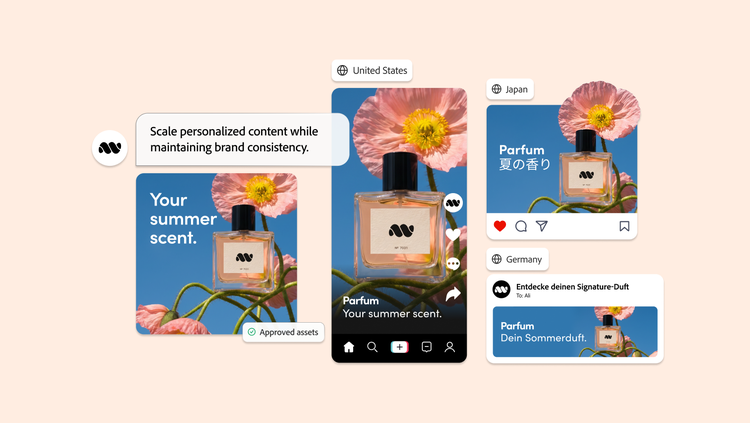
Build a Content Supply Chain for Personalized Experiences

Building a scalable content supply chain for personalized experiences.

Personalization requires brands to create content that resonates with different audiences across channels, markets, and stages of the customer journey. It helps them deliver relevant content to customers. However, it can also multiply the number of assets behind a single campaign.

An enterprise product launch may need different assets tailored to new audiences, localized for regional markets, and suited to each channel where those audiences spend time. When each of those assets arrives as a separate request, personalized content creation can become difficult to scale.

Traditional production models often make that problem harder. In a global survey of 3,000 executives and practitioners, 53% said their organization’s content supply chain remains largely linear and resource-intensive.

On the contrary, a content supply chain designed for personalization at scale helps teams start with what already exists. From there, they can adapt approved content into new variations and let performance data decide what gets created next. Over time, scaling content production becomes more manageable, and teams can support tailored experiences without increasing production effort.

In this blog, we’ll explore:

Why personalization creates a content supply challenge.

Personalization creates a content supply challenge because each new audience, channel, market, or moment can call for another version of the same message. As a brand adds audiences and markets, demand for content variations outpaces the time, budget, and people available to produce them.

Consumer expectations drive much of that demand. In a survey of more than 1,600 marketers, 61% stated that expectations for personalized experiences are the top factor driving the rise in content demand.

That pressure often shows up in production before affecting the results. One-off briefs, handoffs between disconnected tools, and assets rebuilt for each new placement can slow down adaptation and make approved work harder to reuse across channels.

Treating personalization as a supply problem can give teams a clearer way to address the challenge.

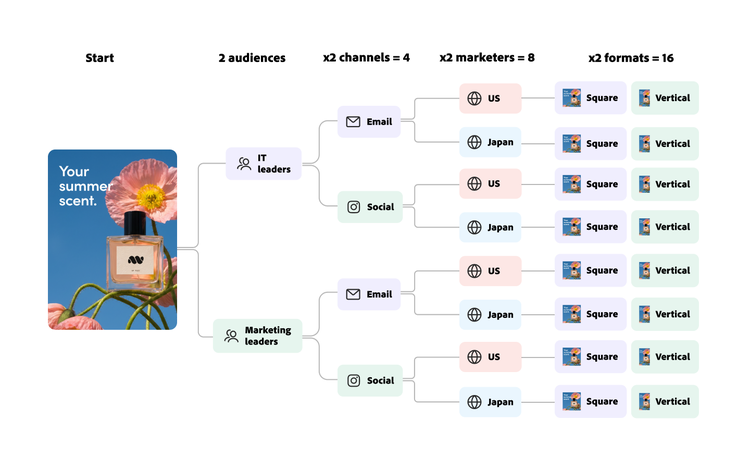
One approved ad branches into 16 versions across 2 audiences, 2 channels, 2 markets, and 2 formats.

Personalization increases demand for content variations

A content variation keeps an approved core, such as the message, offer, and brand standards, while changing its expression or details depending on the situation. That situation might be a placement, a region, a language, a product line, or a stage of the customer journey. A single marketing campaign can touch all of them at once.

The numbers compound quickly. Lumen’s campaigns, for example, span five personas, seven verticals, and three journey stages. Multiplied together, that’s up to 105 combinations before a single channel, format, or language is added. Each new placement or market multiplies the total again, so the number of creative variations can rise much faster than the number of campaigns. Lumen managed that range with Adobe GenStudio for Performance Marketing, which helped its team launch social campaigns three times faster, in nine days instead of 25.

More personalization doesn’t always mean more net-new content.

When each variation starts as a net-new request, the same work tends to repeat. A designer rebuilds a layout that already exists in another size, a copywriter rewrites a message already approved for another market, and each version waits in the same review queue. Cost and turnaround time then increase with each new target audience.

A different approach can break that pattern, as Red Hat found when it modernized its content supply chain. Its designers now build reusable templates in Adobe Creative Cloud, and marketers use those approved assets in Adobe Express to produce regional variations. As a result, social graphics that once took weeks to rebuild for each size can now be reused and adapted in minutes.

Results like that typically come from three alternatives to net-new production. Reuse applies an approved asset to a new situation. Adaptation changes an approved asset to fit a new demand. Assembly combines approved components into a new version.

Together, they help the number of variations grow without each one becoming its own project.

How a connected content supply chain supports personalization at scale.

An AI-powered content supply chain supports personalized experiences by connecting how content is planned, produced, managed, activated, governed, and measured. With those steps working together, teams can build many usable variations from a single approved source asset, so a new audience or channel doesn’t have to submit a new production request.

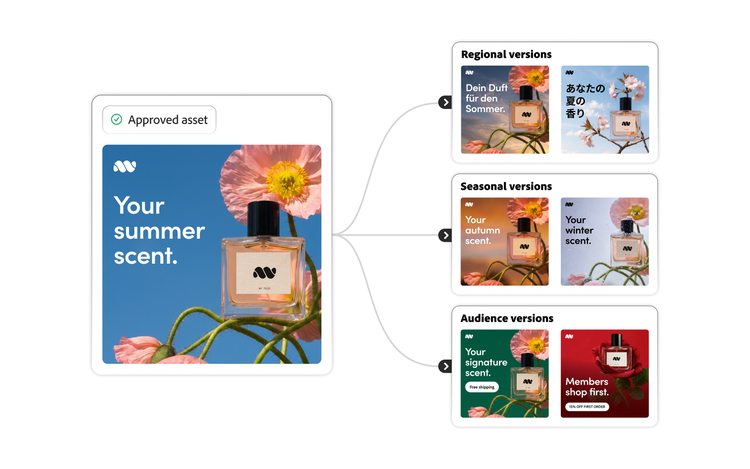
For example, once an approved product image clears brand and legal review, it can become the source for several localized versions. Teams can pair translated copy with imagery adapted to a regional market or swap the summer background for a fall or winter scene for a seasonal campaign. They can tailor the headline, color palette, or personalized offer for each audience segment.

One approved ad adapted into German and Japanese versions, fall and winter versions, and audience versions with different offers.

Reusable content foundations reduce duplicate production.

Duplicate production often starts with an asset that is difficult to retrieve. When approved images, copy blocks, and templates are spread across shared drives, inboxes, and agency folders, recreating a piece can feel faster than locating it.

“We often see that 50% to 70% of content produced is never used because teams can’t easily find it.”

Tammy Pienknagura, Head of Strategy and Innovation for Content Supply Chain

Adobe

A reusable foundation keeps approved source assets, reusable components, and existing content in one place teams can search. Metadata tags, such as product, audience, and usage rights, can make each asset easier to find for the next request. Region-specific tags can also surface assets already available in a local language.

Content Credentials in Adobe Experience Manager Assets add a deeper layer by showing where an asset came from, what changed, who made each edit, and which app or AI tool made the change. That history stays with the file when it’s downloaded, published, or shared, so it follows the asset through the content supply chain.

Modular components can then help teams assemble a new version from parts that have already cleared review. Centralized asset management and checking existing content before briefing new content helps teams reuse content with confidence.

Building on approved foundations can also speed up delivery and help maintain brand consistency as content enters new markets or reaches new audiences. With version control, reviewers can track edits, compare a new version with the approved version, and revert if needed, so each review focuses on what changed. Teams can turn existing assets into new content at scale from the approved library they already have.

Content adaptation uses different assets in different situations based on context.

Reuse covers the cases where an approved asset already fits. Adaptation covers the rest, when the audience, region, or channel changes what the content needs to say or how it needs to look. Customer needs, regional requirements, language, and the delivery environment can each call for a different version of the same approved core asset.

A few examples show what can change in an adaptation while the core message, offer, and brand standards stay intact:

  • Format: A campaign video cut to a 15-second vertical version for a mobile feed.
  • Language: A product page translated and adjusted for local terms, units, and regulations.
  • Imagery: A hero image with swapped visuals that reflect a regional market.
  • Message: A headline reframed for a different audience or stage of the customer journey.

Localization follows the same principle, since relevant regional content often needs adjusted imagery and proof points along with localized copy.

Deloitte Digital took this approach to localization across a global network of more than 140 regional firms that had been creating redundant content. Using Adobe Experience Manager Assets, Deloitte Digital centralized more than 23,000 assets across 33 languages so firms could gain visibility into available assets, a channel for sharing successful creative ideas, and the ability to reuse that content across regional websites.

Adaptation extends how far one approved asset can go. As the number of adaptations grows, manual production becomes a constraint, which is where automation comes in.

Automation increases production capacity.

Adaptation that repeats at volume is a natural fit for automation. Resizing one layout into a dozen placements, reformatting a video for each platform, localizing approved copy, and generating versions within set brand guidelines tend to follow rules a system can apply consistently. Generative AI can take on much of that work to free up designers and copywriters to focus on developing concepts, telling stories, and providing the creative judgment a brand depends on.

Automation can speed up work while keeping audience and personalization decisions with campaign stakeholders. Applying it first to repetitive design tasks can quickly free up production capacity.

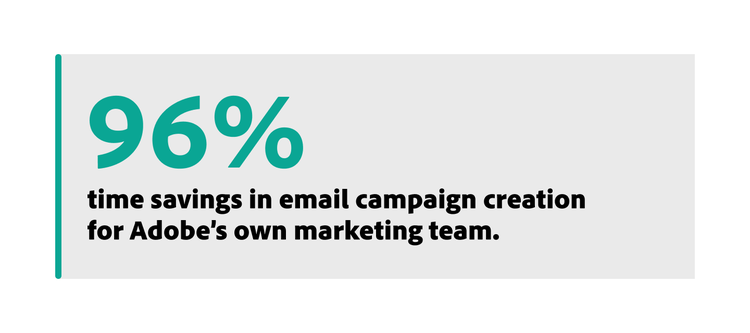
The time savings are measurable. In an Adobe survey of 348 US marketers, respondents reported using AI to save 114 minutes a week on content creation, or 98 hours a year. Adobe’s own marketing team applied the same approach with Adobe GenStudio for Performance Marketing, working within its own content supply chain. By generating on-brand email and ad variations, the team cut content creation time for its Adobe Creative Cloud onboarding emails from 27 days to one. This includes teams in Latin America, which have cut asset localization time by 75%.

96% time savings in email campaign creation for Adobe’s own marketing team.

How to scale personalized content production.

Reuse, adaptation, and automation each add complexity on their own. Scaling personalized content production requires creating a single enterprise model that dictates which variations will be made, when to plan for them, and how each is supplied.

Teams often already have content creation workflows in place. The three decisions below shape the variation requests, briefs, and assets that enter those workflows, which is where enterprise content production tends to gain or lose capacity.

Prioritize the variations that create meaningful relevance.

More variations don’t automatically make personalization better. Each added version brings production, review, and delivery effort, and its value depends on whether that variation meaningfully improves customer experience.

Audiences can tell when variations aren't personalized. In a global survey of 4,000 consumers, half said they disengage when personalized experiences feel off or irrelevant.

Personalized marketing content needs a clear purpose before it goes into production. Teams can test each variation against three checks:

  1. Which personalization objective does it serve? For example, a conversion goal for a segment or a regional launch.
  2. What is the context? A placement, market, or stage of the customer journey.
  3. How will the team know it worked? For example, a change in engagement or conversion.

Variations that pass these checks connect production to the personalization strategies already in place. They also help focus resources on versions with a defined objective and measurable outcome.

Connect content planning to production requirements.

Some personalization needs are clear as early as the planning stage. Others can surface mid-campaign, when a seasonal event, a market shift, or a new segment creates a reason to respond. Planning for both can help teams act on them without reopening finished work.

Identifying personalization requirements while the creative brief is still being written gives production a head start. When the brief lists target markets, seasons, and audience segments up front, designers can build the source asset with those needs in mind. They can also decide which elements will change across versions, such as the headline, imagery, or offer, and which remain the same.

That structure also supports in-moment marketing. In Adobe GenStudio for Performance Marketing, brand-approved templates built in Adobe Express define which elements can be edited, swapped, or locked. Creative teams set those guardrails once, and marketers can then generate on-brand variations from approved assets as opportunities arise. AI-powered checks review each asset against brand and channel guidelines before it goes live.

Across a full campaign, that can mean fewer reopened assets, faster responses to new moments, and a more predictable content production schedule.

Reuse and adapt before creating net-new content.

Teams can decide how to supply a content variation by working through four options. Reuse approved content when it already fits a target audience. Adapt it when changes are needed to achieve a campaign goal. Automate adaptations that repeat at volume. Create net-new content when existing material can’t meet the requirements.

Working through these options in order reserves net-new production for gaps that cannot be addressed with existing content, while expanding usable experiences from current assets.

Choosing how to supply a variation:

Option
Use it when
Example
Reuse
An approved asset already matches a campaign goal or the intended target audience
A product image already approved for the target channel
Adapt
A campaign goal or intended target audience requires changes to a previously approved asset
A campaign image, with its copy translated and its imagery adjusted for a new regional market
Automate
The same adaptation repeats across many variations
Standard sizes for a campaign, generated from one master asset
Create net-new
Existing material can’t meet the requirements
A product launch with no approved assets yet

How performance insights improve content variations.

Performance insights improve content variations by showing which versions contributed to results. Comparing how each variation performed across audiences, channels, and markets helps teams determine which variations are worth producing again and which add volume without adding value.

That comparison often stops at the campaign level. In a survey of 980 B2B marketers, 51% strongly or somewhat agreed that their organization measures content performance effectively. On owned channels, personalized content management can tie each delivered experience to its results, giving teams variation-level data to work from.

Looking at the attributes inside each variation adds another layer. When content performance data is tied to elements such as tone, color, layout, or subject, teams can identify the traits that perform well in a given context and carry them forward.

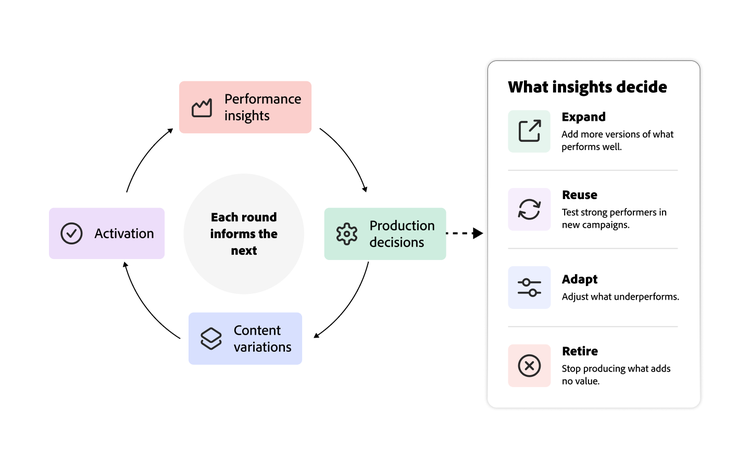
Performance insights shape production decisions, variations, and activation, so teams can expand, reuse, adapt, or retire content.

Build a content supply chain for personalization at scale.

Personalization at scale changes how content gets made in three ways.

Production starts from a reusable foundation of approved assets and components, with fewer variations built one at a time. Each variation earns its place through a clear purpose, which helps keep volume tied to relevance. Activation also feeds the next round of planning, so performance shapes what the team makes next.

Together, those shifts help teams supply more relevant content without multiplying production effort at the same rate.

Explore Adobe’s approach to the content supply chain and how it helps enterprises plan, produce, adapt, activate, and measure the content behind each personalized experience.

Let’s talk about what Adobe can do for your business.

Get started

New message from advisor