

One Adobe system. Unlimited worldwide potential.

Red Hat enables faster on-brand asset creation with a unified content supply chain.

75%

consolidation of repositories into one governed library, improving discoverability and brand consistency.

Faster campaign turnaround time, reduced from days to minutes.
AI-driven campaign scaling delivered double-digit engagement lifts: +12% opens, +15% CTR, +8% CTOR.

“Adobe gave us the framework to bring tools, teams, and processes into one system. Now we can see the full picture, from intake to delivery — that visibility has been game-changing for how our teams plan and deliver work.”

Mitch Brodsky

Product Manager of Content Lifecycle, Red Hat

When connection empowers creation.

Red Hat, an IBM company, sits at the center of some of the world’s most ambitious digital transformations. As the leading provider of enterprise open-source software, it empowers organizations to build, run, and secure the systems that keep their businesses moving. Supporting technology this critical raises the stakes for everyone, including the teams tasked with telling the Red Hat story to the world.

Serving customers worldwide, Red Hat marketing must deliver consistent messaging while adapting quickly to local audiences. But across 100+ markets, requests lived in inboxes and spreadsheets, designers were buried in repetitive updates, and marketers often waited days for support. The company risked losing momentum on its goals of driving $100 million in revenue growth and $25 million in operational efficiencies.

This challenge inspired marketing leaders Mitch Brodsky, product manager of content lifecycle, and Elizabeth Hodges, program manager for digital assets, to rethink how content moved through the organization.

Red Hat began transforming its fragmented workflows into a connected content supply chain — a single system designed to keep content flowing from intake to delivery while protecting brand integrity at every step. The system’s foundation is anchored with Adobe Workfront, Adobe Experience Manager Assets, and Adobe Express, integrated with Adobe Creative Cloud and enhanced by Adobe Firefly generative AI.

“We went from tracking projects in email and spreadsheets to managing everything in one Adobe system,” Hodges says. “Now our marketers can find, request, and reuse content faster — and that’s time we can put back into strategy and creativity.”

The creative challenge meets its match.

Before that system came together, teams across Red Hat were experimenting with different processes and tools to improve workflows — a sign of the company’s agility, but not a scalable system. At Adobe Summit, Brodsky saw how global brands were connecting similar efforts under a single vision: a content supply chain.

“Adobe Summit gave us the language to talk about connecting all these moving parts into one system,” Brodsky says. “It helped us build the foundation for what our content supply chain has become.”

Workfront became the operational backbone, linking campaign requests, reviews, and approvals into a single transparent workflow with clear checkpoints for brand and stakeholder sign-off. Brodsky then led the consolidation of four separate repositories into the Red Hat Content Center — a governed digital hub built on Experience Manager Assets.

“We went from searching through folders to simply knowing where everything lives,” Brodsky says. “It’s completely changed how we work.”

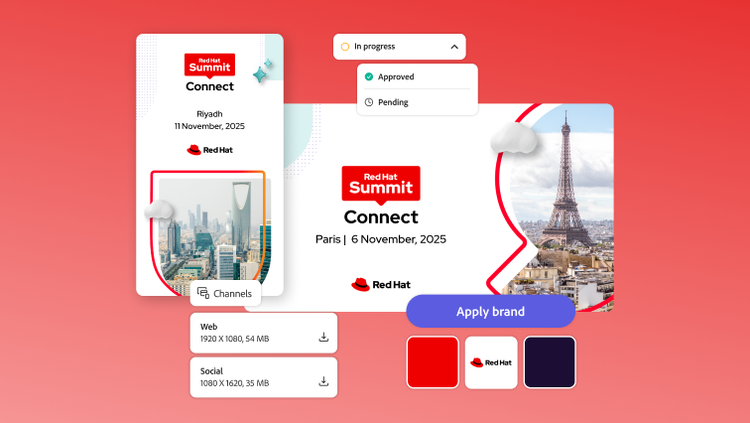
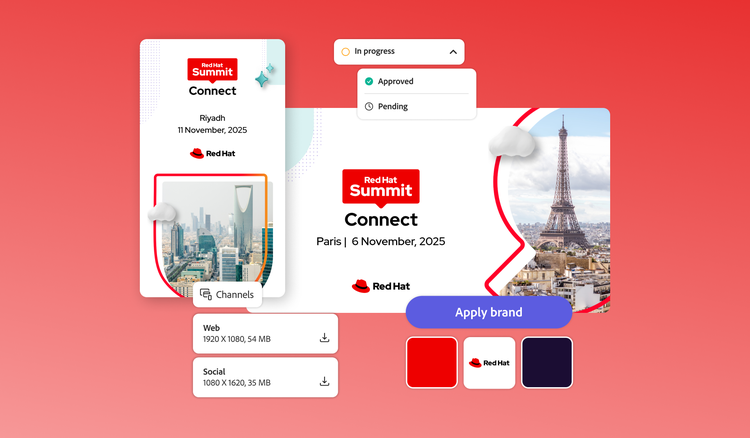
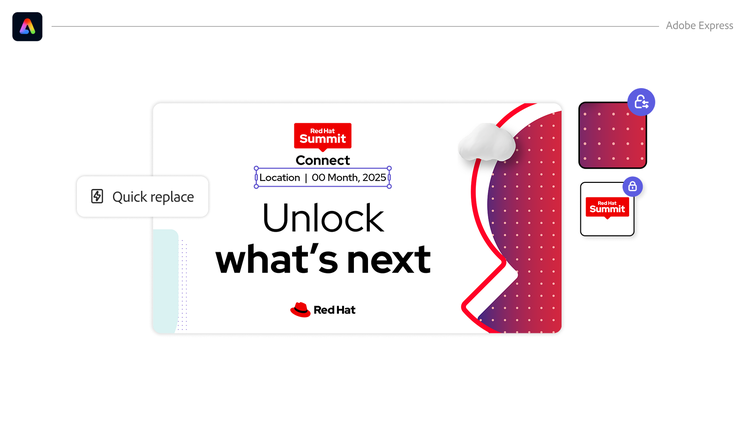
Creation accelerated too. Designers now build reusable templates in Creative Cloud, enabling marketers to edit them in Adobe Express. With built-in guardrails, marketers can localize content while staying true to Red Hat’s signature look and feel.

Brian Jones, Red Hat’s brand enablement and new technology manager, sees the impact daily. “Adobe Express has transformed our workflows, empowering our global marketing teams to create on-brand content — social posts, event promo banners, and campaign assets — with ease, handling last-mile edits themselves. What used to take weeks now takes minutes, saving time, budget, and creative bandwidth.”

The shift changed how teams think about content. Marketers respond instantly to regional needs, and designers devote more time to high-impact creative work.

A new rhythm for global marketing.

Nowhere is this transformation clearer than at Red Hat Summit, which brings thousands of IT professionals together across regions. Behind this event are hundreds of creative assets: banners, videos, session graphics, and social posts.

“Coordinating Red Hat Summit content used to mean spreadsheets, inboxes, and late nights,” Hodges says. “Now, everything connects.”

A campaign brief enters Workfront, routing requests automatically to creative, brand, and regional teams. Content is designed in Creative Cloud, then moved into Experience Manager Assets, where it’s tagged, governed, and stored as the central source of truth. Marketers use those approved assets and templates in Adobe Express to produce regional variations — resizing, translating, and tailoring content while keeping brand standards consistent.

Social graphics that once took weeks to rebuild each size can now be reused and adapted in minutes, letting teams repurpose approved assets rapidly across channels.

“Adobe gave us the framework to bring tools, teams, and processes into one system,” Brodsky says. “Seeing the full picture from intake to delivery has been game-changing for how we plan and deliver work.”

“We went from tracking projects in email and spreadsheets to managing everything in one Adobe system. Now our marketers can find, request, and reuse content faster — and that’s time we can put back into strategy and creativity.”
Elizabeth Hodges

Program Manager for Digital Assets, Red Hat

AI and the next evolution.

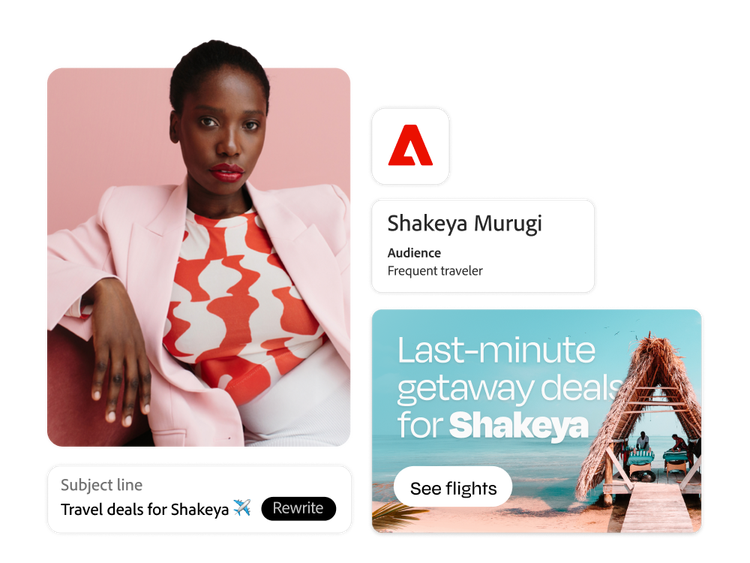
With that foundation in place, Red Hat is scaling creativity through AI. Leading up to Red Hat’s Summit Connect events, Hodges piloted Adobe GenStudio for Performance Marketing, using generative AI to produce and personalize campaign assets for Meta and LinkedIn. The Red Hat pilot team worked closely with internal content and editing experts to review and fine-tune the AI logic and also partnered with Adobe for hands-on workshops on effective prompting. These combined efforts helped the team troubleshoot its approach and strengthen the model’s ability to capture the company’s unique brand voice. This team effort led to a successful pilot that accelerated production and improved targeting to drive +12% higher unique open rates, over +15% lift in unique CTR, and over +8% improvement in click-to-open rates versus control.

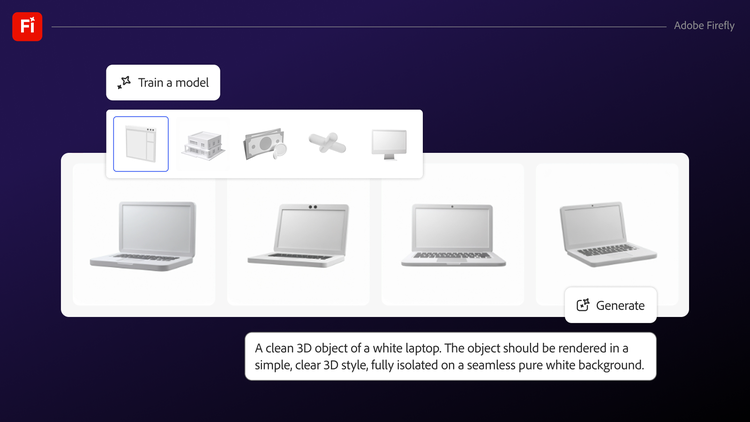
Creative teams are also experimenting with Firefly Custom Models, training them on Red Hat brand assets to ensure every AI-generated variation meets design standards. The custom models have reduced production turnaround from 3–5 days to 1–2 hours.

“Every time Firefly creates an asset that would have taken us hours is time we can put back into creative strategy,” Brodsky says.

And soon, Workfront Planning will extend visibility to the earliest stages — aligning campaign planning, creation, and performance in one connected system.

The result: Designers act as strategists, marketers create compelling on-brand visuals independently, and every team is supported by a continuous flow of work.

The future flows forward.

For Hodges and Brodsky, this transformation has always been about building a system that evolves with the business. With deeper integration, automation, and AI on the horizon, their focus is on advancing end-to-end visibility and efficiency across every stage of the creation process.

“We’re all getting into this new world together,” Brodsky says. “Adobe from the product side, and us from the operations side. This next year will be about true, seamless, end-to-end integration — where planning, creation, and performance all flow as one.”

Let’s talk about what Adobe can do for your business.

Get started