Content as a Service v3 - cx-enterprise-coworker - Wednesday, October 14, 2026 at 15:06
JUMP TO SECTION
What is AI for marketing strategy?
How predictive, generative, and agentic AI support marketing strategy
How to prioritize AI opportunities for marketing strategy
How to design an AI-powered marketing strategy
Examples of AI marketing strategies in action
How can AI support marketing strategy?
AI can support marketing strategy across planning, decision-making, execution, and analytics, but not every opportunity deserves the same level of investment. Rather than adopting AI wherever it can be applied, organizations need to identify where it can contribute to business goals, improve critical marketing processes, and deliver measurable value.
As AI becomes more embedded across marketing operations, success will depend on where you put resources, how you govern AI, and whether you can scale what works. By evaluating opportunities through a strategic lens and establishing the foundations needed for sustained adoption, marketing leaders can move beyond isolated use cases and make AI a part of their broader marketing strategy.
Most marketing teams aren’t short on AI tools. They’re short on a way to decide which AI investments will benefit the business. Without a clear evaluation process, AI efforts remain scattered across pilots that are hard to measure or expand.
This guide covers how to evaluate opportunities, match them to the right AI capability, set guardrails, and scale what works across marketing.
What is AI for marketing strategy?
AI for marketing strategy is the practice of deciding where predictive, generative, and agentic artificial intelligence should support marketing goals, and how those initiatives are governed, measured, and scaled. It gives organizations a framework for deciding where AI can add value, how it should be applied, and what role it should play within marketing operations.
AI can forecast trends and customer behavior, generate and adapt content, automate routine processes, or coordinate actions across multiple systems and workflows. These capabilities can support a wide range of marketing activities, from audience planning and campaign execution to performance analysis and optimization.
A unified approach goes beyond using AI for isolated marketing tasks. It connects AI investments to broader business priorities and operational needs, while giving organizations a clearer way to evaluate results over time. This helps marketing leaders determine where AI can create meaningful value and where additional investment or scale makes sense.
How predictive, generative, and agentic AI support marketing strategy.
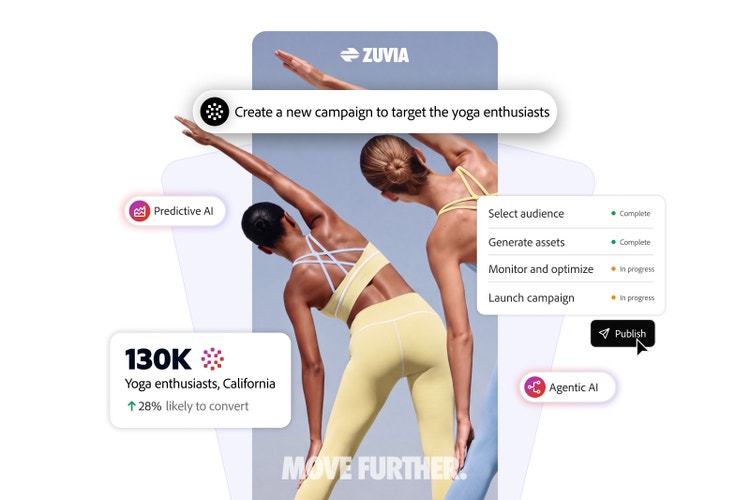
As AI adoption expands across marketing, teams use predictive, generative, and agentic AI for different types of work. Each capability serves a distinct purpose.
Predictive AI analyzes data to forecast likely outcomes and support marketing decisions. Generative AI creates or adapts content based on prompts, data, and other contextual inputs. Agentic AI coordinates actions and multi-step workflows across systems while operating within defined parameters and human oversight.
Understanding where each approach fits helps organizations make more informed decisions about investment and implementation.
AI capability
Marketing areas
Strategic use cases
Common applications
Predictive AI
Market and customer intelligence, audience planning, performance optimization, and marketing and sales alignment
Which audiences should be prioritized? Which customers may be at risk of churn? Which campaigns, channels, or investments are likely to produce the strongest results?
Audience segmentation, propensity modeling, churn prediction, demand forecasting, lead scoring, budget allocation, media planning, performance forecasting, and opportunity identification
Generative AI
Content strategy, campaign development, and personalization
What content is needed to support business priorities? How can experiences be adapted for different audiences, channels, or customer contexts?
Campaign messaging, content creation, creative variations, audience-specific assets, email copy, landing pages, product descriptions, content summaries, and personalized experiences
Agentic AI
Audience and journey planning, campaign activation, workflow management, and marketing and sales coordination
How should actions, approvals, workflows, and customer journeys be coordinated? Where can manual effort be reduced while maintaining oversight?
Campaign orchestration, customer journey management, workflow automation, task coordination, approvals, optimization workflows, operational execution, and cross-platform marketing activities
How to prioritize AI opportunities for marketing strategy.
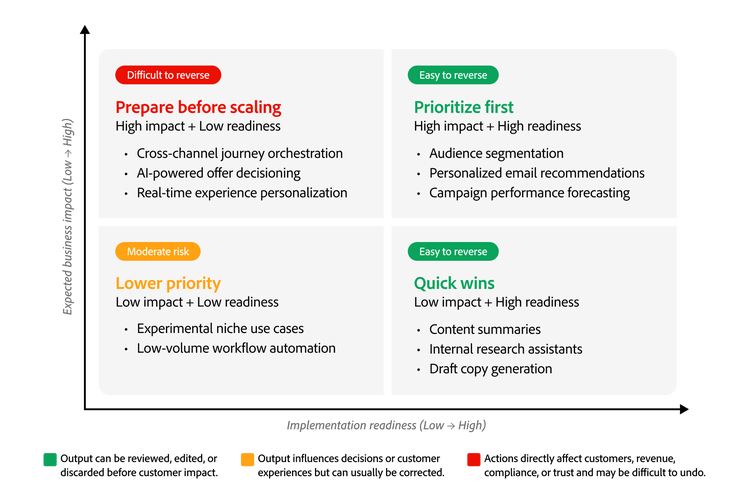
Once you know what each type of AI can do, the next step is deciding where to start. Prioritization helps organizations focus resources on the activities most likely to produce measurable results. Marketing leaders should evaluate opportunities using consistent criteria that consider both potential impact and implementation readiness.
Opportunities that score highly across several of the criteria below are often strong candidates for early investment. Starting with these initiatives can help organizations build operational experience, establish governance practices, and demonstrate measurable value before expanding AI adoption to more complex or higher-risk use cases.
Prioritization criterion
What to evaluate
High-priority opportunity
Low-priority opportunity
Expected business impact
Potential effect on revenue, retention, efficiency, customer experience, or time to market
Can directly support a strategic business objective with measurable upside
Benefits are marginal, speculative, or difficult to connect to business outcomes
Data readiness and accessibility
Availability, quality, relevance, permissions, and governance of required data
Reliable data is available and can be used with appropriate permissions and oversight
Data is fragmented, inaccessible, poorly governed, or insufficient for the intended use case
Decision or workflow frequency
Frequency of decision or task occurrence
High-volume or recurring activities where improvements can accumulate over time
Activities are infrequent or workflows have limited opportunities for repeatable gains
Ease of integration
Effort required to embed AI outputs into existing systems, teams, and processes
Can be incorporated into existing workflows with limited operational disruption
Extensive process redesign, technical integration, or organizational change is required
Ability to measure incremental value
Performance comparability against a baseline or control
Success can be evaluated through clearly defined metrics and attribution methods
Results are difficult to isolate, validate, or attribute to AI adoption
Reversibility of actions
Ease of reviewing, correcting, or withdrawing AI-assisted outputs and decisions
Outputs can be validated, edited, or reversed before causing a significant impact
Errors may be difficult to correct or could create lasting business, customer, or reputational consequences
Required human oversight
Level of review required to maintain accuracy, compliance, trust, and brand standards
Oversight requirements can be incorporated into existing governance and workflow processes
Extensive review requirements may reduce efficiency gains or limit scalability
How to design an AI-powered marketing strategy.
After prioritizing an AI opportunity, teams need a clear way to connect it to business goals. A structured approach can help organizations define the intended outcome, understand the decisions and workflows involved, and establish the controls needed to support responsible execution.
The framework below provides a practical way to design an AI initiative from an initial objective through measurement. It helps teams clarify where AI fits, where human oversight is needed, and how success will be measured.
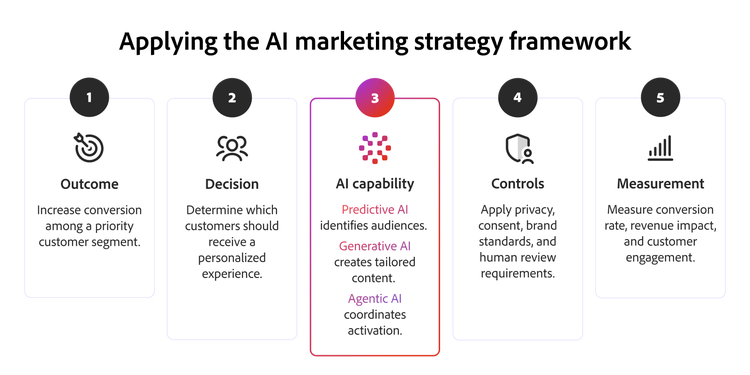
Define the desired business or customer outcome.
Connecting an AI initiative to a clearly defined business or customer outcome establishes why the investment matters and what the organization is trying to improve. It also gives teams a stronger basis for making decisions about scope, resources, and implementation.
Establishing a baseline before introducing AI gives teams a point of comparison for measuring its impact over time. Organizations can then define the specific outcome they want the initiative to improve. This can include increasing revenue, strengthening customer retention, reducing acquisition costs, accelerating content production, or improving customer experiences.
A vague goal might be framed as “use AI to personalize campaigns.” Defining the desired outcome as “increasing conversions for a specific customer segment by improving customer experience while maintaining brand standards” makes the objective more concrete.
Identify the decisions and workflows affecting the outcome.
The next step is identifying the decisions, processes, and workflows that influence the desired outcome.
Marketing outcomes often depend on a series of recurring decisions made across teams and systems. These can shape how audiences are prioritized, how content is selected, and how campaigns move through planning and execution. When those processes are fragmented or overly manual, they can delay campaign launches and lead to inconsistent output.
Mapping the workflow helps organizations see where decisions happen and where friction is introduced. It can also reveal where AI may improve efficiency, support more consistent execution, or help teams act on information quickly.
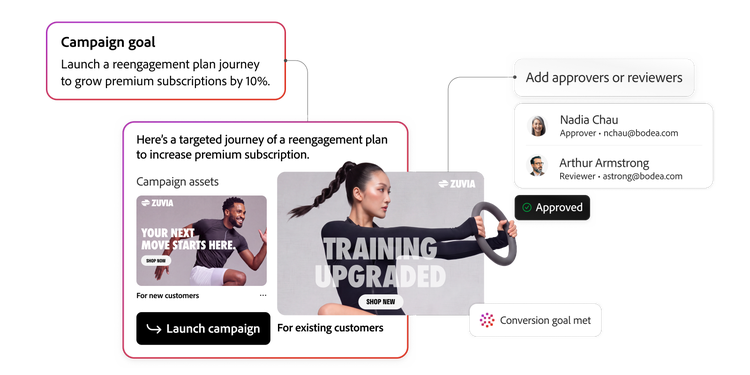
Match the opportunity to the right AI capability.
Once teams understand where AI could improve a decision or workflow, they can determine which capability fits best. Predictive, generative, and agentic AI support different types of marketing needs.
Not every opportunity requires AI. Organizations should consider whether the technology is necessary to solve a current problem and if the expected value justifies the investment and operational complexity.
If the decision is who to target, start with predictive AI. If it’s what content to create or adapt, start with generative AI. If it’s how to coordinate workflow tasks, start with agentic AI.
Establish controls and human oversight.
The next consideration is governance. Organizations need to define the conditions under which AI can be used. That includes setting clear expectations for data use, decision authority, review requirements, and accountability before the initiative moves into production.
Controls should be tailored to specific use cases. Teams may need to determine what data the system can access, which outputs require human approval, and when an issue should be escalated for additional review. These requirements should also reflect existing privacy, compliance, and brand governance standards.
The level of oversight should match the potential impact of the activity. A low-risk internal task may require only limited review. Conversely, an AI-supported customer interaction or decision with regulatory or financial implications may need formal approval, documentation, and ongoing monitoring.
Measure incremental value.
After deployment, teams need to measure and analyze whether an AI investment contributes to the business or customer outcome it was intended to improve.
Organizations should compare AI-assisted performance against a baseline or control group whenever possible. Depending on the use case, evaluation may include revenue, conversion rates, engagement, operational efficiency, customer satisfaction, content quality, adoption metrics, or compliance indicators.
Ongoing evaluation helps teams understand how an AI initiative is performing as conditions and priorities change. Those results can inform whether the initiative needs to be refined, expanded to additional workflows, or discontinued in favor of higher-priority opportunities.
Examples of AI marketing strategies in action.
The framework becomes most useful when it is applied to real marketing challenges and measurable business goals. The following examples show how organizations are pairing connected consumer data with predictive and generative AI to improve marketing performance and efficiency.

Lumen Technologies
Lumen Technologies used Adobe GenStudio for Performance Marketing to scale personalized campaign creative. By applying generative AI to content production, the company saved 70 hours per campaign concept and an estimated $5 million annually.
U.S. Bank
U.S. Bank used Adobe Real-Time Customer Data Platform and AI-powered offer decisioning (predictive AI) in Adobe Journey Optimizer to deliver more relevant offers and marketing interactions. The approach contributed to a 127% increase in annual booked accounts, a 4x increase in overall marketing impressions, and a 5x growth in mobile app engagement impressions.
Costa Crociere
Costa Crociere unified guest data in Adobe Real-Time Customer Data Platform to personalize nearly half of its digital traffic, increasing ecommerce conversion rates by 97% and loyalty registrations by 76%. The company is now piloting AI Assistant in Adobe Journey Optimizer to generate campaign variations with generative AI.
Explore Adobe customer success stories.
Common challenges in adopting AI for enterprise marketing.
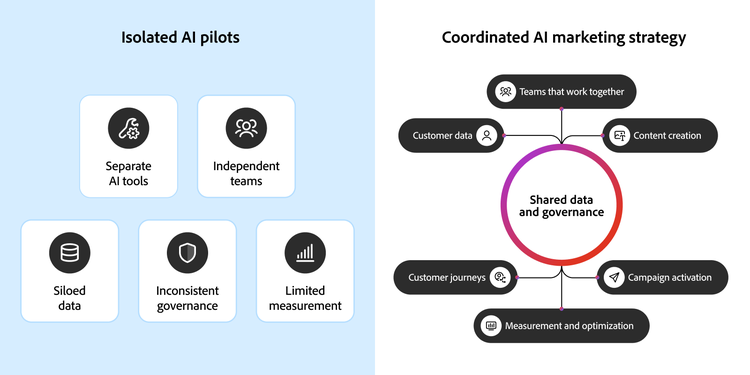
Many enterprises demonstrate value through individual AI pilots but struggle to extend those results across the broader marketing organization.
Scaling introduces new requirements that may not be apparent during an isolated use case. Data needs to work across systems, AI outputs must connect to existing workflows, and teams need consistent governance and ownership as adoption expands. The following challenges can influence whether an AI initiative remains limited in scope or becomes part of a coordinated marketing strategy.
Fragmented data makes AI harder to trust.
Even strong AI models can produce unreliable results when the underlying data lacks quality, context, or consistent governance.
Customer, content, campaign, and performance data often exist in separate environments, making it difficult to apply AI consistently across the marketing lifecycle. Differences in how that data is accessed, structured, and governed can limit the effectiveness of AI initiatives across teams and systems.
Solution: Build a shared data and governance foundation.
Adobe Experience Platform connects data governance to marketing activation through data usage labels, policies, and enforcement. This allows teams to define where data can be used, apply controls to specific marketing actions, and establish accountability before scaling AI-supported experiences.
AI often remains disconnected from marketing workflows.
An AI output only creates value when teams can integrate it into the systems and processes where work happens. At an enterprise level, that means connecting AI-supported insights or content to existing approval, activation, and measurement workflows.
When those connections are missing, useful outputs can remain isolated from downstream systems and teams, limiting their impact and making adoption harder to scale.
Solution: Embed AI directly into marketing workflows.
Adobe's content supply chain approach connects AI-assisted planning and creation with governance, approvals, activation, measurement, and optimization. This creates a more connected path from AI-supported work to execution and performance analysis.
Scaling requires new operating models.
Marketing, data, analytics, creative, legal, compliance, and operations teams may all influence how AI is deployed and governed. As AI becomes part of routine decision-making and execution, responsibilities often shift across teams, creating new requirements for collaboration, training, and accountability.
Solution: Assign clear ownership and a shared process.
Define who owns each stage of an AI initiative, from use case intake and data access to review, approval, and measurement, and make that process the default across teams. A cross-functional working group can set common standards, run training, and decide when a pilot is ready to scale. Adobe’s responsible AI principles of accountability, responsibility, and transparency give those standards a starting point.
More tools create more friction.
Successful AI integration is not determined by the number of AI solutions in use.
As AI deployment grows, different groups may introduce new tools, processes, and governance approaches that operate independently from one another. Over time, this can create fragmented experiences, inconsistent measurement, duplicated effort, and greater governance complexity.
Solution: Scale shared foundations, not individual tools.
Adobe’s AI adoption guidance emphasizes responsible scaling through shared governance, continuous monitoring, and operational consistency. This helps organizations reduce disconnected strategies and fragmented experiences while maintaining consistency, accountability, and business alignment.
Turn AI investments into a coordinated marketing strategy.
As AI becomes embedded in marketing workflows, the value will come from how well organizations connect individual capabilities to broader goals and day-to-day execution. A coordinated strategy gives teams a clearer way to decide where AI belongs, how it should be governed, and how its impact should be measured over time.
Adobe AI for Business and Adobe CX Enterprise Coworker support that approach by connecting customer data, content, journeys, and analytics in one place. That helps teams apply AI consistently across the marketing lifecycle with people setting direction and approving what goes live.
Discover how Adobe AI for Business helps you turn strategy into results.
Frequently asked questions about AI for marketing strategy.
Predictive AI uses data to forecast likely outcomes and support decision-making. Generative AI creates or adapts content based on prompts and data. Agentic AI can plan and carry out multi-step tasks across systems and workflows, within defined permissions and human oversight.
Start by establishing a baseline and defining clear goals and metrics. Then compare measurable gains, such as incremental revenue, improved conversions, or time savings, against the cost of implementing and operating the AI initiative. Where possible, use controlled testing and track quality, customer impact, and efficiency alongside financial results.
Start with a specific, repeatable use case tied to a business goal. Ensure the necessary data, permissions, and brand guidelines are in place before piloting the initiative. Apply human oversight during testing and expand the use case once it demonstrates measurable results.
Title
How to use AI for marketing strategy.
cardDate
2026-11-10
cardImage
CardDescription
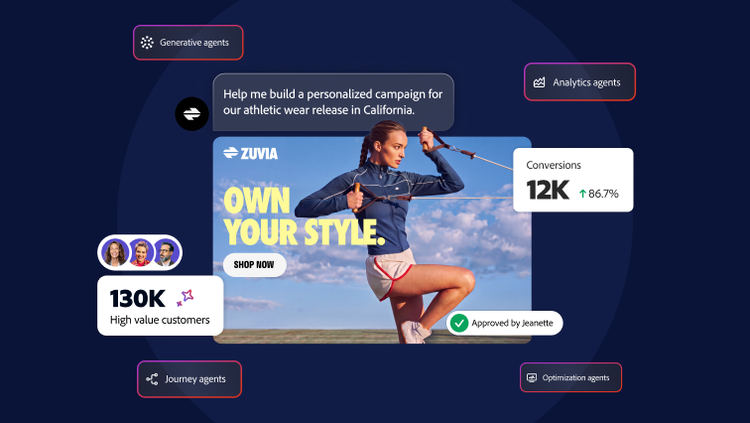
Discover how to prioritize AI use cases, establish governance, and put AI to work across marketing.
primaryTag
caas:content-type/product-page
Tags
caas:content-type/product-page, caas:products/cx-enterprise-coworker, caas:topic/generative-ai