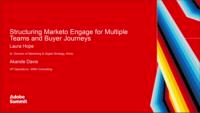
[Music] [Akande Davis] Hey, everybody. Thanks so much for joining us on this session at Adobe Summit. All right, today, we're going to be talking about Structuring Marketo Engage for Multiple Teams and Buyer Journeys. My name is Akande Davis. I'm VP of Operations at GNW Consulting. And this is a topic that really gets me excited, and it's something that I'm really excited to be presenting along with Laura. Laura, would you mind introducing yourself and sharing a little bit of your background? [Laura Hope] Sure. My name is Laura Hope. I am the Senior Director of Marketing and Digital Strategy for Minto Communities. We are a new home builder, based out of Canada, but we also build primarily in the US, in the Southeast, in Florida, South Carolina, soon to be in Texas. I have worked for the company for, I guess, almost seven years now, and we've been a Marketo Engage customer since 2019.
And during that time too, the reason that I'm excited about this, Laura and I have had a chance to work through a lot of these different themes and practices within Marketo Engage. And I think it's one of the things that has really been transformative for Minto in many ways. So as we dive into this, the first place we kind of have to start is there's a challenge behind lead management and complex buying cycles. And I always like to give this funny quote, if you will. "Lead lifecycle management is a piece of cake," said no one ever. It's a complex process. It takes a lot of effort. And the reality is without a tool like Marketo Engage, it becomes even more cumbersome when you think about all the nuance that exists during that buyer journey. Now when it comes to real estate, we use this framing a little bit, but it's a B2B experience for the B2C market. When you think about a home, there's a few things that go into it. Laura, you could speak to this a lot better than I can, but it really is a complex involved buyer journey. Sure. I mean, if anyone's gone through the process, buying a new home is the biggest purchase that most people will make in their lives. Not only is it a big financial investment, but it's also an emotional purchase, and it's not typically an impulse buy. So there's a lot that goes into that relationship from first touch point to last, answering multiple questions. They're looking at our competitors as well. So how do we differentiate ourselves in that market? You're competing with not only other builders potentially, but the resale market. So there's a lot of noise out there when you're in the new home search, and we're here to help minimize that and obviously get them into their dream home with Minto.
And when you think about what Minto really needs, it's a solution at the time that it's going to align community interest. Right? What are they interested in? Where are they at in this journey? How qualified are they? And what is their timeline to actually make a purchase? I think one of the little queries we pulled out, during this discussion was a home purchase could take anywhere from six months to five years. Is that right? Sure. Yeah.
We have a very diverse type of communities. Everything from a community where we sell to first-time homebuyers, younger Gen Z and millennial buyers, to some of our communities that are 55 and better that really target that retiree. And obviously, buyers in between. So, someone could be getting ready to retire and thinking about, "Where do I want to live? What is important to me in terms of amenities? Do I want to be near the water?" And so they might start that, five years before they're ready to retire. So I've seen it many times where people in our database, we get the sales celebration, and they've been in our pipeline for five years, in a crazy market like we had during COVID where everyone was moving to Florida. That buying cycle definitely got a lot shorter, and we were on wait list. Now things have leveled out.
But, yes, it's-- Like I said, it's a very emotional decision, so it's not something that people take lightly and do the lot of research.
There's a whole buyer journey that goes into that, that we use Marketo for. And even if it was just six months, let alone five years, you still need that continuous engagement at set intervals for that variety of audiences. And that speaks to the theme too that we've identified is that Minto is a diverse company. We're in real estate. We're focusing on these different areas. There's multiple channels and touch points and intense signals along the way. So whether you get a direct mailer, whether you see a billboard, or you're watching the YouTube series that talk about the lifestyle at these different communities, there's a lot of touch points that really go into it. And I think one of the things that Marketo Engage also helps with is understanding qualification. You know, I know lead scoring was a big topic and additional to that multichannel consolidation as well as, like, how qualified are they for marketing. But lead scoring, if I'm not mistaken, was one of the main ways that was-- Or one of the main, I guess, sales points that Marketo Engage really leaned into for Minto. Yes. Absolutely. So when we began this journey, probably back in 2018, we had a very big database of leads. And we have our on-site salespeople who help, customers that walk in the door every day, and then we have our online sales team.
We were doing promotions where sometimes we could receive up to 100,000 leads, which is great to have that many people in your pipeline, but also how qualified are those people and how realistic is it to have a sales team even if we had unlimited resources to reach out to those people individually. So we looked at a tool like Marketo Engage, because of the lead scoring. So that way, we could really measure intent and put a process in place and a road map of-- Okay.
On our website consistently, if they're engaging with our emails, if they are making phone calls, things like that, to us, that shows intent. And so, that helped us develop our scoring model. So that way we could get those people who were serious buyers and looking to purchase in a shorter time frame in front of those people to convert them hopefully into buying a home. So the lead scoring model has been tremendous for us in moving those people along the cycle. And the great thing is we still engage with the other people. We have our marketing nurture program. We do our monthly or periodic e-blast depending on what we have happening, events, and things like that. And we have a very low unsubscribe rate. So we know that people are still engaging with us when we look at our metrics, but they just might not be ready to pull the trigger yet. Life happens, circumstances change, and so we understand that we don't want to disqualify them completely if they're not ready to purchase, within a certain time frame. But we do want to keep that line of communication open, for whenever they're ready to purchase. Absolutely. And if they come into the database, they might just be doing an info gather. Getting a phone call from a salesperson, even if we had the manpower, might be like, "Why are you calling me?" This little bit of an odd interaction. And the nice thing about it is once they are ready to buy, once they've started that conversation, we can suspend certain marketing communications. We can tailor our messaging. If there's an event that we know people who are on the cusp of purchasing really should attend to see their home or to see their dream home, they should come to this event. Simply put, Marketo Engage takes these complex lead lifecycles and makes them simpler by aligning them with marketing and sales. So our marketing efforts can really complement what sales is doing and help inform their decisions rather than us just dumping a bunch of stuff their way and saying, "Hey, figure it out," which is one of the powerful ways to enhance that buyer journey and lifecycle. Another thing that we identified early on too was that even though we have these different communities, communities also can range by where they're located and the regions that are being served. And particularly with Minto, we have this approach or this challenge around decentralized centers of excellence. So even though we have distinct teams and unique markets that we're approaching, we're still approaching things at a level of center of excellence. Now what's unique about, this structure is we implemented workspaces, within Marketo Engage to allow, if you're in the Calgary region or GTA or in the US, we have specific sort of initiatives that will dial in based on what you need. So events are always going to be important. Marketing's always going to be important, and even lead scoring is going to be important. But it's different across the unique markets and distinct teams. Now, when I was looking into this, I was able to find that we had roughly X amount of client retention folks, a large sales team, and we had sent in marketing about 13 million emails. So, Laura, if you could speak a little bit to, one, I think the volume of communication we were able to achieve with Marketo, but maybe a little bit on how the teams differ from the US to Canada and how that could impact some of the sales process. Sure. Even though there are neighbors to the north, there are definitely differences in, how our buyers approach the home buying process. So even though we are a Canadian owned company, we still run our business, tailored to more of a US consumer.
Email is still king. I've heard so many times, "Email's dead, email's dead." It's not dead. It is very much alive and kicking. So having a tool like Marketo Engage is great because there is-- Like I said, being in this industry, especially in a state, South Carolina and Florida that were very hot in terms of people relocating and the amount of inquiries that we would get. It was definitely a challenge for us to understand our customers' needs and how do we communicate with them best and developing some-- In marketing, we're always pivoting. Right? It's never a set process. And so, we do work closely with our team in Canada on certain things, but then we also do run autonomously in how we market. We do a couple of big promotions here.
For our Latitude Margaritaville brand, have sponsored weeks of Wheel of Fortune, which hopefully a lot of you are familiar with. Awesome. Yep. And so that obviously generates huge interest alone, just from having that national, technically, international stage. Then also, we are the primary sponsor for the US pickleball tournament over in Naples every year. Pickleball, same thing. During COVID, really took off. You know, it was primarily thought to be more of, typically, an older audience, but now that has grown across the ages as well. And so, those are two events that we participate in, not just to give us brand exposure, but also to bring us potential customers as well.
They don't do those, up in Canada. But we also have to think how are we going to communicate with these people? Right? Because like I talked about earlier, what's their intent? Did they just happen to be watching TV and saw, "Oh, I have the possibility to win a house. Let me go sign up," which we know people do. But we've gotten a couple hundred sales from that promotion. Wow. So to us, we consider that a huge win. But like I said, that does come with the challenges of bringing those people into our database, creating a marketing communication for them, because even if they are interested, they could have a friend or a family member as well. So, and like I said, we're very lucky. They aren't unsubscribing, so they are interested in still receiving our emails even if they didn't win the home. Awesome. And, yeah, to your point, it's the same ingredients. Right? There's a sales team, there's a marketing team, there's events happening, but they're done in a different way. And I know for the Minto team in particular that's located in Canada, they're open to reaching out to every lead that comes in or expresses interest, where the US needs to a little bit more of a tailored approach. You know? And it's funny you mentioned the pickleball and the Wheel of Fortune because those are huge audiences. And with that in mind, the way that we approach marketing to them is going to be vastly different. I think, I could be wrong, but we almost canceled a home showing or an event that was happening for a US community because it was raining. There was some heavy rain. And then in Toronto during the wintertime, it's like 10 inches of snow. So different markets even from that standpoint as well. But Marketo enables that go-to market motion that are familiar across teams while maintaining best practices, and that's really important when it comes to the workspaces. So sales qualification, marketing campaigns, and web campaigns, all different flavors of the same thing and being used with different teams to accomplish the same goal. I think that's the key takeaway here is that even when you have different teams, varying capabilities through the workspace and partitions really allows you to unlock the true, I guess, the power that's latent within Marketo. You can have multiple teams doing different things and scale up that effort while maintaining best practice. Third point here is just looking at advanced segmentation to have that personalized buyer journey, which again, Marketo Engage is really great at doing. Now this is a simplified version of it, but Laura and I were talking-- Laura was like, "It's like a self-serve model," where all the automation that's happening in the back end is fueling the engagement. If you're interested in a community, you'll get community and specific emails. But it really depends on what you end up doing and how you end up moving through the funnel. It's really about, like, "Okay. Well, where did you come from? Where did you first hit? Did you hit our CRM or Marketo Engage? What was your COI? Or how did you hear about us? And, Laura, I know that when the sales team is looking at some of this data or they're going or lead, bubbles up to the COC nurture, there's a lot that happens on the back end that they take into consideration when they start that outreach process. Yeah.
I think I've told you I like to use the term, choose your own adventure.
Type of marketing. So it used to be marketing, pushing out a message, but now the consumer is so much more involved in the marketing process, and they're really making their own decisions. So between, it used to be you'd have a television commercial, maybe a newspaper ad. You were advertising in the yellow pages, something like that. Now it's everywhere. Right? It's digital. They're engaging on our website with different tools. For example, we have a mortgage calculator. Right? So if you're looking at financing, and so that could be a message that we want to communicate a little bit more, personalized to a customer that needs financing. So between, the consumer now, I think, is a little bit in more control than we are, but we have to anticipate what those things are on the horizon and how can we tailor. I mean, we all get personalized emails. Right? So that says, "Hey, Laura. Are you interested in this offer?" Or, "Laura, we've missed you." So, I think the definitely here to stay. I mean, we've got tools like AI now that are going to help us do that even more, because people are sharing that information. It's out there on the Internet for us to gather. And so it's a little bit scary, I think, for some people.
But it's actually beneficial because we're giving you the information that you're telling us that you want versus us just pushing our agenda on the consumer, hoping that it works and that it resonates with someone and that they buy or use our product. Well, yeah. And it's interesting you mentioned that too because one of the things that we've implemented, the mortgage calculator being one. So if you fill out a mortgage calculator and we know who you are, on the website, we're going to send you an email and say, "Hey. Well, are you interested in financing? We saw you using this tool on the website." But even more so, we've been doing ongoing profiling where we say, "Okay. Well, how many bedrooms are you looking for? How many bathrooms are you looking for? What are you doing with your current home?" So when they speak with the salesperson, ideally, the salesperson is like, "Hey. I already know what you're looking for. Here are some of the homes that meet your criteria, and here are some of the other ones that you might consider if you have some flexibility." But, again, it's all volunteered. Right? The user is driving that conversation. And if they don't want to share it, that's perfectly fine, but it's only going to allow them to get faster to where they want to go. And once they've raised their hand enough to say, "Hey, I've learned everything that I need to know about the community. Let's book an appointment." The conversation totally changes. And that's another, I think, powerful factor for Marketo because we take the user all the way from awareness through the inquiry process, through qualification, and then into conversion. And one of the things that's not pictured here is that if somebody goes through this process and let's say, six months, seven months, they fall off and they don't return, if they reenter, they're going to go through that same process, get this, a different community interest if they're interested in that, but even just be bubbled to the top like cream. Right? And we can identify them a lot easier. Now it's a Choose Your Own Adventure to B2C marketing. And and now you have really informed buyers who want to make a great decision, and they really want you to give them what they need when they need it rather than just blasting them about it. And Marketo has really allowed us to do that. Now the last area I wanted to touch on was this approach to marketing operations and marketing technology, but from a marketing leader. And, Laura, this is where I think I really would love to have your insight on because so often, as a marketing technology person enthusiast, as a practitioner, I get lost in the sauce when it comes to technology. And I want to measure everything all the time. But the reality is you can't always measure what marketing does, whether it's a brand experience. And I think we have a couple examples that come to mind, but I'll let you take it away. You know what? There's things that marketing does that are intangible but so important to the process. Sure. I mean, obviously, with things like our Google Analytics and Tag Manager and all of those things that we're able to track sources, QR codes. COVID was the best thing that ever happened to QR codes, and we've added them to a lot of our materials. So being able to measure, and see what's working and not working has been a marketer's dream, over the past 10 years. But there's also things brand awareness. So it's not always going to convert to, seeing a direct result just because there are so many different verticals. So we use a very big mix of things in our marketing plans, in our media plans, everything from traditional media using television, radio, newspaper and magazine, to signs. I always chuckle when I see on our sales celebration that the source of the sale was a community sign. - So I was like, yeah, but-- - Here you go. How they get to the community in the first place? That's what I want to know. But the great thing is chances are, they probably came in through something I could track. So I can always go back into the CRM and say, "Oh, well, actually, they filled out a form on Zillow that got them out there. But, hey, they bought a house at the end of the day. So that's the good thing. Yeah, so it's still not a perfect science. I know you and I talked before. I use a brand a lot like Coca-Cola. Right? They're the largest soft drink company in the world. Everybody knows the name Coke. If you live in the South like me, it doesn't matter what you're drinking. Everything's a Coke. Right? But they spend more money than their competitors, just on keeping brand awareness. So Coca-Cola need to do that? No. Everyone's going to still drink Coke, but they understand that it's still, keeping top of mind, and it may influence you to to go buy a Coke. You know? You can't discount enough...
just making sure that you're in every channel, but also making sure that, it's a good mix, but also that you can track it back to the source. Right? And that intangible tools, the awareness component is so crucial. And also the experience as well. Because a lot of times what I've found is technology enhances impactful brands, but it doesn't fix them. So, without going too deep, there's a certain online ticket vendor, one of the ones globally that everyone has a problem with contrasted to that with maybe, a well-known fast food establishment that's closed on a Sunday and always says, "My pleasure." Right? The brand itself, that's an experiential thing. That's hard to measure, but it's there. Sure. Yeah. I mean, that's I geek out on that. Right? I love looking at different brands and seeing, what they do, across their marketing. The ticket company that you mentioned, I'm a big concert goer as you know. So I constantly-- But we have a love hate relationship, mostly hate, only because the experience is never great. Right? So, I think they could do a good job on the marketing side because I get emails. They tell me, "Oh, your favorite band is coming." They tailor the communications to me. Right? Because they know, they have a history of the bands that I've gone to see or shows or whatever. And so they do a great job on that side, but the experience itself is a nightmare. And I think anybody watching this can attest that if you've ever had to buy tickets and trying to wait in a virtual queue and then even if you get selected, what's available most of the time, it's already on the secondary market. And so it's just not a great experience. And then I always chuckle, excuse me, when they send the survey email, that's like, "How did we do?" And I was like, "You did awful." And I tell you this every time, and I'm sure other consumers do, but nothing changes. - Right? - Yeah. It's still the same thing versus, the other company that you mentioned, which is a fast food restaurant. Right? So it's not anything super sexy or anything, but they understand who their customer is. They understand what brings people back. They're the most profitable fast food restaurant in the country, and they're only open six days a week. - That says a lot. - Yeah. You know, when you get an email from them that's like, "Hey, we're just happy that you're a customer of ours. Here's a reward for you next time you come in." And so, that not only-- That's an incentive, obviously, to bring you back into their establishment, but also it's the feeling. So you can't measure that feeling of when somebody reads something. Right? I was in sales for the first 15 years of my career, and I would always say it's not what people are telling you. It's what they aren't telling you. And so-- Yeah. That's like-- To me-- Yeah. Sorry. Go ahead, Akande. No, no, no. I'm sorry, Laura. Finish your thought. No. I was just going to say so, that's why we're going back to your point of, like, we're never going to know everything about what we're doing if it's successful or not successful. I mean, the metrics and the analytics obviously are telling us what works. But, also, it's like I said, it doesn't always tell you what doesn't work. But as consumers, look at your own-- I always encourage you, look at your own marketing. Constantly, look at other people's-- What are they doing right that I could implement? What do I don't like that I need to avoid for my company as well? And and I think that's like the tale of two cities, the tale of two companies. Both are leveraging technology to deliver or to manage really complex buying cycles, hyper personalized, they respect the qualification, and two completely different experiences that can only be really identified when we talk about our experience with them. Right? So I think that's one of the things that's always a good takeaway. We love Marketo Engage. We're so happy with what it's done and how we've been able to implement it. But marketers don't lose sight of that brand experience and that unique brand takeaway that people-- As you were saying, Laura, it's not about what they say when you're in the room, it's what they say when you're not in the room. Right? And that's always key for marketing operations, folks, to keep in mind. But, yeah, thank you everybody so much again for joining us for this session. We hope it was informative, practical, that there was some key takeaways. Again, we're so happy to be able to talk about this and talk about our experience with Marketo Engage. But, yeah, take some of these takeaways and think about, "Okay. Well, what can we do with our technology to manage these complex lead lifecycle models, to have personalized buyer journeys, and what we can implement. But, yeah, enjoy the rest of the summit, and we look forward to seeing you next time.
[Music]