[Music] [Woman] Over the next decade, organizations will face huge challenges. As industries are reconfigured, sector boundaries blur and competition heats up. Business as usual is not an option for companies that want to shift from surviving to thriving. Leaders can't stem the flow of uncertainty. They must act now to channel disruptive forces and reinvent their business models. Top companies are already doing this, fundamentally reshaping how they create, deliver, and capture value. Like a car manufacturer using its customer data to build a predictive maintenance platform or a retailer sharing its supply chain capabilities by licensing its technology to other organizations through a subscription model. Leading companies are alert to market triggers, trends, and emerging technology. They listen to existing customers while attracting new ones, like a digital bank selling its core technologies and knowledge to other financial service providers so they can build new digital products and apps. Business model reinventers challenge the status quo to grab opportunities like a coal-fired power plant, helping companies install solar panels on their sites, and creating a new business managing these assets. When reinventers move, they move at speed, adopting a minimum viable product approach to test and learn before scaling up fast. Most organizations will face huge industry reconfiguration challenges in the next decade, but those that act today to start reinventing their business models by piloting new innovations will be around tomorrow to enjoy success and seize the future.
[Samrat Sharma] All right. So people typically have Linkin Park or somebody else's hype music. I had the PwC video for that.
So welcome, everybody. Thank you for joining us. My name is Samrat Sharma.
I shepherd the marketing function here at PwC. I'm a recovering strategist, having worked with some of the folks in the room over the past several years and helping companies reimagine, reinvent their business models.
And actually, quite honestly, I don't know if any of you were at the Keynote, I couldn't have asked for a better setup for this session than Shantanu and James Quincy when they talked about the need for reinvention in our business.
So we have a very action-packed agenda.
We're going to go through 7,000 slides, all font size 5.
So please take notes and take them quickly. But all kidding aside, we're going to talk through three things today on our panel. One, why? Why are we talking about reinvention, right? We'll talk a little bit about what the triggers, what each and every one of us is experiencing.
Two, how.
How do we learn from others to leverage or look at this reinvention not just as a threat but as an opportunity for our organizations and for us to go and do great things and really transform the marketing and customer function into a growth and value creation function? And three, the part I'm most excited about, is we'll meet some luminaries in our industry who have been at the cutting edge of helping organizations like yours, like ours, think about reinvention, think about how to drive growth, and then actually impact that growth at their organizations. So this is a very simple-- 7,000 slides aside, the idea is to have a simple conversation.
I will start with some prepared comments because today's session is a combination of some research, proprietary research we've done, but also an article we published in Harvard Business Review in the winter. It was a cover article on growth, right? And how should companies be looking at driving growth, sustain growth through reinvention? And then we're going to open it up. That sound like an agenda? The other thing is, as we have the panel, as we have the discussion, this is a conversation we're having amongst friends. So yes, I have a few prepared questions which have been crowdsourced.
But if you have a question, ask us a question. Make sure you ask them the hardest questions. The easy ones, come to me. All right. So they talk about-- They say gamification always helps engagement. So let's start with a little bit of trivia, right? And let's make it real. Well, if you go to the next slide, which would be my responsibility, so let's start with a question, right? So let's talk about some real examples. So Hasbro.
Mr. Potato Head, Monopoly, etcetera, we all know Hasbro, right? But a question here is, before they became famous for their board games action figures, what business do you think they started off with? They're going old school, so you can put your hand-- You can shout it out.
[Man] B. Saddle and harness making seems to be the consensus over here. All right, let's see if you're right.
Actually no, it was the person who called out textiles who was spot on, right? So Hasbro, it's a fascinating story actually. It's a story of how a company can be so customer obsessed that they understand where the puck is going and they actually started in textiles and they would provide textile cuttings for pencil boxes. And they very soon realized actually there was a demand and a need from children for something other than just different toys or different-- So they created this product portfolio of toys, and for the next 70, 80 years can really have been a force in the toy manufacturing space.
And now they're actually taking a next pivot. They're actually in the throes right now of launching a set of digital channels, right? They have about 20 million active users now on their digital channel. They expect to have 50 million active users where they're basically following the consumer. Today's children, today's young adults actually engage not through physical products but through digital products and channels, right? Fascinating story over there of reinvention. All right, you guys now have a hang of it? There's no wrong answer-- Actually there are wrong answers. But let's go to the next one, all right? So Tiffany's, Tiffany and Company, we all know about Tiffany's.
Where do you think they started out? Don't be shy. [Woman] I thought it was lamps, but that's not a choice.
That's a reinventive answer.
Going off. - All right. - [Man] C. C, stationery.
Anybody else? A, musical instruments.
All right, now we have every answer over there. But stationery is right. They started off as stationeries. And actually, Tiffany's has been around for, I'm going to butcher, but almost 200 years. They started off as stationers, and it's actually a very well published story that the kids of the original founder, they had a store in New York City, they send one of the kids to Europe where they saw actually, hey, the same high net worth individuals that they were targeting with the stationery actually also wanted lamps and other things and then they can now introduce that. Then they set up a retail arm on Broadway, which is their iconic Tiffany store, which fast forward has now become this really iconic Blue Box aspirational luxury brand, right? Again, and a great example of reinvention. All right, we're going to take a couple of quick ones again. All right, so this one was particularly interesting. Samsung. Everyone knows Samsung, I hope.
So where do you guys think Samsung started? [Man] C. C, I hear. Any takers for A, B, or D? Don't be shy.
All right, C.
Actually, it is not C.
They started off with trading in dried fish, right? And it wasn't until the 1960s that they saw this trend in manufacturing of high-tech equipment, et cetera, which then-- Samsung is Samsung, right? So I think we all know. So another great example of really being ruthlessly focused and understanding where the puck is going, what customers want, and then innovating and entering those businesses to stay relevant, etcetera. We'll do one final one. You guys game for another one? All right. Confidence is key.
All right, so in-store lounges. So which retailer introduced retail, sorry, this concept of in-store lounges during the Great Depression? [Woman] C, Neiman Marcus. C, Neiman Marcus. D, Cartier.
Actually, you guys are correct. It is Neiman Marcus.
And they realized this during the Great Depression that if they had to attract the high net worth shopper, they wanted to transform from just a retail outlet to a place where they actually wanted an experience. And that's what their customers were seeking, right? And you're seeing the next reinvention of Neiman and Saks as they're coming together and stuff, really bringing that whole customer experience lens to digital, right? Really following where the customer is. All right, I'm sure we can go through the next 30 minutes of trivia, but you guys are a demanding audience, so we will pivot to the promised agenda. All right, so I said we're going to talk about the why. Why are we even here? We're here because PwC runs a CEO survey, an annual CEO survey, and we've been doing that for several years. And we started asking CEOs about whether they believe their business will be relevant in the next decade.
45% of CEOs, these are your CEOs, 45% of CEOs believe that their businesses will not be relevant and competitive if they do not change and they do not reinvent their business. And what is particularly startling is the fact that that number was just 39% two years ago...
Right? This gets even more interesting, by the way. All right.
Many of you, senior executives, 52% of you mentioned that creating new revenue streams in the next 3 years is a top priority, right? We all know everyone's looking for growth, everyone's looking for innovative ways to drive growth, not surprising. All right, 63% of CEOs then said, "Hey, we actually are in the process, have taken some action towards reinventing our business." But when you compare that intent with actual outcome, only 7% of revenue...
From the public company database actually is really attributed to new businesses or new innovations, etcetera. So clearly the aspiration intent is there, but it's falling short. And then finally, while the CEOs were somewhat pessimistic about their future, all of you are even more pessimistic about the future if we do not do something.
76% of you said that if we do not-- If our company does not change how we operate, we would be out of business.
All right. So what's driving that, right? There are a few different trends. Again, I would love to hear if you agree or disagree, right? Technology. I will not get paid if I don't use the term AI in this conversation, so check to whoever's taking notes. But AI is clearly one of the most disruptive technological phenomenas of our generation, right? We'll talk a little bit more about that as we get into the panel, right? Hopefully everybody agrees.
Consumer preferences. You and I, this whole archaic approach B2C, B2B, at the end of the B2P, it's a business to people business that we're all in, right? And how we are expectations and our preferences are changing, are evolving. An example over here is, and I want to connect a few dots here, right? One of the examples we use is this whole GLP-1 phenomena. Yes, 8% of Americans are using GLP, but 35% of Americans are actually considering GLP-1. So what does that do? If you're a hotel chain, a high-end hotel chain, now it's no longer okay to have high-end luxury retail over there or have a steakhouse, etcetera, you want to have healthy food, you want at leisure outlets over there, you want to offer better, healthier lifestyle solutions and products over there. So while it's a food phenomena, it is impacting not only health care but it's also impacting other downstream, upstream places where you and I engage on a day-to-day basis. The other one, regulatory.
Hopefully we all agree, doesn't matter on which side of the aisle you are, we are in a regulatory...
How do I put it? We're in a regulatorily intense environment, either regulations easing up or regulations amping up in some different places, right? So that will drive in some ways how we as companies, whether we are a telecom company or whether we are a food company or whether we are, in whichever space, how we need to operate very differently.
We are hopefully all in agreement. The best thing a consultant can do is put a page where everybody just nods and says, "That sounds right." All right. And then there's some emerging trends, right? I'll skip the tariffs and stuff because that just tends to be controversial. But let me talk about some of the other things.
Ecosystems. James Quincy talked about the fact that Coca-Cola is an ecosystem orchestrator, right? Our research shows when you actually go and partner with other ecosystem partners, an Adobe with a Microsoft, an Adobe with an AWS or a Salesforce, etcetera, you create more value.
You create more shareholder value. Very tangible value creation, right? And therefore, you're seeing these future trends of more ecosystem plays from a technology, but also from a experience perspective, right? Actually, another great example is Delta Airlines, at CES, I remember, how they're teaming up with Uber, they're teaming up with other platforms, etcetera, to be able to deliver one unified customer experience to their customers, as an example. Social commerce.
I don't know about you, in my household, we have Snap, we have TikTok, we have Instagram.
I think we're too young for Facebook anymore, nobody from Meta over here, hopefully. But we interact with social media. Search starts in social, search starts in commerce. So there's a unified path, right? Many of you have, or your children, or your siblings have transacted commerce on a Snap, on a TikTok, on a WhatsApp, right? And that whole integration of the customer, unified customer experience is what's going to drive that. Again, I'm being very purposeful of not looking at B2C or B2B because B2C, B2B, quite honestly, that delineation should not exist. It's a business to people business that all of us are in.
Finally, AI-powered automated agents.
I will defer that also to the panel because I think we have some great perspectives of leaders who are actually impacting that and thinking about how they're driving that across their organization. But hopefully, Shantanu again, and in fact, Anil did a great tee up for that, so hopefully we agree that that's an emerging trend and we as a business need to address that.
So I talked about the why, right? Nobody had any violent disagreements, so let's get to the how. So this is, as I said, the source over here is the article we published in HBR on growth. And there are a few things. We looked at over 2,000 public companies. We looked at their growth profile over the last five years. And we looked at, of course, if you just look at over a five-year period, you look at the absolute of it, we found in the top quartile of that, there were many companies who may have had episodic growth, right? They grew really exponentially in one year, but then they plateaued the next year, then again grew. So we looked at that sample and said, hey, which companies had sustained growth, every quarter they demonstrated growth, right? And then we called them the growth leaders, right? And it was fascinating. In fact, Adobe was one of them. That's part of the reason we wanted to have this conversation here because Adobe was definitely one of them. The others over there as well. And we tried to study as to like any good consultants would, we tried to study what was driving that so we can pull nuggets from that to understand how.
All right, we discovered one, companies that actually had sustained growth, the growth champions, way outperformed the rest of the industry.
This is enterprise value to revenue ratio. So they had a 4.x, actually versus a 1.7x expansion over that 5 years than the rest of the industry, right? So when you have a sustained, predictable growth algorithm that delivers, your stakeholders, and I consciously mention stakeholders, not just shareholders, not just employees but the communities that you operate reward you for that.
Questions? Thoughts? Actually hold them till the panel comes. All right. So we talked about the why, now let's talk about the how.
There were five things we discovered when we studied these companies. That they did better than everybody else, right? They were obsessed with having a view on what outcome is it driving for their customers.
They were ruthlessly focused on understanding what are those capabilities...
That allow them to deliver competitive advantage and what are the capabilities that they needed to manage for cost. Again, James mentioned that very elegantly in the co-context. Coca-Cola is a great example. They are all about brand.
Intimacy customer for them is the Walmarts and the Amazons. And three, the franchise leadership. They manage a franchise of bottling systems who do all the manufacturing. Everything else, managed for efficiency and cost, they don't need to own it. A great example of them being focused on the capabilities that matter and building capabilities to enable that.
The right operating model.
Making sure you have an operating model that is connected in the right way that can deliver the outcomes that you need to deliver to the customers that you're focusing on, right? Great examples around that. Renewing insights.
I call it privilege insights. A great example in this context is IKEA. Do you know how-- IKEA has two fundamental, 1 fundamental model, that the cost of their product and the price of their product has to come down year on year.
And how do they do that? They actually build such trust with you and me as customers that they have cameras in their consumer space. They're seeing how you and I live every day. And then they optimize, or they-- Sorry, that's a consulting word, I will kill it. I promised myself no consulting words. All right, they refine or improve their product design, their product aesthetics, product material, etcetera, every single year through those privilege insights that they're able to drive. We talk about the integration of journeys and AI and data that Anil talked about, that is in service of being able to drive that privilege insights. Because unless we know our customers better than anybody else, we will always be following somebody else's lead versus us leading and shaping the demand narrative. Finally, measuring the return on investment.
Let's face it, in today's date, if you want to modernize your capabilities, you want to fund your growth, you got to find the productivity to be able to do that.
It is nobody signing a free check as a CMO, as a CXO, as a Chief Revenue Officer, you need to be very articulate about what you're driving and how you're going to fund it. And that's where the power of AI, the power of platforms like Adobe come into play because they drive ruthless efficiency and remove complexity for us to be able to do that, right? All right.
That is a great tee up for me to invite the real stars of today's show.
That was my 15 seconds of fame, which I think has just gone done. All right, so I'm going to invite them one by one.
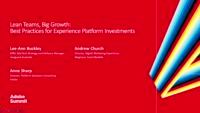
If you want to give a standing round of applause, you want to whistle, etcetera, go for it, right? So I'll introduce Nick, Nick Primola, a dear friend. Nick is the leader of the National Advertisers Association, the premier marketing organization, also leads this Global CMO Growth Council, right? I suspect most of your CMOs, if you're not already a CMO, are members of the CMO Growth Council. So let me invite Nick to the panel.
I use a randomizer because we were trying to say we'll pull the best looking person at the end and there was a real fight over that.
Next up is Nitin. Nitin is a technology leader, a real changemaker, and what I love about the way he focuses on his business, all about he sees technology as a value creation lever within the organization versus the traditional approach of looking at technology as a risk mitigator or a cost center. So Nick-- Sorry, Nitin Ahuja from Verizon.
All right. The third one I'm tremendously proud of being able to invite. Max is, let me do the formal invitation, then I'll give the-- So Max is the Global Leader of Adobe's Marketing Center of Excellence, a marketer amongst marketers. If you're marketing Adobe, you actually have to be really kick ass.
I'm glad he is because he learned while he was working with me, we started consulting together. And he obviously was the brighter one, so he left and went on to bigger and better things. But give a hand to Max Cuellar.
And last but definitely not the least, Karthik. Karthik is another phenomenal, phenomenal partner. He is the whisperer to all the CMOs and CEOs in the consumer market space. He is the Managing Director, Strategy Lead, and Go-to-Market Leader for Adobe's consumer market business and a recovering consultant and a digital leader at Nike, right, previously. So Karthik, welcome.
All right. So all right, let's get this party started. Hopefully the microphones are on. Awesome. [Man] Hello. So maybe the first question, Nick, to you. I'll give this to you. The first question to you, Nick. So we talked about a lot of-- You work with CMOs every day, you created a CMO Growth Council, they're talking about the biggest pain points, etcetera. So what are some of the things that trouble the CMOs today that they're prioritizing? [Nick Primola] How long do we have? So I lead a group or it's a fancy way of saying herding a bunch of cats. It's the CMO Growth Council, and it's about 1,100 CMOs from, I guess, it's called client-side marketers. And together we're tackling the issues that no one individual can tackle no matter what resources they have or don't have. And I guess a good thing for job security, there are a lot of matters that have come up that are priorities, so we meet quarterly to reprioritize and what is the most important thing that we need to do now for us and for our teams. But then what's around the corner? And that keeps changing, quarter to quarter, which is crazy. So that's the number one thing right there is just keeping up. They need to know only what is important for them to make decisions now and for tomorrow, but they need a lot of help. And so that's actually why I'm here. I've been in Adobe Summit, like I was saying, since it was in Park City, Utah. Big difference, by the way, Utah versus Vegas in the vibe. But still nevertheless, I think, what the difference was between then and now is that the industry has come here. I think this is essential for marketers. This isn't just a creativity thing, a designer thing, a coder thing. This is a marketer thing, and marketer meaning it's an enterprise-wide function. And all of what you heard yesterday and today on stage and what's going to continue is that marketing is like an experience function. So when you say it's an experience function, that means it's an enterprise-wide function. So now marketing is too important to be left to just the marketing department doing ads.
That's the most important thing is rethinking the marketing function to be an enterprise-wide function where they are still orchestrating and making sure that data and insights flow through the veins of the organization. And right now, it's not happening. I'll say probably on a scale of 1 to 10, it's like a 3 on average with respect to all the different CMOs from the different brands and there's the top brands in the world in that group. And so they need a lot of help there and so that's what's on their minds is how do they actually not get in front of it, just figure out actually like what it is. So Nick, it's interesting you went to tech and data. So maybe I was going to go to our Adobe Luminaries, but maybe I'll go to Nitin instead first. So Nitin, so we talked about a bunch of technology technological changes. You heard Nick talk about the need for the right data, the right technology, etcetera. As a technology leader, as a partner at Verizon, but just in general, curious about how you look at these things, how do you respond to that, and how do you guide your marketing partners in crime on how to go about that in transformation and journey? [Nitin Ahuja] First of all, thank you for the opportunity to be here. So I think when we look at harnessing this super power of agentic AI or generative AI or AI at scale, we think of it partly from a stakeholder ecosystem standpoint, what is it that really matters to them? When we look at the marketing ecosystem and the marketers today, their lives have become very operational and boring, to be honest with you because they have no control. They have to orchestrate work across so many partners and internal groups, and the burden of operational tasks has significantly increased for them. So I think when we think about agentic AI, it is directly a solution to their problem. It's like the medicine to their pain and has a great promise for them to go back to being strategists for the organization, shift from operational task to high-value strategic task. So clearly, there's an unlock for them there. Now when we think about as a technology organization, as a catalyst of change, our role is how do we drive value from those investments? One of the things that we feel very proud of and I think I feel very strongly about that personally as well is a lot of technology leaders in the business live in a bubble of, "Hey, we're the best at engineering, our code works perfectly, our architecture works perfectly." But I think the emphasis needs to be, we have to be value champions for the business, not just technical champions. And that's a muscle that you have to build over time. And that muscle comes handy no matter whether you're trying to find use cases for AI and drive AI transformation or the previous generation or the next generation. I think that's part of the muscle that we have to build. The third thing I would say is as a leader who manages a big technology ecosystem, we have to be healthy as a technology ecosystem as well. And tech health has its own parameters, right? How lean is your technology ecosystem? How well are you utilizing your platforms? How well integrated they are? When we talk about data, if you have to push data through an ecosystem of 80 to 100 tech partners, that's a challenge in itself. So we've learned that it's very important for us to have tech fitness and we define tech fitness in different ways. One is very strong and robust, what I would say tech governance practice. Looking at our partners, looking at utilization, looking at rationalization, and a maniacal focus on that. And it's very interesting because a lot of times, the next big thing, the next shiny object is expensive and you don't have money in your pocket. But if you have a strong technology governance function, you will realize that it's very easy to self-fund from those efficiencies.
And finance partners love that because I'm going to them with a solution and not a problem. The other thing I also think is very important is speed to innovation. So speed to innovation is very important because all the stuff that's coming at us, how fast can we bring it in our labs? How fast can we go live with some of these capability? And how fast can we-- How effectively can we benchmark this? What we've learned in AI and a lot of this AI work is it's very easy to go to the first launch, but the first launch is mostly not the ROI creator. You have to continuously optimize. So we also believe in test and learn being part of your tech DNA and going back to the tech fitness aspect. Is your ecosystem set up that you can measure those incremental values, you can put those tests in effect and understand the ROI? So Nitin, you had me at market as a board, so maybe let me pivot to the marketer who I know can never be bored. So Max, so what most excites you as you look at the next 12, 18 months? Where are you as a marketer looking to drive innovation, to create the competitive advantage, and to drive growth? [Max Cuellar] I'm going to riff a little bit on their jam. So I've had three chapters to my career. I've been a management consultant.
I've had a marketing chapter which I'm returning to now, and then I was a Chief Data Officer for a large company for HP.
So I've looked at it from a couple different ways.
But I wanted to just go back for a minute to why this is important. I know it's an after lunch session. But it took Adobe-- Adobe's about 42 years old, all right? The average age of a company right now is about 20 years. And it's projected to come down by 2027 to about 12 years. Back in 1950, it was contrast, the average age of a company was 61 years. This is some other consulting research, but I just thought it would be helpful to add a little color. The world is moving really fast.
And it's a milestone that if it took Adobe 42 years old, 21 years to make about $1 billion, and then in the next 20 years, it added another 20.
You have to lean in or not. But you have to have a bias fraction. So back to some of the themes here, what I'm excited about is I've worked in a couple of places. So I've had the advantage of looking across at how marketing works. And I think there's just really two types of possible futures for marketing. You can be a cost center, or you can be a strategy leader. And I think if you're a strategy leader, you need to be a strategy leader by leading in and adopting not just small scale AI experiments but really how do you lead the way through data federation, through large scale application of AI. That is actually the sweet spot that Adobe is in. So I know we all have reticence to thinking about, well, how does AI work with my organization, as an example? And I'd add further to that, that this one is not like the last one. So we used to talk about digital. And as one of our colleagues wrote, digital's a term that's 33 years old. And we're still digitizing. AI is going to happen like wildfire. It is here, it is now, the scale is large, it's time to move beyond experiments. That excites me. The biggest challenge is how to unlock not just AI as a methodology and a tool but how to use data combined with AI in an incredible data-rich part of an average company, which is a marketing function, to really lead the way in how the company thinks about the future product innovation and the like. And I think that the time is now. The time is a little scary. But you've got to absolutely lean in, and Adobe's at the cutting edge of having those conversations with customers, and in fact, having those conversations internally about what the human plus AI future looks like. I think that's why we're a successful, continue to grow 42-year-old company in a world where the average company lives and dies in a much shorter lifespan.
That's well said. But that's also a great tee up for my next question to Karthik because we talked about technology, we talked about the need for marketing being a value creation function, you talked about the role of AI and completely transforming like wildfire. So Karthik, you talk to a range of CXOs, right? And they're always asking about, "Hey, we get that we need to reinvent, but how do I drive the value?" Curious about how you connect-- Maybe in the context of Adobe, how you connect the value equation to the transformation equation to create that sustained growth agenda for them. [Karthik Ramachandran] First of all, thank you for inviting me on this panel.
Two things. I'll talk at a tactical level and then I'll talk at a big picture level.
At a tactical level, it goes back to the first bullet you had in terms of driving growth. What is the outcome I'm trying to drive, right? If I had all the technology I had, what would I do? What kind of experiences would I drive? Because that's what creates value, whether it's top line growth or doing something faster, cheaper, better. So that's the tactical answer. Like it's not capabilities, it's not the specific technology, but what are you going to do about it? So bias for action, whether it's partnering with agentic AI or doing it in an entrepreneurial tiny experiment and launching it at scale.
Now, what is really happening in the world of marketing, I'm going to piggyback on Nick, is experiences are not just a CMO or a CCO sort of function. It is everybody's role, right? It becomes a CFO is involved, a brand president is involved, a chief customer officer is involved...
HR officers are involved because I need to up level my workforce. So it is becoming a much more of an enterprise level opportunity. And to serve that, Adobe has an enterprise platform. So they don't have to-- When enterprises are looking to reinvent, whether they're looking to build another ecosystem, right, they want a technology partner. They don't want a technology vendor. They want somebody where, hey, with an SI, technology partner, and us, let's do some magic. So going back to your point on ecosystems, and that's emerging, that's a very different way of thinking. So that's really, really important from my perspective. And that's great. And maybe just to build on that back to you, Nitin, you talk about...
So obviously, making that transformative leap...
Focused on outcomes, focused on value creation, making sure it's a team sport also has a set of challenges. You are in the throes of-- Every one of us is in the throes of driving that transformative agenda. Curious from your perspective, what are some of the challenges that you think technologists and marketers face today, and any thoughts on how we should think about addressing those as we undertake that journey? I think the organizational overlap or the need for organizational collaboration to drive CX is emerging, as you said, and Karthik.
From our vantage point, it's something we're directly trying to address through our technology ecosystem as well. Typically, you have separate organizations for sales tech, and they started calling them sales tech to rev tech, that term changed two years back, right? MarTech has always been around and now there's CX tech. And so I think we need to, from my vantage point, is really around driving consolidation of your customer facing personalization platforms.
And behind the scenes, I would say, with that centralization, you can actually drive the unified customer experience across domains, across organizations. So it's very essential. You might not be able to consolidate all your technology. It's like a dream, like a unicorn. I think if you can create the last mile personalization system consolidation, and what I mean by that is your customer journey orchestration. You probably don't need a separate system for marketing email to go versus sales email to go. Even if you have that, you can orchestrate those experiences with some consensus, right? I think that's one area where that's a challenge, and that's how we're thinking about solving that as well.
The other thing is adoption. I think adoption is not talked about a lot. We talked about leaps and bounds of AI impact, but what is really the biggest barrier is adoption. So it's funny, like last week I was at a tech conference and we were in a panel and we were talking about, "Hey, what do you think is the killer app for AI, generative AI?" And half the team said, half the members in the room said, "It's productivity amplified." Another half said, "Oh, it's personalization." And I said, "Hey, the killer app is adoption. If you can get adoption to a critical mass of these technologies, then you will unlock the value." So I think the challenge that we face is the, I would say, under emphasis of adoption, and the solution is to have fair investments in those programs. And also, a lot of times when we think about building solutions for our customers and our front lines, there's this HQ versus the end user distance. We have to cross that distance. We have to embed ourselves in the front line. We have to embed ourselves in the voice of the customer. And that is a practice that you have to build, otherwise it will be-- So that's I think a big solution from an adoption perspective. That's great. Max, I'm going to come back to you. So we had a lot of these things. So as you're undertaking this transformative journey...
What tactical advice would you give your fellow marketing, customer experience data practitioners, or growth practitioners around how they should think about doing that as they-- And where should they start? So you know I'm like a factoid guy already at this point, but I'm also like a little history buff. So the era of managerial capitalism, the US goes back to about 1920. It's when companies went from being family owned and family run to the belief that the scale and the complexity required real levels of expertise. The first job, in turn, for the most part was finance. And the forecasting was invented, gave rise to modern consulting. But the second one, it was essentially marketing.
And so marketing in that way for over 100 years has been-- Marketing done well has been the doorway and the entrance for innovation for so many things that companies have adopted, both the professionalization of work, thinking about new and innovative growth models, it's given rise to chief data officers, of which I was one, chief growth officers, chief digital officers. So it's really like this core in the family tree of important jobs and economic development. So I would argue that that era remains. And what I see right now that troubles me in the data and the research is that I just prepared for a Keynote, so I've got some more stats fresh in my head. Something like 86% of our customers are experimenting with GenAI in some way, shape or form. So it's like almost 90%. And yet an equal number have no training, no guidelines, no cross-functional collaboration on it. And so when you think about the implications of that, it's like you've let 1,000 flowers bloom, but then you're trying to run a data strategy alongside it.
You're getting functional point improvements. And it feels more comfortable because it's like you can nest it inside your strategy and planning person or whoever, wherever. But I would argue, to answer your question with that background, that marketers need to be bolder than ever and that those that are not are going to have a lot of time available because they won't be marketers for long. So I think the scale, there's a relationship between the scale at which you adopt AI and scales as you mentioned, right, you may start small. But in particular at the nexus of finance marketing and go-to-market and sales, that I think is an appropriate level which to think about how you do things, and in pipeline management, how you understand demand at a very fine grain, in the enterprise context, that would be like at the sub-not-parent level, how you pick up signal, even if the contact is unknown and build a great data strategy. So I think it's time for marketers to be brave. You've got to go big on AI and the costs of not doing that are going to be huge, you're going to lose compounding advantage and you need to lead the way for the company as a whole.
That's awesome. Nick, maybe a question for you on this because you're the voice of the industry, the 2,000 plus CMOs.
Many of us in this audience, actually, they are our key stakeholder, whether we're on the technology side or we're on the marketing side, brand side, etcetera. What piece of advice would you give the audience over here and how should they engage with their CMO to help their agenda and be a part of that transformation that they need to undertake, being bolder? Yeah, I think it's, I'll say, maybe instead of bold, which still is necessary, I think, we need to be more, let's say, desperate. That in a positive way and not in a-- I mean it like COVID, right? Remember COVID, we just got shit done together with the organization. We didn't use PowerPoints. We didn't go on a three-year plan of reinvention.
You mentioned, what was it like 39%, 45% of CEOs think they need to reinvent, 100% of CEOs reinvented their stuff and marketing was at the table. They weren't like in a different room. They were at the table representing the customer. What were they talking about? Creating value. Whatever that was for your organization, even if it wasn't a product that you were selling at the time, it was creating value in a way that was unique to your organization and marketing was there representing the needs of the customer, the insights of the customer, talking to the supply chain, talking to engineering, talking to service in other countries and here and the employees, right? And so marketing has to recapture that, not desperation, but we're down by two and it's the fourth quarter and there's a minute left on the clock, right? And that's what we have to act like. It's a team sport for sure, but just get going versus trying to keep up with the technology, right? If you have that eye on the prize and you're in it to win it, then the technology should help you do that. And you have to, obviously, adopt the technology because your consumers are, but you have to do it in a way that's going to help you win versus just trying to keep up with the technology because frankly that's impossible.
I was saying, said in another way, just burn the boats.
Get going, yeah. And adopt the technology along the way, but that shouldn't be 35%, 40% of CEOs are looking to reinvent at some point.
They're going to be reinvented, whether they're on the path or not. So let's embrace it. Let's embrace the importance of marketing's role in that equation, like we did for a few months or even a year during COVID times. Karthik, you want to say something? Yeah. Now we talked a lot about technology and experiences and whatnot. When I think about change, change starts with you, right? Don't expect organizations to change when you can't change. You've got to let go of your old processes, let go of your own limiting beliefs and be the leader of change. I'm going to combine some of the comments here. Nick said "Just do it, get shit done," right? If I think about Edison, he didn't come up with the bulb right away. He had like 9,000 plus failures before he invented the bulb. So you got to fail. Fail fast, fail early, experiment, and then figure out how to scale from there, right? And I like Max's point. You have got to think bold, right? Marketing is not about email anymore. It's about growth. Your company's life line is on marketing, right? So if you put yourself as a GM, as a business owner, what would you do, right? I think that's at the heart of it is you are the change, you drive the change. Yes, companies, processes, technology is not perfect. I haven't seen one company that is perfect. But how to navigate that is really important. Well said. All right, so we're going to do a quick rapid fire. All right, this one's for everyone. So we're going to go across. I'm going to ask you, as to, we're in 2025 March, What is the one technology or one trend that most excites you about 2025 as a marketer, as a growth leader? So I'll start left to right. Nick. I think it's a technology-- Not so much a technology as a way of working.
On your performance reviews, you should all have an A plus on works well with others because that's what marketing is and that's what it takes to win, and then technology obviously enables that. It binds it all together, but marketing has to operationally, organizationally, and obviously professionally work well with the organization to be that glue that's going to create the value for the consumer.
Nitin. I think for me, I mentioned at a professional level is really around giving the superpower back to our marketers and having them unleash 34x levels of productivity, really operate on massive scale and optimize at a massive scale. I think at a personal level and even from an ecosystem standpoint, I think this superpower is for us to embrace. I talk about the impact of technology, even in personal life, that gives you the ideas and gets you comfortable with the change. How, even in our personal lives, we can now very quickly summarize information. How can we very quickly research any topic for that matter, right? There used to be an ad about you stayed at Holiday Express last night. I don't know if you guys remember a few years back. That's real. You could become a deep expert in a domain very quickly, much faster. So I think that that whole ability for you to learn and grasp and consume new ideas and new information is something that I'm very excited about. For me, for my family, for my kids, for my peer workers and also my stakeholders.
Can I just get the flip side of that before you get to Max, which is, if you're not doing that, you're an opportunity cost for your company. It's too important not to do that, and that's not a nice thing to do. You're representing not just yourselves, but your teams internally and your agencies as that force multiplier for growth. If you're not leading the way on that doing everything you just said, you're an opportunity cost and it's too important for that.
So what I'm very consistent with the themes what I'm most excited about is that all of us in this room are going to be on one side of this in 2025, right? Either you go big, and you go brave, and you go bold, and you take the risk at times, and you start to mold your organizations in a way that they can work and you integrate the AI into the workflows, right? That seems to be really, really, really back to the adoption is a killer app, right? Or you don't. And it's going to get harder to make that change. If you think about the world that's ahead of you, yeah, I could say I'm really excited about agentic and agentic orchestration, but the reality is there's going to be lots of agentic orchestrators inside a company potentially marketing and selling to other agents outside the company. How do you deal with that, right? And so being at the forefront of these big philosophical transformational questions that affect not just how we market, not just how we sell, not just how we engage customers, not just how jobs are created but what's the future of human labor? These are giant and important questions and you all get to be at the front seat of that if you make the bold moves, right? So I think from an anthropological, historical perspective, you are in a really, really, really interesting time. But it does require boldness even as we live in a world that is fragmented, where there's a lot of fear, a lot of concern, where some parts of it we're working on are deflationary, not job creating. There's a lot of thorniness to this, but you are at the forefront of it. And adopting that and getting maybe some combination of the boldness, the swagger, the bravery, the vision, all together in centering, not just an individual but in your organizations, there could not be a more exciting time to live and work and think about these things.
Okay, very, very similar mindset and ideology. As humans, we do two things. We think and we do. The doing aspect of it is going to get shortened by agentic AI, AI, GenAI, right? So what took three days will take three minutes. What took three weeks takes three hours, right? So what are we going to do, just sit around for the rest of the time? No. You got to think. You got to be innovative. You got to come up with bold ideas to create more value and technology advances humanity. So this is an era where I firmly believe be bold, be courageous, leverage AI. How do you partner with AI? There's a lot of talk about is AI going to replace humans? No, humans plus AI will replace humans for sure. So how are you going to work with AI to elevate your game is what I think about all the time.
Perfect. Gentlemen, thank you. I know we're out of time. We could have this conversation for another two hours.
And I'm glad we only used AI 51 times.
But more importantly, I think that if the three things you want to take away from this, ask yourself these three simple questions, right? One, in your market, in your industry, are you seeing some of these shifts we've talked about, the panelists talked about and stuff.
Are you seeing your customer expectations change, right? As I said, it doesn't matter if you're B2B, B2P, whatever. Are your customer expectations changing? And then most importantly, is your business model, your talent model, your leadership model keeping up with that chain. With that, thank you, panelists. Thank you. Thank you. Thank you.
[Music]