What Is Conversational AI: A Guide for Enterprises
.

Delivering more intuitive, human-centered digital experiences.

As digital interactions become more conversational, expectations for how people access information, support, and services are evolving. Users increasingly value experiences that are intuitive, contextual, and easy to navigate, regardless of channel or touchpoint.

Conversational AI is emerging as a key enabler of this shift. By allowing people to engage through natural language, it helps simplify complexity, connects users with the right information, and creates more seamless paths to achieving outcomes. As for enterprises, it presents a significant opportunity to rethink how people engage with their processes, expertise, and offerings.

This article explores how conversational AI works, the technology behind it, and its role across the modern enterprise. Discover how organizations can use these capabilities to create more responsive, personalized, and human-centered experiences for both customers and employees.

A customer wants to track an order. An employee needs a policy document. A buyer is evaluating products. Traditionally, each of these tasks required manually navigating websites, applications, menus, or knowledge repositories.

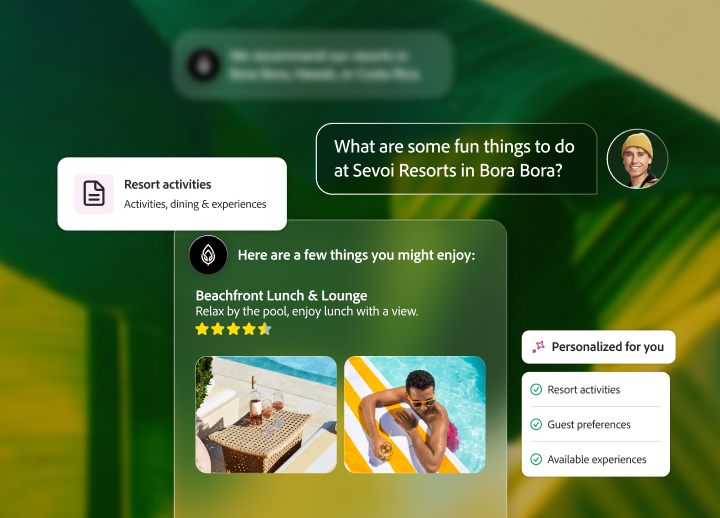
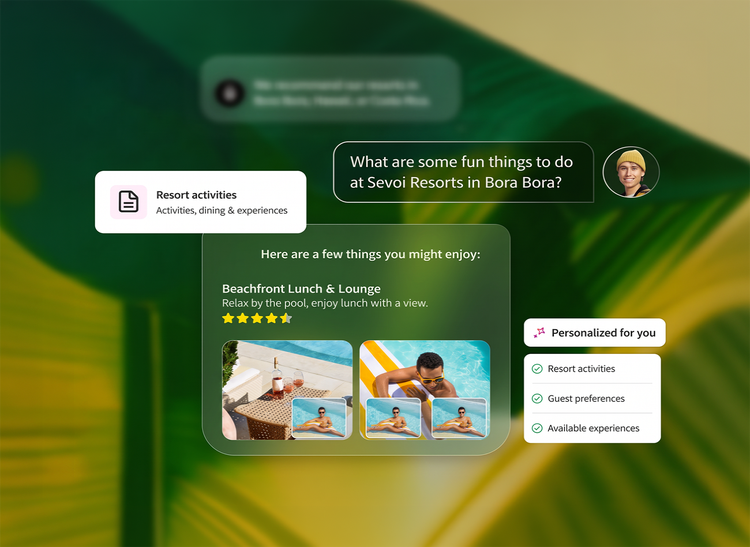
Today, people expect a simpler path — ask a question and get an answer. By enabling natural, human-like interactions that are consistent, trusted, and personalized across chat, voice, messaging platforms, virtual assistants, and enterprise search, conversational AI allows people to engage with technology using everyday language. Instead of learning how a system works, users can simply describe what they need and get the information or assistance they're looking for. This is changing how people interact with digital experiences, making conversational AI an increasingly important interface between users and the systems they rely on.

79%

of consumers using AI for online shopping report feeling more confident in a purchase after using an AI assistant.1

69%

say they are less likely to return an item they bought with the help of an AI assistant.1

The journey of conversational AI began with ELIZA, the pioneering chatbot developed by Joseph Weizenbaum at MIT in 1966. Over time, advances in natural language processing (NLP), machine learning, and generative AI have made conversational systems more capable and flexible. Today, conversational AI is redefining how enterprises connect customers to services, employees to knowledge, and questions to outcomes. Instead of directing people through predefined journeys, these systems can respond to questions and needs as they come up, helping organizations better understand intent and reduce friction across digital experiences.

Let’s take a closer look at how the technology works, where it's being applied, and the value it's delivering across industries.

What is conversational AI?

Conversational AI enables machines to understand, process, and respond to human language, spoken or written, in a natural, back-and-forth manner. It allows users to communicate with systems using natural language instead of navigating menus, memorizing commands, or following rigid workflows.

Conversational AI combines several capabilities that work together, such as:

  • Natural language processing (NLP): Processes and interprets human language.
  • Natural language understanding (NLU): Determines the meaning and intent behind a user's words.
  • Natural language generation (NLG): Generates human-like responses that are clear, relevant, and contextually appropriate.
  • Speech recognition: Converts spoken language into text, enabling voice-based interactions.
  • Dialogue management: Orchestrates the flow of conversations, determining how the system responds based on user intent, context, and business rules.
  • Machine learning (ML): Improves system performance over time by learning from interactions and data.

Together, these capabilities enable conversational AI systems to deliver personalized and human-like interactions across a wide range of business workflows.

How conversational AI differs from generative AI.

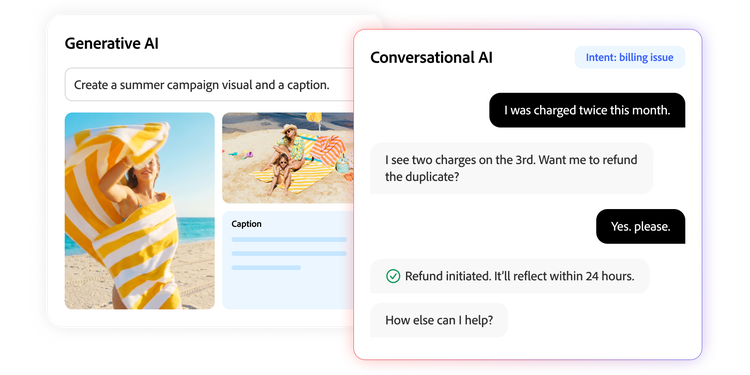
Generative AI is designed to produce new content from a prompt, whether that's text, images, code, audio, or video. Conversational AI is designed to create a dialogue. Its job is to understand intent, remember context, manage follow-up questions, and keep an interaction moving naturally toward an outcome.

A simple way to think about it is:

  • Generative AI creates.
  • Conversational AI engages.

However, the two technologies are interconnected. Modern conversational experiences often rely on generative AI models to produce more natural and flexible responses than the scripted chatbots of the past.

Conversational AI vs. generative AI
Dimension
Conversational AI
Generative AI
Primary purpose
Facilitates a natural, ongoing dialogue
Creates new content from a prompt
Output type
Context-aware responses
Text, images, video, code, and more
Use of context
Tracks conversation history, intent, and follow-up questions
Uses context when provided, but isn't inherently conversation-centric
User experience
Feels like interacting with an assistant or agent
Feels like requesting content creation
Role
Enhances service, support, search, and workflow experiences
Accelerates content creation and knowledge work
Example
An AI assistant resolving a billing issue
An AI tool generating a marketing image
In short, generative AI expands what machines can create, while conversational AI transforms how people interact with them.
Illustration showing generative AI creating content from prompts and conversational AI interacting through dialogue and responses.

How does conversational AI work?

Conversational AI relies on several capabilities working together to interpret user input and determine an appropriate response. The process begins when a user submits a question or request through a conversational search interface. The system then analyzes the input to understand both the words being used and the intent behind them. It considers context, such as previous messages, user preferences, or earlier actions, to maintain continuity throughout the conversation. Once the request is understood, the system generates and delivers a response.

At a high level, the process follows four steps:

Capture a user's question or request.

Interpret language, intent, and context.

Generate the most relevant answer or recommendation.

Trigger a workflow or retrieve information from connected systems.

Together, these steps allow conversational AI to provide a more direct way for users to access information, complete tasks, and interact with digital systems. Across industries, organizations are embedding conversational experiences directly into customer journeys, project workflows, and everyday business operations.
Industry applications of conversational AI
Industry
Conversational interface
Example use case
B2B ecommerce
AI shopping assistants embedded in ecommerce sites, customer portals, or procurement platforms
A buyer asks, "Which industrial pumps meet food-grade compliance standards and are available for delivery this week?" The assistant compares products, checks inventory, and recommends options.
Finance
Banking chatbots, mobile banking assistants, and voice banking systems
A customer asks about a recent transaction, requests a credit card limit increase, or receives information about loan types through a conversational interface.
Healthcare
Virtual health assistants, patient portals, and voice-enabled support systems
A patient schedules an appointment, checks insurance coverage, or accesses pre-procedure instructions.
Media and entertainment
Streaming platform assistants, recommendation engines, and content discovery interfaces
A subscriber asks, "What are some crime dramas similar to this show?" and receives personalized recommendations based on viewing history.
Manufacturing
Conversational search tools, digital worker assistants, and shop-floor support applications
A technician asks, "How do I calibrate this machine?" and instantly receives relevant documentation, troubleshooting steps, and maintenance guidance.
Travel and hospitality
Travel assistants, hotel chatbots, and voice-enabled guest services
A traveler changes a booking, checks flight status, requests hotel services, or receives destination recommendations through a conversational experience.
The underlying goal in every industry remains the same — making information, expertise, and services easier to access through conversation.

Understanding different types of conversational AI.

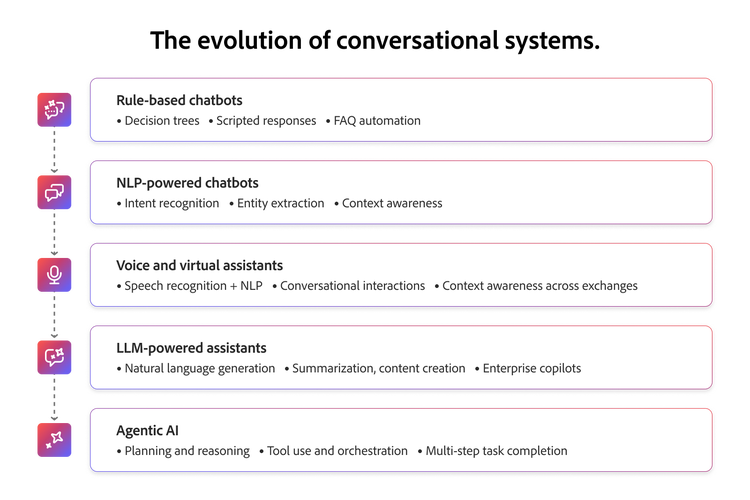
Conversational AI is often equated with chatbots, but enterprise applications extend far beyond a simple chat window. To deliver more intuitive experiences, it has evolved into a spectrum of capabilities, from answering basic questions to completing complex tasks with human oversight.

Common types of conversational AI include:

Chatbots:

They are the most widely recognized form of conversational AI. Chatbots interact with users through text-based conversations to answer questions, provide information, and guide them through common processes. They are commonly used across websites, mobile apps, customer service portals, and messaging platforms. While early chatbots relied on predefined scripts and decision trees, modern AI-powered chatbots can understand varied phrasing and support more flexible conversations.

Virtual assistants:

They help users complete tasks through conversational interactions. By integrating with business systems, virtual assistants can retrieve information, answer questions, and execute actions such as scheduling meetings, managing accounts, or processing requests. They typically operate in response to user instructions and are often embedded directly into employee and customer experiences.

Voice assistants:

They bring conversational AI into spoken interactions. Voice assistants allow users to make requests using spoken words and receive responses through voice-based interactions. These capabilities are frequently used in call centers, IVR systems, customer service environments, and voice-enabled devices to enable faster, more accessible support.

AI agents:

They represent the next evolution of conversational AI and are increasingly being used within enterprise systems and applications. AI agents can reason through objectives, create plans, and coordinate multiple actions to achieve a desired outcome within defined guardrails. By combining conversational capabilities with decision-making and task execution, AI agents can support more complex workflows within defined parameters with appropriate human oversight.

These forms of conversational AI differ in how they interact with users and the level of support they can provide, ranging from answering straightforward questions to assisting with more complex, multi-step tasks.
Flow chart illustrating the evolution of conversational systems.

Enterprise use cases for conversational AI.

Conversational AI can become more valuable when it connects users with information and actions across multiple systems. Interactions are no longer limited to a single channel or application. Enterprises can use conversational interfaces to help guide customers from intent to discovery, decision, action, and support while keeping the experience personalized, context-aware, and consistent across all touchpoints. Conversational AI can also help employees move easily across connected workflows. This can create a more consistent experience as users switch between channels, systems, or stages of a task.

Some of the important use cases include:

Marketing and sales:

Conversational entry points replace static forms in the customer journey, making it easier for prospects to engage on their own terms. By drawing on intent, context, and information already shared, conversational AI can guide product discovery, qualify leads, answer questions, and deliver personalized recommendations across channels.

Enterprise scenario: A prospect researching cybersecurity solutions asks questions through an AI assistant on a company's website. When they return later with additional questions, the system can use context from previous interactions across channels, including email and support channels, to provide more relevant responses, creating a more personalized customer experience.

Customer enablement:

Conversational AI can help deliver guided, personalized onboarding experiences that accelerate time-to-value and improve customer adoption. Rather than relying on static documentation, training portals, and email sequences, customers can receive contextual guidance, recommendations, and proactive support tailored to their goals and usage patterns.

Enterprise scenario: A software company uses conversational AI to guide enterprise customer onboarding, answering questions, surfacing resources, scheduling training, and identifying adoption gaps. This helps customers reach key milestones faster with less reliance on support teams.

Commerce:

Conversational AI can support customers throughout their buying journey, from discovery to post-purchase support when connected to commerce, inventory, order management, and service systems. Maintaining context across interactions can drive guided product discovery, personalized recommendations, and seamless handoff to commerce or support. In more advanced implementations, conversational AI agents can also help complete tasks such as placing orders, tracking shipments, or initiating returns.

Enterprise scenario: A customer discovers products, compares options, completes a purchase, tracks delivery, and initiates a return through a single conversational experience, without switching systems or repeating information.

Customer support:

Conversational AI helps unify support services across chat, voice, messaging, and self-service channels. The system maintains context throughout the customer journey and can seamlessly transfer conversations to human agents when needed. This type of interaction is expected to become increasingly common, with Gartner predicting that by 2028, at least 70% of customers will use a conversational AI interface to start their customer service journey.2

Enterprise scenario: A customer starts resolving a billing issue through web chat and later transitions to a support representative. Because context travels with them, previous interactions and troubleshooting steps don't need to be repeated, reducing friction and accelerating resolution.

Employee enablement:

Employees spend significant time navigating disconnected systems to find information, complete requests, or access expertise. Conversational AI provides a common entry point that spans functions such as HR, IT, finance, procurement, and onboarding. This helps employees access information through dialogue compared to relying on traditional search queries or navigating multiple systems.

Enterprise scenario: A new employee uses a conversational assistant to manage benefits enrollment, equipment requests, training, and expense reporting through a single experience, eliminating the need to navigate multiple systems.

Across these use cases, conversational AI helps connect people with the information, support, and actions they need through a more direct interface. For customer-facing conversational AI, delivering that consistency requires approved product information, brand voice, claims guidance, and business rules, so responses stay accurate and compliant.

Key benefits of conversational AI.

The benefits of conversational AI extend well beyond automation as it is adopted across enterprise functions and workflows. It can deliver meaningful business value across customer, employee, and operational experiences.

Some of the key benefits include:


1. Consistent customer experiences across channels. Customers often interact with a brand through multiple channels, including web chat, mobile app, and on-call support. Conversational AI helps ensure those interactions feel like part of the same journey. By providing a shared conversational layer across channels and business units, it helps enterprises deliver consistent information, product guidance, and brand experience regardless of where or how customers engage. This reduces fragmentation while helping build trust and loyalty over time.


2. Improved accessibility and inclusion. Conversational AI enables people to interact using natural language, making digital experiences more accessible to users with disabilities, different language backgrounds, or limited technical expertise. By guiding users through tasks and helping them find information more easily, it lowers barriers to access for both customers and employees.


3. Deeper insight into customer intent. Every conversation contains valuable signals about what customers are trying to accomplish, where they encounter friction, and what matters most to them. When analyzed at scale, these interactions become a valuable source of insight. It helps enterprises identify emerging needs, uncover recurring pain points, refine customer experiences, shape product roadmaps, and make more informed business decisions based on real customer intent.


4. More relevant and personalized interactions. Customers increasingly expect experiences tailored to their specific needs and context. Conversational AI incorporates information such as prior interactions, preferences, purchase history, and customer profiles into each exchange. The result is a more relevant and seamless experience, with interactions shaped by the customer’s context and current needs.


5. Greater operational and cost efficiency. Conversational AI helps enterprises scale engagement without increasing resources at the same rate. Automating routine inquiries and streamlining common workflows reduces the burden on customer-facing and internal teams. This allows employees to focus on higher-value activities while lowering operational costs, improving efficiency, and maintaining service quality as demand grows.


These broader benefits can also translate into practical improvements in day-to-day service and support. Conversational AI enables organizations to help customers across time zones, shorten response times for common requests, improve consistency in guidance, and expand access to self-service support.

As conversational AI becomes more integrated into enterprise workflows, its role can extend beyond basic automation to support more responsive customer experiences and more efficient internal operations.

What to consider when deploying conversational AI.

For conversational AI to deliver value at enterprise scale, organizations must ensure that experiences remain accurate, secure, and effective over time. This can be achieved through the following key considerations:

Foundational knowledge management.

A conversational AI system is only as reliable as the information it can access. If responses are based on outdated, incomplete, or inconsistent content, trust can quickly erode. Accurate responses depend on access to trusted sources, such as product documentation, policies, and operational systems. Those sources also need to be regularly maintained so the information remains current. Without a strong knowledge foundation, even the most advanced conversational AI experience will struggle to deliver consistent results.

Governance and compliance.

Governance is essential as conversational AI expands across customer and employee experiences. Organizations need to establish clear policies for areas such as data access, privacy, security, permissions, auditability, and human oversight. These requirements become especially important when conversational AI operates across multiple business units or regulatory environments. A strong governance framework helps organizations maintain responsible and compliant AI use as adoption grows.

Systems integration.

Conversational AI is more useful when it can draw on the systems and information employees and customers already rely on. Integrations with CRM platforms, ERP systems, ticketing tools, knowledge repositories, and identity services can help conversational AI retrieve relevant information and support actions within existing workflows. These connections also need to be implemented securely so access and data use remain appropriately controlled.

Operational ownership.

Conversational AI is a continuously evolving capability rather than a one-time implementation project. Customer expectations evolve, products change, policies are updated, and business priorities shift. To remain effective, conversational experiences require ongoing monitoring, evaluation, and refinement, with clear ownership across business and technology teams.

Ultimately, the biggest challenge is building a conversational AI system that remains accurate, governed, integrated, and relevant as the business evolves. Organizations that establish this foundation early are better positioned to turn conversational AI from a promising pilot into a sustainable competitive advantage.

Getting started with conversational AI.

The most successful conversational AI initiatives start with a clear business objective. Enterprises must ensure that conversational AI addresses a specific need and does not merely become a solution in search of a problem. You can begin by:

Defining a specific use case and success metrics, such as improving customer satisfaction, reducing resolution times, or streamlining employee support.

Assessing the content and knowledge sources that will power the experience and addressing any gaps before deployment.

Establishing human oversight from the outset, with clear escalation paths, review processes, and monitoring mechanisms for complex or sensitive requests.

Piloting in a limited scope to measure results, apply lessons, and build stakeholder confidence before scaling.

With the right foundation in place, you can gradually extend conversational AI across your organization. This creates consistent experiences while uncovering valuable insights from every interaction.

As conversational AI evolves, brands need more than a chatbot. They need governed, connected, and brand-aware AI experiences that can guide customers through discovery, decisioning, and support. Explore how both Adobe CX Enterprise Coworker and Adobe Brand Concierge enable this shift by combining conversational and agentic AI capabilities to deliver more personalized, context-aware customer experiences at scale.

Let’s talk about what Adobe can do for your business.

Get started


New message from advisor