Adobe Real-Time CDP Features
Full funnel activation
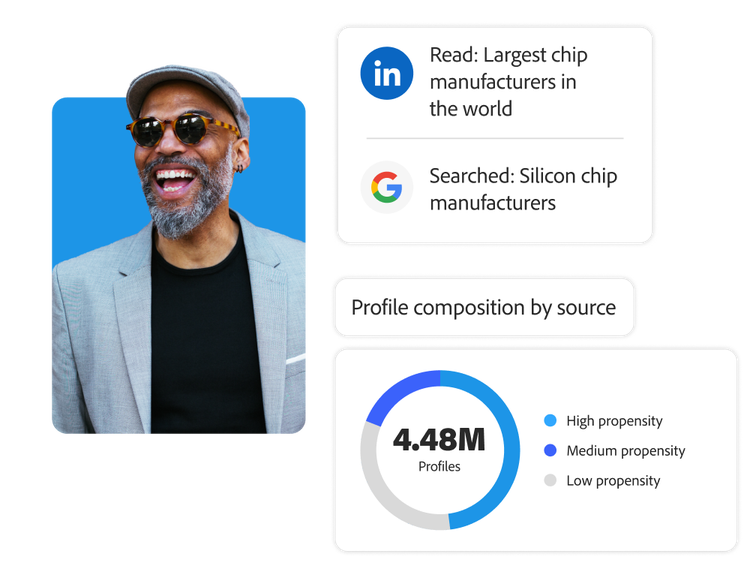
Activate your B2C and B2B audiences in real-time everywhere, across both Adobe and non-Adobe marketing applications. Real-Time CDP helps you deliver more targeted customer experiences and in-the-moment personalization that helps prospects convert and keeps buyers engaged and coming back for more.
Adobe Real-Time CDP Collaboration
Real-Time CDP Collaboration simplifies how organizations can drive joint audience analysis, activation, and measurement to reach prospects and customers across channels — all while prioritizing customer and data privacy. Organizations can enhance advertising and co-marketing efforts by working with trusted brands and publishers to gain a deeper understanding of prospects and customers and meet them where they are.
- Discover. Identify and better understand high-value audiences for engagement and campaign planning across collaboration partners.
- Activate. Brands and publishers work together to reach relevant audiences across channels, such as connected TV, commerce media, walled gardens, digital audio, and DSPs.
- Measure. View campaign performance and reporting in a single environment to inform advertising and co-marketing efforts.
Learn more | Learn more about Adobe Real-Time CDP Collaboration
Partner data support
With partner-sourced prospect profiles and partner data that doesn’t rely on third-party identifiers, you can reach new customers and enrich your first-party data without cookies for more impactful personalization and business results.
- Customer acquisition and addressability. Reach net new customers and reduce dependency on third-party cookies by using cookieless identifiers as well as hashed PII from data partners of your choice.
- Full-funnel marketing in a single system. Prospect, personalize, and convert prospective and known customers in a single system.
- Built on a foundation of trust. Market responsibly by governing partner data and profiles with patented data usage, labeling, access controls, and more.
Destinations
Activate campaigns, email, targeted advertising, and more with pre-built channel integrations. And use SDKs to create custom destinations of your choosing.
- Person and account-based audiences. Deliver audiences based on person or account identities for flexible activation for B2C and/or B2B campaigns.
- 100+ destinations. Choose from advertising, analytics, email, personalization, agentic, survey, and voice of the customer partners for easy access to where your consumers spend time.
- Flexible destinations. Use SDKs to build custom destinations into bespoke or internal systems and endpoints.
- Marketer workflows. Use guided workflows to activate audiences to destinations and to understand how they’re being utilized across the enterprise.
- Embedded controls. Enforce governance and make sure only appropriate data is leveraged for personalization by ecosystem partners.
Orchestration
Plan customer journeys on an easy-to-use canvas.
- Signals beyond marketing. Improve customer experiences by using signals beyond marketing touchpoints, for a more holistic view of customer behaviors and needs.
- Outcome-focused approach. Move customers toward conversion with in-moment actions based on defined conditions.
Real-Time CDP Connections.
Efficiently collect and use event-level data directly without needing third-party cookies or legacy integrations.
- Data collection. Use Adobe Experience Platform Edge Network to scale data requests securely.
- Event forwarding. Use server-side data event forwarding in real time.
- Tag management. Simplify management of analytics, marketing, and advertising tags using our industry-leading tag management system to consolidate web, mobile, and server APIs.
- Web and mobile SDKs. Collapse and compress all Adobe product libraries into a single development kit for web and mobile platforms.
Real-time streaming ingestion, segmentation, and activation
Engage your customers in exactly the right moment by ingesting, processing, and activating data at speed and scale. Real-Time CDP lets you stream data in real time from Adobe and non-Adobe systems for faster insights and time to market.
Learn how to use audience activation features.
Find out everything you need to know about Real-Time CDP activation and more in Experience League - our vast collection of how-to content – including documentation, tutorials, and user guides.
Learn more | Learn more on how to use audience activation features
Questions? We have answers.
What is audience activation in Adobe Real-Time CDP?
Audience activation refers to the process of turning rich, unified customer profiles into actionable audiences that can be used across channels—email, paid media, in-app messaging, call centers, agentic conversations, and more. In Adobe Real-Time CDP, this capability is deeply integrated with the platform’s real-time profile store, allowing you to immediately act on behavioral and contextual data as it changes.
For marketers and creatives, this means you can design campaigns that respond to customer signals in real time. For IT and data teams, it means building stable pipelines that reliably sync audiences to downstream systems without manual overhead. For CIOs and CMOs, it ensures that personalization efforts are not only fast, but consistent, compliant, and scalable.
How does audience activation work within Adobe Real-Time CDP?
The process starts by segmenting customers using unified profile data in real-time—this can include demographic information, real-time behaviors, transaction history, consent status, and more. Once a segment is built, Adobe Real-Time CDP syndicates the audience for in-the-moment activation to destinations using prebuilt connectors, APIs, or batch/streaming workflows.
Activated audiences can be sent to:
- Paid media platforms (e.g. Google, Meta, LinkedIn) for targeted advertising.
- Adobe tools like Journey Optimizer and Target for real-time personalization.
- CRM, email, and push systems to trigger lifecycle campaigns.
- Internal systems for customer service, loyalty, or sales enablement.
What sets Adobe apart is the speed and intelligence of this process. Profiles update in milliseconds, and segments can recalculate and activate based on new behaviors as they occur—no manual refresh needed.
How fast is activation? Can I use real-time signals?
Yes. Real-Time CDP was built for immediate activation and in-the-moment engagement. It supports real-time streaming of both data ingestion and audience activation. That means you can trigger activations and personalization within milliseconds of a user browsing your website, abandoning a cart, or engaging with a mobile app.
This velocity allows creative and marketing teams to stay contextually relevant — catching the moment of intent with the right offer, message, or journey. It also helps product and IT teams reduce reliance on outdated batch jobs that introduce delay and friction.
Can I activate audiences across both B2C and B2B channels?
Yes. Adobe Real-Time CDP supports both individual profiles (B2C) and account-based profiles (B2B). You can build audiences of people and audiences of accounts and activate them across platforms that support consumer or business-focused engagement.
For example:
- In B2C, a travel brand might target individuals who showed interest in summer packages but haven’t booked yet.
- In B2B, a software company might target all decision-makers within accounts showing late-stage buying behavior to accelerate conversion.
This dual support enables CMOs to unify marketing operations across buyer types, and CIOs to manage a single platform for all customer data initiatives.
How does Adobe Real-Time CDP ensure that activated audiences comply with privacy regulations?
Compliance is enforced at every stage—from segmentation through activation. Adobe Real-Time CDP uses label-based data governance, consent and rights management, and workspace-level controls to ensure that only data with appropriate permissions can be activated.
Teams can restrict audience use by criteria such as geography, brand, or data sensitivity. Real-Time CDP also integrates with consent systems, allowing you to exclude individuals who have opted out of targeting or data sharing. This gives legal, marketing, and IT leaders confidence that personalization efforts won’t jeopardize compliance.
Can I coordinate audience activation across channels and teams?
Yes. Real-Time CDP supports collaborative audience creation and cross-channel orchestration. You can define audiences once and activate them in multiple tools—from advertising to email to web personalization—ensuring consistency across touchpoints.
For example, a single “high-value prospects” audience can be used to:
- Trigger ads on LinkedIn and Google Ads.
- Sync with Adobe Journey Optimizer for personalized email journeys.
- Feed into Target for onsite content personalization.
- Alert sales teams in CRM for real-time follow-up.
This coordination breaks down channel silos and helps creative, media, and lifecycle teams deliver unified experiences across the customer journey.
How does audience activation connect to business outcomes?
Effective audience activation increases conversion rates, reduces wasted ad spend, and improves customer lifetime value. When profiles and segments are real-time, you can:
- Reach customers when they’re most likely to convert.
- Suppress irrelevant audiences to avoid wasted impressions.
- Scale personalized journeys without increasing headcount.
- Measure ROI at the audience level to refine strategy.
For CMOs, this translates into higher campaign performance and better attribution. For CIOs, it delivers more value from existing data investments, streamlined architecture, minimal data movement, and ensures enterprise systems remain interoperable and compliant.