In Adobe Real-Time CDP, composability refers to a flexible approach that allows enterprises to activate data wherever it lives, without unnecessary duplication or movement. Organizations can ingest data directly from enterprise data warehouses for low-latency experiences, build audiences from warehouse datasets without copying underlying data, or combine both approaches based on use case needs. This flexibility enables unified, intelligent profiles while supporting scalable personalization and better data governance.
Enterprises increasingly rely on cloud data warehouses as the foundation for collecting, storing, and managing large volumes of customer data, including historical transactions and past interactions. Marketing teams typically require only a subset of this data to create audiences and deliver timely, personalized experiences. A composable approach allows organizations to harmonize zero-, first-, second-, and third-party data for activation without moving or duplicating entire datasets, supporting faster adoption and operational efficiency.
Ingesting data involves bringing data directly from enterprise data warehouses into Adobe Experience Platform to power low-latency, in-the-moment experiences. Federating data allows audiences to be built and enriched directly from warehouse datasets without copying the underlying data. Adobe Real-Time CDP supports both patterns — as well as combinations of the two — so organizations can choose the most appropriate approach for different datasets and use cases.
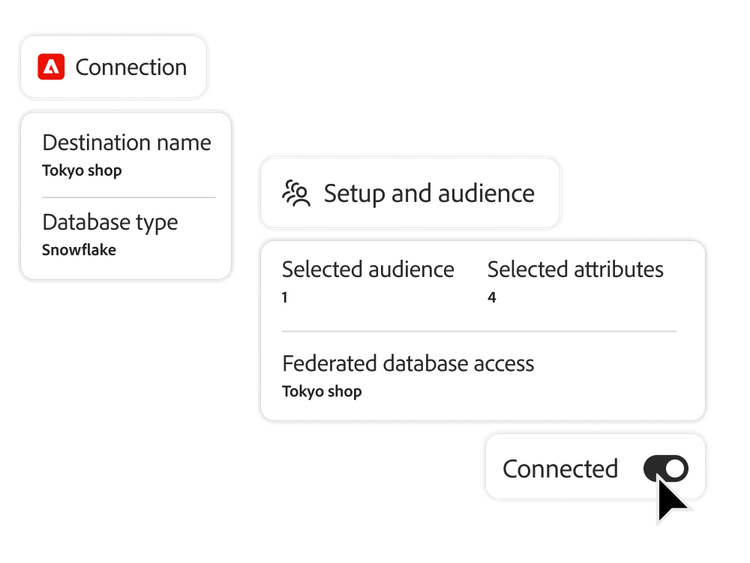
Federated Audience Composition allows customers to create audiences directly from their enterprise data warehouse and enrich existing audiences with attributes from warehouse partners. With this approach, customers can query relevant datasets in a single environment to support segmentation, targeting, and activation, while continuing to ingest data from internal and external sources as needed. This helps minimize data copy, govern sensitive data usage, and optimize IT investments.
Yes. Adobe Real-Time CDP enables organizations to activate warehouse data while also supporting real-time experiences. By selectively ingesting data needed for low-latency interactions and federating other datasets, customers can power real-time personalization, same-page experiences, and cross-channel activation without having to migrate or duplicate all warehouse data.
Composable data connectivity allows IT teams to maintain control over data governance, privacy, and security by keeping sensitive data within enterprise systems. At the same time, marketing teams can access relevant audience data through a marketer-friendly interface to create, enrich, and activate audiences across channels. This unified approach simplifies workflows, reduces data duplication, and supports consistent, scalable delivery of personalized experiences.