Strategy
Clear AI vision with ownership and investment commitments.



Financial services leaders see enormous potential in AI, but investment alone won’t translate into impact. This report looks at the operating model needed to scale AI and five decisions that set AI Leaders apart.
Financial services organizations are deploying artificial intelligence (AI) across customer acquisition, lifecycle marketing, digital onboarding, customer communication, offer personalization, and advisor-enabled experiences. This adoption is expanding across banking, insurance, payments, and wealth management functions. The central question is whether the operating models supporting these deployments are evolving at the same pace. For many organizations, it is not.
AI initiatives often progress within individual functions. Retail banking, insurance marketing, wealth management, risk, compliance, and technology teams may each work from different systems, have different priorities, and follow different review calendars. Suitability requirements, disclosure obligations, model risk controls, and regional financial promotion rules add necessary safeguards, but sequential handoffs can make it difficult to test, refine, and scale customer-facing applications. Marketing leaders may therefore have limited visibility across the full portfolio of AI activity.
Processes designed for slower product development and regulatory cycles can struggle to support AI’s need for rapid iteration, clear decision rights, shared data, and continuous measurement. Without these foundations, successful deployments remain isolated, and investment becomes harder to defend.
This report examines five operating model decisions made by the strongest AI Leaders in the study. Together, these provide financial services marketing leaders with a practical framework for generating more value from investments already underway.

Ashley Cheretes
This report draws on global research conducted by Incisiv on behalf of Adobe.




MARKETS COVERED
Australia and New Zealand, Central Europe, India, Japan, Latin America, the Middle East, North America, Southeast Asia, South Korea, the United Kingdom (UK) and Ireland, and Western Europe.
The 342 AI Leaders referenced in this report come from the full study population of 5,633 senior executives across 12 industries. They form a global, cross-industry cohort rather than a financial services-specific group and provide the benchmark for comparing performance in the financial services industry.
Each organization was assessed across six operating model pillars, with each pillar scored on a scale of 1 to 5. The six scores were combined into an operating model maturity (OMM) composite, providing a consistent measure of the structures and practices supporting AI deployment.
Strategy
Clear AI vision with ownership and investment commitments.

Structure
Dedicated AI ownership with budget authority.

People
Roles and culture evolving for an AI-enabled environment.

Governance
Risk frameworks calibrated for AI velocity.

Technology
Infrastructure built for scale, not just pilots.

Workflows
AI embedded into how work is actually done.
To qualify as a Leader, an organization had to meet two criteria: achieve an OMM composite above the top-quartile threshold of 3.27 and operate at the expanding or transforming stage of AI deployment. By applying both criteria, we identified 342 Leaders across 12 industries, equivalent to 6% of the 5,633 respondents.
These organizations have established the ownership structures, governance, measurement frameworks, technology foundations, talent, culture, and ways of working needed to make AI deployment repeatable and sustainable. This designation reflects the measured operating model maturity and deployment stage, rather than respondents’ assessment of their own performance, the amount invested in AI, or the number of isolated pilots launched.



Across Adobe’s global research, 342 organizations stood apart in both AI deployment and operating model maturity. This cross-industry group of AI Leaders provides a benchmark for financial services, revealing five decisions that help turn AI investment into sustained impact.

Leaders are 4.7 times more likely than financial services organizations to have a formal AI owner with title and budget authority, creating clear accountability for priorities and decisions that cross business and functional boundaries.

Leaders establish the ROI framework before deployment. Among Leaders, 44% measure AI ROI comprehensively, compared with 14% of financial services organizations, giving them stronger evidence to support funding, scaling, and future investment decisions.

Among Leaders, 81% operate with collaborative or integrated business-IT relationships, compared with 25% of financial services organizations. Shared objectives and accountability help both sides resolve data, technology, governance, and measurement issues together.

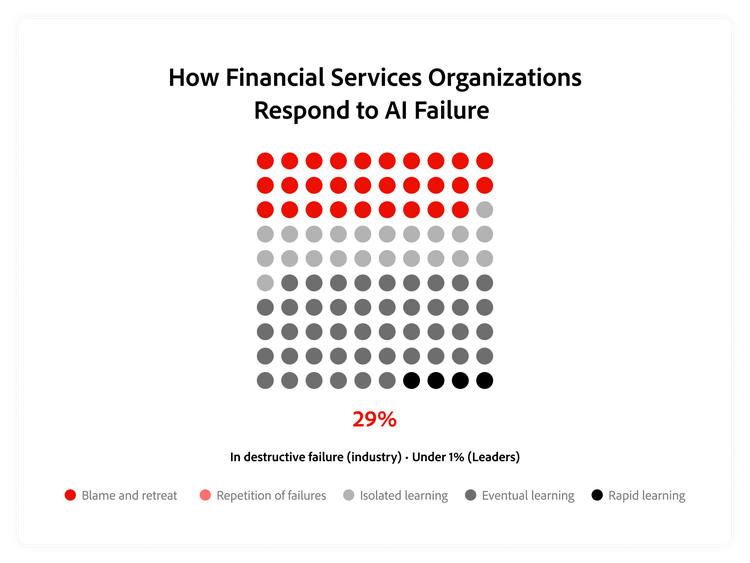
Leaders treat underperformance as information that can improve the next deployment. While 29% of financial services organizations exhibit destructive failure patterns involving blame or repetition, the corresponding figure among Leaders is less than 1%.

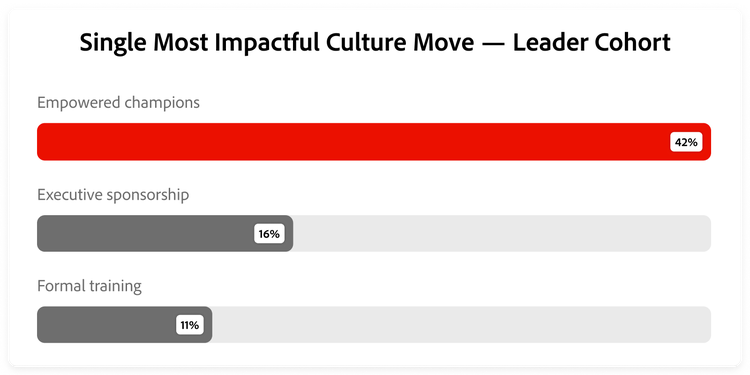
Among Leaders, 42% identify finding and empowering internal champions as their most effective cultural action, ahead of executive sponsorship at 16% and formal training at 11%. These proven practitioners help translate adoption into repeatable practices.
PART ONE
Among financial services organizations, 60% are in the Frozen Middle, which means AI is active within individual functions, while the coordination needed to scale it remains limited.
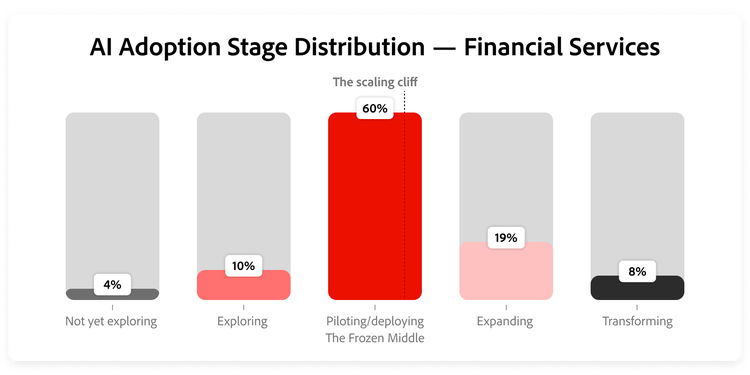
Financial services organizations adopt AI one use case at a time. Prospect propensity models may sit within customer acquisition, churn-prevention tools within lifecycle marketing, and advisor-enablement content within wealth marketing. Each initiative can move forward on its own schedule, creating pockets of deployment that are difficult to connect.
The Frozen Middle describes organizations in the piloting or deploying stage that have not established the coordination needed to scale. Data, learnings, and results remain within individual functions, limiting the organization’s ability to compare outcomes, demonstrate value, and extend successful applications across banking, insurance, payments, and wealth management.
Moving beyond this stage requires clearer ownership, shared access to performance data, and well-defined decision rights across marketing, technology, risk, and compliance. It also requires workflows that connect customer signals across channels and business lines. When these structural decisions are deferred, isolated deployments accumulate, duplicated efforts increase, and successful use cases become harder to scale.
Where ownership exists, it typically stops at the function boundary.
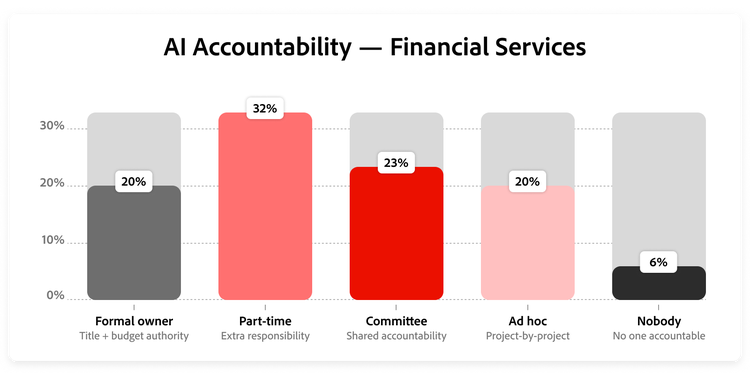
AI initiatives in financial services span retail banking, insurance, wealth management, payments, marketing, risk, compliance, and technology. When accountability is distributed across these groups, teams may struggle to resolve priorities or make binding decisions about resources, data access, and deployment.
A lifecycle marketing initiative, for example, may require behavioral data from a digital banking platform, relationship manager signals from an advisor portal, and personalization rules shaped by suitability requirements. Without an owner with authority across the work, progress depends on functions reaching an agreement, often through sequential reviews.
Part-time owners and committees may coordinate activities, but their mandates often stop at functional boundaries. A CMO, chief digital officer, or another senior leader can provide the necessary accountability when the appointment includes a formal title, budget, and authority across business lines. The requirement is not another governance layer. Rather, it is one accountable owner who can set priorities, resolve conflicts, and move approved initiatives forward.
Security review removes the largest share at a single gate: 32 of every 100 ideas.
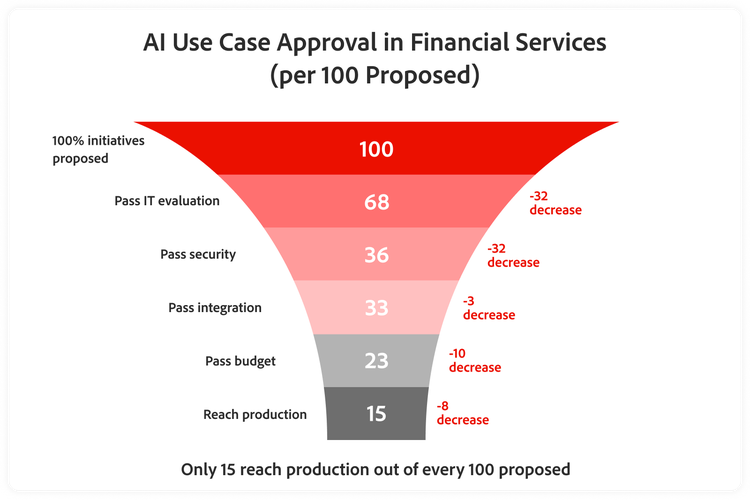
Moving an AI use case from proposal to production requires decisions across technology, security, risk, legal, and compliance teams. The survey tracked requests through IT evaluation, security review, integration assessment, budget approval, and launch. In financial services, security review accounts for the largest share of rejections.
These reviews assess model risk, data protection concerns, integration complexity, regulatory obligations, cost implications, and operational readiness. Each check is necessary, but the process can lose sight of the business outcome the initiative is intended to improve.
A churn-prevention model or cross-sell propensity tool may depend on digital banking data, advisor activity, product eligibility, and customer consent. If these requirements surface only during the review process, teams must redesign the use case or abandon it. Organizations can improve funnel conversion by involving security, compliance, and model risk specialists during the ideation stage. Resolving data rights and validation requirements allows teams to evaluate feasibility and customer value together before a proposal reaches a formal review gate.
Among financial services organizations, 75% operate through relationship models built around sequential requests rather than the continuous collaboration AI requires.
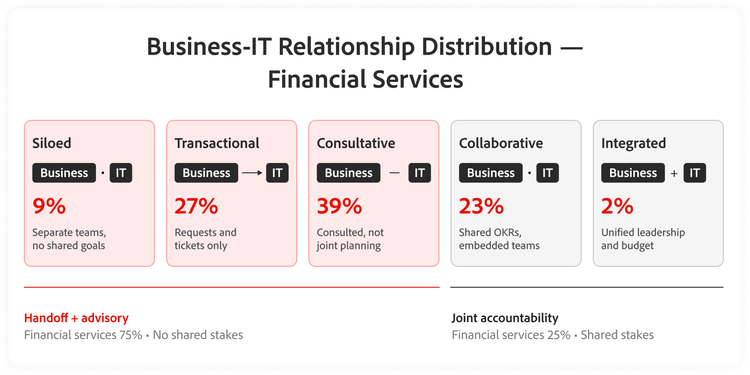
Financial services marketers continuously adjust campaigns, audiences, and offers as customer behavior changes. Although AI increases the need for testing and refinement, most organizations manage business-IT collaboration through sequential handoffs.
Whether the relationship is siloed, transactional, or consultative, the pattern is similar: business teams submit requests and technology teams respond. This approach reflects traditional planning, governance, and review cycles. However, it is less suited to AI initiatives that require teams to resolve data access, integration, security, and measurement issues during delivery.
When business and IT teams have a collaborative, integrated relationship, they partner to define the use case. Shared objectives and key results give marketing and technology teams joint responsibility for delivery and business outcomes. When a customer acquisition leader and the IT owner of the customer data platform share a retention or conversion goal, briefing, development decisions, and measurement follow the same direction. As a result, issues can be resolved during delivery rather than moving between queues and approval processes.
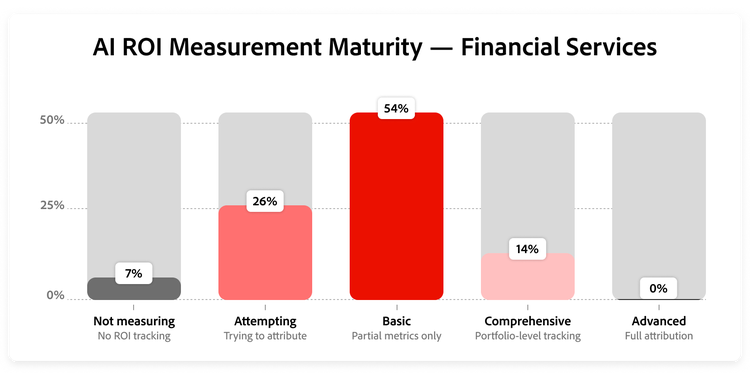
Financial services organizations are increasingly using AI across acquisition, onboarding, personalization, retention, and advisor-supported engagements. Yet, measurement often remains focused on activity and efficiency. Teams may track campaigns launched, customers scored, content produced, or hours saved without establishing whether AI improved conversion, retention, share of wallet, or customer value.
Stronger measurement starts before deployment. Teams define the intended commercial or customer outcome, establish a baseline, and agree on how AI’s contribution will be assessed. Once an initiative is live, changes in interest rates, competitor activity, product launches, and seasonal customer behavior can make the original baseline difficult to reconstruct.
This matters because AI deployments carry substantial technology, security, compliance, and governance costs. Without credible evidence of outcomes, marketing leaders cannot compare use cases or defend continued investment during budget reviews. A pre-deployment measurement framework provides decision-makers a consistent basis for evaluating performance, directing resources toward the most effective applications, and deciding which initiatives should be improved, expanded across business lines, or stopped.
Part Two

AI initiatives in financial services span marketing, data, technology, risk, compliance, and business lines. When accountability rests with part-time owners, committees, or project leads, no single individual may have the authority to resolve conflicts related to priorities, budgets, data access, or regulatory requirements.
Leaders address this gap by appointing a designated AI owner with a formal title, mandate, and budget authority. Leaders are 4.7 times more likely than financial services organizations to have this structure. The AI owner can make decisions across functions when acquisition, onboarding, retention, or advisor engagement initiatives encounter competing governance demands.
Formal ownership also enables other Leader behaviors. An accountable owner can establish shared objectives with technology teams, require measurement frameworks before deployment, and ensure that lessons learned are shared across business lines. The role needs cross-functional reach, not seniority. A CMO or chief digital officer can provide that reach when the mandate extends beyond a single campaign or function. Organizations can establish this authority within reporting and governance structures without undertaking a reorganization.
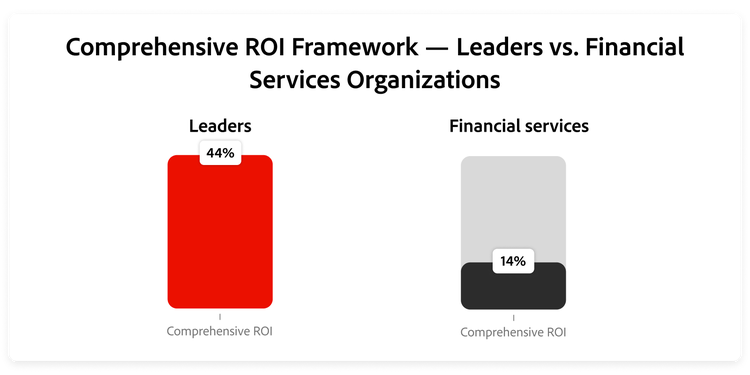
Marketing leaders need evidence early enough to guide funding and scaling decisions. Leaders include measurement in the design of each AI use case rather than adding it after launch. Among Leaders, 44% measure ROI comprehensively, compared with 14% of financial services organizations. Every Leader measures AI performance at some level.
Before deploying acquisition models, lifecycle personalization, cross-sell targeting, or digital onboarding, Leaders define the intended customer or commercial outcome. Measures may include conversion, retention, share of wallet, advisor-led engagement, cost efficiency, and time to value. Marketing, technology, finance, and channel owners align on the attribution approach and establish a baseline before changes in customer behavior affect performance measurements.
Timing is critical. Once a campaign, offer, product change, or market movement affects customer activity, the original baseline becomes difficult to reconstruct. Day-one measurement provides Leaders with a clearer basis for comparing use cases, improving performance, and determining which deployments warrant additional funding. It also provides marketing leaders with evidence for budget discussions, helping initiatives progress from isolated deployments to sustained adoption across business lines.
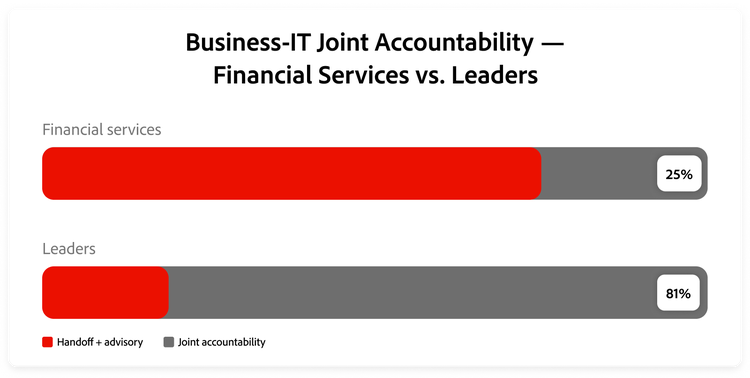
AI-supported marketing initiatives depend on customer data platforms, advisor portals, digital onboarding systems, analytics environments, and other technology systems. Sequential handoffs create friction whenever data, support, security reviews, or measurement activities must move between teams. Many financial services organizations remain siloed or transactional, and an additional share operate in a consultative model, where IT provides advice without sharing accountability for outcomes.
Across the 342 Leaders, collaborative and integrated relationships are the norm. Business, marketing, technology, risk, and compliance teams are involved in defining a use case, allowing them to address feasibility, controls, and customer value together. This approach replaces a completed request handed from one function to another with shared briefs and jointly agreed priorities.
Shared accountability continues through delivery and measurement. When a customer acquisition leader and the IT owner of the customer data platform share the same conversion goal, build decisions and performance metrics align in the same direction. Leaders establish this partnership through shared objectives and key results within existing reporting lines, avoiding the need for structural reorganization.
Financial services marketing teams operate within demanding governance and compliance processes. Campaigns may pass through legal, risk, suitability, privacy, and regional promotion reviews. When an AI initiative underperforms, teams may feel pressure to protect deadlines or avoid scrutiny. A faulty churn model or inappropriate cross-sell recommendation may therefore be treated as an isolated problem rather than as evidence that the organization should investigate further.
Leaders respond differently. They examine what happened, why it happened, and what must change before the next deployment. Across the financial services industry, 29% of organizations exhibit destructive failure patterns characterized by blame or repetition. Among Leaders, the figure is less than 1%. This difference turns underperformance from a reputational threat into a source of operational learning.
A learning culture becomes visible during regular operating reviews. Senior leaders make time to discuss weak results, support teams that raise concerns, and share lessons across banking, insurance, payments, and wealth management. This approach prevents one function from repeating another’s mistakes and helps teams strengthen models, controls, and workflows before wider deployment.
AI adoption becomes more credible when employees see colleagues using it effectively in familiar work contexts. In the financial services industry, these practitioners may include lifecycle analysts who apply churn signals, acquisition managers who improve onboarding journeys, or wealth marketing teams who use propensity models to support advisor outreach. Their results show how AI can improve specific workflows while operating within existing controls.
Leaders identify these practitioners and provide them with recognition, a small budget, and the authority to extend their approach to adjacent teams. Among Leaders, 42% cite identifying and empowering internal champions as their most effective culture action, ahead of executive sponsorship at 16% and formal training at 11%. Champions gain influence by demonstrating value rather than relying on a centrally mandated approach.
The model works best when proof is paired with reusable support. Shared evaluation methods, governance guidance, and implementation playbooks help champions transfer lessons without ignoring business-line requirements. Giving proven practitioners cross-functional reach accelerates adoption, reduces duplicated experimentation, and allows successful applications to scale across banking, insurance, payments, and wealth management.
These actions translate the five Leader behaviors into practical steps for financial services marketing leaders. They build on existing business, marketing, data, technology, risk, and compliance capabilities, helping organizations strengthen accountability and scale proven AI applications without requiring a wholesale redesign of established governance or reporting structures.
Name one AI owner with authority across business functions.
Appoint an executive with a formal mandate and budget authority across the business lines and functions involved in AI. The role may sit with the CMO, chief digital officer, or another senior leader, but it must extend beyond a single campaign or team. Give this owner authority to set priorities, resolve conflicts involving data, technology, risk, and compliance, and make binding investment decisions. Existing reporting lines can remain in place, but accountability cannot remain distributed.
Define the intended outcome before the next AI deployment is launched.
Specify the commercial or customer outcome before an AI use case moves forward. Set a baseline against the current process and agree on how results will be measured. Marketing, finance, technology, and the relevant business line owner should align on attribution before launch. Depending on the use case, metrics may include acquisition, conversion, retention, share of wallet, advisor engagement, cost efficiency, or time to value. Document the measurement approach in the approved brief to ensure it remains integral to the delivery.
Make marketing and technology jointly accountable for outcomes.
Give marketing, technology, data, risk, and compliance teams shared objectives for AI initiatives that span customer platforms and business lines. Bring these functions together when the use case is being defined rather than after a completed brief reaches the review stage. Assign joint responsibility for both delivery and the intended customer or commercial outcome. Shared objectives and key results should cover data access, integration, controls, launch, and measurement, allowing teams to resolve issues during delivery rather than routing them through a series of requests and approvals.
Turn AI underperformance into shared learning.
Make discussions on AI underperformance a standard part of campaign, model, and operating reviews. Senior marketing leaders should identify what went wrong, support teams that surface problems, and ensure that the lessons learned are documented and shared. Include failures related to targeting, suitability, data quality, content, and customer journeys. Assign an owner to update the model, control, workflow, or playbook before the next deployment. The objective is not to normalize poor performance, but to prevent the same failure from recurring elsewhere.
Empower practitioners who have already made AI work.
Identify practitioners who have already used AI effectively in customer acquisition, lifecycle marketing, onboarding, customer communication, or advisor engagement. Give them recognition, a small budget, and authority to extend a proven workflow to an adjacent team or business line. Pair their practical experience with reusable evaluation methods, governance guidance, and implementation playbooks. Track the outcome of each expansion and document any required changes. This approach turns credible examples into repeatable practices while preserving the controls and context required across the financial services industry.
Conclusion
AI is redefining how businesses discover customers, create content, and orchestrate experiences across every channel. Capturing that potential takes more than access to models. It requires a unified data foundation, a connected content supply chain, and the governance needed to deploy AI with confidence.
That is what Adobe is built for. Adobe Experience Platform brings customer data together as the intelligence layer for AI, powering more than a trillion experiences each year. Adobe CX Enterprise builds on that foundation to create an end-to-end agentic system that orchestrates the entire customer lifecycle, from the first interaction to long-term loyalty. An integrated content supply chain further embeds AI directly into creative and production workflows, grounded in brand standards and shared governance.
The result is a clear path beyond AI experimentation and toward value realization, built on an open ecosystem that works across the tools teams already use. When you are ready to scale, Adobe brings the technology and the expertise needed to help turn AI into a sustainable competitive advantage.
Adobe empowers organizations to create impactful digital experiences. Our portfolio of customer-experience products and services helps businesses put every interaction in context, understand what each customer needs right now, and design and deliver digital experiences that build loyalty and drive growth. Visit adobe.com to know more.
Incisiv offers domain intelligence on global consumerism, commerce, and technology. It helps enterprises navigate transformation, evaluate solutions, and unlock growth, delivering prescriptive insights to their people and agents.