Adobe Real-Time CDP Collaboration for Agencies Use Cases

Scale privacy-centric data collaboration across clients.

Discover how Adobe Real-Time CDP Collaboration helps agencies discover audience opportunities, activate campaigns across paid and owned media, and measure performance with multiple partners in a user-friendly environment.

Agencies need efficient ways to manage growing volumes of data while collaborating with multiple clients throughout the campaign lifecycle. But separate data clean-room implementations and point solutions can fragment workflows, slow audience discovery and activation, and make measurement difficult to scale.

This guide explores how Adobe Real-Time Customer Data Platform (CDP) Collaboration helps agencies simplify privacy-centric, interoperable data collaboration with advertisers and publishers. It also explains how these capabilities help drive high-impact campaigns and deliver value across channels.

What is Real-Time CDP Collaboration?

Built natively into Real-Time CDP, Adobe's customer data platform, Real-Time CDP Collaboration is a user-friendly data collaboration application that helps organizations work securely with trusted partners. It brings first-party data together in a privacy-centric environment for joint audience analysis, activation, and measurement across paid and owned media channels.

Traditional data clean rooms can support this kind of collaboration, but separate implementations often create new silos, require significant technical setup, and add complexity around data movement and governance. Real-Time CDP Collaboration extends the clean-room model by bringing these workflows into a single application that helps brands, agencies, publishers, and other media partners work together more easily.

It simplifies end-to-end collaboration with three core capabilities:


Discover: Identify high-value audience opportunities by comparing first-party data with brand partner and third-party data partner audiences to uncover overlap and targeting potential without running new data queries.


Activate: Securely activate shared audiences across channels including connected TV, commerce media, walled gardens, digital audio, and demand-side platforms to support prospecting, retargeting, and suppression use cases.


Measure: View campaign performance in a unified environment, then measure and optimize it with on-demand dashboards and metrics that support real-time adjustment.


How does Real-Time CDP Collaboration work for agencies?

Designed for agencies to manage client relationships at scale, Real-Time CDP Collaboration helps them orchestrate privacy-centric data collaboration on the clients’ behalf, enabling them to:

Uncover collaboration opportunities

Identify new publisher relationships on behalf of customers, expand audience activation with existing media partners, and develop co-marketing programs with complementary brands.

The takeaway: Extend audience reach and create valuable partnership opportunities for clients.

Plan, activate, and measure campaigns

Use first-party audiences across paid media channels, then connect ad exposure to engagement across owned media.

The takeaway: Measure cross-channel performance and optimize media investments with actionable, personalized insights.

Manage multiple clients in a single environment

Operate Real-Time CDP Collaboration on behalf of multiple brands, with access controls, while also supporting clients that already own the application themselves.

The takeaway: Reduce one-off setups, manage client relationships more consistently, and scale collaboration across their portfolios.

Across these workflows, Real-Time CDP Collaboration brings MarTech and AdTech closer together, helping agencies reduce duplication and extend the value of audience, behavioral, and conversion data across the customer journey.

These capabilities support two common collaboration patterns: working directly with publishers on behalf of advertiser clients and enabling advertisers to collaborate with their agencies while retaining control over first-party data.

Use cases for Real-Time CDP Collaboration for agencies.

Use Case 1: Agency-to-publisher collaboration

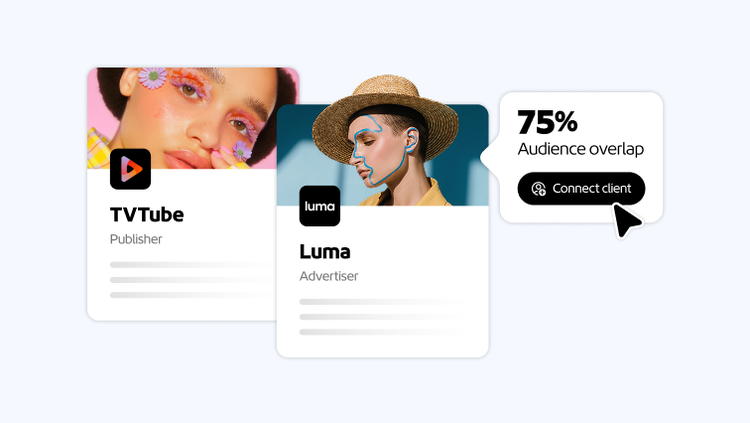
Real-Time CDP Collaboration gives agencies a more direct way to use advertiser-approved first-party data to plan and activate media with a publisher partner. Agencies can identify relevant publisher audiences, deliver campaigns across the publisher’s inventory, and measure performance without either party exposing its underlying raw customer data or relying on disconnected clean-room workflows.

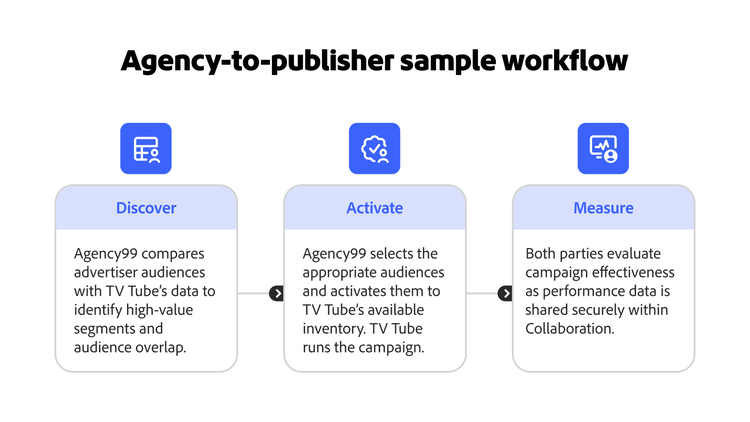
Let’s say Agency99, a media agency, wants to run targeted campaigns across TV Tube, a digital streaming publisher. Agency99 joins with the agency role, creates a sub-account for its advertiser client, and sources the client’s approved first-party audiences into its workspace. TV Tube onboards with the publisher role and configures a destination for campaign activation.

Once the collaboration is established, the agency and publisher work through three core capabilities:

Flow chart shows an agency-to-publisher sample workflow.
Minimal movement of underlying raw customer data.
This model helps agencies extend campaign reach through publisher audiences faster without exposing or transferring raw information, protecting customer data. It enables more precise audience targeting, simplifies campaign execution, and provides shared performance insights to improve effectiveness and optimize future investments.

Use Case 2: Advertiser-to-agency operating model

Brands want agencies to execute campaigns without losing control of first-party data. Real-Time CDP Collaboration lets advertisers define how agencies can use their data while enabling both parties to plan audiences, activate campaigns bidirectionally, and share performance insights without direct raw-data transfers.

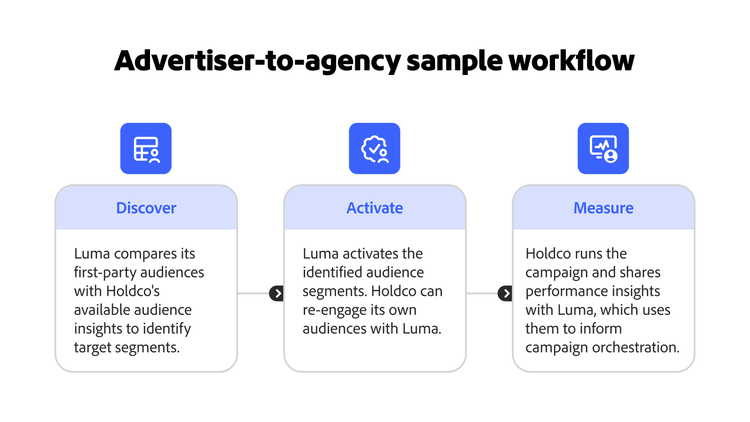
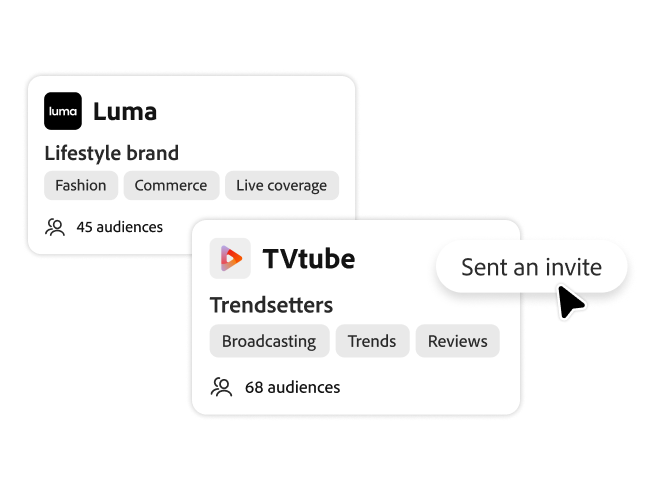
For example, Luma, an athletic retailer, wants to collaborate with Holdco, an agency, on audience planning and campaign activation. Luma joins with the advertiser role, while Holdco joins with the agency role. Both source their audiences and configure destinations because either party may activate audiences through the collaboration.

Luma connects with Holdco and defines the settings that govern how the two organizations will work together. Once Holdco accepts, Luma creates a collaboration project. The collaboration then moves through three stages:

Flow chart shows an advertiser-to-agency sample workflow.
This collaboration pattern enables advertisers and agencies to work bidirectionally without exchanging underlying customer data. Agencies can execute more effective media campaigns using first-party insights, while advertisers gain actionable performance data that can inform customer profiles, owned media orchestration, and future audience strategies.

Get started with Real-Time CDP Collaboration to improve business outcomes for agencies.

Adobe Real-Time CDP Collaboration empowers agencies to turn privacy-first collaboration into a competitive advantage. With a unified, governable platform that brings together MarTech and AdTech, agencies can securely discover audience opportunities, activate campaigns across channels, measure performance, and scale operations across multiple clients — delivering greater value for every partner while keeping privacy at the core.

Let’s talk about what Adobe can do for your business.

Get started