Content as a Service v3 - experience-manager-guides - Thursday, July 17, 2025 at 12:14

70%
content reuse across technical documentation
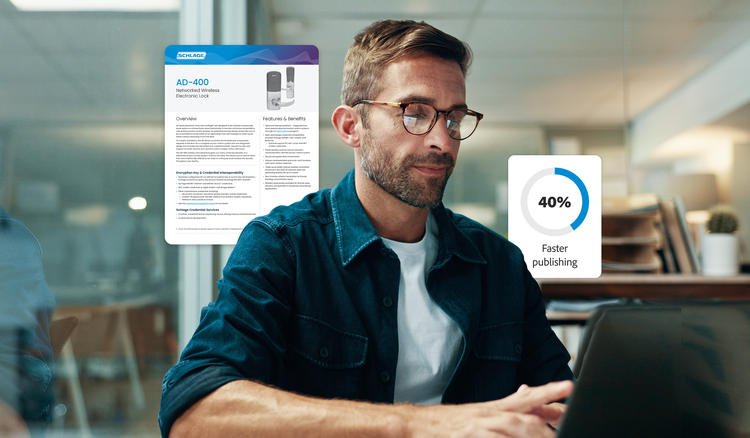
40%
faster time to publish content expected
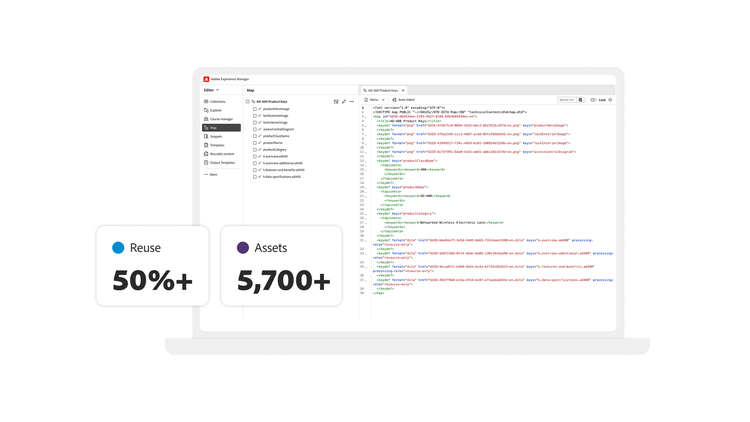
5,700+
technical document assets in scope for modernization

“We’re transforming content from a maintenance challenge into a strategic asset for the business."
Bill Wolfe
Director of Enterprise Content Management, Allegion
Protecting businesses and lives.
Every day, people trust Allegion products to guard homes, schools, hospitals, offices, and apartment buildings. The global security company manages more than 30 brands spanning locks, card readers, fire doors, and remote access systems, with thousands of highly configurable products designed for nearly any access and security need.
That scale creates enormous content complexity. Bill Wolfe, Director of Enterprise Content Management, Americas at Allegion, oversees the teams responsible for managing technical product content across the business, working closely with Digital Marketing Transformation Manager, Americas, Christy Spurgeon and Global Web and Marketing IT Lead Brijesh Chauhan. Together, teams manage more than 5,700 technical documents in the Americas that help architects, installers, distributors, and customers find the right models and product guides for their projects.
Content teams managed these assets manually, updating individual documents and copying information from other files and systems. As product information changed more frequently, especially for electronic lock systems, maintaining accurate, up-to-date documentation became increasingly difficult.
“We were spending so much time maintaining existing documentation that it became harder to keep pace with new product launches,” says Spurgeon. “We needed a way to keep content up to date while still moving as fast as the business needed.”
The company saw an opportunity not just to modernize documentation workflows, but to elevate technical content into a business driver supporting sales, service, and future AI-powered experiences. “We’re transforming content from a maintenance challenge into a strategic asset for the business,” says Wolfe.
Building a smarter content foundation.
Allegion decided to build on its existing Adobe Experience Manager Sites and Adobe Creative Cloud investment by adding Adobe Experience Manager Guides, creating a single content foundation to support thousands of products, future web experiences, and AI-ready content delivery.
The company launched a pilot project with Seattle-based Adobe Silver solution partner POP that focused on Schlage brand electronic locks. Rather than outsourcing the work entirely, Allegion approached the pilot as a collaborative learning process between marketing, IT, and content teams, preparing Allegion to scale the solution across the company.
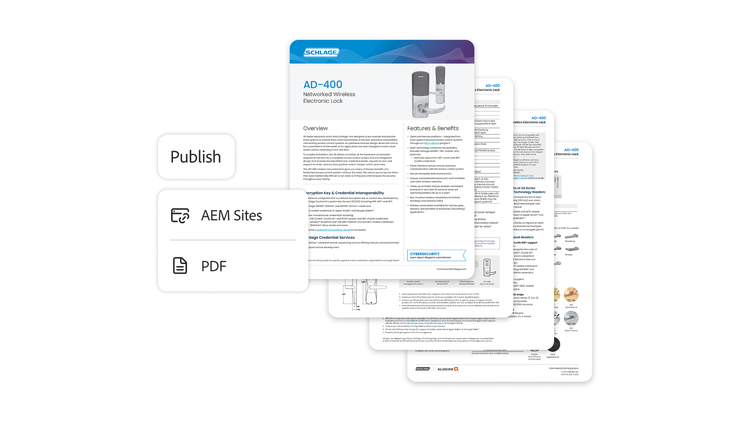
Using Experience Manager Guides, Allegion rebuilt a product data sheet using structured DITA content and reusable components. The pilot helped teams rethink how to organize, reuse, and maintain content across products and brands.
“We're encouraging teams to put more long-term thought into the content,” says Spurgeon. “We’re asking how we can get the most value from the content through the harmonization of maintaining multiple versions that say nearly the same thing."
Unlocking efficiency with reusable content.
Even during the pilot phase, Allegion saw immediate benefits from structured authoring and content reuse.
The company estimates that Experience Manager Guides enables at least 50% to 70% content reuse across technical documentation. Shared information such as warranty language, compliance statements, safety messaging, and product specifications can now be updated once and reused across multiple documents.
“Content reuse is one of the biggest opportunities for us,” says Chauhan. “We can break content into reusable components and scale it much more efficiently across the business, helping us deliver consistent content much faster.”
Allegion expects that once all content is moved onto Experience Manager Guides, the content team will spend 25% less time developing new content, freeing up nearly 5,000 hours annually across the team that they can use to focus on strategy and messaging.
Building for web, search, and AI.
For Allegion, better content management is ultimately about deliverin g better customer experiences. The company primarily publishes print documents and PDFs, but it is already designing its content architecture for future web publishing through Experience Manager Sites. The goal is to make technical information easier for sales teams, contractors, and installers to access in the field.
AI will play a big role in this future web experience. By building semantically structured DITA content now, Allegion is preparing its technical documentation for retrieval-augmented generation (RAG), AI-powered search, and intelligent content discovery.
“The time to prepare for AI-ready content is while you’re authoring,” says Wolfe. “We’re building content in a way that positions us for where we’re going, not just where we are today.”
Allegion is also getting ready for future integrations with product information management systems so technical specifications can automatically flow into documents and web experiences. This will allow content authors to maintain one source of truth for important product information, with updates that automatically cascade across all documents.
The company expects deeper automation and structured metadata will improve content accuracy while reducing publishing time by up to 40%. It will also impact employees by making it much easier to find, reference, and reuse existing content. Allegion estimates that its employees will spend 10% less time searching for information, recovering 7,680 hours.
“This is definitely a multi-year journey, but our goal is clear,” says Wolfe. “We want one source of truth for content that scales across the organization and helps us deliver better information to customers everywhere.”
Recommended for you
title
Allegion Unlocks AI-Ready Content with Adobe
cardDescription
Allegion uses Adobe Experience Manager Guides to achieve 70% technical content reuse and accelerate publishing by up to 40%.
cardDate
2026-07-31
cardImage
badgeImage
primaryTag
caas:content-type/customer-story
Tags
caas:content-type/customer-story, caas:products/adobe-experience-manager-guides, caas:industry/manufacturing