Content as a Service v3 - Customer Analytics - Friday, March 27, 2026 at 12:11
Ask

Explore the benefits of Customer Journey Analytics.
Powered by AI and built for scale, Customer Journey Analytics transforms billions of data points into customer‑level insights in milliseconds—empowering every team to make smarter decisions and deliver better experiences.

Customer-level insights with speed, scale, and efficiency.
Customer Journey Analytics synthesizes customer identity and engagement by connecting and standardizing behavioral and trait-based data to deliver fast, comprehensive insights grounded in the full-journey context.
- Unify customer data across channels and devices — both online and offline — and assign it to a single profile to visualize how each customer moves through their journey.
- Run analyses with a modern data framework that supports all customer data types in their natural state and without loss of detail or structure.
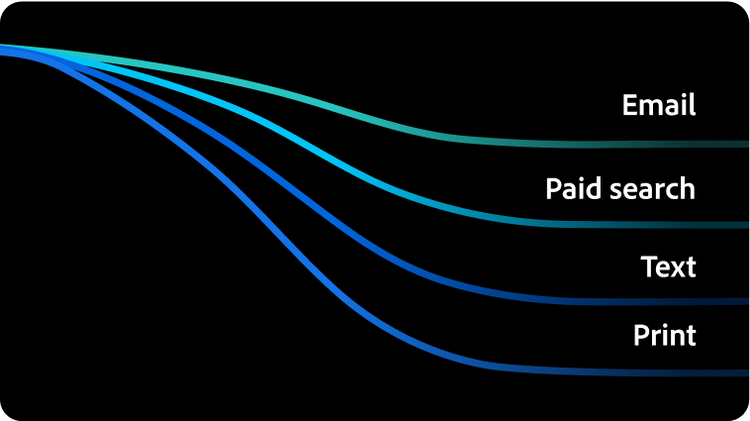
- Analyze integrated marketing performance by connecting customer engagement across campaigns, channels, and content.
- Leverage intuitive, drag‑and‑drop visualizations and self‑serve tools that enable rapid insight discovery and on‑demand reporting.

Unrivaled data flexibility and handling.
Easily integrate data with an adaptable framework that eliminates typical manual constraints. This advanced model simultaneously supports event, profile, and look-up data with on-demand self-serve capabilities and reinforced with enterprise-level data governance.
- Adjust your data views and fields right within the UI to help answer business questions as they arise.
- Update your analyses, make changes, and fix data errors — instantly, retroactively, and non-destructively — without a lengthy IT cycle.
- Empower non-technical users to easily create custom data views without impacting the underlying dataset, freeing up analysts’ time from ad hoc reporting requests.
- Give teams across the organization secure and controlled access to customer data with a patented data governance framework.

Agentic- and AI-accelerated insight discovery.
Transform your growing amount of customer data into high-quality, scaled intelligence using built-in agentic AI, generative AI and machine learning (ML).
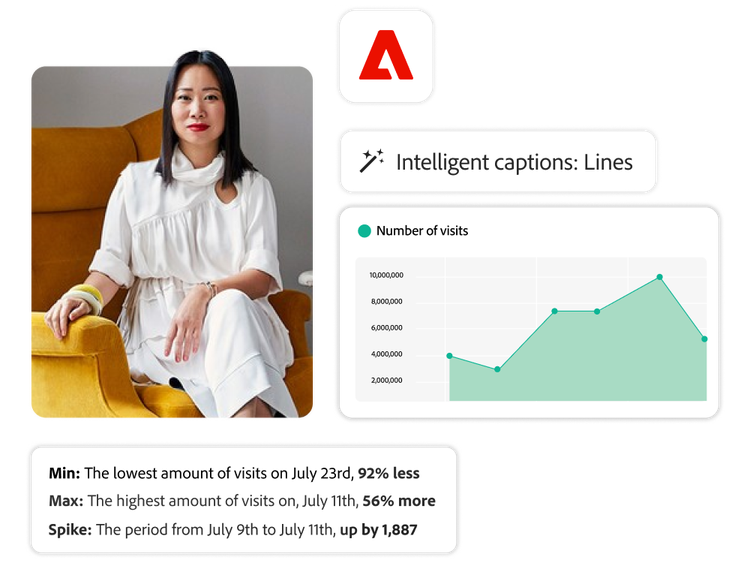
- Let agentic AI automatically produce insights and user-friendly captions and transform your analyses into presentation-ready slides.
- Accelerate insight discovery with AI‑ready access to Customer Journey Analytics that lets assistants and custom apps surface and act on journey insights faster.
- Evaluate the lift and confidence of any experiment with AI/ML-supported analysis of customer interactions and outcomes.
- Leverage natural language to query data and answer questions such as, “What are my top 10 pages?” and “Which products have the highest revenue?” Use algorithmic attribution to compare marketing channels to determine those responsible for specific conversions.

LLM engagement in the customer journey.
Turn large language model (LLM) interactions into measurable, actionable insights and bring deeper understanding, optimization, and transparency to AI‑driven touchpoints.
- Convert raw prompts, responses, and conversations into structured signals that reveal sentiment, intent, and engagement patterns across the journey.
- Connect AI‑driven interactions to downstream actions like conversions, revenue, or pipeline influence.
- Measure and improve AI‑driven experiences with the same rigor as any traditional digital channel.
Immediate insights to improve experiences.
Activation and integration tools let you quickly put insights to work improving customer experiences and maximizing ROI.
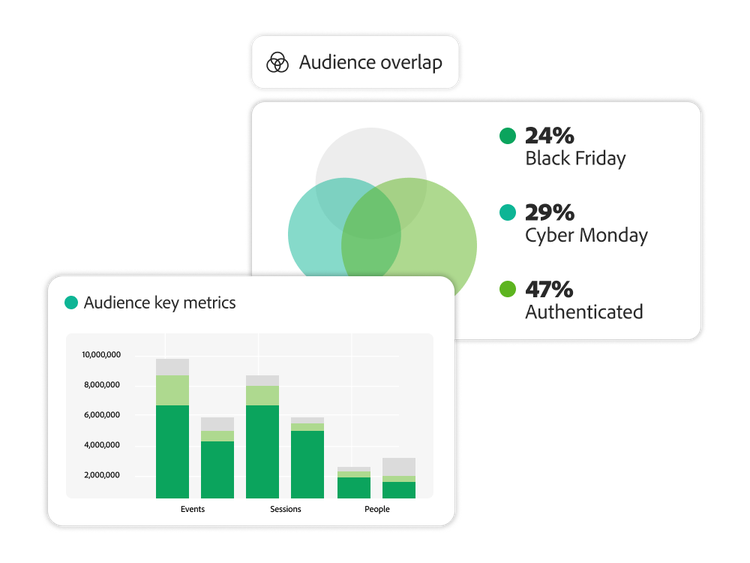
- Publish enriched audience profiles, measure campaign element performance across channels, and incorporate reporting in critical workflows.
- Define rich audiences based on trait and historical behavior data and share them for activation and orchestration in Adobe Real-Time CDP and Adobe Journey Optimizer. Then, re-ingest results for further analysis and audience insights.
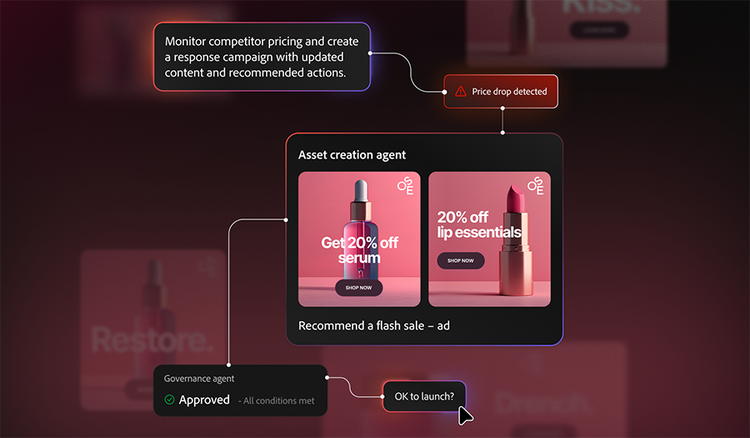
- Enable AI assistants and custom apps to tap into Customer Journey Analytics intelligence and turn customer insights into immediate action.
Turn every Adobe CX Enterprise app into one connected workflow.
Power it all with Adobe CX Enterprise Coworker — your newest AI teammate.

Forrester Report
The Total Economic Impact™ of Adobe Real-Time Customer Data Platform, Journey Optimizer, and Customer Journey Analytics.
Learn how this Adobe solution delivered a 431% return on investment.
Providing comprehensive customer analytics to enterprise brands around the globe.
Learn more about Adobe Customer Journey Analytics.
Unlock more with Adobe integrations.
Customer Journey Analytics + Adobe Journey Optimizer
Get real-time customer insights and use them to reach customers instantly across channels with tailored offers.

Customer Journey Analytics + Adobe Real-Time CDP
Enrich customer profiles with cross-channel behavioral insights for enhanced audience creation and activation.
Customer Journey Analytics FAQs.
Customer Journey Analytics and Adobe Analytics are sibling products inside Adobe's CX Analytics portfolio, built for different scopes of insight. Adobe Analytics (branded "digital analytics") measures web and mobile behavior using its own native data collection, on a fixed report-suite schema locked at collection time. Customer Journey Analytics runs on Adobe Experience Platform, ingesting any online or offline data source, so it connects behaviors across web, app, call center, and in-store touchpoints using person-based identity stitching instead of session or cookie identifiers, and it lets you reshape reporting at report time rather than re-collecting data. Most enterprises run both: Adobe Analytics for focused web and app analysis, Customer Journey Analytics when the question spans channels and identities. Moving to Customer Journey Analytics is a matter of evolving your analytics, not a forced migration away from Adobe Analytics.
Customer Journey Analytics is one product inside Adobe CX Analytics, the analytics portfolio Adobe introduced at Summit 2026 alongside Adobe Analytics, Adobe Customer Journey Analytics B2B Edition, Adobe Marketing Campaign Analytics, and Adobe Content Analytics. Within that portfolio, Customer Journey Analytics is the product for connecting behavioral and offline data into a single, identity-resolved customer profile, then exploring it visually with AI-assisted tools rather than fixed dashboards. It combines behavioral and trait data across channels and devices, supports flexible ad hoc analysis with retroactive data manipulation, and uses AI to surface insights and predict outcomes, all built for business users, not only analysts.
Customer Journey Analytics is built for enterprise teams that need marketing, product, and analytics aligned on one source of truth, and it removes the specific barriers that make customer intelligence slow today. That includes: CMOs and marketing leaders optimizing journeys across paid, owned, and earned channels and measuring campaign performance without waiting on IT; product and digital teams tracing how features affect conversion and engagement across app, web, and in-store experiences; analysts and insights teams that need to run retroactive queries and self-serve exploration at scale instead of fixed reports; CIOs and data leaders who need policy-based governance enforced while still giving teams safe, self-service access to the same data. Getting value depends on connecting real cross-channel data into Adobe Experience Platform first; the analysis itself does not require analyst-level tooling once that data is flowing.
Customer Journey Analytics lets you change data fields, session definitions, and reporting views at report time, non-destructively, without reprocessing pipelines, rewriting code, or touching the source dataset, and every governance control travels with that flexibility rather than being traded off against it. Because Customer Journey Analytics is built on Adobe Experience Platform, it inherits Experience Platform's data governance framework: usage policies and sensitivity labels apply to the underlying data, role-based permissions restrict who can see or export it, and in-product alerts flag policy violations before they happen. Business users get to self-serve new questions; the label and permission model stays enforced underneath them.
Yes. Customer Journey Analytics shares audiences directly with Real-Time CDP and Journey Optimizer, so an audience you define from behavior, campaign response, or cross-channel journey data in Analysis Workspace can be activated for targeting and orchestration without exporting it elsewhere. Performance results from that activation can be re-ingested back into Customer Journey Analytics, closing the loop between analysis and the next decision rather than leaving analysis as a one-way report.
Customer Journey Analytics connects identity and interaction data across every touchpoint, online and offline, so you can trace a full journey sequentially instead of reading channel-siloed reports. In Analysis Workspace you can see what drives engagement, drop-off, or conversion at each stage, compare the paths different customer segments take to find friction or missed opportunities, and use AI-assisted analysis to surface trends and anomalies as they emerge. That full-journey context lets teams move from reactive reporting to proactively redesigning an experience and to measuring if a content or product change moved the journey.
Yes. Customer Journey Analytics is built on Adobe Experience Platform, and a Customer Journey Analytics license is required to access the application; there is no standalone version that runs independently of Experience Platform. In practice this means your data needs to reach Experience Platform, whether from web and app SDKs, offline sources, or existing Adobe Analytics report suites, before Customer Journey Analytics can report on it.
Your existing Adobe Analytics report suite data flows into Customer Journey Analytics through the Analytics source connector, which brings it into Adobe Experience Platform without requiring you to re-instrument your site or app. From there it becomes a connection you curate into one or more data views, the Customer Journey Analytics equivalent of a virtual report suite, so you keep your historical Adobe Analytics data while gaining report-time flexibility and the option to join it with offline or other channel data as you add sources. This is an evolution of your existing setup, not a rebuild from zero.
Let us show you the full power of Adobe Customer Journey Analytics.
title
Make smarter decisions with AI-powered insights.
CardDescription
Adobe Customer Journey Analytics transforms billions of data points into customer‑level insights so you can deliver better experiences.
cardDate
2024-11-13
cardImage

primaryTag
caas:content-type/product-page
Tags
caas:content-type/product-page,caas:products/customer-journey-analytics
Let’s talk about what Adobe Customer Journey Analytics can do for your business.