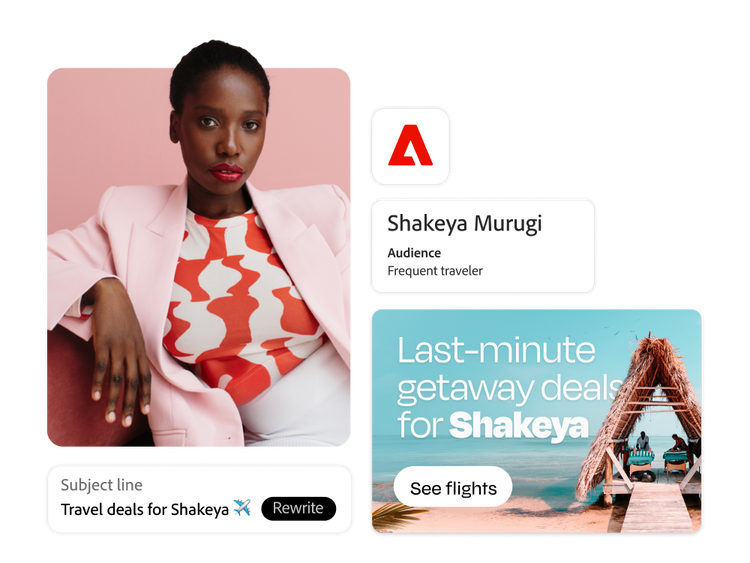
Low quality, brand adherence, or accuracy
Off-brand assets, misaligned messaging, low resolution, or inaccurate visual representation


Guide
The value of enterprise-wide on-brand content creation.

Content creation has moved beyond the studio, with AI multiplying both opportunity and risk. This guide, created in partnership between Adobe and Accenture, outlines how organizations can democratize content creation across marketing, sales, and knowledge workers while safeguarding brand, legal, and reputational integrity. It also quantifies the business impact — showing that enterprises with an estimated value of $30 billion annual revenue can achieve up to a 9x ROI over three years by enabling employees to create on-brand content with the right tools and governance.
Nearly every employee across the enterprise needs access to high-quality content, whether creating it themselves or relying on others to produce it. Yet demand increasingly outstrips supply, leading to missed opportunities or rogue content creation by functions that studio teams do not support.
To better understand this gap, we surveyed 1,457 professionals who create content and found:
This leads not only to a content bottleneck, but also to significant risk to the brand and to the business at large. One mismanaged asset can result in millions in lost brand equity or legal liabilities, such as IP infringements.
Assets created outside of approved brand or governance systems. The following are sample potential outcomes of rogue content creation:
Off-brand assets, misaligned messaging, low resolution, or inaccurate visual representation

Unauthorized use of copyrighted content, lack of disclosures, misuse of assets where rights have expired or are geo-gated

Trust and societal harm due to bias, misinformation, insensitive content
Organizations that proactively equip the entire enterprise to create standout, on-brand content can ensure consistent and compelling experiences for their customers, employees, and other stakeholders.
To seize this opportunity, marketing leaders can drive change both within and outside their remit, empowering three distinct groups of employees to create content independently while staying on-brand. The table below lays out these three groups:
When every employee can create on-brand content, value compounds fast.
For a $30 billion enterprise1, those layers stack to nearly $90 million in annual upside2 and a 9x ROI — proof that AI-powered content self-service is as much a growth strategy as it is a governance one.
While the value scales exponentially as influence extends across the organization, value per full-time employee (FTE) is highest the closer we are to core creation. See below how these estimates break out by group.
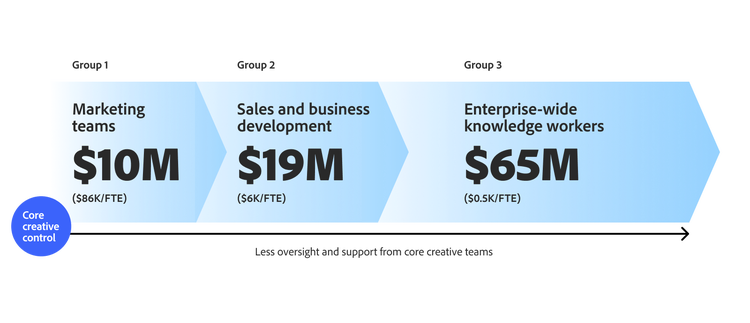
In this model, creative and brand teams are still critical in setting creative direction, brand standards, and shared systems for the entire organization to use. Their remit now expands to develop the foundational backbone to help scale creativity across the enterprise, inclusive of brand kits, templates, approved libraries, and custom-trained AI models.
Next comes enabling and empowering every team to create. The following deep dives explore each of the three groups, outlining priority functions, common use cases, and best practices to guide your democratized content creation journey.

The marketing organization shapes and executes the brand strategy, orchestrates comprehensive campaigns, and creates critical pathways that convert demand into revenue. Nearly every program depends on on-brand, visually compelling content to engage prospective or existing customers.
While growth marketing and experience orchestration teams typically get support from centralized creative teams, other marketers tend to remain underserved — leaving opportunities on the table or resorting to sub-optimal content.
A democratized content creation solution can change this. Below are representative marketing functions and corresponding use cases that will benefit from the opportunity:
When marketers can easily self-serve, adapt, and publish approved assets, the organization moves faster, spends less, and grows revenue. With intuitive AI-assisted tools, we estimate that these groups can free up 12 hours per week to focus on higher-value work.
In all, our analysis shows that these benefits represent an estimated $10 million annual upside for a $30 billion organization — split between productivity gains (60% of the value) and incremental revenue growth (40% of the value).
Marketers today spend

per week creating or retrofitting visual content3
Source: 3. Company-wide creation survey
CMO takeaway.
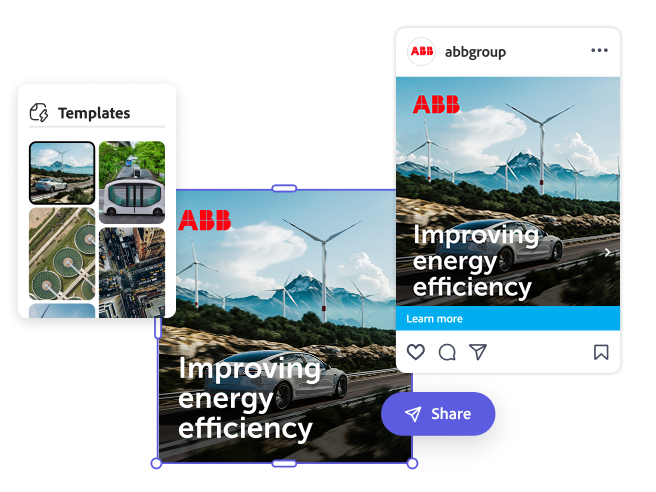
ABB empowers global teams to create faster.
ABB, a global leader in electrification and automation, empowered its marketing teams across 100+ countries to create quality, on-brand content with Adobe Express. From customizing social media posts and captioning video content to translating, localizing, and re-sizing assets — marketers across ABB are now able to deliver content that is on-brand, faster, and produced with less effort. Initial results include a reduction from 8 days to 30 minutes in localization and translation, and 6x higher engagement rates versus prior baselines. Read more here
Sales teams and their supporting ecosystems are under immense pressure to build relationships, create pipeline, and ultimately close. Next to marketing, they are often the top external ambassadors of the brand, yet often lack the time, ability, or resources to create visually compelling content tailored to customers, partners, or sales strategies.
The result: teams resort to retrofitting old materials, searching the web for what they need, and piecing together what they can. Not only does this detract from valuable time spent selling, but it often leads to a poor representation of the brand.
Empowering sales and business development teams to easily create and adapt content can take many forms. The following are sample roles and related use cases to consider prioritizing within this group:
Our research has found that 33% of individuals in sales organizations spend more than 20 hours a week on content creation. Deploying AI-powered, easy to use content creation tools can help them reclaim 10 to 13 hours of lost time each week.
For a $30 billion organization, the opportunity can unlock up to $19 million in incremental productivity gains. This represents roughly $6000 of annual value per individual in this cohort. Additional revenue tied to allocating more time to be customer-facing and utilizing more effective content were not quantified in our model and would be incremental.
CMO takeaway.
Roles across the organization such as talent acquisition, corporate communications, learning and development, investor relations, and community outreach are increasingly creating content to engage their stakeholders.
As with sales teams, these groups get limited support from creative teams. Hours are lost searching for assets in brand portals and trying to adjust them with sub-standard tools. Ultimately, this leads to content that does not perform — and worse, can damage brand perception.
The opportunity to support teams across the organization with this capability is vast. Below are examples of roles and use cases where a self-service approach can drive results:
Our research estimates that equipping knowledge workers with this capability can unlock approximately $65 million in annual value for a $30 billion organization. This larger amount is driven by a wide reach of the solution — impacting the most employees by increasing both the efficiency and effectiveness of their communications.
CMO takeaway.
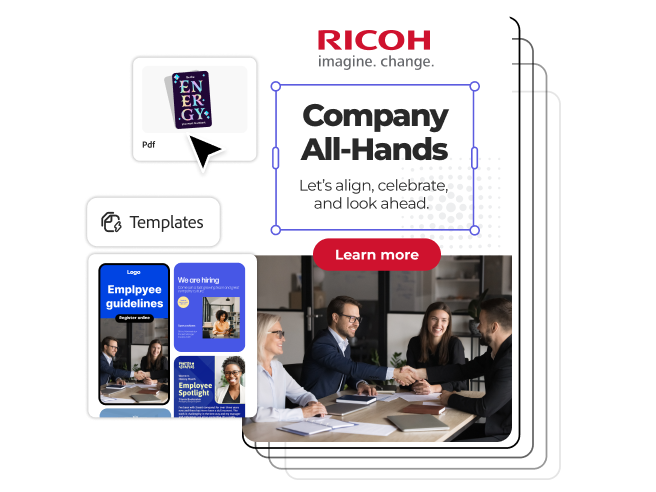
Ricoh reimagines content creation to increase learning.
Ricoh Japan’s HR Development Center supplies learning content to 18,000 employees. To boost the appeal of its training platform, the group leveraged Adobe Express — creating a library of 200,000 templates and rights-cleared assets for team members to craft eye-catching content. AI-powered tools keep visuals on-brand while a single, self-service hub replaces lengthy design queues. Results include higher learner adoption, with usage rates jumping from 30% to 75%, and 50% faster creation for elements such as video thumbnails or course graphics. Read more here
Without an enterprise standard, quality, and brand consistency fracture across silos. By leading the charge on an intuitive, centrally governed solution, CMOs can help meet functional needs while preserving brand expression and reducing risks.
To this end, organizations must establish:
Below are five best practices to consider:
Form a cross-functional SteerCo among marketing, IT, legal, and other key functional leaders to gain alignment and oversee strategy, priorities, and governance.
Select tools that support responsible AI practices, IP protection, and brand safety. Prioritize solutions that easily integrate into your existing content supply chain ecosystem to ensure faster adoption and higher asset re-use.
Work with brand and creative teams to create modular brand kits, templates, and guardrails that can be centrally managed, customized, and updated. Ensure templates, libraries, and approved assets are available directly from creation tools.
Start with strong internal sponsorship from marketing and one additional functional team. Identify priority users and business needs to focus on the first, celebrating early wins to build momentum and excitement in the rest.
Use insights from early efforts to refine best practices and strengthen broader enablement efforts. Then, expand the program to additional teams based on readiness, need, and strategic priorities — turning early efficiencies into enterprise-wide growth.
Whether you are embarking on your journey to democratize creativity across the enterprise or are looking to optimize existing efforts, Adobe is here to help you navigate complexities and deliver value. Contact an Adobe representative today to learn more.
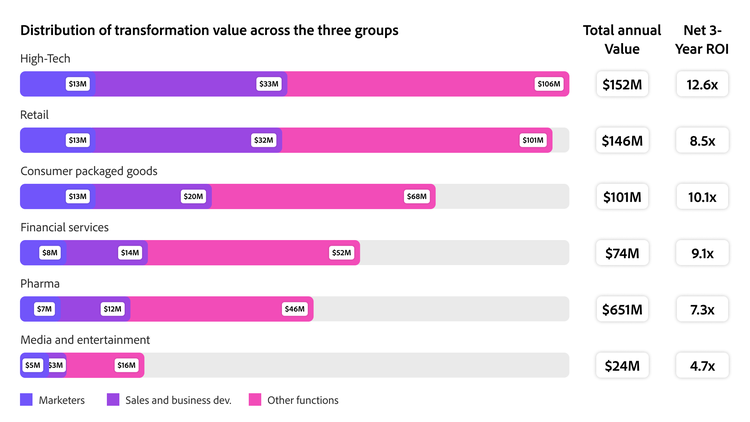
Industry differences in estimated value center mostly around three factors — how much time employees spend producing on-brand content, the size of the potential user base, and the scale of AI-enabled efficiency gains.
The table below summarizes the opportunity by grouping and ROI for the industries we evaluated:
Research approach: Adobe and Accenture partnered to estimate the financial impact of content creation and production transformation across six areas of value in six distinct industries. Insights are rooted in four research components — survey data, expert interviews, econometric analysis, and secondary research.
Company-wide survey: Two 30-question online surveys gathered insights from 1,457 respondents who actively worked on content creation during October and November 2024.
Expert interviews: 37 individual interviews were conducted to gain qualitative insights across industries. The following subject matter experts were interviewed:
Econometric analysis: The following outlines the assumptions and sources used to build the value case model to quantify the value of transforming content creation and production workflows: