Content as a Service v3 - generative-ai - Tuesday, July 15, 2025 at 11:21



Scaling the Value of AI in B2B Industries
Most B2B organizations are investing in AI, but many struggle to turn pilots into repeatable commercial value. Adobe’s global study examines the operating model gaps that stall progress, what Leaders do differently, and five actions to connect AI with pipeline, retention, and customer growth.
EXECUTIVE SUMMARY
AI Readiness in B2B is an Operating Model Question
For B2B leaders, AI readiness is no longer a question of access to models or the number of pilots underway. Artificial intelligence activity is already widespread. Repeatable deployment depends on the operating model around it — clear ownership, meaningful measurement, coordinated decisions, and workflows that connect marketing and customer experience with sales, revenue operations, customer success, data, technology, and operations.
Adobe and Incisiv surveyed 1,501 senior B2B executives across seven industries and 11 markets, supported by more than 25 in-depth interviews, within a full cross-industry study of 5,633 executives. The organizations moving from activity to repeatable value had done something structural. They built the ownership, measurement, and coordination that connect AI to commercial outcomes.

“The gap between Al activity and Al value is not technical. It comes down to who owns the outcome and whether anyone captured the baseline before launch. Most B2B firms have neither, and no model closes that gap for them.”
Jonathan Burdette
Director, Global Industry Strategy, Adobe

Most B2B firms are concentrated in the middle.
More than half of B2B firms sit at piloting or deploying stages, with AI tools in use and early results, yet many have not progressed to repeatable deployment across functions.

Few have the conditions for repeatable deployment.
Only one in eighteen B2B firms combines formal AI ownership, collaborative business and IT relationships, and comprehensive ROI measurement. The largest single gap is ownership, where the global Leader benchmark leads the B2B average by more than 5x.
The State of AI Adoption in B2B Industries
AI adoption is advancing across the B2B respondent base, but progress toward repeatable deployment remains uneven. This section examines journey-stage concentration, the four operating model segments, and the six-pillar profile behind B2B readiness.
The Frozen Middle
More than half of B2B firms are at the piloting or deploying stage. Tools are in use, applications are producing early results, and initiatives are planned. That activity does not by itself show that successful use cases can be extended across functions or connected to commercial outcomes.
Marketing, sales, and customer success teams often advance applications independently. When ownership, measurement, data access, and decision rights remain fragmented, learning and results stay within individual teams. That makes it harder to compare use cases, demonstrate ROI, and decide which workflows should receive funding. The concentration at the piloting and deploying stages is an operating model challenge across the respondent base, not evidence that every industry faces the same barriers.
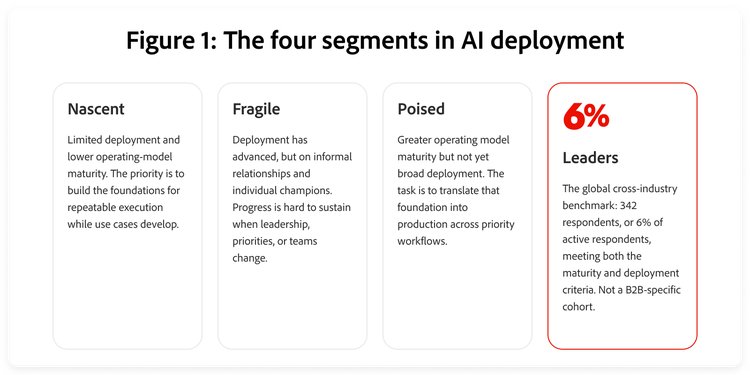
The Four Segments
Assessing the deployment stage alongside operating model maturity produces four segments with different trajectories and risks. The framework distinguishes organizations that are early on both dimensions from those with stronger structures, broader deployment, or both, so the adoption stage alone is not treated as a complete measure of readiness.
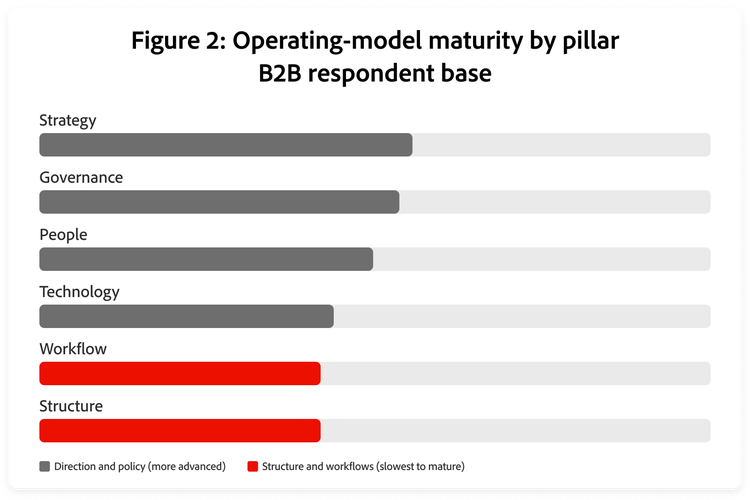
The Pillar Profile
The B2B pillar profile shows strategy and governance ahead of structure and workflows. Respondents have progressed further on setting direction and establishing policy than on changing how teams, roles, decisions, and day-to-day work are organized around AI.
KEY TAKEAWAY
The move from deploying to expanding is where many B2B firms face difficulty. Keep structure and workflows on the roadmap and build the capability to redesign roles, decision rights, handoffs, and commercial workflows rather than deferring that work until direction and policy are finalized.
The Challenges of Scaling AI in B2B Industries
Scaling AI across B2B workflows requires more than promising use cases. Progress depends on how ideas are prioritized, funded, measured, reviewed, and integrated. These are the operating model gaps that make repeatable deployment difficult across marketing, customer experience, and commercial teams.
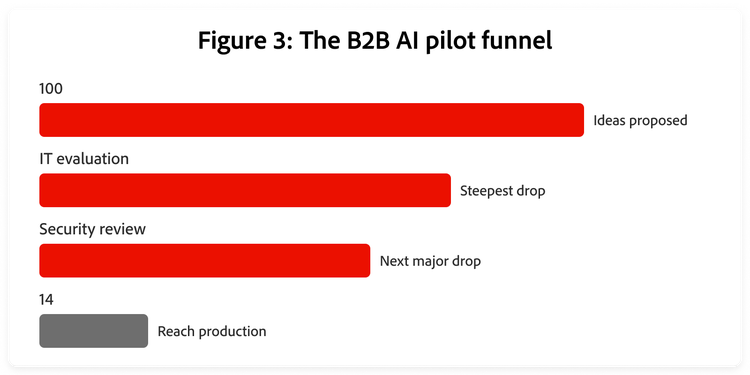
The Pilot Funnel
Of every 100 AI ideas proposed in B2B firms, approximately 14 reach production. The funnel reflects the reviews and resources required to advance an idea, not simply its quality. Proposals may need an integration approach, data access, security and privacy review, budget alignment, and agreement on the commercial workflow. The steepest drop occurs at IT evaluation, where proposals often lack detail on integration architecture, data requirements, or failure modes.
Four Operating Model Gaps
Beneath the funnel sit four structural gaps that recur across the seven B2B industries. Each reflects an enterprise system that has not kept pace with AI.

The ownership vacuum
Most B2B firms assign AI responsibility without full authority. The global Leader benchmark has a formal owner with budget authority at more than five times the B2B average of 15%. Committees, part-time roles, and project sponsors coordinate activity without providing authority.

The business-IT divide
Many B2B firms run business and IT through requests, tickets, and advisory input. That approach suits stable specifications, not AI work whose problem, data, and workflow evolve as the use case develops.

The measurement gap
B2B measurement is dominated by activity metrics like adoption, usage, and time saved. These do not establish contribution to deal velocity, conversion, retention, output quality, or rework.

The skills gap
Skills and talent rank first among B2B barriers, with integration complexity close behind. The widest capability gaps are in agent architecture, strategic AI thinking, and workflow design, not in prompt-writing.
KEY TAKEAWAY
Every top regret for B2B organizations is related to timing — metrics, ownership, budget, IT involvement, and change management started too late. Establish success metrics, budget, ownership, business and IT alignment, and change management before deployment begins.
What Separates Leaders
Leaders do more than deploy AI. They assign accountability, measure outcomes before launch, plan across business and IT, learn from failure, and amplify effective practitioners. For B2B organizations, these behaviors support repeatable deployment across marketing, customer experience, and commercial workflows.
Compared with the B2B average, the global Leaders show their widest pillar advantages in structure and workflows. Together, those gaps are larger than the gaps in strategy, governance, technology, and people combined. This is the difference between adding AI activity and changing how work is organized around it, and the behaviors that define it operate as a connected system.
Five Connected Behaviors
The five Leader behaviors form a connected framework. Real ownership supports measurement from day one because an accountable owner can fund and require it. Shared measures give business and IT a common basis for genuine partnership, which makes it easier to examine setbacks and strengthen a learning culture, and a learning culture makes empowered champions more visible. The framework begins with real ownership, where the global Leader benchmark leads the B2B average by more than five times.
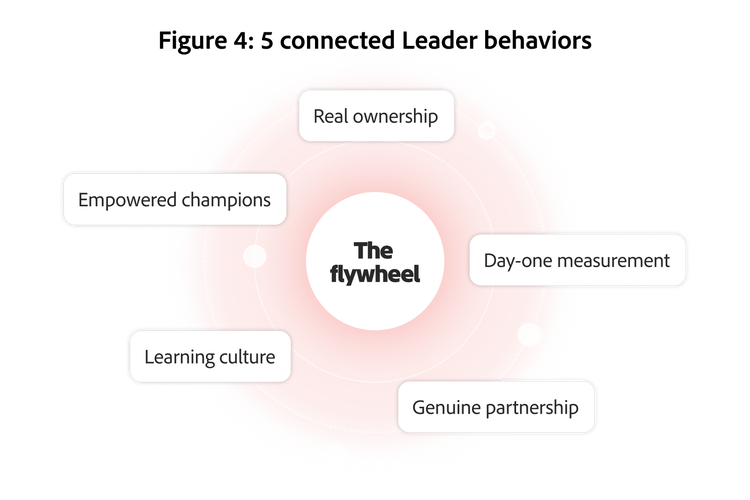
- Lesson 1 — Real ownership: The global Leader benchmark has a formal AI owner with budget authority at more than five times the B2B average. Real ownership combines dedicated budget, cross-functional authority, seniority, and performance accountability. The gap concerns authority, not the title alone.
- Lesson 2 — Day-one measurement: Leaders define the intended commercial outcome, record a baseline against the existing process, and agree on an attribution method before a use case goes live. Once in production, the baseline may no longer be recoverable.
- Lesson 3 — Genuine partnership: In collaborative or integrated relationships, business and IT share objectives, define the problem before requirements are written, and stay accountable for the outcome as B2B use cases cross functional and system boundaries.
- Lesson 4 — Learning culture: Destructive responses to setbacks, assigning blame or repeating mistakes, occur at a negligible rate among Leaders and are more common across the B2B base. Leaders examine what happened and share the learning across functions.
- Lesson 5 — Empowered champions: Leaders find the practitioners already making AI work in commercial workflows and give them recognition, a modest budget to extend to one adjacent team, and protection from avoidable friction.
The Compounding Dividend
Global Leaders report more value per dollar spent. Across cost reduction, cycle time, and volume processed, the global Leaders report materially stronger improvements than the B2B average. Similar AI capabilities are broadly available. The measured difference is associated with deployment stage and the operating model surrounding the technology.
Each deployment can generate inputs for the next — measurement data, review pathways, documented decisions, and examples from B2B workflows. When these assets are retained and shared, organizations can approach later use cases with more evidence and established practices. The pattern points to a cumulative advantage, though the research does not establish that deployment alone widens the gap.
KEY TAKEAWAY
Treat the operating model as a cumulative organizational asset. Retain measurement data, review pathways, workflow decisions, and implementation learning so later B2B use cases can begin with stronger evidence and established practices.
The Path Forward
For B2B marketing and customer experience leaders, the next step is not another isolated pilot. It is a sequence of operating model decisions that connect AI to commercial priorities, shared workflows, and accountable execution. Each action builds on the one before it.
- Appoint one owner before the next deployment.
Name one senior leader with authority for AI outcomes across marketing, customer experience, sales, revenue operations, customer success, product, data, technology, and operations. Provide a dedicated budget and document the mandate, decision rights, and performance accountability. - Define the commercial outcome and baseline before launch.
Before any deployment touching pipeline, account management, marketing, or customer experience, define the intended commercial or customer outcome, establish a baseline against the current workflow, and agree on the attribution method with the affected functions before the use case reaches production. - Bring commercial and technical teams together before the brief.
Convene marketing, customer experience, commercial, data, and technology leaders before requirements are drafted. Define the problem together, agree on what success means, identify security, privacy, legal, and governance requirements, and align on measurement. - Make underperformance analytical before assigning blame.
At the next pipeline, campaign, customer, or revenue review where an AI use case underperforms, begin with analytical questions. Ask what happened, what the data revealed, and what should change, then share the learning before assigning responsibility. - Resource the practitioners already making AI work.
Identify practitioners already applying AI effectively in B2B workflows. Give them recognition, a modest budget to support one adjacent team, and protection from avoidable friction, and ask them to document the workflow and lessons so peers can adopt it.
CONCLUSION
Turn AI Activity into Repeatable Commercial Value
For B2B organizations, AI readiness is not defined by the number of pilots underway or tools available. It is defined by the ability to connect those investments to marketing, customer experience, pipeline, retention, and customer growth through clear ownership, credible measurement, coordinated decisions, and workflows designed for repeatable execution.
Adobe is built for exactly this. Adobe Experience Platform brings customer data together as the intelligence layer for AI, powering over a trillion experiences a year. Adobe CX Enterprise extends that foundation into an end-to-end agentic system that orchestrates the full customer lifecycle, from first interaction to lasting loyalty, while an integrated content supply chain embeds AI directly into creative and production workflows grounded in brand standards and shared governance.
The result is a path beyond AI experimentation and into value realization, on an open ecosystem that works across the tools teams already use. When you are ready to scale, Adobe brings the technology and the expertise to help B2B organizations turn AI into a lasting competitive advantage.
Methodology
This report draws on global research conducted by Incisiv on behalf of Adobe. 5,633 executives participated in the full cross-industry study. 1,501 senior executives represented the B2B respondent base across seven industries and 11 global markets, and 1,381 B2B respondents were included in the active analysis across five stages — from exploring to transforming. All B2B respondents held formal decision authority over AI investment at organizations with $100 million or more in annual revenue, complemented by more than 25 in-depth executive interviews.
Unless otherwise stated, Leaders refers to the global cross-industry cohort of 342 respondents whose organizations met both Leader criteria — an operating model maturity composite above 3.27 and operation at the expanding or transforming stage. They represent 6% of the 5,323 active respondents and are not a B2B-specific cohort.
Title
The State of AI Readiness in B2B Industries.
cardDate
2026-09-03
cardImage

CardDescription
See what stalls AI progress in B2B and learn five actions for turning isolated pilots into repeatable commercial value.
primaryTag
caas:content-type/report
Tags
caas:content-type/report