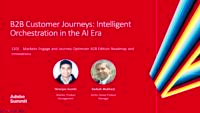
[Music] [Baskaran Natarajan] Good afternoon, everyone.
I hope you are having a great Adobe Summit.
Welcome to the session today. And with us, we have industry leaders in the Digital Experiences from three different industries...
Travel, and hospitalities, and banking, and financial services.
I am Basky Natarajan. I head the Digital Experience business at TCS. At TCS, we help businesses to redefine their brand experiences.
With that, let's welcome the guest speakers, and let me start with Valarie. Why don't you introduce yourself? [Valarie Bastek] Sure. Thank you. Hi, everyone. Valarie Bastek. I'm the Vice President of Marketing Technology and Digital Engagement at Wyndham Hotels and Resorts. Long title for us, that means our MarTech stack, search engine optimization, and the digital engagement team that works in Adobe Experience Manager.
Therron? [Therron Hofsetz] So Therron Hofsetz. I work for Vanguard. Until about seven months ago, I had a very similar job to Valarie. I was leading the MarTech engineering team. I moved to our personal investor business. That's our B2C or direct-to-consumer business, and now I lead a team of web engineers that are building client experiences using a lot of the Adobe Stack that I was leading the delivery of prior to this.
- Michiel? - [Michiel Van Raemdonck] Yes. Hi, everybody. I'm Michiel Van Raemdonck. It's quite difficult name to pronounce. I'm going to talk, if you're not Dutch speaking, so I'm going to talk to my parents after the Summit.
I'm working for the Belgian Railways for 15 years now, for the last five years focusing on customer data and marketing automation, and getting the most out of all of the massive amount of customer data that we have to really improve the experience of our customers.
Thank you.
I think, AI is creating a great momentum in the market and across all the brands. The key aspect is how do you make AI real for the brands? So that's where the important topic for the panel discussion today. And we are structured into four different sections. And let's get into the section one, where we talk about how AI is reshaping the digital experiences perspective on industry, whether it's a financial services or travel or hospitalities.
So let's start with the hotel industry, Valarie, because the hospitality industry is very unique. The evolving guest expectations and how brands are managing and leveraging the AI to deliver the seamless guest experiences here. So can you throw a light in terms of how Wyndham is managing the guest experience in the context of AI? Sure. We've started, I would say, small, probably like most of you with just a few key use cases for how we can talk to our customers. So for us, that's all in the personalization realm. How do we make sure when you're on the site that we're serving you an experience that matches your needs? With Adobe Experience Manager, we've been able to do that with some integrations with Target to customize some of the placements. So let's say you're a loyalty member, gold status, we can talk to you about the benefits of that. If you're platinum status, perhaps we serve you different content overall. And I would say we're fortunate. Our leadership team is really great about having these conversations. I think when I first started on more of a marketing type role, it was taboo. Nobody wanted to talk about it. It was going to steal jobs. There's no good way to use it. But in our commercial organization, we're able to really just hone in on what our customers looking for, what's valuable for them, and how do we do that in a way that feels right to us and really meets their needs. So some small things on the site to start. We are in the process of working on Journey Optimizer. So we're a few months away from really doing personalization at scale and frankly, a lot of the AI tools around even just how our teams work and how we can get to velocity. With 9,000 hotels and very small teams, it's not easy to do that, with hands on keyboard, but AI will help us get there as well. So we're looking at it both from the guest perspective and our employees, how do we activate more in that regard. Thank you. Thank you, Valarie. Michiel, in today's world, the expectation of the traveler is not just about moving from A to B. It's much more than in terms of delivering a seamless travel experience. So how Belgium Railways reimagining in terms of delivering the seamless travel experience in the context of AI? Interesting question. And first of all, it's quite important that we can get the customer from A to B. That's our main goal to start with.
But I think and that summarizes it a bit. You have to see it in two different aspects. You have the operational communication, quite important, but also the marketing communication. And when you look at operational communication...
We have come a long way because in the past we weren't able to do anything. And thanks to, let's say, the Customer Data Platform, AEP that we started in 2021.
We already have some view on what our customers are doing, how they are traveling, how they are taking the train, but we are not really-- We don't have enough details yet. So that's why we're looking at AI to go that one step further to be there at the right moment, at the right place, at the right time. Everybody heard it, but it's really important because relevance is really, really key. We have to be there when the customer needs us. And at marketing point of view, marketing communication, we are mainly focusing today on, let's call it, propensity to buy. We really want to see and understand who is our customer, what is his travel mode, if not really easy with our product portfolio, but it will take us too long. It's not a session of three hours, so let's not go into detail. But we're really trying to understand who is our customer, what type of product does he need to go from A to B or maybe even to C. Give him some inspiration to go to another trip, that could be interesting for him. So that's one part of marketing communication. And the other one is also-- It sounds easy. It's not easy for us to really define what is the ideal home or destination station for our customer. So it's quite complex. We're in Belgium with a lot of train stations. It's not based on the data that we have, it's not always that easy to define. Okay, this is really the station of a customer. So that will help us in our marketing, but also in our operational communication. If there's an issue in one of the many stations we have in Brussels, you don't need to communicate that to all the customers.
Thank you. It was insightful, Michiel. Therron, let's look at the investment management.
The whole industry has gone through a lot of digital transformation, matured. And with the AI, I think it's going to create an impact in terms of next level of transformation. Yeah. So how do you see Vanguard adopting the AI strategy to stay ahead in this market? So a couple of things, we'll turn 50 years as a company here in two months. We have tremendous amounts of data about what individual investors do, oftentimes not for their own benefit, right? So if you look back at 2001, 2008, 2020, you see people flee the market, right? Exactly the wrong thing to do. So one of the things that we've been able to do with AI is start to harness a lot of the data. It gives us the ability to scale our message in a way that we couldn't before. We had data trapped in different silos in the organization. We were telling our story in different ways, articles, PDFs, things like that on the site. But now we can use the power of AI to accelerate the information and the communication to help our investors stay the course, believe in the long-term investment philosophy that Jack Bogle professed when he founded the company.
So that's a big part of it. We've evolved, right? We've done much more one-to-one marketing in the last three to four years if we added more of the Adobe Stack. Comments like AEP, we're starting to get rich insights around our customers. I can tell you the highest peak of volume that we see every day is right after the market opens, right around 9:27, 9:35 in the morning, right? But we also get another blip around 4pm, and it's a lot of people coming in to see their balances and what happened through the day, right? So we know when people are starting to come to the site. We can use that for one-to-one personalization to help them stay the course. Don't panic if there was a sell-off today. In fact, a lot of our investors try to buy on the dip. So we're starting to think about AI in a way that we can help clients either stay the course or take better actions or be informed about what are real things that are impacting the market. And then I'd say in the last two years, a lot of what we've done previous was traditional AI, right? So machine learning, reinforcement learning type personalization. But in the more recent years, obviously, GenAI has taken off, so we're looking that in three different ways. One, around as an assistant, right? Productivity enhancing stuff like you get with Copilot where you're helping your crew or your team write better code faster or you're summarizing meetings or things like that that you get in Office 365. But we're also looking at it where GenAI is going to help us take action, right? So you see automation of segments being created on top of the AEP now that Adobe is presenting today. And then soon, we're going to put GenAI capabilities in the hands of our clients, and that's really an area we're going to step into extremely cautiously. Because if the LLMs hallucinate or get things wrong, we don't want our clients to, one, react unfavorably, or two, just cause a stir in the market based on the ethos that we have as a company, which is to help our investors do the best for themselves over the long-term. Yeah. Great insights. So up to the brand in terms of how are they leveraging the AI to drive, whether it's a travel experience or a guest experience or the investor experience. So with that, let's get into the next section where we get closer to in terms of what exactly and how that AI delivering value and impact to the brands. And the next section, we'll talk about personalization at scale, how the brands are orchestrating the Adobe Solution certs, as well as the AI tools, and any IP within the company, so the orchestrating the various tools and technologies for a specific purpose. Let's do a little, deep dive specific to the industry and brand here. So let's start with Michiel.
Can you give an example that how we are leveraging or planning to leverage AI to minimize the disruptions in the travel, so that you are able to deliver the seamless travel experience? Yeah.
For that type of question, I'd really prefer not to focus too much on Adobe-- Yeah, anything that's I said-- Because it's a wider world. It could be any AI and generate tool. The thing is about how do you leverage the AI to deliver the business use case and deliver a value to our customers. - Yeah. - Yeah. Indeed, I think for the entire company, AI is a big enabler. There are a lot of ideas, a lot of potential on a very wide scale. Because to give you an idea, we have about-- It's a company of 18,000 employees within different departments going from train conductors, train managers...
Yeah, purchase of trains. So it's real broad range, next to, let's say, the digital marketing. And there are a lot of ideas, a lot of potential, and we are trying to, let's say, streamline it a bit. We implemented an AI board that helps us to promote AI inside the company, but also try to be sure that every initiative that's taken, that is following the rules, let's say rules and regulations, and also fits in the company goals. Quite important too. And when we look at more the technical part, not my expertise, but we have done some initiatives on predictive maintenance, which helps, of course, to avoid disruptions. Another example is when there's a train somewhere stuck in Belgium, AI to help the technicians to resolve the problem more quickly, more efficiently. So that's one. And also another topic is the transport plan. Once in the four years, we make a giant exercise on, okay, which train needs to ride between point A and B, how many times, how big the train should be. And until now, we were basing ourselves on manual counting in the month of October. So there were-- In each station, first with a clicker to see how many people get up or off of the train.
We're not going to get there by working like that. That's clear. And also, COVID also changed the world entirely. Don't need to tell anybody working from home came, so the travel behavior from the commuters changed dramatically. So we are trying to use AI to get a better view on that behavior and really create a demand-based transport plan.
And that way, we will be using still manual counting. We're not going to stop that, but also purchase data, scan data on the train, social geographical data. All of those data will be combined. Also, the weight of the trains all come together to really have a demand based plan to really define, okay, where is the potential? Is there a potential between, let's say, Amsterdam, Brussels, Brussels, Bruges? Do we need to increase the trains rolling there or not? So that's a bit the idea of what we are doing there, company-wide. Thank you. That's insightful, Michiel. So, Valarie, let's look into the hotel industry again. Can you give an example where AI has been leveraged at Wyndham to drive the overall booking experience and conversion? Yeah. And as well as improving their customer satisfaction and loyalty. Yeah. We've been really inspired by what our contact centers have done. So they've used AI to when the moment the agent picks up the phone, they're able to say, I know who this customer is. Here's the details about them. I don't have to go through the script of trying to find out who they are. We can start having a conversation immediately. And when we think about the guest profile, there's just a lot of great opportunities for us to mimic that on the sites and really know you've looked at a Baymont in Ohio before. Can we serve that to you again? Is there an opportunity for us to serve you something similar? Are there ways for us to get creative about the offers that we're giving you based on your profile? So things like that that have really, for us, moved the needle as far as not having that same generic experience over and over again. We do skew very heavily in the economy mid-scale market. So for a lot of customers they want to get in and out. They're not necessarily looking to browse, but they are looking for deals. They're looking for things that that could enhance the stay. So we've used AI on a lot of our components in AEM to do more dynamic serving of content, bring things together a little faster in that regard, and really just talk to the customer as if we know who they are, and just really think through what that means for them as they're coming to the sites, and what it means for them coming back as well. On property, you've all seen this. There's many, many opportunities to use AI on property. I'm sure you all got the text message when we arrived as far as how's your stay going. So lots of cool things that, can't talk about yet, but still happening in that regard as far as how do we make that a more seamless experience without having to burden our franchisees or owners with doing more.
Thank you. Thank you. So, Therron, let's shift to the investment management, example of how we are leveraging at Vanguard AI to a more insightful and personalized experience for investors and also to secured. Yeah. So I mentioned the mission of the company is to help investors achieve their best financial success, right? So the company was founded on the principles of take a stand for all investors, treat them fairly, and help them achieve their best financial outcomes. We're essentially a nonprofit corporation, right? So when we make money, we reduce the fees that we charge on the assets that we manage for our clients. So our typical conversion metric is a little different than maybe than Valarie's in terms of a night booked, or a stay, or things like that. Ours are about the client doing something in their best interest that helps them achieve a financial outcome. So two to three years ago, we started a program called CX Alpha. If you're in financial services, you understand Alpha is everything. That means getting your best return, so we overuse that a lot in the industry. But CX Alpha was really geared at digital experiences to help clients take action, next best action or nudges to benefit themselves. We've done to date, in three years, we had a goal of $600 million in client outcome, meaning their portfolios would be healthier by $600 million. Not us, them. And that CX Alpha, so we're two years of three into that program. We've done about $400 million in client value realized, but it's personalization using AI in a way that we couldn't have done before. So examples are, we have way too many people that invest in cash. They trade, they come out of their investment, an ETF, a fund, a bond, a stock, whatever, and it goes into the settlement account, and they don't do anything with it. We have over $500 million in cash sitting in our accounts. That money is not earning any meaningful. We do provide money market type equivalent products, but it's not earning meaningful long-term capital appreciation. So some of the personalizations we have are to nudge our clients to get out of their cash holdings and get back into investments, right? We have other ones. We have a ton of people who die, who'd never have identified a beneficiary, and we are managing the money sitting there in their accounts, and we have no idea who to inform that their loved ones has passed on and there's money sitting with Vanguard, right? So we do nudges to help our clients come back through and assign beneficiaries. We do other things like, if you're overweighted in your portfolio in a particular type of asset class, right? Oftentimes, in our advisor business, sorry, our institutional business, many of our clients that are in our 401(k) products are way over invested in their company stock, right? And so what we try to get them to do is think about diversification and investing for the long-term. So those are the types of nudges that we've been able to do with some basic, it's more traditional AI versus GenAI, but XGBoost models that are reinforcement learning, so we can see what's working versus what's not working. We test against control. We're starting to introduce Champion/Challenger type models where we'll test two different models against each other and see how that's affecting clients. But so in the three years that CX Alpha has been running, over a million clients have taken action to benefit themselves, and we've seen, as I said, over $400 million in client gain against that $600 million target.
Yeah. Very insightful. I think, good to see that across the brands, how we are leveraging AI to deliver the personalization of skill and whether it's a travel experience or a guest experience or investor experience. So with that, I just want to open a question to all of you. While driving this transformation of delivering a personalization at scale, what is the biggest challenge you'll come across, and what is the most memorable experience or the outcome we delivered as part of this initiative? Anyone per brand, any examples? Challenges you faced? - Yeah. - Any outcome? So financial services is highly regulated, right? So regulatory environment, compliance, risk, we're a tremendously risk-averse company, right? So getting people to buy into the idea that everybody could get a unique experience is really hard to get people's heads around in a company like Vanguard. So institutional silos within the company is one of the challenges we faced dealing with a risk-averse culture, working through compliance processes. How do we approve the content so that we're not-- We have a lot in the regulatory space that we're not implying a return could come, right? All investment is inherently risk. So we have to be super careful about not implying that you're going to get a type of return via the content that we put on our website or even in our next best action. So those have all been internal working challenges that we've had to overcome as we've moved more and more into a hyper-personalized and a hyper-client tailored experience. Yeah. I would echo that for sure on the content creation side that there's a lot of hesitancy about, can we really do this? We like to review everything. You can't review 10,000 versions of something, though, with one lawyer. So how do we work past those barriers? And secondarily, I would say, not necessarily a challenge because our teams have tackled it well, but just getting the data in the right spot so that we're doing things smartly and we're able to actually personalize and not just take that batch and blast approach. And that has been a long process for us. I think it's taken, in some ways, longer than we expected to get all of those pieces moving together. It's going to be great once it's actually live and in place, but it's the timeline on that was certainly extended, which presented some challenges.
Yeah. I think actually there are quite some similarities across different industries and it's interesting to see. But I want to add that it's a difficult, let's say, balance to find because indeed it's highly regulated. You have to be careful. But also we have that idea of, okay, we want to be innovating. We want to be there for the customer. We want to and we really need to find a balance to not kill all initiatives. We have to really define a playing ground to really get something going on because we know it's got added value. You really need to, yeah, be careful, but also be sure that everybody goes in the right direction. - Yep. - Yeah. Thank you. I think, one thing clearly comes out is not about leveraging the AI or generic tools for your business. It's all about how do you orchestrate the various technologies and the AI tools specific to your business purpose, right? That's where the delivering the art of possible with the personalization. So I think good insightful discussion. Let's move on to the next section.
Human and AI. I think, all of us believe the growing importance of AI and the bigger role the AI is playing day in, day out in terms of the various use cases and the various scenarios coming out. And it's going to be very important for the brands to strike a balance between the AI-powered automations and human insights. So how do you balance it for a specific use case, specific scenarios, and deliver the value? So I think, with that...
Just wanted to start with Therron, again with you because the more and more the AI involvement in terms of the customer interactions. So how do you ensure, particularly from investment management perspective, giving a human touch, empathy, and also more comfort to the investors. It's not about the machine. - There's a human touch is there. - Right. I think last year, we really thought human in the loop would solve for this.
I think the pace of change in particular in the GenAI space is so fast that we've probably moved past that, and we found out the models are super smart. You can train them to do more than you think you can, right? And so I was telling Valarie earlier, we're using internal call transcripts to train the model how to sound and act more like Vanguard, right? Our employees that are on the phones go through extensive training around, not only financial products and advice, but also just how to live and breathe the Vanguard ethos of invest for the long-term, stay the course and don't panic at market sell-offs, things like that. So we're using other bodies of knowledge we already have in the company to help inform the GenAI models in terms of the voice of Vanguard. I think the other thing we're doing is a lot of test and learn, right? So we found the first projects we did with GenAI, they hallucinated tremendously, right? And so you have to come up with more of the guardrails that you want to put in place. A lot of our thinking around agentic AI is a distributed set of agents, and one of them might be a compliance type agent. One of them might be the voice of Vanguard type agent, right? So you can get back the response from the generated answer, but then we send it through another couple of layers in the modeling to make sure that it's not going to violate requirements around compliance or to make sure that it sounds very authentic as if someone was speaking to a Vanguard crew member.
Thank you. I think you've made some excellent points in terms of how do we balance the human and AI, and that's very important from shaping the future of experience.
When it comes to the hotel industry, Valarie, I think, as part of the guest experience, the more and more involvement in terms of leveraging AI, whether it's recommendation or personalized interactions. So how do you ensure the more personal touch is not lost as part of the more and more automation of the AI? So what are the strategy being adopted or being explored between them? Yeah. Obviously, for hospitality, there's always going to be that human interaction. I don't think that'll ever go away. Maybe for some of us that perhaps don't want to talk to someone at the front desk, that's fine. But there's still many that that do want to have that. And I think when you look at the data around how people are using AI, a lot of it is informational at the moment, especially in the SEO space when you think of the AI overviews and just what those are doing. I think I saw a stat that 95% of those are informational and only 4% are transactional at the moment. So at the end of the day, we're still a business that needs to transact and do those types of things. So getting specific about where are the right places that we can use AI to be a benefit to a customer, to aid them, to help them do things that perhaps may feel hard or have been challenging in the past. And then when are those moments where we just don't want to leverage a tool like AI? Maybe it's something on property where we'd rather that they're interacting with our front desk staff or something like that. So using it carefully in that regard and really having those discrete use cases around where are the right moments to do this and where are the moments where it might feel a little off.
Thank you. Thanks, Valarie. So, Michiel, coming to the travel industry, I think it's not just about moving from A to B, the location, in terms of that communication in terms of timely relevant communication. Yeah. And there how are you balancing and leveraging AI with the human insights to deliver the seamless experience, elevated experience for the travelers? Yeah. I think it's clear that we need both, and I think we can focus really on the operational communication. That's the most important part in this story.
If you go back a few years, let's say, we have had some purchase data available that we can base ourselves on, and we already have seen major improvements on something, yeah, simple like opening rates of an email going from 30% to 70% or 80% or higher. So we're on the good track, but AI will really need to help us to really be there at the right time. Like I mentioned before using the purchase data, but also scan data, also geolocalization that we're going to start using with AJO to be really there when the customer needs us. When you see, five years ago, we had a one-size-fits-all. If there's an issue on the network, we're going to send a mail to everybody. Not a good idea. So we avoided that only in case of major problems. And then, okay, we started to learn along the way and we're still growing and growing. And the most important and difficult part is, to give you an idea. Belgium, I know it's really small. It's a really small company, and we have 3,700 trains approximately rolling each day, more than 300 stations. But if there's a problem in one upper right corner of Belgium, it could have an impact on, yeah, really in the south of Belgium. So it's really trying to understand what the impact of a disruption is, and that's really something that a human cannot simply define when working, like we're working today. With a human point of view, you take the real network. You see, okay, these stations. Okay, let's take that one for the segment. But it's really much more broader than that, and that's where we are really using AI to want to create an optimal audience for that type of communication.
Thank you. It was insightful. I think this question is to all of you, with the growing importance of AI and the role in the overall human and AI ecosystem, how the brand should evaluate building the trust of the customers.
Because trust is good, the important thing when you have a ecosystem of human and AI. So any view on specific to your brands, building a trust with the customers? I think for us, it's been-- I never thought I would talk so much about data. I started at Wyndham 14 years ago as a content writer, and it's not my love language, but getting that data right to build the trust. So for me, my husband, I don't have kids. If you're showing me a image of a hotel with a pool with lots of kids and the water slides and everything, maybe not so much. Now if you have the champagne bottle on the bed ready to go, I'm in. But really just getting to know the customer and making sure that the data's in a place where, again, we're sending the right message and not sending messages or over blasting things that that don't feel personal, that don't feel relevant. For us, that's been really important to get that part right.
And I think in addition to that, also what you said earlier, the human contact is also really important. You have the combination of both. You can have a chatbot also looking into, okay, can an AI agent help in our chatbot to further optimize, but you really have to have the impression that there's always a human there to help you if needed.
Yeah. I think authenticity is really a big part of it, right? So again, don't show up like one of our competitors when you're using AI. We do not support crypto at Vanguard, right? We just do not believe in it as an investment vehicle. There are underlying reasons we don't. We don't support gold funds either for the same reason, right? We feel that there is no intrinsic value being created by those products, and so as a company, we don't do that. So it'd be bizarre if our AI started recommending crypto products to our clients. So some of it's just being authentic to the company and the brand. Some of it is getting the insights into our investment philosophy.
Again, as I said, we're using our knowledge base to train some of the agents to seem more authentically Vanguard. So I think all of those are really important, but it's establishing that trust that's showing up in those moments that doesn't feel creepy, but feels informed and authentic in the way that any of us can have an experience with a company, but if they show up at the right time and are talking to you about things that are relevant for you, it's super impactful, right? If everyone in this room knows a brand that when you say, tell me a brand that really gets you, right? Whoever that is, whatever company that is, you know those companies. You also know the inverse of that, that is like the creepy company that shows up all over whatever your social feeds are or your websites that you go to, and you see the same terrible ad 15 times just because so they get impressions, right? You know the two sides of that. So I think it's really being true to the mission of the company, being authentic in the way that you treat your clients, and then showing up in those ways. Yeah. Thank you. I think it was very insightful, and it also refers to the art, accountability, responsibility, and transparency. That's very important in building that trust. So with that, I think, we'll move on to the next section, navigating the AI journey. While all of us know, yes, this is the industry-specific use case or scenario, how we can reimagine with AI and how we can orchestrate the AI tools and your in-house technologies to deliver a business value and how we can harmonize the AI and the human ecosystem. While all of the things are defined...
Still there are challenges with the organizations in navigating the AI transformation journey. So there are few examples where brands are struggling in terms of data readiness, legal and security compliance...
and the employee readiness, the talent availability and the employee readiness. So overall, the adoption is another challenge the brands are evaluating. So I'm just trying to understand from your brand perspective, how the company is navigating the AI journey in the context of data readiness, legal security, and the employee readiness, the overall adoption of AI.
Start with maybe Therron. - Yeah. - Sure.
So data is an interesting thing, right? A lot of people talk about, is your data ready? Large language models need readable content, right? So if you wrote your API with camel case as an example, and you use ADDR1, ADDR2 for address 1 and address 2. An LLM doesn't really know what that is, right? Now it can start to intuit that, but what we found is we've had to go back and augment APIs with more metadata tags, if you will, so that the LLM has better context in terms of what those generated solutions are trying to do, right? So that's one thing. So it's not just data readiness. I think data readiness is like, we're going to talk about that till the end of time, I think. But it's then how do you use the data in the context of which you want the AI to use it most effectively? So we've had to go back and augment our APIs so that the LLMs understand what we're trying to get them to do.
I think the other thing is really, we are fortunate. We have a CEO and a CIO who are both very open about AI will change the way we do business. And so from the top down, we have a pretty strong edict, if you will, that we need to become AI-ready, right? All of our competitors are probably already doing this. We need to be as well, and it's empowering, right? We do have a lot of people who are afraid of it, right? But I think the thing that is most impactful is, if you can get yourself to how can we or what could we do in terms of a mindset, I think that starts to pivot you into the potential and the possibilities of so many things, like just compliance, right? How could you use AI to get 10,000 images approved versus one lawyer that's never going to be able to do that, right? So the potential is all over the place. It's not just in personalized digital experiences. It's all of our processes have opportunity. So I think we're excited about that, and we have really strong advocacy from the leaders.
Thank you. Thanks, Therron. - Valarie? - Yeah. Therron mentioned the executive buy in, and I think that's critical as well when you have someone that's championing for the things that could really either help an employee or accelerate the business or, of course, drive more revenue overall for the company. So when we first started down the-- I'll call it the AI journey, the organization did put together a steering committee that encompassed a lot of different groups across the organization to start looking at where are the places where this feels right, where are the places that perhaps we need more time to vet things out, and just having some really firm wins early on helped. I think a lot of people hear AI and they think, you're just going to spin out all this content. It's not going to make sense. It's going to be the creepy ads following you. But then seeing some of the things like Copilot, like you mentioned, or even just some of the ways we've been able to author across all of our brands in at Velocity has really helped to sell the story that it doesn't have to be this scary thing that's, again, taking away jobs or anything like that, but that there's real discrete use cases that we can use. And we're excited with journey orchestration. I'll admit, I never thought as an organization that that we would get there as far as the ways that we are going to personalize across all channels. But being able to see the benefit through things like our contact center and just other groups using AI has certainly helped on the journey. Pun intended. Thank you. Thanks, Valarie. Appreciate it. I'll use an expression I learned during this session. I'll echo that.
Did you like that? No. Yeah. Like I mentioned before in this session, it's really the management buy in and the fact that like for innovation, also for AI, we installed a board that helps to promote, to align, and to get everybody aboard of the whole AI train.
We see what you did there.
I feel like I need a pun. Yeah. - It'll come here. - Yeah. Thank you. I think it's a good-- If you invest in AI, you're going to get great returns. I love that. It's terrible. Boom. We're here all the night.
Tip your waiters.
So I think, across all the three brands, you have gone through the various journey in terms of navigating the AI solutions for your industry. So now I think in the audience, we have leaders from different industries and many of the various brands. They may be in the different stage of the journey in terms of, either they're already in the journey or planning for it. Is there any advice in terms of how they should approach in terms of navigating the AI journey based on your experience? What are the top three things they should look at? - Just to open question-- - Yeah. I don't know. The first thing is get started.
If you're not doing it now, somebody else in your organization, and they're going to be the people that are going to get the opportunities and the promotions and whatever else. If your company is not doing, one of your competitors is. So just keep that in mind. I think, a colleague of mine said this the other day. He, I guess, has an hour long commute, so he chats with Copilot on his way in and out of work. He gives it ideas. It gives him ideas back, right? Use it as an advisor. I think learning about the limitations and the capabilities is really important because you can start to see the patterns especially with LLMs, they become a little predictable in the way they answer questions. But so start using it, invest in upskilling or learning for your teams, right? We use Degreed, which is a learning management platform, but we have leader tracks, we have employee tracks.
And then we're encouraging a ton of people to use tools outside of work that we currently don't support in the office, but just to generate ideas and input into the conversation.
I said our CEO and our CIO are super invested in this as a future differentiator for us. I think two years ago, we had 30 AI use cases in the company, and at event I was at last week, we have over 700, right? The ideas are pouring in faster than we can even sift through them to figure out how to get them started or implemented. So I think we're now in a situation where there's not a shortage of how to use AI. It's now how do we do it at scale even more effectively.
I would say to really sit down and think through, again, where it's appropriate. One thing that we did with Adobe recently I'm sure everyone's tired of hearing the term content supply chain, but we started looking at that across the organization of where are the places that maybe we're not struggling and we don't need to think differently, and where are the places where we really are struggling and could think about tools differently and just think about different ways to use AI to either supplement some of the work the teams are doing, to better personalize on the sites, to do more at scale. So sitting down and mapping that out helped. I think with things like AI, it's very buzzy. It's like, "We got to do all of the things." We've got to start with content. We've got to use the agents. We've got to-- I don't know, do images and things like that. But really figuring out where you can start so you can activate a little faster and not get hung up, I think, on some of the things that could trip you up as you go further down the journey.
Thank you. Yeah. I think it's the story of just start, learn, adapt, and grow along the way. I think that's the most important message. Thank you. I think, with that, I just want to open the floor for any questions from the audience because we heard all of the insightful discussion from the guest speakers. Just want to see, is there any question from the audience before I get on to the next one? So we've been asked to have you go to the mic so that everybody can hear you and that can be heard on the recorded session.
[Man] Hey, everyone. Thanks for the insights. The question that I have is, in the earlier Keynote also that we had earlier today, it seems like AI is helping to optimize a lot of processes, but it's also gravitating towards personalization and super personalization. In your industries, especially, that are open to end users, how do you balance super personalization with still keeping your landscape open for people to realize that there are other options too that they can explore and not just give them a tunnel vision? That's a great question. I would say we're still thinking about that as we think through just the capabilities. Now to your point, there's so many options. How do you even choose what to say when there are so many different things? So I think looking across the channels, seeing what that customer behavior is like, using upsell as an opportunity, I think for us, that's what helps us to not limit it to just one hotel or one type of vacation. Where are the areas where we can sneak in and say, "We know you've traveled here before. What about this? We've got an all inclusive there now." So keeping it open in that regard, but not necessarily, I would say, like hitting somebody with the same message over and over. And I think that's where the pathing comes in handy to really think through where are the steps in the customer's journey that I can talk to them, that I should talk to them. What could this look like for someone that's interacting with us the first time versus the 500th? So it's a process, I would say, but starting to think through it in that regard, for sure.
I think one thing we're doing is, you hear a lot about life stage being important for investors, right? So our personalization is very different for a 23-year-old that just got out of college than a 35 to 45-year-old that's got two kids and is thinking about college and struggling to figure out if they should put more money into 529s or retirement, right? So life stage helps us differentiate our personalization. It also helps us differentiate the types of not only messages we give, but also the products that we recommend for people.
The complexity of what you're dealing with as you enter your late career, retirement, how do you withdraw the right amount, how do you not run out of money, right? There's very different things that are on the minds of investors over the course of their lives. And so we try to use those life stage events as one thing to bound the things that we think are important for them to pay attention to, right? And even then a 23-year-old who's working as a software engineer that makes $150,000 needs completely different recommendations and advice than the same 23-year-old who's working at a diner and making $45,000, right? So part of that is just one of the biggest things you can do to be successful investing is start, right? The other thing you can do is don't deviate. This is terrible to say, and I probably shouldn't say it on a recorded thing, but do you know who the most successful investors we have are? People who are deceased because they don't change their strategy because they don't react to the market fluctuations.
But it's true. We have all of this data that says if you stay the course over the long run, you will do well, right? Most people don't know, Warren Buffett made almost all of his real money after he turned 65 because of the power of time. So part of it is we have different messages for different audiences, but even those within, you can't just generalize 23-year-olds who need this kind of personalization. It depends on where they live, what income they have, do they or don't they have children yet? Right, all of those things make a difference.
Yeah. It's a bit the same at the Belgian Railways too. You have to see the customer as an individual. The 23-year-old can go, can be still in school, can already go to work. So it's a really complex combination of all different aspects. Yeah. Yeah. - Any other questions? - Yeah.
Give me one second.
So I work for an engineering firm, and it's a little bit more B2B, obviously.
But I'm curious, what's the closest intersection you guys have had with AI and like very technical or very regulated content? And have you kept that specifically divided? Have you been able to bucket areas where, "hey, this needs to be professionally stamped," so to speak, and then within the lines, we can put content. Have any of you guys had an experience similar to that, or have you...
I guess, approached those lines at any point in your journey? Every piece of content we produce, regardless of if it's for B2B or B2C, has got to be approved by somebody at Vanguard for compliance reasons. So we're regulated by FINRA and the SEC, and there are very specific guidelines. I think this an area where LLMs are going to be tremendously valuable, right? If they can essentially read the guidelines that come out from those agencies, and they could do it globally, we have much more scale in the way that we can enforce compliance, right? So we have two equally large B2B parts of our company. We deal with advisors who we want them to tell their clients to put Vanguard products into their investments. We also work with institutional companies who provide 401(k)s or 403(b)s or whatever defined contribution plan for their employees. And so the insights we get out of individual investor behavior, whether they're a retiree, a retirement participant, or an individual 529 still apply across the board, right? But the messaging that we go to in terms of those B2B business is quite different in how we try to get people to listen to us. I mean, at the heart of it, it's all of the same, right? We are here for the value of the investor, but until 15, 20 years ago, advisors didn't want to deal with us because we don't pay commissions to them, right? So there's been change in the world where index funds are much more palatable for most types of portfolios, right? Low fees, everybody's heard that now for a long time, especially since 2007 and '08, right? So the messaging at the core of what the company does is very similar, but the specifics of where we go-to-market in our B2B spaces versus our B2C are very different. But all of that is regulated content. Thank you.
One of the things that we're trying with Journey Optimizer is to think through the concept of a content library where we can piecemeal things together on, I'll call it, on the fly, as we're doing it and have those things preapproved by legal or whoever the team is so that it's not a process every single time. When the team wants to kick off a journey, they don't have to wait 10 days for a lawyer to look at something. So how much can we put together that still makes sense that a lawyer would feel comfortable with doing? So that's been helpful. Well, we haven't launched anything yet. But in theory, that will be very helpful for us that we've already got those preapproved pieces. Yeah. Same approach here. Just defining the playing ground, and then it gives you a lot of liberty to do the things you think are the best for our customers. And you go beyond that line and, okay, you'll check with legal audit. It gets a lot of free space.
Thank you. I think whether it's a B2B or B2C. - Yeah. - There's a question. - Yeah, please. - No, that's fine. - Yeah. Please go ahead. - Yeah, go ahead. [Man] No, I think my question is about the roadmap.
You have a vision for your product, and then you have a roadmap, but the breakneck speed that technology innovations are happening. Last year, you came over your content supply chain, meant you have AEM, you have Workfront, Firefly was coming to picture, then you have compliance system. You integrate them, you're good to go.
Now there are five more alphabets in that soup, right? So how do you build a roadmap? And it's all about AI.
You have Firefly full speed right now. You have GenAI Studio. Then you have the agentic approach that launched by Adobe.
It's all driving personalization and content, all GenAI and AI driven. So how any challenge, any solution that you are using? Yeah.
If you look at the way we have organized in making the AI real for the brands, right? Instead of looking at these are the AI tools or these are the capabilities available in the industry, look at what is the business problem we are trying to address or to solve, right? Then orchestrate based on the value versus feasibility. Because there are certain capabilities and tools may work in your industry, your company, and your ecosystem of the legal and compliance and security. That may not work for other industry. So finally, as a business use case, then orchestrate based on the purpose, not to look at so many tools and technologies available. I need to leverage all of them, and what should I do with it? So I think because as you rightly said, the innovation happening in the technology, every day something new coming up.
From the leverage and adoption perspective, look at the purpose, the problem could be solved. That's the only way we can stay with the journey.
You need another example? I was at a financial services industry lunch today, and one of the stats that they shared was about, any of the MarTech adoption or your roadmap. And the impact of the tools, everybody thought that'd be really high. The reality is the impact across the implementation was considerably lower when they did a post-implementation survey. And the two areas that were really high were people and process. And I think you hear this at these events, whether it's Salesforce or Adobe or whoever, that if you buy a stack of tools, you're going to do magic. But if you don't bring your people and your process along with it, you're not going to do very good magic, right? Now the reality of, I think your question is great, and so it networks with me at Vanguard.
I think flexibility in your process is the key, right? I think if you need to continue to have a multiyear North Star, around what you're trying to deliver, what business problem you're trying to solve. But your approach and your flexibility around how you're going to solve that has to change much more frequently now. Our SEO, our team is inundated by the changes that are happening within Google's generative answer engine.
If you guys haven't read some of the Gartner stuff on this, where terrified people aren't going to come to our site anymore, right? Because they can get an answer that is robust enough in a ChatGPT, or a Google, or a Bing type interface that they don't need to come read it on our site anymore, right? So how do you draw out of that experience to get people to come see long-form content videos, or short-form content videos, or audio, or whatever it is, right? But you have to get them to engage differently than simply getting a generated answer off of the content that's already available on your website. So anyway, back to flexibility, I think, is, I guarantee our search teams probably change direction three or four times, always with the same North Star of attracting more and more prospects to come to Vanguard through effective search advertising. But you can no longer set a three-year course and start out slowly, right? You got to look at that every quarter, every maybe even every couple of sprints. So flexibility in the process, I think, is a key. Yeah. Thank you. Thanks, Therron. So I would like to summarize the overall panel discussion. In making the AI real for brands, we looked at the four different sections of the steps. First is about look at the business problem and identify the business use case which you are trying to solve. That's the first thing. Second is about orchestrating the AI and your in-house solutions available, the tools available specific to that purpose.
Third is about how do you balance the human and AI in the harmony.
That's the third part of it. While one, two, and three is getting ready, you need to look at the fourth in parallel, navigating internally that looking at your data readiness, your legal and security compliance, and your talent. You imply readiness to use the tool and the capability, navigating the journey. So these are the four important steps when you're trying to make AI real for your brand.
I think, it was a very insightful discussion and valuable input from all of the industry leaders here across the travel industry, hospitality, and the financial services investment management. So I thank you very much. Thanks for the present speakers.
[Music]