Content as a Service v3 - generative-ai - Tuesday, July 15, 2025 at 11:21



JUMP TO SECTION
Generative AI first accelerated content creation. Now enterprises must scale control
What makes generative AI enterprise-grade?
Generative AI for content velocity
Generative AI for journey orchestration
Generative AI for analytics and insights
Governance, safety, and trust: How Adobe makes scale a competitive advantage
Move from generative AI adoption to enterprise advantage with Adobe
Unlock new ROI from generative AI tools across your marketing campaign operations.
Generative AI has accelerated content production, but when it's not embedded within workflows it can expose governance gaps, integration overhead, and delayed insights that erode ROI.
This guide provides a practical framework for moving generative AI from isolated pilots into governed, enterprise-ready operations that reduce complexity, strengthen oversight, and deliver measurable ROI at scale.

Generative AI has moved past novelty and into the core of how modern marketing organizations produce content, engage audiences, and personalize experiences. Teams are generating more creative assets, at lower cost, and at higher velocity than ever before — and they’re already seeing measurable gains in efficiency and relevance.
But accelerated output alone is no longer the strategic differentiator. What separates leading organizations from the rest is how effectively generative AI is embedded across workflows, journeys, and measurement — enabling organizations to scale not just content, but a consistent, trusted brand experience. Without that integration, gains in speed and scale can stall — or worse, fragment across teams, channels, and the brand itself.
For marketing and experience leaders, the imperative is to build systems that:
- Sustain content velocity with brand governance embedded at scale.
- Generate and orchestrate personalized customer journeys, not just individual assets.
- Convert data into insight and action across the organization.
These priorities reflect a broader shift where generative AI is no longer evaluated by what it can create in isolation, but how effectively it drives connected experiences across the full customer lifecycle.
Meeting that standard requires generative AI that is not layered onto the organization, but embedded within it — connected to governed data, integrated into content and journey workflows, and accountable to measurable business outcomes.
What makes generative AI enterprise-grade?
Enterprise-grade generative AI is defined by its ability to operate safely, consistently, and reliably across complex organizations, not by any single model or feature. At enterprise scale, it must do more than produce brand-aligned outputs. It must enforce governance and provenance, respect data boundaries, integrate across workflows, and adapt in real time as business priorities evolve.
What distinguishes enterprise-grade deployment is a set of non-negotiable capabilities that determine whether generative AI can be trusted, governed, and operationalized across teams, regions, and use cases.
Solutions that meet these requirements enable organizations to move beyond experimentation and deliver durable value even as content volume, personalization demands, and regulatory complexity increase.
Key capabilities for scalable generative AI solutions.
With it
Without it
1. Data governance
Generative AI must operate inside clear data boundaries, permissions, and usage rules.
Adoption fragments, regional compliance risks rise, and teams slow to validate what is permissible.
2. Provenance
Every AI generated asset must be traceable: what was created, how it changed, and what is approved for reuse.
Approvals stall, reuse declines, and duplication increases as teams lack confidence in asset history.
3. Brand safety
Generated content must be aligned with current brand standards, compliance, and be commercially defensible.
Inconsistency grows, brand image weakens, legal exposure increases, and post-production correction erodes productivity gains.
4. Consistency at scale
Outputs must remain reliable across teams, channels, markets, and regions.
Quality varies, personalization becomes noisy, and trust in AI-generated content declines.
5. Workflow integration
Generative AI must live across planning, creation, review, asset management, activation, and measurement.
Disconnected tools multiply, manual work increases, and speed at creation creates downstream friction.
6. Cross-cloud intelligence
Outputs must be grounded in approved assets, brand rules, campaign intent, and performance signals without requiring expert intervention.
Results vary widely, non‑experts struggle to operate confidently, and productivity gains remain limited to specialists.
7. Real-time adaptability
Teams must be able to iterate based on live feedback while staying within approvals and policies.
Teams struggle to adapt at new speeds, or they accelerate without proper controls—exposing the organization to compliance and brand risk.
Sustainable ROI depends less on model sophistication and more on whether the technology can operate inside the same governance, data, and compliance frameworks the enterprise already relies on. Adobe’s generative AI portfolio was architected with these enterprise requirements at the forefront. Across Adobe Firefly, Adobe GenStudio for Performance Marketing, Adobe Journey Optimizer, and Adobe Customer Journey Analytics, governance, traceability, and brand safety are embedded directly into the solutions — so teams can create, adapt, and learn without bolting on governance or reconciling fragmented tools.
By grounding generative AI in governed data, connected workflows, and measurable outcomes, Adobe enables organizations to scale creation with confidence, maintaining reliability as both volume and complexity increase.
Generative AI for content velocity.

As teams generate more content to support markets and channels, output increases dramatically, but so does risk. The challenge is producing more content in a way that keeps brand standards, governance, and reuse intact without slowing teams down. This is where many generative AI initiatives stall, forcing organizations to choose between speed and control. To scale content safely, enterprises need more than creative acceleration. It requires generative AI that can:
- Generate and adapt large volumes of content without diluting brand voice.
- Localize and customize assets while preserving approved styles and templates.
- Apply governance and provenance during creation, not after the fact.
- Support reuse and variation without manual duplication or rework.
When these capabilities are built in, speed translates into smoother approvals, consistent execution, and lower operating costs.
How Adobe enables content velocity with control.
Adobe’s generative AI capabilities for content velocity are built to scale reliably across the enterprise, operating directly within the workflows teams already use. Our content supply chain solutions enable teams to scale content creation while staying aligned to brand standards, minimizing the need for additional reviews. With Adobe Brand Intelligence, brands can ensure that every AI-generated asset remains consistently on-brand — by embedding brand standards directly into the creation and validation process.
How Adobe uses generative AI across content workflows.

1. Plan: Turns insights into clear direction

2. Create: Scale on‑brand content across channels, and markets.

3. Manage: Support compliance and reusability at scale.
Adobe solution: Adobe Workfront applies generative AI to summarize performance inputs and accelerate brief creation so teams align faster before production begins.
Adobe solution: Adobe Firefly Creative Production, Firefly Custom Models, and GenStudio for Performance Marketing use generative AI to help teams create and adapt content variants at scale, while grounding outputs in brand guidelines.
Adobe solution: Adobe Experience Manager Assets and GenStudio for Performance Marketing use Generative AI to support tagging, classification, and brand/compliance checks, making assets easier to reuse, govern, and activate across teams and regions.
Impact: Reduces rework and planning churn by standardizing inputs early without automating business decisions.
Impact: Expands creative throughput and accessibility without diluting brand intent or quality.
Impact: Introduces governance earlier and reduces manual review overhead without lowering standards.
Is generative AI integrated into Adobe Workfront, Adobe Experience Manager Assets, and analytics tools?
Yes. Adobe embeds generative AI directly into core enterprise workflows across Adobe Workfront and Adobe Experience Manager Assets, enabling teams to plan, create, and govern content at scale. Content and metadata flow between analytics and reporting tools, supporting performance measurement, ROI tracking, and compliance without manual handoffs.
At enterprise scale, content velocity only happens when friction is removed across planning, creation, and asset management. By embedding generative AI and building asset governance and reuse directly into the content supply chain, organizations eliminate handoffs, reduce rework, and create a predictable flow from planning through activation. The result is not just faster production, but a more stable operating model — where creative teams focus on higher-value work, and scale increases efficiency instead of complexity. Generative AI becomes a driver of durable performance, not operational strain.

Lumen scales on‑brand performance marketing without losing control.
With Adobe GenStudio for Performance Marketing, Lumen centralized brand standards, approvals, and performance insights in a single, unified workflow, reducing friction and speeding campaign activation.
Impact:
- 3× faster time‑to‑market for social campaigns.
- 65% less time to produce Meta ad variations.
- 64% reduction in social campaign production cycle time, down from 25 days to 9 days.
Watch how Lumen transformed its entire content supply chain.
How Adobe scales content production with APIs.
Generative AI pilots prove what is possible, but scaling it requires turning those capabilities into systems that operate programmatically across workflows, channels, and regions without breaking governance, provenance, or brand rules.
When it comes to content creation, APIs enable generative AI to run inside enterprise systems so content can be generated, adapted, and activated continuously – not manually and not in isolation. Scaling generative AI in this way depends on three capabilities working together:
- Customization to encode brand, style, and business rules into the AI layer.
- Automation to support high-volume production without manual orchestration.
- Integration so AI operates inside existing workflows, data systems, and controls.
Without this foundation, AI remains fragmented and dependent on human coordination.
Custom models: Encoding your brand standards into the AI layer.
Adobe Firefly Custom Models allow enterprises to train generative AI on approved brand assets, styles, and templates, so that every generated output reflects the brand by design, not by review. Because Firefly models are trained only on licensed and Adobe-owned content, organizations gain commercial safety alongside creative scale. The result is generative AI that amplifies brand expression instead of diluting it.
Enterprise impact:
- Brand consistency scales automatically.
- Review cycles are reduced without lowering standards.
- Creative teams spend less time correcting outputs and more time shaping ideas.

Generate content at scale with Adobe Firefly Custom Models.
Custom model type
What it generates
Enterprise value
Image
Photorealistic or illustrated visuals based on text prompts and brand‑trained reference assets.
Fast, on‑brand creative production with full commercial safety
Vector
Icons, logos, illustrations in the exact brand style.
Rapid asset creation with global consistency.
Design
Multi‑layered layouts (Banners, hero images, posters, web sections) using brand templates.
High‑impact campaign design at scale with minimal manual effort.
This is how brand governance moves upstream, becoming integrated within the AI ecosystem itself.
APIs: Turning generative AI into operating infrastructure.
Adobe Firefly Creative Production extends generative AI beyond user interfaces and into the workflows that power enterprise content operations.
Assets can be generated, transformed, localized, resized, and activated programmatically without breaking governance, provenance, or brand rules. This allows content to move fluidly across channels and regions while reducing handoffs, rework, and integration overhead.
Enterprise impact
- High-volume production without linear headcount growth.
- Reduced integration maintenance over time.
- Greater consistency across regions, formats, and channels.
Scaling generative AI requires more than creation and decisioning — it requires systems that can execute consistently. By embedding generative AI into APIs and enterprise workflows, organizations enable content to be generated, adapted, and activated programmatically, without sacrificing governance or control. This is what allows generative AI to scale reliably across the enterprise.
Does Adobe offer APIs and custom model support for enterprise use?
Yes. Adobe provides Firefly Services APIs and Custom Model APIs designed for enterprise production environments, along with native integrations across creative and marketing platforms. These capabilities allow organizations to automate, extend, and scale generative AI workflows. Support for video, audio, voice, and object composite APIs is expanding, enabling broader use cases across channels.1
The Scale Imperative outlines a blueprint for leaders to build AI-powered content engines at enterprise scale.

Generative AI for journey orchestration.

As content volume increases, the challenge shifts from creation to coordination. The question is no longer what to produce, but what to deliver when and to whom across channels and contexts that constantly shift. This is where generative AI moves from production to supporting decisions. Without orchestration, decisioning breaks downs across systems, making experiences difficult to govern, coordinate, or scale. The result is operational complexity that grows faster than relevance.
What journey orchestration needs to reach enterprise scale.
At enterprise scale, orchestration means coordinating decisions across every moment and across teams. That requires the ability to:
- Adapt journeys in real time based on live signals.
- Select next-best messages, offers, and creative dynamically.
- Maintain consistent decision logic across channels.
- Enforce governance, permissions, and brand rules as journeys evolve.
When these capabilities are disconnected, personalization becomes brittle, difficult to manage, and impossible to scale with confidence.

of B2B tech companies cite significant impact from personalization.2
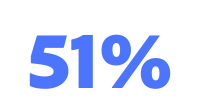
have implemented generative AI for real-time journey personalization.2
How Adobe enables real-time journey orchestration.
Adobe’s approach to journey orchestration is grounded in live context and shared intelligence. Adobe Journey Optimizer uses generative AI to adapt journeys as customer behavior unfolds, selecting next steps, messages, and timing in real time. Instead of manually defining every journey variation, teams can operate within governed parameters while AI determines what to deliver next.
This orchestration is informed by customer data in Adobe Real-Time CDP, which provides unified profiles and behavioral context across channels. Live customer signals inform decisions as they happen, ensuring experiences remain relevant without duplicating logic and signals across systems.
For B2B and lifecycle marketing scenarios, Adobe Marketo Engage and Adobe Journey Optimizer B2B Edition extends orchestration across longer buying cycles, coordinating engagement across campaigns, channels, and touchpoints while maintaining consistency and control. Embedding generative AI into orchestration workflows increases operational efficiency without losing control.
As these tools operate synchronously, personalization decisions become continuous and customer-focused instead of static or campaign-based.

Qualcomm reinvents digital engagement with an AI-driven experience platform.
Qualcomm modernized personalization with Adobe Experience Manager Sites, Adobe Real‑Time CDP, and Adobe Target, replacing manual workflows with scalable, real‑time activation.
Impact:
- 250% increase in time spent on site
- Nearly 800% growth in page views
- 86% reduction in page load times (from ~15–22 seconds to ~3–5 seconds)
- Faster global publishing and improved accessibility across markets
Can generative AI personalize customer journeys in real time?
Yes. Generative AI in Adobe Journey Optimizer with Adobe Real-Time CDP enables next-best action, personalized offers, A/B test variants, etc., at every customer touchpoint in real time. Adobe Marketo Engage and Adobe Journey Optimizer integrate AI Assistant for rapid copy creation, campaign test variants, and insights.
How does generative AI connect with CDP and campaign platforms?
Adobe connects generative AI directly to customer data and activation systems through Adobe Experience Platform. Content and metadata flow seamlessly into Adobe Real-Time CDP and journey orchestration platforms, allowing AI-generated assets to be activated immediately‑ for audience targeting and measurement.
Generative AI for analytics and insights.

Content velocity and journey orchestration create momentum. But at enterprise scale, long-term performance is determined by how quickly teams can understand and act on market shifts. For many marketing organizations, the constraint is not lack of data. It’s interpretation of the data and action.
Organizations generate vast amounts of performance data, but insights are fragmented across platforms, dependent on specialist teams, and disconnected from the systems where decisions happen. Without a unified source of truth, they surface too late — after the window to act has already closed.
What insights accessibility requires at enterprise scale.
At enterprise scale, insights can’t remain a post-campaign function — they must operate as a continuous input into execution.
That requires:
- Accessibility and usability for non-specialists.
- Interpretations in plain language.
- Availability while work is still in motion.
- Connection to planning and optimization decisions.
When insights are confined to dashboards and periodic reports, organizations default to reactive decisions rather than continuous optimization.
How Adobe makes insights operational.
Adobe embeds generative AI directly into analytics workflows, so insights become an active input rather than a retrospective output.
For example, Adobe Customer Journey Analytics uses generative AI to explain performance trends, identify behavior drivers, and highlight friction points in clear, plain language. Teams can ask questions, understand what’s happening, and act without waiting for analyst interpretation.
To extend insight into decision-making, Adobe Marketing Campaign Analytics applies AI to forecasting and investment planning. Teams can model scenarios, test assumptions, and adjust spend based on live performance signals – shifting analytics from attribution reports to forward-looking guidance.
These capabilities help to shorten feedback loops and reduce the backlog pressure traditionally absorbed by analytics and data engineering teams. Insights become shared understanding, not siloed expertise, making it possible for:
- Marketing to shift from reactive to proactive optimizations.
- Decisions to be grounded in evidence, not instinct.
- Performance to improve without adding reporting overhead.
When content, orchestration, and insight operate together, scale becomes possible.
Governance, safety, and trust: How Adobe makes scale a competitive advantage.

When governance is applied to AI projects late, risk shifts to IT, legal, and brand teams that create delays, rework, and slow adoption. But when governance is embedded directly into generative AI workflows, trust becomes standardized, enabling teams to move faster.
Adobe treats governance as a fundamental part of operational infrastructure, not an overlay. Control, traceability, and policy enforcement are built directly into workflows, ensuring that as content and decisions move through systems, safeguards remain intact.
How Adobe embeds governance into generative AI workflows.

Ethics‑led by design: High‑impact generative AI capabilities are reviewed through formal AI Ethics Impact Assessments and oversight by Adobe’s AI Ethics Review Board.

Commercially safe outputs: Adobe Firefly models are trained on licensed and Adobe‑owned content and support IP indemnification for qualifying customers.

Auditable provenance: Content Credentials, built on the C2PA open standard, track how generated assets are created or modified.
Enterprise impact:
Risk is addressed upfront, enabling broader adoption without repeated escalation cycles.Enterprise impact:
Content can scale without increasing legal or reputational exposure.Enterprise impact:
Traceability follows content across systems, simplifying review, reuse, and compliance.
Bias‑aware safeguards: Bias risks are assessed as part of ethics reviews, with Firefly designed to support diverse and inclusive representation.

Hard boundaries on misuse: Policies prohibit using generative outputs to train or improve external AI models.
Enterprise impact:
Reduces the likelihood of off‑brand or insensitive outputs at scale.Enterprise impact:
Protects proprietary assets and limits unintended data leakage across partners and vendors.These controls allow generative AI to scale without shifting risk to IT, legal, or brand teams. Audit trails remain intact, content provenance travels across systems, and governance rules are enforced automatically rather than negotiated campaign by campaign. This reduces escalation cycles, simplifies compliance reviews, and provides executive leadership with consistent visibility into how generative AI is operating across the enterprise.
What governance and brand safety controls does Adobe provide for generative AI?
Adobe Firefly uses licensed and public‑domain training data (not customer data), offers enterprise indemnification, applies Content Credentials for provenance, and is overseen by Adobe’s AI Ethics Board with built‑in safeguards for commercial safety, bias detection, and actionable brand compliance checks.
Why content needs a “digital nutrition label” in the age of AI?
As synthetic content scales, trust has become a competitive advantage. Adobe co‑founded the Content Authenticity Initiative (CAI), a global coalition advancing transparency through Content Credentials: tamper‑evident metadata that travels with content to show its origin, creation methods, and edits.
Built‑in authenticity allows marketing teams to scale AI‑driven content faster while preserving brand integrity, trust, and control across markets and channels. Learn more about the Content Authenticity Initiative.
Move from generative AI adoption to enterprise advantage with Adobe.

Organizations that lead in this next phase of AI adoption are not experimenting. They are operating with it as part of their enterprise architecture — where content, decisioning, insight, and governance work together as a connected system. This is what turns generative AI from a productivity tool into a source of sustained competitive advantage.
What differentiates Adobe from standalone generative AI tools?
Adobe connects generative AI natively across the content supply chain, data, and experience tools — delivering speed, scale, and governance in a unified ecosystem. Adobe empowers customers with model choice, from Firefly to leading third-party models, so teams can apply the right model to the right task, without sacrificing compliance, transparency, or control within Adobe's trusted creative and marketing apps.
Adobe delivers this by embedding generative AI across the full content supply chain within a unified platform. Because these capabilities are built into the systems enterprises already rely on, generative AI operates inside workflows, data, and governance frameworks rather than alongside them — eliminating fragmentation, reducing operational complexity, and allowing teams to scale execution without losing control.
The result is not just faster content, but a more reliable operating model where brand integrity is maintained as volume grows, experiences adapt in real time as customer behavior changes, and performance improves continuously, without adding overhead. With Adobe, generative AI becomes not just a tool for creation, but a system for driving measurable business outcomes.
Explore how Adobe helps enterprises scale generative AI with architectural clarity, governance by design, and durable operational control.
Sources
- “Deliver personalized retail experiences at scale,” Adobe 2025 AI and Digital Trends, 2025.
- “Marketing Transformation Business Case,” CDW Adobe Digital Tech Business Case, 2025.
- “AI and Digital Trends Report MedTech Edition,” Econsultancy and Adobe, 2025.
- Product Announcements Summary, Adobe Summit 2025.
Title
Generative AI at enterprise scale.
cardDate
2026-09-30
cardImage

CardDescription
Explore how leading enterprises turn generative AI into a scalable system for content, orchestration, and insight.
primaryTag
caas:content-type/guide
Tags
caas:content-type/guide, caas:products/genstudio, caas:products/firefly
Let’s talk about what Adobe can do for your business.