Content as a Service v3 - generative-ai - Tuesday, July 15, 2025 at 11:21



Turning AI Momentum into Repeatable Execution
For The State of AI Readiness in Media and Entertainment study, we surveyed cross-industry executives to understand how organizations are moving from AI experimentation to adoption, where operating model gaps may hold them back, and which behaviors can help turn AI activity into more repeatable and responsible execution.
Foreword
Artificial intelligence (AI) is changing how media and entertainment leaders think about audience relationships, content, and experiences. The opportunity extends beyond adopting tools. It depends on whether organizations can connect AI activity to audience priorities while preserving judgment, accountability, and responsible practices that media environments require.
That work crosses boundaries. Audience and marketing teams may define the experience, content teams shape it, and product, data, and technology teams provide systems and information for delivery. Rights, legal, privacy, security, and governance leaders help determine how AI is used responsibly. When these groups work on different priorities, activity may remain difficult to coordinate.
The operating model matters as much as the technology. Ownership helps teams resolve priorities. Shared decision rights bring functions into the work early. Predeployment measurement helps leaders decide what to improve, expand, or stop. Learning helps organizations apply lessons from one initiative to the next without treating responsible review as an obstacle to progress.
This report examines AI adoption among media and entertainment respondents and the operating model gaps that may impede execution. It considers five behaviors more common among the global cross-industry Leader cohort. Findings help executives connect AI investment to audience value, content effectiveness, responsible innovation, and sustainable execution.

Gaurav Mallick
How Leaders Were Identified and Scored
The 342 Leaders referenced in this report are drawn from the cross-industry sample of 5,633 executives across 12 industries. They form a global cross-industry cohort and are not specific to media and entertainment. They provide a benchmark for contextualizing the media and entertainment findings.
How maturity was measured: Operating model maturity was assessed across six pillars. Each pillar was scored on a scale of 1 to 5. The six scores were combined into an operating model maturity composite for the overall maturity assessment.

Strategy
Clear AI vision with ownership and investment commitments.

People
Roles and culture evolving for an AI-enabled environment.

Technology
Infrastructure built for scale, not just pilots.

Structure
Dedicated AI ownership with budget authority.

Governance
Risk frameworks calibrated for AI velocity.

Workflows
AI embedded into how work is actually done.
How Leaders were identified: To qualify as a Leader, a respondent’s organization had to meet both criteria: achieve an operating model maturity composite score above 3.27 and operate at the expanding or transforming stage of AI deployment. Applying both criteria identified 342 Leaders across the 12 industries, representing 6% of the broader 5,323 active respondents.
The designation reflects measured operating model maturity and deployment stage. Unless otherwise stated, “Leaders” means a global cross-industry cohort rather than a media and entertainment-specific group. Leader comparisons indicate association rather than causation.
Executive Summary
Media and entertainment respondents report AI activity across different stages of adoption, but deployment alone does not establish readiness for repeatable execution. The findings point to gaps in ownership, measurement, and collaboration across the functions responsible for audiences, content, experiences, data, and technology. This report closely examines those gaps and the behaviors more common among the global cross-industry Leader cohort.
The Industry Picture

of the active media and entertainment respondent base is concentrated in the piloting and deploying stages.
These respondents have moved beyond initial exploration, but the stage distribution does not show whether individual initiatives have progressed over time or whether execution is coordinated across functions. Moving from isolated activity toward repeatable deployment may require clearer ownership, shared decision rights, consistent governance, and agreed measures of audience, content, commercial, or operational value. The result identifies a concentration in the middle stages, not definitive evidence that respondents have permanently stalled over time.

of media and entertainment respondents report a formal AI owner with title and budget authority.
Responsibility may be distributed, part-time, committee-led, or project-specific. Assigning responsibility is not the same as granting authority. When work spans audience, marketing, content, product, data, technology, operations, rights, and governance, limited authority may hinder the ability to set clear priorities, allocate resources, and resolve requirements.

of media and entertainment respondents describe the business and technology relationship as siloed, transactional, or consultative.
These models rely on requests, advice, or handoffs rather than shared accountability. AI work can require coordination across data access, workflow design, measurement, privacy, security, rights, and governance. Collaborative or integrated relationships may help teams address these requirements as initiatives are defined and delivered.
What Leaders Do Differently
The 342 Leaders identified across all industries combine advanced AI deployment with operating model maturity. Leaders are structurally different. They score 60% higher than the industry on organization structure and 46% higher on workflow transformation. The gap isn’t technological — it’s organizational.
These five behaviors are more common among Leaders and provide a blueprint for repeatable deployment.

Leaders are 3.3 times more likely than media and entertainment respondents to have a formal owner with title and budget authority. This does not establish that ownership caused maturity.

Day-one measurement
44% of Leaders measure return on investment comprehensively, compared with 14% of media and entertainment respondents. Predeployment baselines support evaluation and investment decisions.

Genuine partnership
80% of Leaders report collaborative or integrated business and technology relationships, compared with 31% of media and entertainment respondents. Shared objectives can reduce handoffs without requiring a reorganization.

Learning culture
Destructive failure-response patterns are reported by 21% of media and entertainment respondents, compared with under 1% of Leaders. Leader status does not preclude failure.

Empowered champions
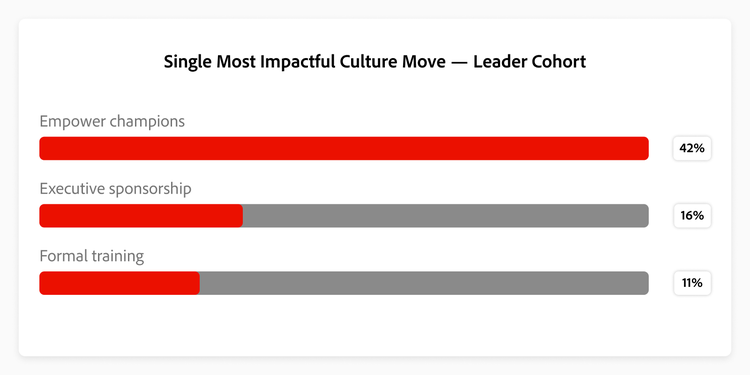
42% of Leaders identify finding and empowering internal champions as their most impactful culture action, ahead of executive sponsorship at 16% and formal training at 11%. Appropriate authority, support, and governance can help champions extend relevant practices.
These behaviors show how ownership, measurement, partnership, learning, and leadership are connected. Part one examines media and entertainment findings. Part two considers what the global cross-industry benchmark may mean for more coordinated, responsible, and repeatable execution.
Part One
The Industry Picture
Finding 01: The Frozen Middle
55% of the active media and entertainment respondent base is at the piloting or deploying stage.
AI activity has progressed beyond exploring, but the distribution does not show how long respondents remain at either stage or whether deployment is repeatable.
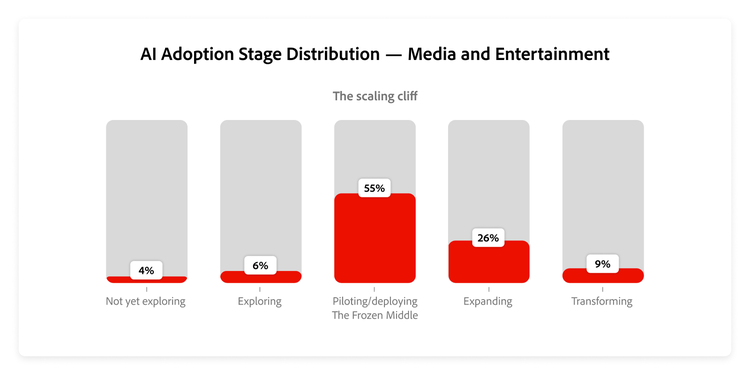
The adoption-stage distribution shows that AI activity has moved beyond initial exploration for much of the active media and entertainment respondent base. However, reaching piloting or deploying does not indicate that initiatives are coordinated across audience, marketing, content, product, data, technology, operations, rights, and governance functions.
The piloting and deploying stages account for 55% of the active media and entertainment respondent base. This concentration describes respondents’ stage at the time of the survey. It does not show how long they remained there, how initiatives progressed, or whether deployment is repeatable across teams.
Progress toward repeatable execution may require more than extending deployments. Teams need shared priorities, appropriate data access, clear governance, agreed measures of value, and decision rights across functions. Without those foundations, learning and results may remain within functions, making it harder to compare outcomes or apply practices elsewhere. The next question is who has the authority to align those decisions.
Finding 02: The Ownership Vacuum
Only 28% of media and entertainment respondents report a formal AI owner.
A title and budget authority distinguish formal ownership from shared responsibility or project-level accountability.
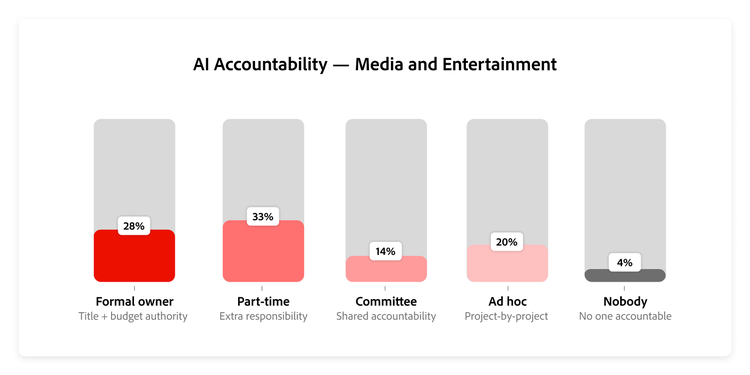
AI work can cross audience, marketing, content, product, data, technology, operations, rights, and governance functions. Responsibility may be shared among these groups, but shared responsibility does not necessarily grant anyone authority to set priorities, allocate resources, or resolve competing requirements. The distinction becomes important as an initiative moves beyond one team.
Only 28% of media and entertainment respondents report a formal AI owner with a title and budget authority. Most respondents do not report this ownership model. The result does not reveal their alternatives or whether responsibility sits with an individual, committee, function, or project team.
Formal ownership establishes accountability without displacing participating functions. A named senior leader needs a clear mandate, budget authority, and access to teams shaping delivery. Rights, privacy, security, legal, and governance expertise remains essential. Clarifying authority early may help respondents resolve requirements before proposals enter evaluation, where unresolved ownership and coordination questions can become harder to address.
Finding 03: The Approval Barrier
Media and entertainment respondents report that 18 out of every 100 proposed AI ideas reach production.
Information technology evaluation is the most significant point of attrition, reducing the funnel by 44 ideas at the first measured gate.
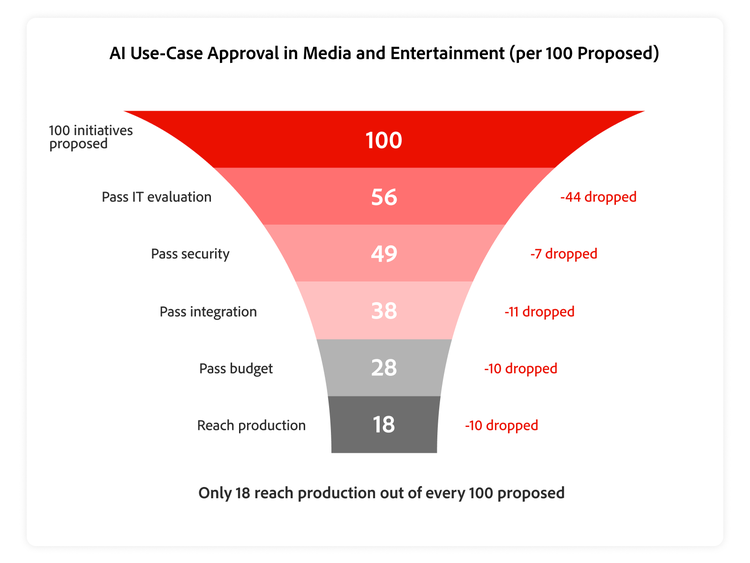
The funnel narrows most sharply at its first formal gate. Of every 100 proposed AI ideas, 56 pass information technology evaluation, and 18 ultimately reach production. The pattern places the central challenge earlier than integration or budget approval: many ideas are being tested for technical viability before they move deeper into review.
The data does not explain why 44 ideas leave at that point. It does, however, raise an important operating question: are audience, content, commercial, data, system, rights, privacy, security, and governance requirements being brought together early enough to shape proposals before formal evaluation?
Media and entertainment executives can respond by creating an early cross-functional review that considers intended value and deployment readiness together. Defining the outcome, required data, system ownership, measurement approach, and responsible-use conditions during ideation will not guarantee approval, but it can give reviewers a stronger basis for deciding which ideas should advance.
Finding 04: Business-IT Handoff
69% of media and entertainment respondents report siloed, transactional, or consultative relationships.
These ways of working stop short of the shared accountability associated with collaborative or integrated relationships.
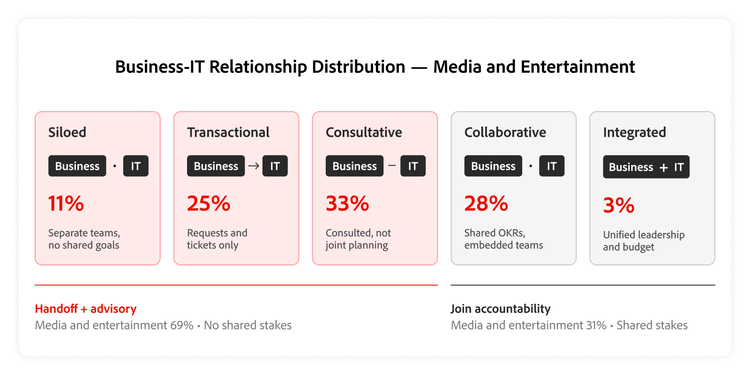
AI initiatives can require coordination as teams define outcomes, resolve system dependencies, address responsible-use requirements, and adjust delivery. Handoffs may slow that work when functions do not share accountability for results.
Among media and entertainment respondents, 69% describe the business and technology relationship as siloed, transactional, or consultative. These modes differ, but each stops short of the shared accountability associated with collaborative or integrated relationships. The result describes ways of working rather than organizational structure.
Collaborative and integrated relationships involve business and technology teams in defining work before requests are completed. Shared objectives and key results can give both sides responsibility for delivery and the intended audience, content, commercial, or operational outcome. This approach does not remove the responsibilities of product, data, technology, rights, privacy, security, legal, or governance teams. It creates a basis for resolving requirements as work progresses. That shared basis also supports measurement by aligning teams on the outcome before deployment.
Finding 05: The Measurement Gap
Only 14% of media and entertainment respondents measure return on investment comprehensively.
Activity and efficiency measures do not establish whether AI has improved audience, content, commercial, or operational outcomes.
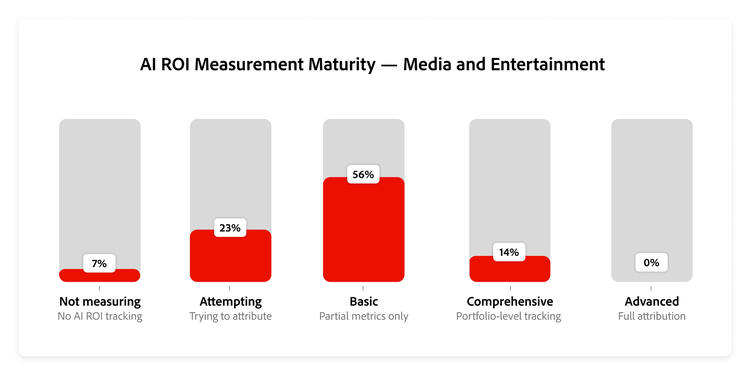
As AI becomes part of audience, content, and experience workflows, teams need to distinguish activity from outcomes. Possible activity measures include outputs produced, audiences analyzed, processes completed, or time saved. These indicators may show usage or efficiency, but they do not establish whether AI improved audience value, content effectiveness, commercial performance, or operational results.
Only 14% of media and entertainment respondents report comprehensive return on investment measurement. Stronger measurement begins before deployment, when teams define the intended outcome, record a baseline, and agree how results will be assessed. Illustrative measures might include engagement, conversion, retention, content performance, advertising performance, cost, quality, or cycle time. These are possible metrics, not achieved results reported by the research.
Changes in content, audience behavior, pricing, campaigns, platforms, or market conditions can make AI’s contribution difficult to separate after launch. Predeployment baselines can help leaders review performance, improve execution, and decide more confidently whether investment is warranted.
PART TWO
What Leaders Do Differently
Leaders are structurally different. They score 60% higher than the industry on organization structure and 46% higher on workflow transformation. The gap isn’t technological — it’s organizational.
These five behaviors are more common among Leaders and provide a blueprint for repeatable deployment.
Leader Behavior 01: Real Ownership

Leaders are 3.3 times more likely to report formal AI ownership.
Formal ownership combines a defined title and budget authority with the mandate to make decisions across functions.
AI work can cross audience, marketing, content, product, data, technology, operations, rights, and governance. As decisions extend across these functions, part-time owners, committees, and project leads may coordinate activity without holding authority to resolve priorities, commit resources, or determine when requirements have been met.
Leaders are 3.3 times more likely than media and entertainment respondents to report a formal AI owner with a title and budget authority. The result indicates that formal ownership is more common among the global cross-industry Leader cohort. It does not establish that appointing an owner caused greater operating model maturity or advanced deployment, or that ownership can substitute for governance and cross-functional expertise.
For media and entertainment respondents, this means distinguishing coordination from authority. A named senior leader needs a mandate, budget authority, and access to functions. That leader should align priorities while leaders across audience, content, product, data, technology, operations, rights, privacy, security, legal, and governance retain responsibility for their respective areas of expertise. The mandate can fit existing structures.
Leader Behavior 02: Day-One Measurement
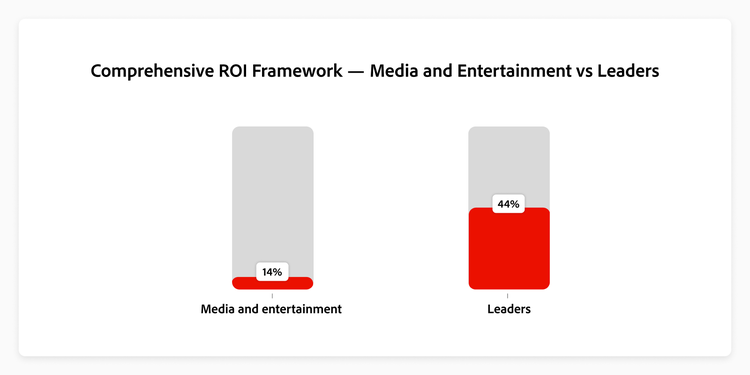
Measurement is most useful when it is established before teams commit to deployment. Among the global cross-industry Leader cohort, 44% report comprehensive return on investment measurement, compared with 14% of media and entertainment respondents. This association does not show that measurement alone caused greater maturity or deployment.
Leaders define the intended outcome, baseline, assessment period, and attribution approach while a use case is designed. For media and entertainment respondents, measures may concern audience value, content effectiveness, commercial performance, quality, cost, or cycle time. The appropriate measure depends on the use case and should not be treated as an achieved result.
Timing matters: content releases, audience behavior, pricing, campaigns, platform changes, and market conditions can affect the outcome. Once those factors change, the baseline may be difficult to reconstruct. Agreeing on the measurement approach before launch gives teams a consistent basis for reviewing performance, improving execution, and deciding whether investment or expansion is warranted.
Leader Behavior 03: Genuine Partnership
AI work often depends on decisions across audience, marketing, content, product, data, technology, operations, rights, and governance. Sequential handoffs can separate the team defining the intended outcome from the teams responsible for data, systems, measurement, and responsible-use requirements. Consultation alone does not create shared accountability.
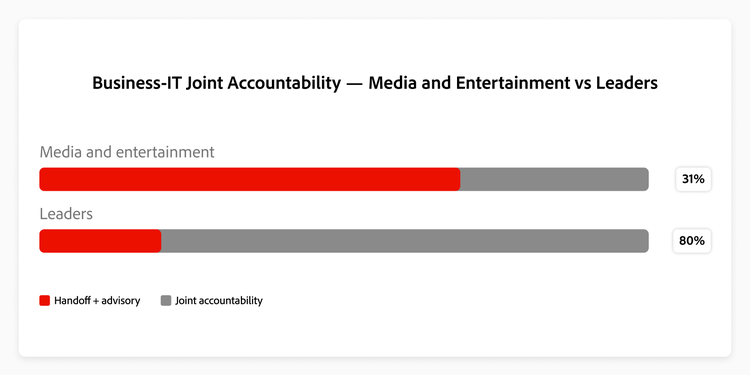
Among the global cross-industry Leader cohort, 80% report collaborative or integrated business and technology relationships, compared with 31% of media and entertainment respondents. This result shows that shared ways of working are more common among Leaders. It does not establish that partnership alone caused greater maturity or deployment.
Genuine partnership begins when work is defined. Shared objectives and key results give business and technology teams responsibility for delivery and outcomes, while specialist functions retain authority within their expertise. For media and entertainment respondents, this brings audience value, content requirements, feasibility, measurement, rights, privacy, security, and governance into a single decision-making process. Shared accountability can operate within reporting lines.
Leader Behavior 04: Learning Culture
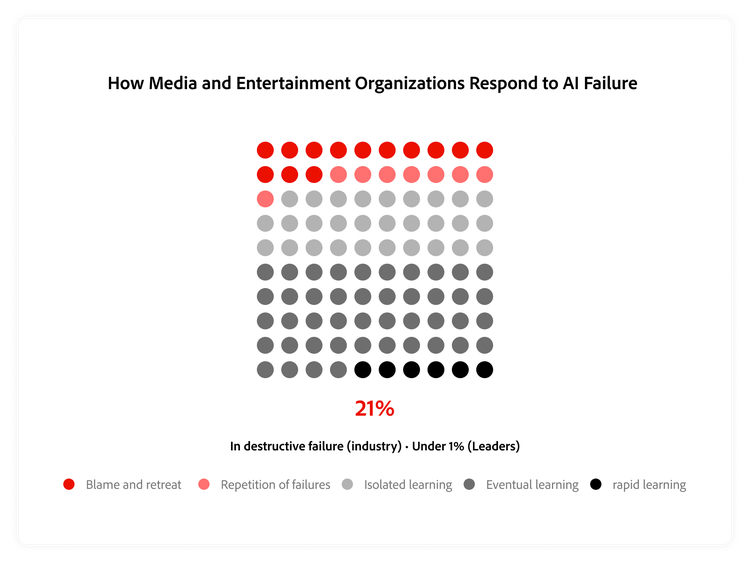
AI initiatives do not always meet expectations. What matters is whether teams examine underperformance, share what they learn, and change the next decision. Blame can discourage openness, while repeated mistakes may indicate that lessons are not shared across audience, marketing, content, product, data, technology, operations, rights, and governance teams.
Destructive failure-response patterns involving blame or repetition are reported by 21% of media and entertainment respondents, compared with under 1% of the global cross-industry Leader cohort. The difference shows that constructive learning practices are more common among Leaders. It does not mean that Leaders avoid failure or that failure response alone caused greater maturity.
A learning culture requires operating reviews. Leaders examine what underperformed, why it happened, which assumptions failed, and what should change. This does not weaken quality, rights, privacy, security, legal, or governance review. It converts responsible oversight into shared learning that can inform use cases, measurement, and deployment decisions.
Leader Behavior 05: Empowered Champions
People may be more willing to evaluate AI when they can learn from colleagues working in familiar audience, content, product, data, or operational contexts. Internal champions can translate broad direction into practical methods, surface limitations, and show how responsible-use requirements apply within day-to-day work.
Among the global cross-industry Leader cohort, 42% identify finding and empowering internal champions as their most impactful culture action, ahead of executive sponsorship at 16% and formal training at 11%. The result shows that this action is more commonly prioritized by Leaders. It does not establish that champions alone caused adoption, maturity, or business outcomes.
Empowerment requires more than recognition. Champions need scope, time, support, and governance, plus permission to share learning across teams. Executives can connect champions with leaders across audience, marketing, content, product, data, technology, operations, rights, and governance. Champions should help others evaluate practices, not bypass specialist review or present activity as proven value.
Five Moves That Build the Operating Model
These actions translate the five Leader behaviors into practical steps for media and entertainment executives. They strengthen existing capabilities and decision rights without requiring a wholesale organizational redesign today.
- Establish one accountable AI owner across audience, content, and experience.
Appoint a senior executive with a formal mandate and budget authority across audience, marketing, content, product, data, technology, operations, rights, and governance. The owner should set priorities, resolve cross-functional decisions, allocate resources, and establish accountability for delivery. Specialist leaders should retain authority within their expertise, ensuring that clearer ownership strengthens responsible execution rather than concentrating every decision in one role. The role should coordinate expertise without replacing teams accountable for specialist decisions. - Define the outcome and evidence before deployment begins.
Before approving deployment, the owner and participating teams should define the intended audience, content, and the commercial or operational outcome. Record a baseline, choose an assessment period, and agree on the attribution approach. This gives leaders comparable evidence for reviewing performance and confidently deciding whether to improve, continue, expand, or stop the initiative instead of relying on activity or output measures alone. - Create shared accountability between business and technology.
Give business and technology leaders shared objectives, decision rights, and accountability for delivery and outcomes. Bring audience, marketing, content, product, data, operations, rights, privacy, security, legal, and governance expertise into the work while requirements are being defined. Earlier collaboration helps teams resolve dependencies and trade-offs together, rather than passing an established request through sequential reviews after key choices have already been made. Shared accountability also ensures teams agree on a common outcome to measure from the start. - Make underperformance a source of repeatable learning.
Make structured learning part of operating reviews. Senior leaders should examine what underperformed, identify incomplete assumptions, document lessons, and assign changes for the next use case. Share relevant learning across audience, marketing, content, product, data, technology, operations, rights, and governance teams. This discipline can improve later decisions without weakening quality standards or treating privacy, security, legal, rights, and governance review as obstacles to progress. The aim is to make reflection routine, visible, and useful across every successive deployment. - Equip trusted practitioners to extend responsible AI adoption.
Identify practitioners who are already applying AI thoughtfully in relevant work. Give them time, recognition, support, and permission to share documented methods with adjacent teams. Connect champions with leaders across audience, marketing, content, product, data, technology, operations, rights, and governance, so wider adoption remains grounded in evidence, responsible-use requirements, and appropriate specialist oversight. Their influence should come from evidence and transferable learning.
Conclusion
Turn AI Activity into Repeatable, Responsible Execution
Media and entertainment respondents have moved AI beyond exploration, but the research suggests that deployment alone does not create repeatable execution. Concentration in piloting and deploying sits alongside limited formal ownership, handoff-based business and technology relationships, and low comprehensive measurement.
The global cross-industry Leader benchmark points to a connected response. Formal authority, pre-deployment measurement, shared accountability, structured learning, and empowered practitioners are more common among Leaders. These behaviors do not guarantee outcomes, but together they provide a stronger operating model for evaluating, improving, and extending AI responsibly.
The practical next step is to choose one priority use case and establish ownership, intended value, evidence, decision rights, and responsible-use conditions before deployment. That discipline can help executives connect AI investment to audience value and content effectiveness while maintaining the rights, privacy, security, legal, and governance standards required for responsible innovation.
About Adobe
Adobe empowers organizations to create impactful digital experiences. Our portfolio of customer-experience products and services helps businesses put every interaction in context, understand what each customer needs right now, and design and deliver digital experiences that build loyalty and drive growth. Visit adobe.com to know more.
About Incisiv
Incisiv is an industry insights and strategy firm combining close to a decade of industry trend data with primary research, messaging architecture, and content development to help enterprises navigate transformation, evaluate solutions, and unlock growth. Visit incisiv.com to know more.
Title
Scaling AI for impact in media and entertainment.
cardDate
2026-09-24
cardImage

CardDescription
Discover how five behaviors can help media and entertainment teams move from AI experimentation to repeatable, responsible execution.
primaryTag
caas:content-type/report
Tags
caas:content-type/report, caas:industry/media-and-entertainment