

The rise of the (new) creative technologist.
The missing link in AI-driven creative transformation.

Operationalizing AI for scaled content production.
AI is fundamentally changing creative work and offering new opportunities to deliver top- and bottom-line growth. In The Scale Imperative, we explored how this transformation can yield an 8.5X net ROI over three years across industries.
To seize this opportunity, most organizations’ first instinct is to deploy new tools. But value realization rarely comes from technology alone. It comes from newly imagined workflows and structures that are durable, reusable, and scalable. As Satya Nadella, CEO of Microsoft, said, “The hardest part of AI isn’t the tech. It’s getting people to change how they work.”1
Creative Technologists are critical to making this happen, acting as the connective tissue across creative, engineering, marketing, and other teams. Yet, their role remains a missing layer in most enterprises. This report, informed by interviews with Creative Technologists, marketing leaders, and Adobe experts, explores the evolution of this role and outlines best practices for what to look for and how to ensure success.
A shift already underway
Enterprises are investing heavily in AI to accelerate content production, yet many are running into the same reality: While AI can help scale output, it does not deliver ROI on its own.
The real bottleneck is the way creative work is structured: design files built for human flexibility don’t easily translate to automation needs; brand guidelines live in static PDFs instead of codified systems or machine-readable inputs; workflows developed for siloed tasks struggle to keep up with broader enterprise needs, inclusive of quality and performance.
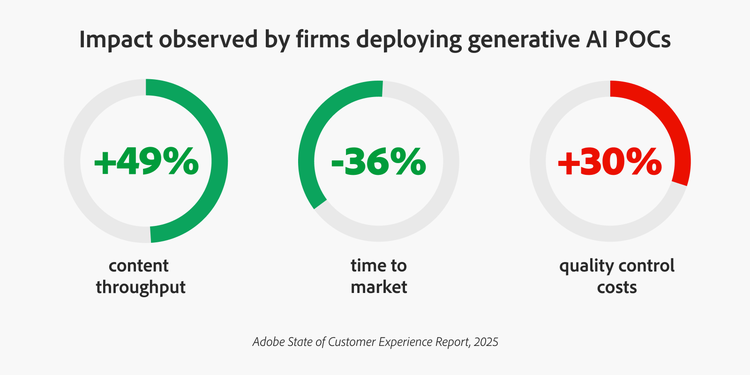
Leading organizations are solving for this challenge by shifting to a design for automation mentality: standardizing how creative assets, templates, and workflows are structured so that AI and other systems can use them to scale output without extensive rework.
The key to achieving this is not another tool, agent, or model. Rather, it is a reimagined role: someone who can translate creative ideas into automated systems and help organizations operationalize AI for scale. The Creative Technologist, once known primarily for building plugins or templates, is evolving to be the bridge between creative craft and the systems required to deliver value at speed and scale.

“We have to upskill our teams. Creating a design for something one-off and creating design for the purposes of automation are two completely different things.”
Pete Steiner
Head of Creative Labs, Code and Theory
Organizations are increasingly hiring for the role2. While approximately 60% of recent job postings for Creative Technologists come from agencies and professional services firms, the remaining 40% come from enterprises themselves. Comcast, for example, has recently expanded its Creative Technologist ranks to 20+ individuals. Other organizations actively hiring for this function include JPMorgan Chase, The Coca-Cola Company, Apple, and Microsoft.
The most rigorous job descriptions ask candidates to own work from concept through delivery, including selecting appropriate tools and platforms and using generative AI, agents, and automation strategically. Most crucially, they require individuals to make decisions on when AI improves outcomes versus when other approaches are more appropriate.
Bridging the enterprise ecosystem.
Today’s Creative Technologists ensure that creative ideas move seamlessly from concept to large-scale production, meeting business needs without impacting quality or brand trust. Three key benefits to enterprises are elevating their importance:
1. Having higher strategic impact
Creative Technologists are becoming increasingly involved in upstream processes such as campaign strategy development, giving them greater influence on results. At the same time, this enables them to better take ownership of results and deliver on KPIs.

“With the shift toward an AI-native ecosystem, we are moving beyond tactical execution to a more holistic approach. It is no longer just about producing content, it’s about delivering on strategic outcomes faster while elevating the brand.”
Eph Cruz
Director of GenAI and Creative Technology, Comcast
2. Brokering knowledge
What makes the role unique is its ability to connect disciplines that rarely speak the same language. Traditional creatives excel at design and storytelling but are not trained to architect or integrate technology. Developers understand systems and infrastructure but cannot channel creative concepts or brand essence into outputs. The Creative Technologist effectively codifies unique creative ideas and nuance into systems designed for automation.

“I once worked with a Senior Art Director at a potato chip brand who asked for their ads to feel ‘light and airy, like a potato chip’. Our challenge was to translate this subjective ask into outputs that could reliably evoke that feeling at scale.”
Daniel Hicks
Senior Manager, Forward Deployed AI Engineer, Adobe

“In the UK, we must print in a specific font if fake lashes or technology were used to enhance lashes in mascara ads, making the use of AI problematic. Each region has its own idiosyncrasies, and individuals with creative expertise will naturally recognize them, and design systems that account for these needs.”
Yuri Ezhkov
VP Creative COE, The Estée Lauder Companies
3. Unifying the content supply chain
Creative Technologists are extremely well positioned to connect creative production to the broader content supply chain and deliver innovative solutions that move the business forward. The Estée Lauder Companies’ recent work with Adobe exemplifies this well.
Bringing it to life: The Estée Lauder Companies reimagines asset production for retail partners.
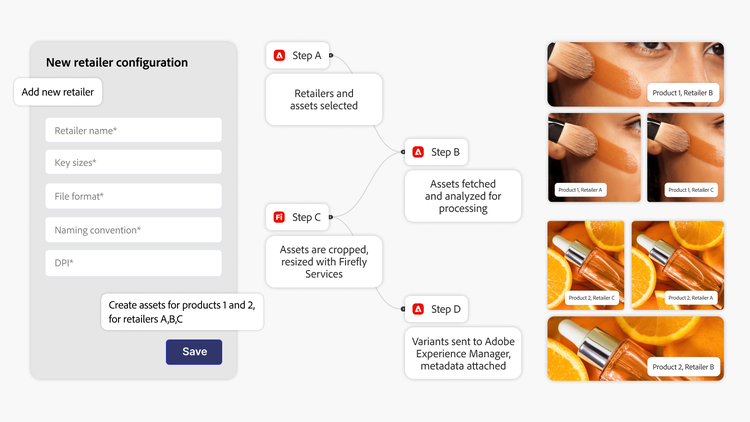
The Estée Lauder Companies’ Creative Center of Excellence, a group that supports global creative teams across 25+ brands, faced an urgent challenge in delivering assets to dozens of retail partners in a timely manner. Creative teams spent hours manually resizing images, converting formats, and renaming files to comply with each partner’s unique requirements, a process repeated every time new products were released or updated.
Creative Technologists worked alongside creative and operations teams to understand the bottlenecks and rebuild the workflow. They captured each retail partner’s specifications and developed a custom interface on Adobe Experience Manager Assets, where end users can select retailers and hero assets, then run an automated workflow with Adobe Firefly Enterprise solutions to produce variants that meet their needs. The outputs are then routed to partner-specific folders with the right metadata, formats, and naming conventions, ready for syndication.
The result: a more seamless and scalable content engine. Time spent on variant production dropped by ~90%, and new retailers can now be onboarded with ease. Equally important, what once required specialized resources can now be run by the e-commerce leads working directly with retailers. Creative teams are no longer buried in manual execution and instead can focus their time on higher-value work.
Key qualities to look for.
As organizations consider this role, five qualities reinforced in our research stand out:
1. Creative expertise: Individuals must have a deep understanding of creative workflows to ensure that what is produced can be used across the ecosystem, and that it elevates brand value rather than erodes it. Without this, there will be limited buy-in for their solutions.
2. AI tinkerer mentality: Candidates must be passionate about AI innovations coming to market. They may have recently experimented with AI agents or orchestration tools to streamline creative work, have a bias toward action, and are eager to build, and iterate on POCs quickly.
3. Flexibility: Successful individuals must be willing to change direction as they work with stakeholders. This openness to course-correct as new information comes in will deliver solutions that end users will adopt and use every day.
4. Holistic approach: Creative Technologists must not only solve for creative production teams, but also for the broader goals and needs of the organization. Understanding upstream and downstream needs as well as broader regulatory requirements will be critical to their success.
5. Being a change agent: Creative Technologists will help architect the new creative operating model. They will be the voice that articulates the vision, builds buy-in across teams, and leads evangelism programs. Strong communication and influence skills are thus a must.
“You almost have to become a ‘gentle monster’ in a sense to create buy-in on the vision and ease teams into future ways of working, yet always stay solution-focused to drive outcomes that meet our success criteria.”
Eph Cruz
Director of GenAI and Creative Technology, Comcast
Experts also highlighted characteristics to avoid in hiring for Creative Technologists, most notably:
1. Purely technical backgrounds: Staffing this role with engineers or developers often leads to solutions that technically work yet do not meet the needs of end users. Frequently, this leads to tools that are over-engineered yet not adaptable to the changing needs of the business.
2. Rigid thinking: Individuals resistant to change tend not to do well in this role. Creative Technologists must be open to constantly learn from teammates, adapt to new technologies, and, in some cases, “throw out the playbook” in terms of traditional ways of working.
3. Niche focus: Successful candidates will be fluid across creative disciplines. This may seem unnatural to some, as for decades creatives have had successful careers as experts in a specific area (e.g., being a world-class retoucher). Look for individuals open to going beyond one area of focus and curious about solving broader challenges across the creative workflow.

“Someone who is too niche in one area won't succeed. The more you understand how the broader operation works, from strategy to delivery, the better you can build automation solutions with upstream and downstream needs in mind.”
Matt Hall
Executive Creative Director, Studio Rx
Ensuring long-term success.
Organizations must create the conditions that will allow Creative Technologists to deliver impact. The following action items will help facilitate their success:
1. Communicate the mandate: Establish their mission publicly as well as the benefits they will bring to the teams they will work with. We have seen different approaches work well, from CMO-level communications to more creative, internal-facing video campaigns.
2. Empower them to drive change: Set the expectation with key stakeholders that change is a core competency. Clarify that ways of working today may be built for legacy tools and processes, and staying within these confines will limit the value brought to the business.
3. Remove roadblocks to experimentation: Create a path with procurement to evaluate new AI technologies quickly for early testing. Approaching this challenge creatively by testing new tech in virtual machine environments, for example, has in some cases streamlined the process.
4. Define clear, measurable goals: Too often, we see AI mandates not tied to business outcomes. To avoid this, set KPIs that directly relate to what Creative Technologists can influence. Examples include cost per asset, time to market, error rates, or content performance.
5. Facilitate onboarding: As the team grows, find ways to streamline learning of operations, key stakeholders, and best practices. One company, for example, created an onboarding agent for its growing team of Creative Technologists, which was trained on brand, organizational, and technical documentation, to facilitate making connections and kick-starting new projects.
Ushering in a new era.
There is immense potential for organizations to treat content as a growth engine, and the Creative Technologist is becoming the linchpin to realize this potential.
Businesses that place this responsibility on the wrong talent, or treat it as a “nice-to-have”, will see their AI investments fall short. In contrast, organizations that invest in the right talent and set them up for success will discover that speed, scale, and quality are not opposing forces. Instead, they become mutually reinforcing strengths that, when aligned, unlock extraordinary outcomes.
Ready to get started?
Whether you are just beginning your AI-driven scaled production efforts or looking to advance existing initiatives, Adobe is here to help you navigate complexities and deliver value. Contact an Adobe representative today to learn more.
- Lee Chong Ming, “Satya Nadella Says AI Is Changing How People Work and Jobs,” Business Insider, June 2025.
- AI-driven search leveraging Claude across LinkedIn, Glassdoor, and Indeed. Results were filtered to ensure high relevance to creative work, with specific job postings supported by human review.
Recommended for you
https://main--da-bacom--adobecom.aem.page/fragments/resources/cards/thank-you-collections/firefly