con-block-row-bgcolor
#F5F5F5

What is enterprise content management?

#F5F5F5

Improve enterprise content management with Adobe Experience Manager.

Enterprise content management (ECM) systems help organizations capture, organize, manage, preserve, and deliver content across teams and digital channels. As content volumes increase and workflows become more complex, modern ECM systems help improve collaboration, strengthen governance, reduce operational complexity, and support scalable digital experiences.

This guide discusses how ECM works, the core features and benefits of modern ECM systems, examples of ECM software, and how Adobe Experience Manager can support enterprise content operations at scale.

Enterprise content management (ECM) combines the strategies and processes that help businesses take control of their content — capturing, organizing, storing, and delivering information through a unified framework. With the evolution of content types and workflows, ECM has also expanded beyond document management into a connected ecosystem for managing content across teams and channels.

The volume of content businesses create continues to grow, from internal reports and marketing campaigns to blog posts and website updates. So does the work around it: tailoring content for different audiences, distributing it across channels, personalizing and marketing it, and measuring its performance. ECM gives decision-makers a single framework to manage all of it.

What does an ECM system do?

Enterprise content management systems help organizations capture, manage, organize, govern, and deliver content across teams and channels. The category is growing fast: the global ECM market is estimated at US$42.93 billion and is projected to reach US$150.97 billion by 2032, according to Fortune Business Insights.

At its core, an ECM system stores documents and digital assets centrally with metadata for easy organization, searchability, and access. It reduces duplicate content by identifying and consolidating similar files, thereby improving reuse and cutting clutter and storage needs. ECM solutions are robust enough to handle both web-based marketing content and internal document management — two functions that are often described separately.

Document management.

The document management side of ECM — sometimes called "content management" — combines physical and digital content management in a way that integrates directly with existing information systems and processes. It handles an organization's transactional, process-driven content, such as invoices, contracts, and records.

Content services.

The other side of ECM is often referred to as "content services," which deal with data. It is a full-service functionality that captures, tracks, analyzes, and delivers informational content where and when it's needed. With the right permissions, users can locate content through full-text searches and securely access, edit, and collaborate on it across devices and locations — saving time and getting the right information to the right people.

Why ECM matters now.

With rising concerns around financial fraud, data breaches, and strict compliance regulations, organizations must manage content carefully to protect both operations and reputation. ECM systems support better decision-making by integrating with analytics tools that turn raw content into business insights. As cloud platforms, distributed teams, and expanding content types — video, audio, and social media — continue to evolve, ECM systems are becoming increasingly critical for supporting secure collaboration, maintaining governance, and managing growing volumes of unstructured content.

#EEFBFB

Key features of an ECM system.

Enterprise content management generally consists of five core elements — capture, manage, store, preserve, and deliver. These work together to create a cohesive ECM architecture that supports both user-facing and technical functions.

https://main--da-bacom--adobecom.aem.page/assets/icons/solutions/content-management/enterprise-content-management/icon-1-icon-acrobatagreement-capture.svg

Capture

Ingests and organizes content from documents, forms, digital assets, and business systems into a structured repository. This includes content such as invoices, contracts, customer communications, and research reports.

https://main--da-bacom--adobecom.aem.page/assets/icons/solutions/content-management/enterprise-content-management/icon-2-usersettings-manage.svg

Manage

Lets users access, modify, and collaborate on content through tools such as document management systems, web content management platforms, collaboration software, and records management solutions.

https://main--da-bacom--adobecom.aem.page/assets/icons/solutions/content-management/enterprise-content-management/icon-3-icon-archive-store.svg

Store

Supports the short-term storage of frequently updated information within flexible folder structures, allowing users to easily retrieve or edit content as needed.

https://main--da-bacom--adobecom.aem.page/assets/icons/solutions/content-management/enterprise-content-management/icon-4-project-preserve.svg

Preserve

Ensures long-term retention and governance of content that must be maintained for compliance, regulatory, legal, or historical purposes — often via records management policies and digital preservation protocols.

https://main--da-bacom--adobecom.aem.page/assets/icons/solutions/content-management/enterprise-content-management/icon-5-fileconvert-deliver.svg

Deliver

Distributes the right content to the right people, systems, or channels at the right time. This could include internal distribution via enterprise portals and external publishing through websites and mobile apps.

Benefits of an ECM system.

As content demands continue to grow, enterprise content management systems help organizations streamline workflows, strengthen collaboration, and manage content more efficiently at scale.
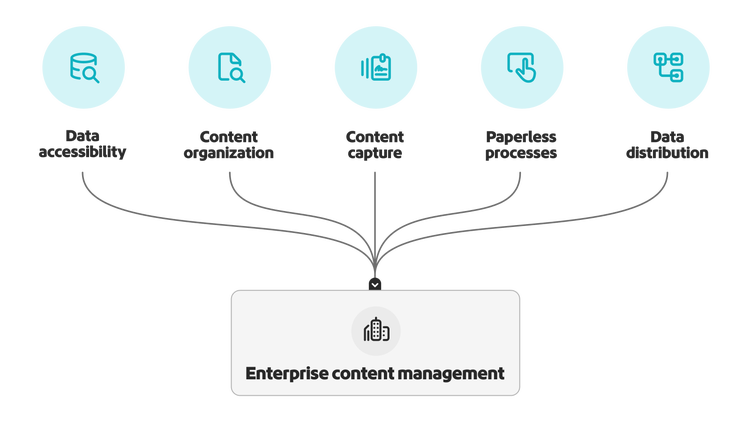
Benefits of modern ECM solutions.

Here are some of the key benefits that modern ECM solutions offer:

  • Data accessibility: ECM systems help eliminate data silos and reduce costs by combining data from multiple sources and archives. They provide immediate access to comprehensive data, giving companies content storage that is clear, uncluttered, and cost-effective.
  • Content organization: ECM software offers advanced search capabilities that enable organizations to analyze and explore internal data more effectively. Companies can use it to create pathways that connect and extract otherwise disjointed content, allowing them to uncover — and profit from — previously untold data stories and improve internal reference centers.
  • Content capture: ECM systems allow organizations to intelligently streamline and refine content inputs. This means capturing content across formats such as spreadsheets, marketing materials, audio, video, and paper-based documents.
  • Paperless processes: ECM solutions speed up transactions and processing in efficient, environmentally friendly ways. Transitioning to an all-digital platform also facilitates easier compliance with industry regulations and improves content security.
  • Content distribution: Full-featured ECM software facilitates the distribution of content across digital channels, internal systems, customer experiences, websites, mobile applications, and business platforms, ensuring users can access the right information when they need it.
  • Cost reduction: ECM platforms help reduce operational costs by automating manual, paper-based tasks, thereby reducing physical and digital storage needs and eliminating postal and printing expenses. These platforms also reduce the risk of compliance violations by keeping content organized, trackable, and accessible. During legal or regulatory inquiries, ECM platforms speed up document retrieval, cutting e-discovery costs and helping teams respond more quickly and confidently.
  • Enhanced collaboration and trust: By providing a secure, centralized repository, ECM software serves as a single source of truth. This reduces content duplication and version confusion, ensuring teams work with the most accurate and approved information. As a result, collaboration becomes more consistent and efficient. These platforms also support better knowledge management by making it easy to capture, share, and refine institutional knowledge across departments.
  • Improved efficiency: A well-implemented ECM system streamlines access to information and simplifies content-centric processes, reducing time spent searching for files or managing approvals. It also enforces security and compliance rules while minimizing unnecessary storage, paper usage, and administrative overhead. By removing common bottlenecks, ECM platforms let teams work faster, make better decisions, and reduce friction across workflows.

ECM solutions are widely adopted in industries such as banking, financial services, and insurance (BFSI), healthcare, government, and retail, where efficient content management and regulatory compliance are critical.

Read how Adobe transformed its enterprise content supply chain in the age of AI.

Examples of ECM software.

There are many enterprise content management solutions available today, each offering a different mix of features to support content capture, collaboration, storage, compliance, and delivery. The right choice depends on your organization’s size, industry, and specific content needs. Here are some widely used ECM platforms:

  • Microsoft SharePoint: A content collaboration and document management platform that integrates with Microsoft 365. It supports document collaboration, workflow management, and content governance within Microsoft 365 environments.
  • OpenText Content Suite: An ECM platform focused on compliance, secure archiving, and automated content workflows. It is commonly used in regulated industries.
  • IBM FileNet Content Manager: An enterprise ECM platform for large-scale document capture, workflow automation, and governance, with content preservation and delivery features.
  • Hyland OnBase: A platform for capturing, managing, and integrating content across departments, with workflow automation and records management for compliance.
  • Adobe Experience Manager: A powerful content management platform that combines content management and digital asset management (DAM), letting organizations create, manage, and deliver personalized digital experiences and content across channels.
  • Laserfiche: A platform for document management, process automation, and content delivery, with governance and retention features.

How to get started with an ECM system.

Getting started with an enterprise content management system doesn't have to be overwhelming. With the right foundation, organizations can streamline implementation, improve adoption, and scale content operations effectively.
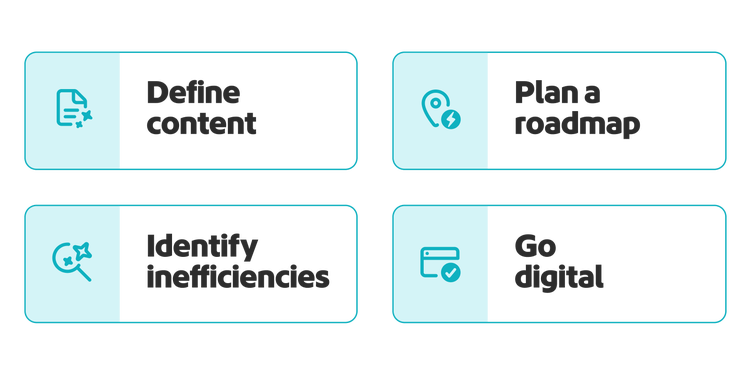
Steps to get started with an ECM system.

Here’s a list of steps organizations should take to get started with an ECM system:

  1. Define your content strategy: Start by understanding the content your organization manages, where it lives, and how teams use it today. From there, align on the outcomes you want to achieve, whether that's improving content reuse, strengthening governance, delivering more personalized experiences, or streamlining content delivery across channels.
  2. Align stakeholders and workflows: Bring together business, IT, legal, and operations teams to map current workflows, identify steps, and review approval processes. This helps ensure your ECM system supports the way teams work while meeting compliance and governance requirements.
  3. Identify gaps and inefficiencies: Take a close look at your existing content lifecycle to uncover bottlenecks, duplicate content, inconsistent metadata, and disconnected tools. Identifying these issues early can help you prioritize the improvements that will have the biggest impact.
  4. Modernize content operations: Replace fragmented tools and manual processes with centralized content management workflows. A modern ECM system can help streamline collaboration, strengthen version control, improve search and tagging, and support more scalable content delivery across digital experiences.
#F8F8F8

How Adobe Experience Manager can help.

Enterprise content management solutions are equipped to provide continuous benefits as your organization grows, shifts, and scales. However, informed evaluation of these systems is essential to producing the most profitable outcomes.

Adobe Experience Manager brings together DAM and content management in a unified solution that helps organizations scale ECM more effectively. Its expansive capabilities help you manage, automate, and deliver timely, relevant digital experiences in a streamlined, always-on, and up-to-date cloud service.

#EEFBFB

Find out more about how Adobe Experience Manager can transform your organization and meet your ECM needs.


Watch video Book a demo

Frequently asked questions about enterprise content management.

What is the difference between an enterprise content management system and content management system?

An ECM system is designed to manage all types of content, structured and unstructured, across an organization, including documents, records, and workflows. In contrast, a content management system (CMS) focuses primarily on creating, editing, and publishing digital content for online channels. ECM encompasses broader content management needs within an enterprise.

What is the difference between enterprise resource planning and ECM?

Enterprise resource planning (ERP) systems are designed to manage and integrate core business processes, such as finance, human resources, and supply chain operations with a focus on structured data and transactions. ECM systems, on the other hand, manage unstructured content, such as documents, emails, and multimedia, ensuring proper storage, retrieval, and compliance. While ERP handles transactional data, ECM focuses on the content that supports these transactions.

How does enterprise content management improve compliance and security?

ECM improves compliance and security by centralizing content under consistent permissions, retention policies, and audit trails. This helps teams control access, reduce the use of outdated or unauthorized content, and respond more efficiently to audits, legal requests, and regulatory requirements.

Which industries benefit the most from enterprise content management systems?

ECM is especially valuable for industries with large volumes of content, strict compliance requirements, or complex review workflows. This often includes financial services, healthcare and life sciences, government, education, media and publishing, retail, manufacturing, and other large enterprises managing content across teams and channels.

Can enterprise content management systems integrate with existing business tools?

Yes, ECM systems are designed to work with existing business tools, including CRM, ERP, analytics, collaboration, and workflow platforms. These integrations help teams connect content to the systems they already use so information moves faster and stays more consistent across the business.

How does AI improve enterprise content management systems?

AI improves ECM by automating tasks such as tagging, classification, extraction, search, and summarization. This makes content easier to find, govern, and reuse, while reducing manual effort and helping teams work faster at scale.

https://main--bacom--adobecom.aem.live/fragments/resources/cards/thank-you-collections/generic-dx