Content as a Service v3 - Industry analysts speak - Friday, May 15, 2026 at 14:43
Ask



Explore the features and capabilities of Real-Time CDP.
Built on Adobe Experience Platform, Real-Time CDP lets you create high-value audience segments with intelligence for real-time B2C and B2B use cases across the entire marketing funnel.

Connect to data from one flexible environment — no matter the source.
Take full advantage of your data warehouse investments and easily enrich first-party data to empower enterprise teams to activate valuable data and drive more personalized customer experiences.
- Maximize the value and minimize the movement of your data with a flexible architecture. Activate customer data directly from your existing warehouse for real-time, personalized experiences without the need to move or copy underlying datasets.
- Build powerful, federated audiences. Create and enrich high-value audiences directly from your data warehouse and combine them with continuously ingested internal and external data sources.
- Unify comprehensive data sources. Securely ingest and unify zero-, first-, and cookieless third-party data, including insights from trusted second-party sources for in-the-moment engagement and personalization.

Connect data to form.
With Real-Time CDP, you can connect and normalize in one platform. From this foundation, Real-Time CDP automatically denormalizes and materializes data optimized for real-time decisioning, personalization engagement with customers and prospects.
- Standardize, clean, and monitor data, with the assistance of CX Enterprise Coworker. Ensure data is consistently structured, clean, and traceable, enabling accurate insights and trusted customer experiences.
- Harmonize and unify customer profiles. Empower teams across the organization to access and update a unified customer profile that ensures they’re working with consistent, current information.
- Get efficient self-serve templates and interactive tools. Help teams to act more quickly with resources that are marketer-friendly and agent-supported.
- Accelerated data onboarding. Automate data onboarding, SQL preparation, data collection, and troubleshooting with guidance and automated workflows powered by CX Enterprise Coworker.

Build, activate, and optimize audiences at scale.
Stand up and optimize campaigns with comprehensive tools to create customer profiles and audiences in real time – enriched with diverse data sources and powered with agentic AI workflows. Execute end-to-end audience management and creation workflows with CX Enterprise Coworker. Discover and explore audiences and attributes in natural language, estimate audience size to inform campaign reach, seamlessly build audiences with validation checks and approvals, aligned to organizational governance tenants.
- Create and manage audience at scale in a centralized, intuitive interface. Quickly experiment, create, manage, and optimize audiences by utilizing embedded AI-powered search and marketer-friendly tools. Reduce the reliance on technical resources and accelerate speed to market for campaigns.
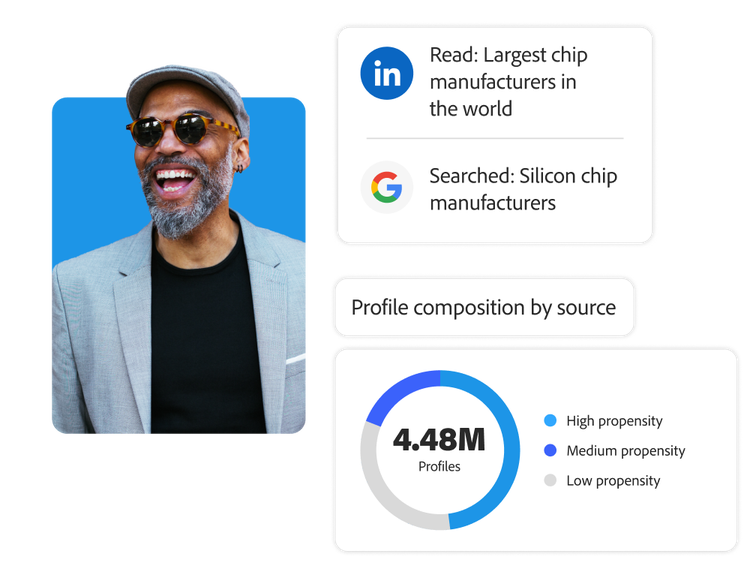
- Identify and grow high-performing audiences with AI-powered intelligence. Use AI-powered propensity scores to predict which customers are most likely to convert, purchase, or engage, and automatically build audiences to find new prospects with similar behaviors and characteristics.
- Enrich audiences with flexible input from all sources. Leverage data from multiple sources — including warehouse connections without copying data and second- and third-party partner data — to enrich and activate audiences across channels, while keeping management central and internal.

Confidently manage your data with enterprise governance tools.
Manage customer data across all lines of business from one centralized platform.
- Give teams enterprise data privacy and compliance. Create, manage, and enforce data usage policies across teams that help ensure sensitive data is only used in approved ways and aligns with privacy regulations.
- Use permissions to control data access and security. Determine which users and teams can access specific data types and actions, limiting the exposure of sensitive information and reducing the risk of unauthorized access.

Deliver relevant, real-time customer experiences across every channel.
Reach new customers, personalize engagement, and optimize the entire funnel for measurable impact with real-time engagement.
- Deliver targeted customer experiences and in-the-moment personalization. Leverage real-time data ingestion and streaming delivery to activate personalized experiences for customers faster.
- Plan, orchestrate, and activate cross-channel journeys. Use prebuilt integrations and APIs to activate known and unknown data across channels to build destinations for customers along their journey. Plan journeys using a marketer-friendly, easy-to-use canvas to activate with even more speed.
Adobe Real-Time CDP use cases

Engage new audiences.
Discover and engage new audiences without relying on third-party cookies.

Convert unknown prospects.
Recognize and remarket to unknown visitors with personalized experiences for better conversion.

Create customer profiles.
Build unified profiles that power more targeted and relevant omnichannel experiences.

Retain customers.
Connect data faster to enhance your customer profiles, unlock deeper insights, and retain customers.

Govern customer data
Earn and maintain customer trust through responsible data governance, management, and usage.
Industry analysts speak.
Additional Real-Time CDP offerings.

Adobe Real-Time CDP Collaboration
A purpose-built data collaboration application that lets you connect with brand partners, advertisers, and publishers — from connected TV to commerce media — to find high-value audiences in a user-friendly environment, all while prioritizing privacy.

Adobe Real-Time CDP Connections
Streamline how data is collected and distributed to Adobe Experience Platform and other systems and endpoints — such as Facebook and Google — while improving site performance. Adobe Real-Time CDP Connections uses server-side forwarding to enable you to instantly deliver powerful marketing experiences.
Driving results for some of the world’s biggest companies.

“Our expanded partnership with Adobe will enable us to enhance the customer experience even further, driving personalization at scale and further optimizing The Home Depot experience across online and in store.”
Melanie Babcock, Vice President of Integrated Media
The Home Depot
Learn more about Real-Time CDP.
Better together.
Connect Adobe products to create experiences that are right on time and just right for your customers.

Real-Time CDP + Adobe Journey Optimizer
Build unified profiles and actionable audiences while also creating and delivering personalized customer experiences.

Real-Time CDP + Adobe Customer Journey Analytics
Supplement customer profiles with cross-channel behavioral insights for enhanced audience creation and activation.

Personalization at scale
Adobe can help you make personalized experiences a part of every customer moment.
Real-Time CDP FAQs.
Real-Time CDP is the customer data platform application; Adobe Experience Platform is the foundation it runs on, so a Real-Time CDP license includes the platform services it depends on rather than being a separate purchase you bolt on. Experience Platform provides the shared data plumbing: ingestion, Experience Data Model schemas, Identity Service, the Real-Time Customer Profile, segmentation, and governance. Real-Time CDP is the application that turns those services into a marketer-facing workflow for unifying data, building audiences, and activating them. If you are comparing Adobe against standalone CDPs, Real-Time CDP is the product to compare, and it inherits the platform's identity, governance, and AI rather than reinventing them.
Real-Time CDP standardizes, validates, and connects data from online, offline, and pseudonymous sources into one real-time customer profile that every team can act on. Incoming data is structured to a common Experience Data Model, validated as it is ingested, and resolved to a person or account through Identity Service, so records that arrive from your website, mobile app, call center, point of sale, and CRM become one profile rather than five disconnected ones. That unified profile is what makes downstream audience building and activation consistent, instead of each team working from its own copy of the customer.
Usually yes, because they do different jobs, and Real-Time CDP is designed to unify their data rather than replace them. A CRM manages relationships and transactions with your known customers and leads; a DMP works with anonymized third-party audience data for advertising; a CDP builds a persistent, unified profile by harmonizing data from across all of those systems and your own channels. In practice Real-Time CDP ingests CRM data and other sources into one profile, then activates audiences from it, so your CRM stays your system of record for customer relationships while Real-Time CDP becomes the system that makes that data actionable across channels.
The three are sibling applications on Adobe Experience Platform, and they divide the work: Real-Time CDP unifies data and builds and activates audiences, Journey Optimizer orchestrates the multi-step journeys and messages those audiences receive, and Customer Journey Analytics analyzes how those journeys performed. Because all three share the same Real-Time Customer Profile, an audience you build in Real-Time CDP is directly available to Journey Optimizer for orchestration and to Customer Journey Analytics for measurement, with no export and re-import between them. You can start with Real-Time CDP alone and add the others as your use cases grow into orchestration and cross-channel analysis.
Real-time segmentation qualifies a person into or out of an audience the instant their behavior or attributes change, rather than on a batch schedule that can be hours or a day behind. Traditional segmentation evaluates against static or historical data on a recurring run, so a visitor who abandons a cart is not reachable until the next batch completes. In Real-Time CDP, streaming segmentation can qualify that visitor in the moment and make them available for same-session personalization or immediate activation, which is what makes "in the moment" use cases possible rather than next-day ones.
Choose by the kind of profiles you manage: B2C for consumer profiles, B2B for account-based profiles (people and the accounts they belong to), and B2P (Business-to-Person) when you need both in a single CDP to target the same person across all lines of business. All three are editions of the same product, each offered in a Prime and an Ultimate package, so the choice is about data model and use case, not about buying a different platform. The B2B edition adds B2B-specific schemas, account and people identity resolution with account hierarchies, and a purpose-built Marketo Engage connector; confirm the exact edition and package with your Adobe account team, since guardrails and included capabilities vary by tier.
They are additional Real-Time CDP offerings for two specific jobs. Real-Time CDP Collaboration is a data clean room application that lets you discover, activate, and measure high-value audiences with advertising and publisher partners in a privacy-safe environment, without relying on third-party cookies and without exposing underlying customer data (it is currently in limited availability by region, so confirm availability for your market). Connections is the data-collection side, capturing streaming behavioral data through Adobe's Edge Network so profiles update in real time. Both extend the same Real-Time CDP profile rather than being separate platforms.
Getting started centers on connecting your data sources, mapping them to Experience Data Model schemas, configuring identities and merge policies to build the real-time profile, and setting governance labels and policies, after which you build audiences and connect destinations for activation. You do not have to move everything at once: Real-Time CDP supports ingesting the data you need for real-time use cases while federating other data from your warehouse, so most programs start with one or two high-value use cases and a subset of sources and expand from there. Teams typically pair a data engineer or architect on the connection and identity setup with the marketing owners of the use case.
Let us show you the full power of Adobe Real-Time CDP.
cardTitle
Adobe Real-Time CDP for unified customer profiles.
Description
Unify and harmonize customer data to build AI-powered audiences and real-time profiles for personalized engagement across the customer journey.
cardDate
2024-03-26
cardImage

primaryTag
caas:content-type/product-page
Tags
caas:content-type/product-page, caas:products/adobe-real-time-cdp
Let's talk about what Adobe Real-Time CDP can do for your business.