


Unify data to unlock AI’s potential.
Address data fragmentation by investing in unified customer data platforms and governance. These provide the foundation AI needs to deliver the experiences customers expect.



Section 4
AI is already accelerating marketing and IT operations, but its true potential lies in deepening customer engagement, not just automating tasks. For martech leaders — those who bridge marketing strategy and technology execution — realizing that potential means aligning data maturity, content production, and workflow optimization into a unified growth engine. This overview distills the Adobe 2026 AI and Digital Trends findings into three critical areas for martech leaders: powering profiles with data and insights, streamlining content and scaling campaigns, and driving impact with unified workflows.

Section 1
Customers expect streamlined brand experiences and are already using AI to find them, but organizations lack the data foundations needed to deliver on those demands. Prioritize data unification, quality, and accessibility before integrating agentic AI into customer interactions.

of customers regularly or occasionally use AI tools at work and in their personal lives.

of customers believe AI will improve their overall experience with brands.
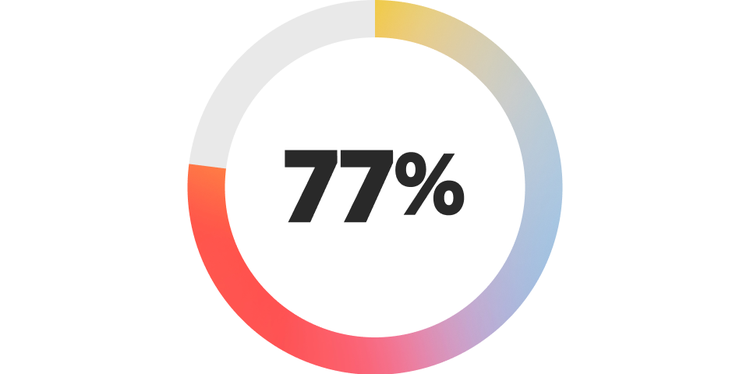
expect at least half of customer support interactions to be handled directly by agentic AI within the next 18 months.
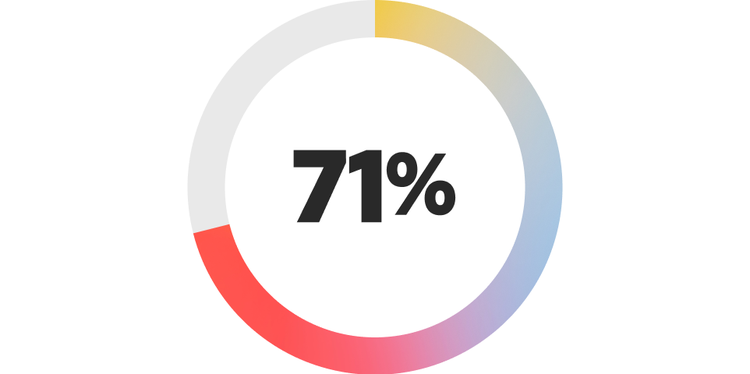
anticipate the same for post‑purchase support.
44% say their data quality and accessibility are adequate for AI.

49% say their organization’s ability to advance AI initiatives is limited by its current level of data unification and structure.

42% report having a unified customer data foundation for extracting insights from AI‑generated data.

Section 2
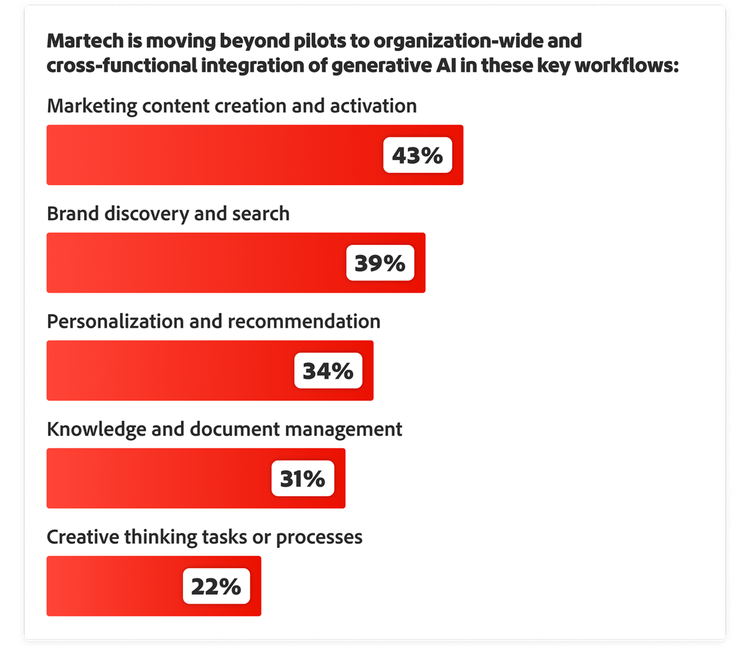
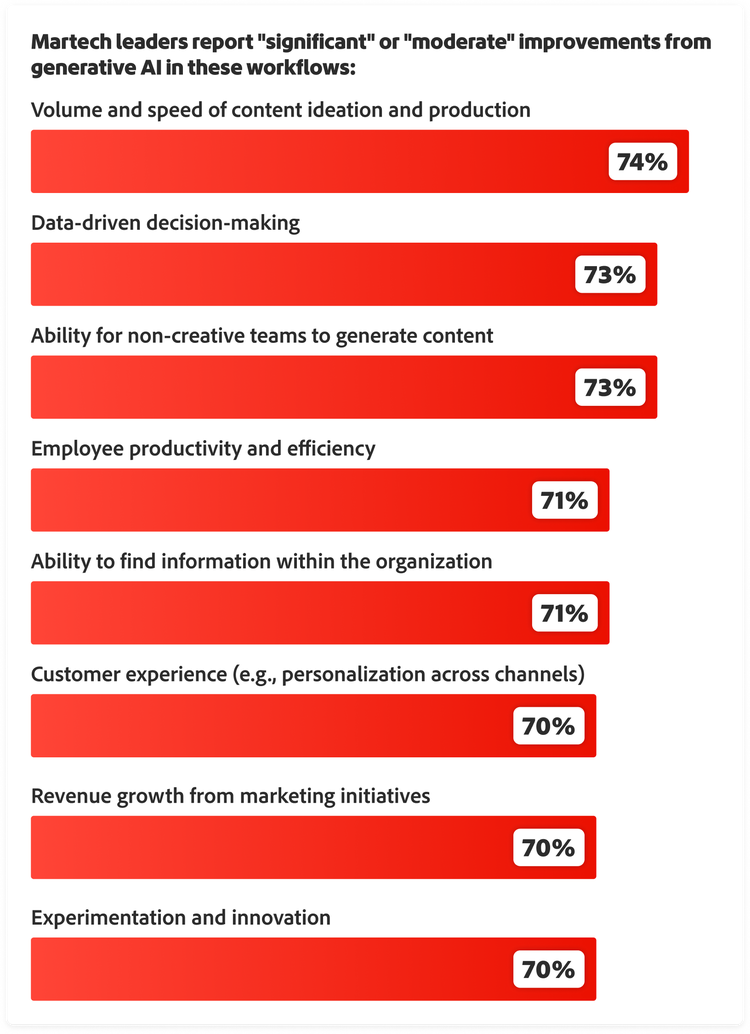
Creative demand is outpacing resources, but generative AI is already improving content speed, decision‑making, and productivity — and agentic AI promises to bring these operations to scale. However, without unified data for connected insights, teams risk campaigns that underperform and an inability to capture AI’s full impact.

of customers are likely to disengage from a brand if a personalized interaction feels irrelevant.

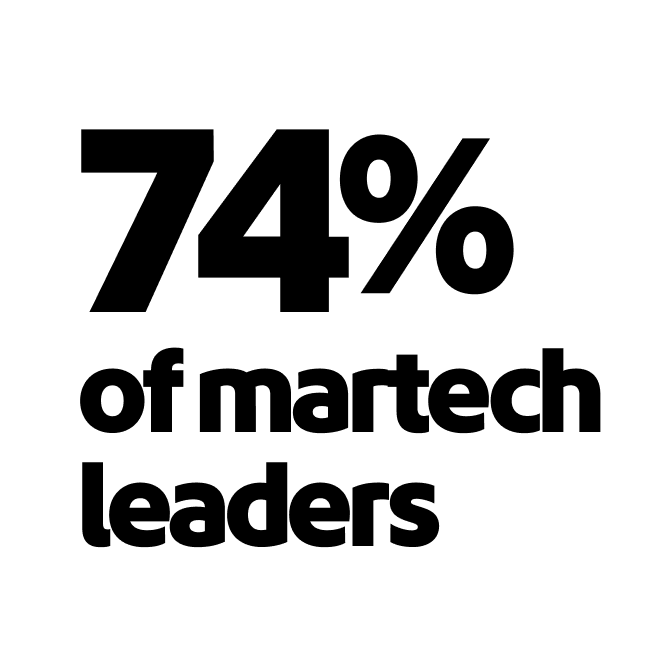
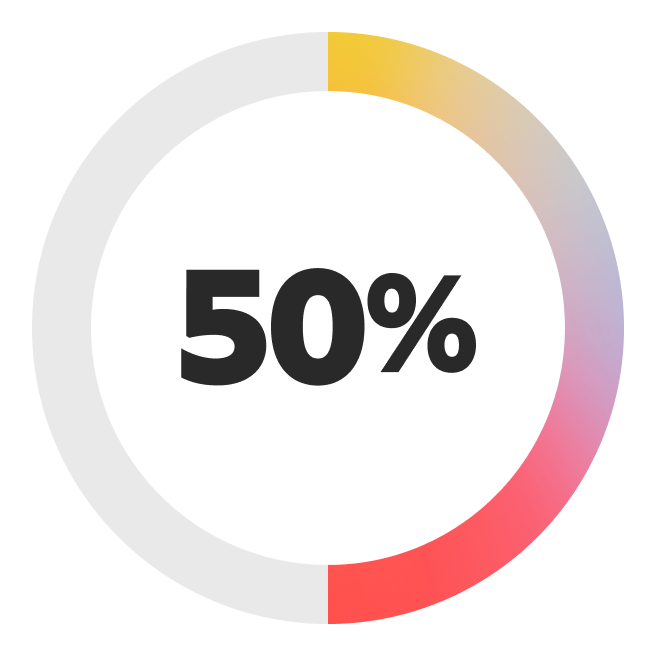
of martech leaders say their organization’s content supply chain is largely linear and resource‑intensive.

Section 3
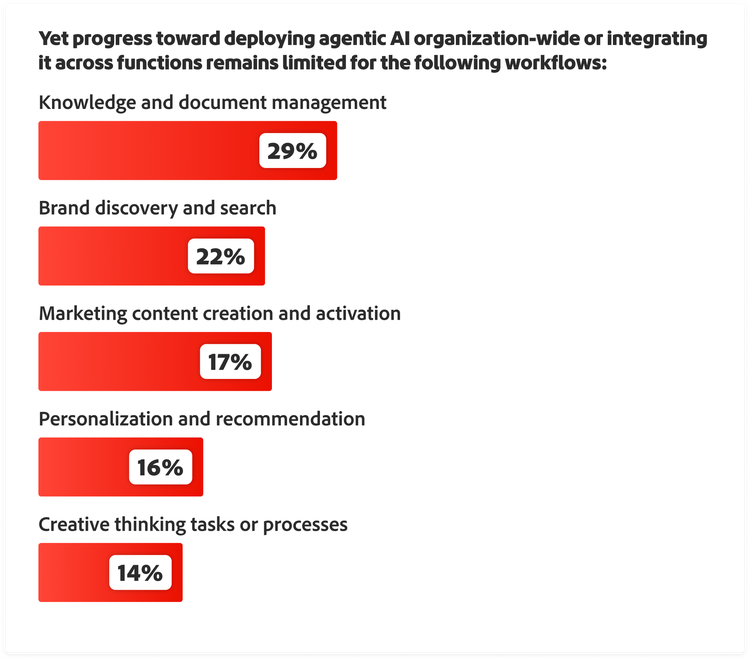
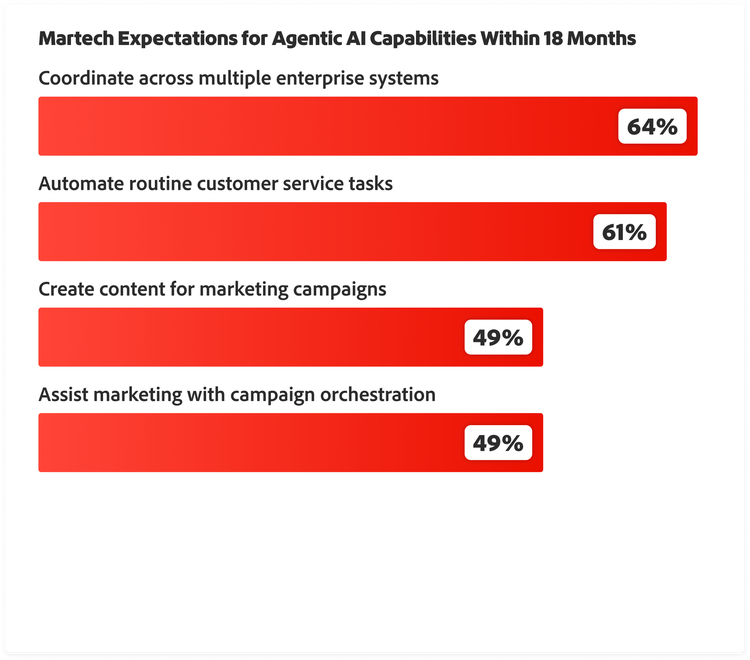
High‑velocity, data‑driven campaigns require breaking down technology infrastructure silos, aligning leadership with day‑to‑day practitioners, and preparing workers for high‑impact AI use cases. Only then can brands fully leverage agentic AI to accelerate delivery, amplify output, and drive business ROI.



Unclear ROI or business case

Talent and skill gaps

Technology infrastructure limitations such as legacy systems, vendor lock‑in, and compatibility

Section 4
Unify data to unlock AI’s potential.
Address data fragmentation by investing in unified customer data platforms and governance. These provide the foundation AI needs to deliver the experiences customers expect.

Scale content across workflows and systems.
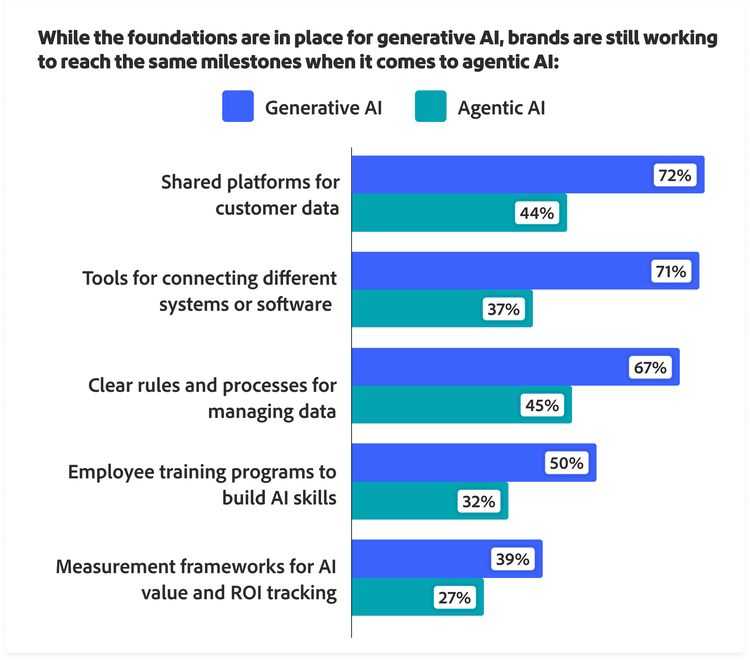
Build on generative AI’s gains by extending cross‑system connectivity and investing in foundational tools that enable agentic AI.

Align strategy to accelerate agentic AI.
Before scaling agentic AI, identify high‑value use cases, align leadership and teams around them, and define clear success metrics.
Appendix
For Adobe’s 16th annual AI and Digital Trends research, Oxford Economics, in partnership with Adobe, conducted global surveys of 3,000 executives and practitioners and 4,000 customers to better understand how organizations are leveraging AI to capture customer interest, build brand loyalty, and augment customer experience (CX) workflows — and how customers are responding to these changes. The surveys were fielded online and via computer‑assisted telephonic interviewing (CATI) from October through November 2025.
“Martech” refers to a global set of marketing team leads, managers, directors, VPs, SVPs, and C‑suite leaders. This group makes up 31% of business survey respondents and represents a wide range of industries and business sizes.
View the 2026 AI and Digital Trends report for more on the full research methodology.