
Strategy
Clear AI vision with ownership and
investment commitments.





AI is advancing rapidly across automotive organizations, but sustainable value depends on more than individual use cases. This report explores five operating model behaviors that help leading organizations strengthen ownership, governance, measurement, collaboration, and adoption, creating the conditions for more coordinated, scalable, and responsible AI deployment.
Ask an automaker where AI lives today, and you'll probably get seven answers: marketing, customer experience, retail, service, product, data, and technology. Often, organizations place several bets at once, but these efforts are rarely in sync. Coordinating all of that is the job of the operating model: establishing ownership, governance, measurement, and ways of working across these initiatives.
The research behind this report asked a simpler question. Is the operating model keeping pace with AI itself? For most respondents, it isn't. AI usually shows up with a budget before it shows up with an owner.
This gap shows up in familiar ways. Different functions run their own AI initiatives across separate systems, with distinct data, partners, and definitions of success. Visibility suffers first. Then it gets harder to tell which use cases are worth scaling, who's accountable for them, and how results should be measured.
None of this is surprising in an industry that plans in model years and just encountered a technology that evolves weekly. The workflows connecting business teams with data, technology, privacy, cybersecurity, legal, governance, and risk partners were built for slower cycles and functions that mostly stayed in their lanes.
AI keeps outrunning the organization chart. It needs fast iteration, clear decision rights, shared data access, and oversight that keeps pace rather than waiting to review decisions after the fact. Without that foundation, individual AI deployments tend to remain exactly that — isolated initiatives. These wins are hard to repeat and even harder to scale.
This report examines five operating model behaviors that are more common among the global, cross-industry Leader cohort. It gives automotive executives a practical framework for assessing ownership, measurement, collaboration, learning, and adoption capabilities, while still respecting the customer, owner, dealer, service, privacy, security, safety, governance, and partner realities specific to this industry.

Jon Beebe

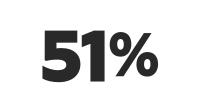
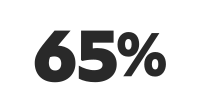
executives participated across 12 industries and 11 global markets.

respondents represented automotive and 482 were included in the active analysis across the exploring, piloting, deploying, expanding, and transforming stages.
MARKETS COVERED
Australia and New Zealand, Central Europe, India, Japan, Latin America, the Middle East, North America, Southeast Asia, South Korea, the United Kingdom (UK) and Ireland, and Western Europe.
The 342 AI Leaders referenced in this report come from the study population of 5,633 executives across 12 industries. This is a global cross-industry cohort, not an automotive-specific group. It provides the benchmark to compare automotive respondents.
Each organization was assessed across six operating model pillars, with every pillar scored on a scale of 1 to 5. The six scores were combined into an operating model maturity (OMM) composite.
Strategy
Clear AI vision with ownership and
investment commitments.

Structure
Dedicated AI ownership with budget authority.

People
Roles and culture evolving for
an AI-enabled environment.

Governance
Risk frameworks calibrated for AI velocity.

Technology
Infrastructure built for scale, not just pilots.

Workflows
AI embedded into how
work is actually done.
To qualify as a Leader, an organization had to meet two criteria: achieve an OMM composite above the top-quartile threshold of 3.27 and operate at the expanding or transforming stage of AI deployment. Applying both criteria identified 342 Leaders across 12 industries, equivalent to 6% of the 5,633 respondents.
Leaders have established the ownership, governance, measurement, and ways of working associated with repeatable and sustainable AI deployment. The designation reflects the operating model maturity and deployment stage, rather than an automotive-specific ranking.
Automotive respondents report AI activity across a range of functions and workflows. As that activity expands, the operating model supporting it often struggles to keep pace. Ownership remains unclear, measurement is limited, and coordination across business, data, technology, governance, and risk partners is inconsistent. This report examines those gaps and the behaviors more common among the global cross-industry Leader cohort.
Unless otherwise stated, Leaders refers to the global cross-industry cohort of 342 respondents who have an OMM composite above 3.27 and are operating at the expanding or transforming stage. They represent 6% of the 5,633 respondents and are not an automotive-specific cohort.
The 342 AI Leaders have established ownership, measurement, working relationships, and culture practices that are more common among organizations operating at later stages of deployment. This cohort provides a benchmark for five operating model behaviors.

Leaders are 5.3 times more likely to have a formal AI owner with a title and budget authority.

Leaders define the return on investment (ROI) framework before deployment. Among Leaders, 44% measure ROI comprehensively, compared with 7% of automotive respondents.

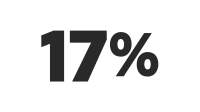
Leaders are more likely to operate at the collaborative or integrated level. Among Leaders, 81% do so, compared with 17% of automotive respondents.

Among respondents, 35% are in destructive failure patterns, blame, or repetition. Among Leaders, the figure is less than 1%.

Among Leaders, 42% identify finding and empowering internal champions as their most impactful culture action, ahead of every other culture action measured.
PART ONE
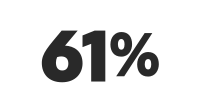
In the automotive industry, 61% of the organizations are in the Frozen Middle, which means AI is active within individual functions but the coordination needed to scale it remains limited.
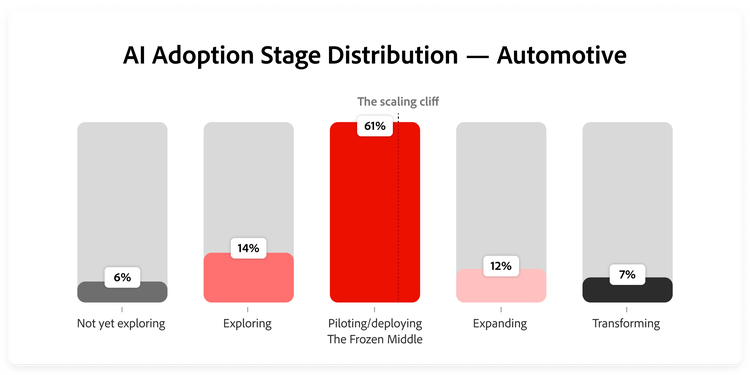
Automotive respondents may be deploying AI across marketing content, audience engagement, retail and shopping journeys, customer care, owner communications, service engagement, and the data and technology capabilities that support them. These use cases can involve different teams, systems, partners, and decision-making processes. When these use cases are developed separately, senior leaders may have limited visibility into which approaches warrant further evaluation, measurement, and extension.
The Frozen Middle describes respondents operating at the piloting or deploying stages. The 61% figure indicates a concentration in these stages but does not establish that every respondent has stalled or that progress has stopped. Where ownership, data access, learning, and results remain within teams or tools, it can be harder to compare activity and make coordinated decisions about wider deployment.
Moving beyond this pattern can require clearer ownership, agreed decision rights, appropriate data access, and shared measures across the teams involved. It can also require workflows that integrate AI into cross-functional work rather than treating individual tools as isolated deployments. Deferring those decisions may make alignment more difficult as deployments accumulate.
Where ownership exists, it may remain limited to a function, team, or individual initiative.
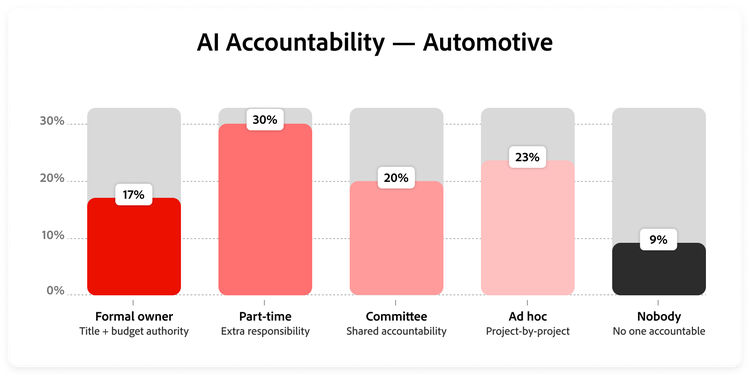
AI accountability can sit across marketing, customer experience, data, technology, governance, and risk functions. Delivery may also depend on partners. When responsibility is distributed without a clear mandate, it can be difficult to resolve priorities, allocate resources, and assess use cases.
An AI-supported customer or owner engagement workflow may require inputs from marketing, customer experience, data, technology, privacy, cybersecurity, legal, governance, and dealer-facing teams. It may also involve relevant partners. Without a defined owner who can coordinate the work, progress often depends on separate teams reaching agreement through their respective processes.
Part-time ownership and committee-led accountability can leave issues unresolved until after individual teams have moved ahead. A senior marketing, customer experience, or transformation leader can fill the role when the appointment includes an explicit mandate, suitable authority, and engagement from the functions and partners required. The requirement is clear accountability for cross-functional decisions, not assumed authority over every automotive channel or participant.
Integration evaluation accounts for the largest absolute reduction at the first measured gate, while the highest proportional attrition occurs later in the funnel.
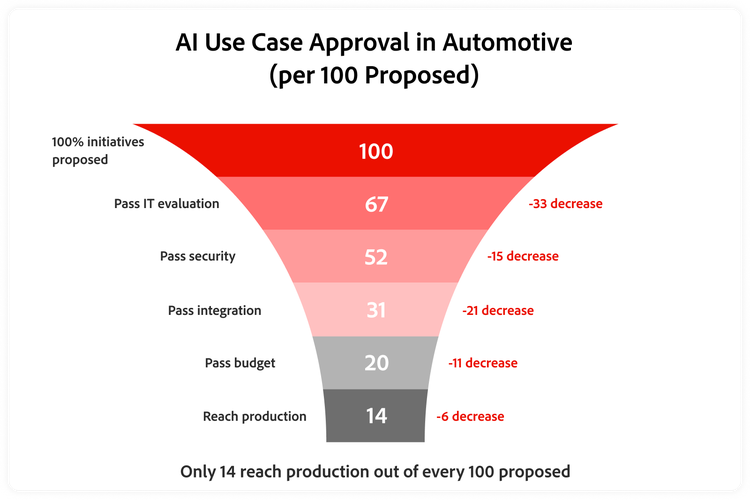
Moving an AI use case from an idea to production can require decisions across business, data, technology, privacy, cybersecurity, legal, governance, risk, and partner teams. The survey follows proposals through evaluation stages. In automotive, integration evaluation accounts for the largest absolute reduction at the first measured gate.
The review can consider integration complexity, data access and governance, security and privacy, cost justification, vendor approval, timing, and other requirements. These checks help determine whether a use case is practical to deploy. They should also maintain a focus on the customer, operational, or commercial question the work is intended to address.
A marketing, customer, owner, or service use case may depend on data rights, system ownership, and participation from multiple functions or partners. Settling requirements during ideation, before the review begins, can give teams a clearer basis for evaluating feasibility and value together. It does not guarantee production approval, but it can reduce avoidable uncertainty later in the process.
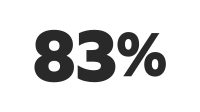
Among automotive respondents, 83% operate in relationship models that can rely on sequential requests, reviews, and decisions.
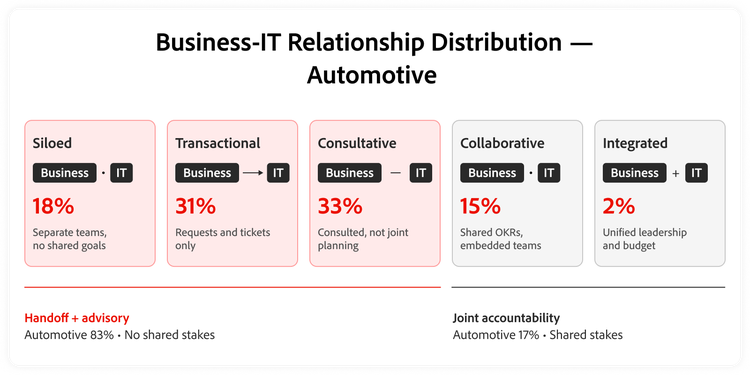
Business, customer, data, and technology teams may need to adjust their plans as business conditions and partner commitments change. AI may require timely testing, adjustment, and shared, informed decisions. Yet many respondents manage business and IT through handoffs.
Whether the relationship is siloed, transactional, or consultative, the pattern can be similar — one team submits a request and another responds. This may reflect established delivery cycles. It can make testing and shared decisions difficult when AI work crosses data, systems, and oversight requirements.
Collaborative and integrated relationships bring partners together when work is defined. Shared objectives and key results (OKRs) give participating teams responsibility for delivery and outcomes. When marketing, customer experience, data, technology, and other relevant partners establish the objective together, briefing, build decisions, measurement, learning, and review can follow one direction. This can help teams resolve data access, integration, timing, privacy, security, and governance questions as work progresses rather than through isolated functional handoffs.
Most respondents track activity measures. However, whether AI contributed to the outcomes that matter can remain unanswered.
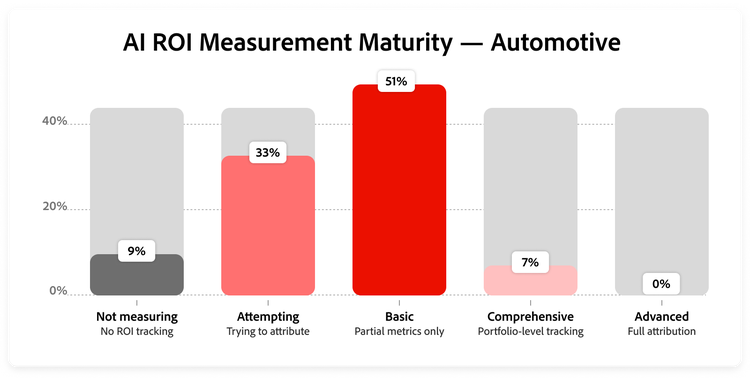
As AI becomes part of customer, retail, service, marketing, and operational work, teams need to measure more than activity. They may track content produced, audiences reached, interactions handled, or workflows completed. These measures can confirm activity and efficiency, but they do not consistently show whether AI contributed to customer, commercial, or operational outcomes.
Stronger measurement begins before launch. Teams define the intended outcome, record a baseline, and agree how results will be assessed. Once a campaign, customer interaction, offer, service communication, or other initiative is in the market, changing demand, pricing, media activity, operational conditions, and partner actions can make AI's contribution difficult to separate.
Pre-deployment measurement gives executives a clearer basis for planning and budget discussions. In automotive, where journeys and decision cycles can extend across multiple touchpoints and teams, this evidence can support more informed decisions about continued funding, wider deployment, and the measures used to assess future initiatives.
PART TWO

AI can affect marketing, customer experience, retail, service, product, data, technology, governance, and risk functions. Work may also involve partners with distinct roles. As work crosses boundaries, part-time owners, committees, and ad hoc leads may lack the mandate to resolve competing priorities.
Leaders address this by appointing an AI leader with a formal title, clear mandate, and budget authority. The leader can coordinate decisions when priorities conflict. Formal ownership is also associated with other behaviors. For example, Leaders are 4.8 times more likely to operate collaborative or integrated business and IT relationships, and 6.1 times more likely to measure ROI comprehensively.
The named AI leader needs access to the business, data, technology, governance, and risk partners required for the work. A senior marketing, customer experience, transformation, or other leader can fill this role when the appointment includes authority beyond one function or initiative. Organizations can establish that mandate within existing structures without assuming control over every channel, partner, or participant.
Leaders treat measurement as a condition of deployment, giving executives a clearer basis for investment decisions.
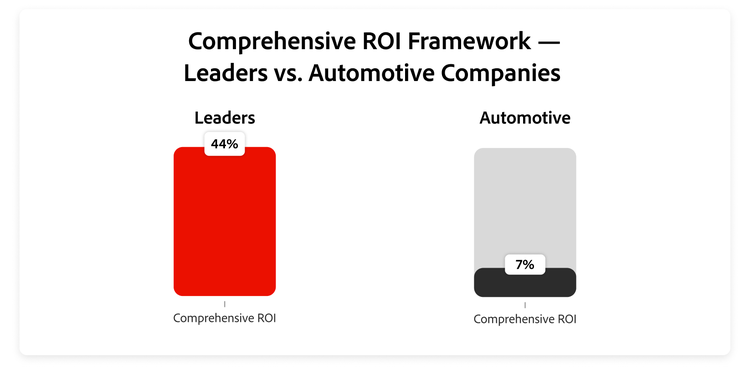
Business, data, and technology leaders need evidence early enough to guide investment decisions. Leaders account for measurement in the early design of each AI use case. Among Leaders, 44% have a comprehensive ROI framework, compared with 7% of automotive respondents. While every Leader measures AI performance, only 9% of automotive respondents do not measure it.
Before launching customer, marketing, owner, service, or other AI work, Leaders define the intended outcome. Measurement metrics may include engagement, completion, response, cost efficiency, time-to-value, or appropriate customer, operational, or commercial returns. Participants agree on the shared assessment approach before launch, giving executives a basis for planning and investment decisions.
Timing matters for work linked to changing conditions and behaviors. Once a campaign, interaction, offer, or service communication changes the baseline, the original comparison can be difficult to reconstruct. Leaders record current performance before launch and assess the same measures afterward. This provides a clearer basis for continued investment and more confident future funding decisions.
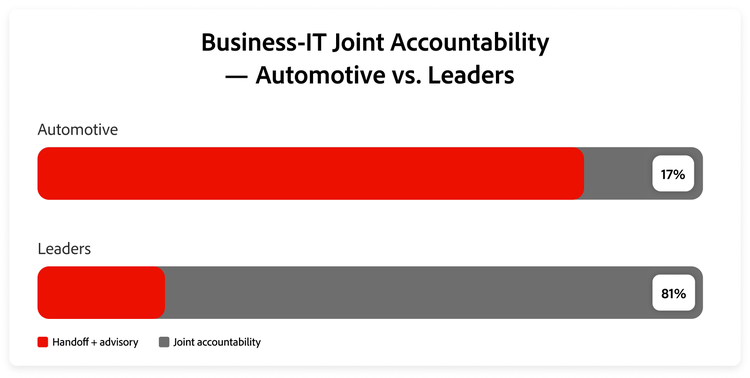
AI-supported customer, retail, owner, service, marketing, and operational work can depend on data, systems, governance, and partner participation. Sequential handoffs can create friction whenever data, support, evaluation, or measurement must move between teams. Many respondents follow a siloed, transactional, or consultative approach, meaning technology teams advise business teams on delivery without sharing accountability for outcomes.
Among the 342 Leaders, collaborative and integrated relationships are more common. Partners are involved when the brief is created. Marketing, customer experience, data, technology, and governance functions develop the scope together rather than handing over a completed request.
Shared accountability continues through delivery and measurement. When participating leaders share accountability for the same outcome in their performance reviews, briefing, build decisions, and measurement can follow one agreed direction. Leaders establish this partnership through shared objectives and key results within existing structures, allowing teams to work together without requiring a reorganization or assuming control over external or independent partners.
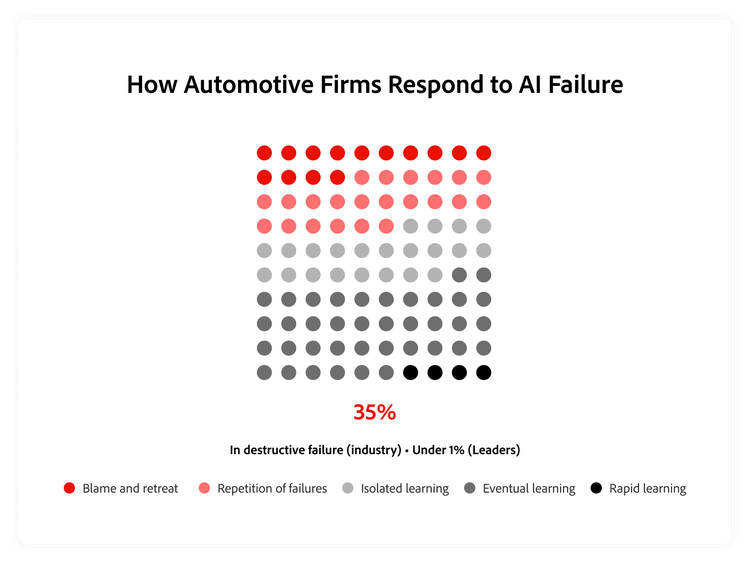
Automotive organizations can operate through planning and review cycles and can involve multiple teams and partners. When an AI initiative underperforms, teams may face pressure to move on quickly rather than taking time to examine the result. A customer engagement workflow, retail experience, service communication, or marketing model that does not perform as expected can inform the next initiative.
When underperformance goes unexamined, other teams may carry the same assumptions into later work. Without a shared learning process across the functions involved, lessons could remain local and another team could repeat the same mistake. This can make it harder to assess whether a change in process, data, measurement, governance, or oversight is needed.
A learning culture becomes visible in regular operating reviews. Leaders create time for reflective discussions, allowing teams to examine what underperformed, why it happened, and what should change. When senior leaders make this process a part of planning and performance reviews, lessons can be shared across teams and applied to future work without assigning blame.
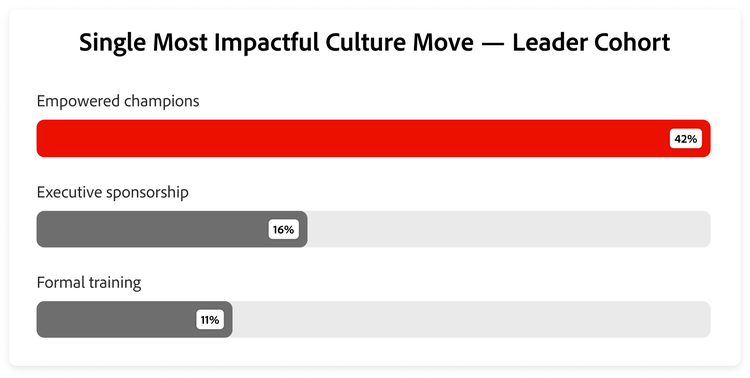
People may be more likely to consider AI when they see a colleague use it in familiar work. In automotive, this may include a marketing practitioner improving an audience brief, a service colleague testing a workflow, or an analyst assessing a process.
Leaders identify practitioners and give them support and permission to extend an approach to an adjacent team. Evidence from a recognizable workflow can carry more weight than centralized messages. Champions can build influence by documenting what was tested, how it was assessed, and what teams may evaluate or adapt. They can help other teams learn from it without presuming that one workflow applies directly unchanged elsewhere.
Among the 96 automotive respondents at the expanding or transforming stage, 66% embedded AI leads in business units. Establishing an AI center created reusable infrastructure for 64%, while restructuring business and IT relationships reduced approval friction for 52%. These findings describe reported actions, not evidence that any action caused a deployment or outcome.
These actions translate the behaviors exhibited by Leaders into practical steps for automotive executives. They build on existing customer, marketing, retail, service, data, technology, governance, and risk capabilities rather than requiring a wholesale organizational redesign. They also support responsible coordination across customer, owner, retailer, service, and partner contexts without assuming a uniform automotive operating structure.
Conclusion
AI readiness in automotive is not defined by access to a tool or the number of isolated deployments underway. The findings point to the operating model conditions that can make AI work more repeatable — clear ownership, measurement from the start, shared accountability, learning, and practitioners who can help others evaluate proven approaches.
For automotive executives, the next step is to assess where these conditions are present and where they need attention. The assessment should include the customer, owner, retail, dealer, service, partner, data, technology, privacy, cybersecurity, legal, governance, risk, and human-oversight considerations relevant to the organization and the intended use case.
The goal is not to move faster at the expense of responsible decision-making. It is to create a disciplined way to evaluate, deploy, learn from, and extend AI where it can support customer and business priorities. Organizations can begin with one use case, one accountable leader, and one agreed measure, then use the evidence to decide what should be adapted, expanded, or stopped.
Adobe empowers organizations to create impactful digital experiences. Our portfolio of customer-experience products and services helps businesses put every interaction in context, understand what each customer needs right now, and design and deliver digital experiences that build loyalty and drive growth. Visit adobe.com to know more.
Incisiv is an industry insights and strategy firm combining close to a decade of industry trend data with primary research, messaging architecture, and content development to help enterprises navigate transformation, evaluate solutions, and unlock growth.