Strategy
Clear AI vision with ownership and
investment commitments.





Travel and hospitality organizations are actively piloting and deploying AI, but broader expansion remains less common. For The State of AI Readiness in Travel and Hospitality, we surveyed executives to understand how organizations are progressing with AI, where operating model gaps may limit expansion, and which behaviors can be modeled to scale.
Travelers no longer search for and choose experiences the same way. Increasingly, they describe what they want, delegate discovery, and use AI to compare options. Guests expect brands to recognize their preferences and make each interaction feel connected. Travel and hospitality brands are therefore designing for two audiences: guests and the AI systems influencing discovery and engagement.
The industry has responded with AI activity across marketing and customer experience. Yet the research shows that visible activity does not always rest on an Operating Model equipped for repeatable deployment. Many travel and hospitality respondents are concentrated at the Piloting and Deploying stages. Responsibility is often distributed, measurement is limited, and business and technology teams work through sequential handoffs.
The result is a gap between launching individual initiatives and connecting them across the customer journey. Closing it requires clearer authority, shared outcomes, earlier measurement, and collaboration across marketing, loyalty, customer experience, data, technology, operations, and risk.
That gap, rather than a shortage of AI ambition, is the central issue explored in this report. The global cross-industry Leader cohort provides a benchmark for decisions that can help travel and hospitality executives move toward more coordinated, measurable, and repeatable execution.

Julie Hoffmann

executives participated across 12 industries and 11 global markets.

respondents represented travel and hospitality.

travel and hospitality respondents were included in the active analysis. This active respondent base comprises respondents at the exploring, piloting, deploying, expanding, or transforming stages of AI adoption.


MARKETS COVERED
Markets covered were Australia and New Zealand, Central Europe, India, Japan, Latin America, the Middle East, North America, Southeast Asia, South Korea, the United Kingdom and Ireland, and Western Europe.
The 342 Leaders referenced in this report come from the full study population of 5,633 senior executives across 12 industries. This is a global, cross-industry cohort rather than a travel and hospitality-specific group. It provides the benchmark for comparing the travel and hospitality findings.
Each respondent’s organization was assessed across six operating model pillars, with every pillar scored on a scale of 1 to 5. The six scores were combined into an operating model maturity (OMM) composite.
Strategy
Clear AI vision with ownership and
investment commitments.

Structure
Dedicated AI ownership with budget authority.

People
Roles and culture evolving for
an AI-enabled environment.

Governance
Risk framework calibrated
for AI velocity.

Technology
Infrastructure built for scale, not just pilots.

Workflows
AI embedded into how
work is actually done.
To qualify as a Leader, a respondent’s organization had to meet two criteria: achieve an OMM composite above the top-quartile threshold of 3.27 and operate at the expanding or transforming stage of AI deployment. Applying both criteria identified 342 Leaders across the 12 industries, equivalent to 6% of the 5,323 active respondents.
The designation reflects measured OMM and deployment stage rather than self-reported leadership or membership in a specific industry cohort. Unless otherwise stated, “Leaders” refers to the global cross-industry cohort of 342 respondents whose organizations met the Leader criteria, representing 6% of the 5,323 active respondents.
Travel and hospitality respondents report AI activity, but the structures connecting, evaluating, and extending it are less mature. The findings point to a gap between deployment within functions and an operating model supporting repeatable execution across marketing, customer experience, and business and technology partners.

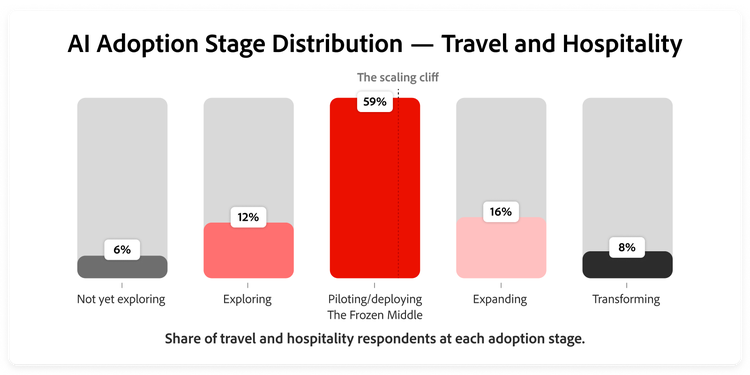
of active travel and hospitality respondents are at the piloting or deploying stage.
This concentration, described in the report as the frozen middle, indicates that AI is active within individual use cases or functions, while broader expansion remains less common. Progress depends on coordinated decisions about ownership, data, measurement, and ways of working.

of travel and hospitality respondents report that their organization has a formal AI owner with a defined title and budget authority.
Elsewhere, accountability may be distributed across marketing, loyalty, digital, revenue management, technology, and operations. When initiatives cross these boundaries, distributed responsibility can make it harder to resolve priorities, commit resources, and make final decisions.

of travel and hospitality respondents report siloed, transactional, or consultative relationships between business and information technology teams.
These models depend on requests, reviews, and sequential handoffs. AI initiatives often require earlier involvement from technology, data, privacy, security, and operational partners, along with shared accountability for customer and commercial outcomes. Without that coordination, deployments can remain difficult to connect and evaluate.
The 342 Leaders form a global, cross-industry cohort rather than a travel and hospitality-specific group. Five operating model behaviors are more common among these Leaders and provide a benchmark for the industry findings.

Leaders are 5.7 times more likely than travel and hospitality respondents to report a formal AI owner with a defined title and budget authority. This gives cross-functional work a clearer point of accountability.

44% of Leaders report comprehensive return on investment measurement, compared with 10% of travel and hospitality respondents. Leaders define how value will be assessed before deployment rather than adding the measurement approach later.

81% of Leaders report collaborative or integrated business and information technology relationships, compared with 20% of travel and hospitality respondents. These models bring both sides into the work earlier and make them jointly accountable for outcomes.

35% of travel and hospitality respondents report destructive failure-response patterns involving blame or repeated mistakes, compared with under 1% of Leaders. Leaders are more likely to examine underperformance and apply the learning to subsequent work.

42% of Leaders identify finding and empowering internal champions as their most effective culture action, compared with 16% for executive sponsorship and 11% for formal training. Proven practitioners can help translate AI into workflows for adjacent teams.
PART ONE
Many travel and hospitality respondents are concentrated at piloting and deploying.
59% of active travel and hospitality respondents are in the frozen middle, with AI active in individual areas while broader expansion remains less common.
Travel and hospitality teams often introduce AI through marketing and customer experience use cases. Loyalty teams may target cohorts for seasonal campaigns, while guest preference matching may be managed with marketing. Each initiative can move forward within its own remit, creating activity that is difficult to connect across functions.
The frozen middle describes respondents at the piloting or deploying stage, where AI is active, but expansion is less common. Data, learning, and results can remain within teams or tools. This limits the ability to compare outcomes, coordinate customer experiences, and determine which deployments warrant investment.
Moving beyond this stage requires clearer ownership, shared access to data, and agreed decision rights across marketing, loyalty, technology, and operations. It also requires teams to redesign workflows around AI rather than add isolated tools to existing processes. When these decisions are deferred, disconnected deployments can become harder to align around shared customer and commercial outcomes.
Only 16% of travel and hospitality respondents report a formal AI owner.
Responsibility may be distributed across functions, while the authority to resolve priorities and commit resources remains unclear.
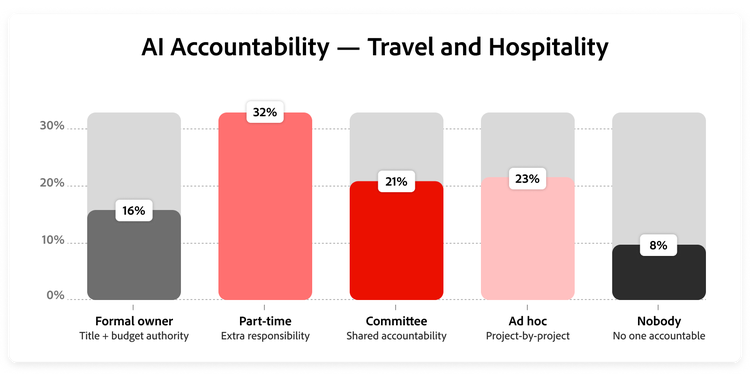
AI accountability in travel and hospitality may be distributed across marketing, loyalty, digital, revenue management, technology, and operations. Delivery depends on several of these groups. When responsibility is spread across functions, it can be difficult to resolve priorities, commit resources, or make binding decisions when an initiative crosses boundaries.
An AI-supported lifecycle engagement initiative, for example, may require booking data, loyalty status, customer preferences, and pricing inputs managed by different teams. Assigning someone to coordinate the work does not necessarily give that person authority over budgets, data access, or deployment priorities. Progress can still depend on separate functions reaching agreement.
Part-time owners and committees may coordinate work without authority to settle cross-functional decisions. A chief marketing officer or head of loyalty can fill the role when the appointment includes decision rights and budget authority. The requirement is not a particular title. It is the authority that extends beyond one function, system, or campaign.
Only 15 of every 100 AI use case requests reach production.
Initial information technology evaluation removes the largest number of requests, while budget approval creates the steepest proportional decline.
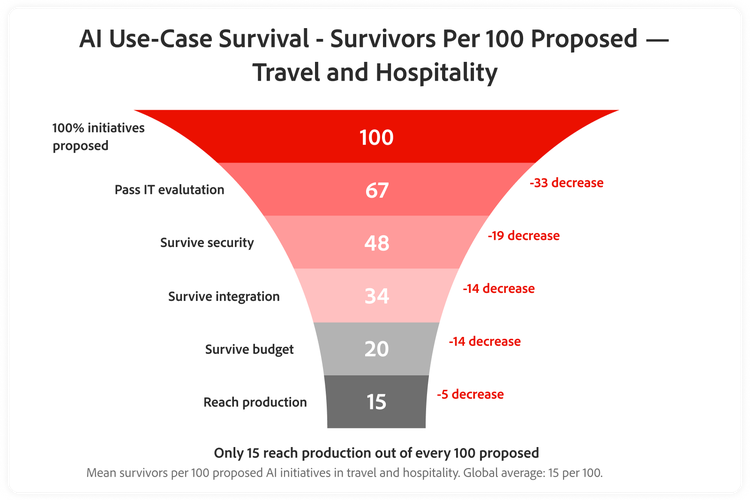
Moving an AI use case from idea to production requires decisions across marketing and its technology, data, security, finance, and risk partners. Initial information technology evaluation removes the largest number of requests, showing how quickly proposals encounter questions about feasibility, system fit, ownership, and readiness.
Later reviews test whether the use case can be deployed responsibly and funded. Security and integration assessments examine data access, governance, privacy, technical complexity, and operational risk. Budget approval creates the steepest proportional decline, suggesting that technical survival does not guarantee a clear or compelling case for investment.
That pattern makes early alignment essential. A personalization or lifecycle engagement initiative may depend on booking data, loyalty records, customer preferences, and systems owned by teams. Defining the customer or commercial outcome, data rights, system ownership, integration requirements, security considerations, and funding expectations during ideation allows partners to evaluate feasibility and value together before the proposal reaches formal review.
Most travel and hospitality respondents still manage business and IT through handoffs.
80% report siloed, transactional, or consultative relationships between business and information technology teams.
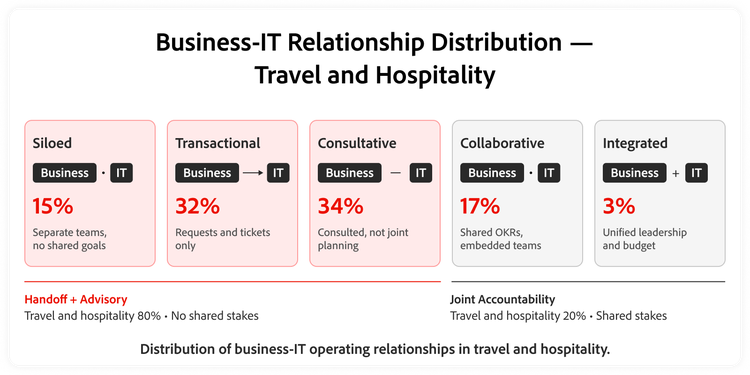
Marketing and customer experience teams adjust content, offers, and journeys as behavior changes, while AI requires frequent testing and refinement. Both require teams to work together as initiatives evolve. Yet many travel and hospitality respondents report relationships between business and information technology teams that depend on requests, reviews, and sequential handoffs.
Across siloed, transactional, and consultative relationships, technology may respond to a request or advise without sharing accountability for the outcome. This approach can separate customer objectives from decisions about data, integration, privacy, security, and deployment. Issues may move between functions instead of being resolved during delivery.
Collaborative and integrated relationships involve business and technology partners when an initiative is defined and throughout the process. Shared objectives and key results give both teams responsibility for delivery and the business outcome. When marketing, loyalty, technology, and data agree on the goal, briefing, build decisions, and measurement follow one direction. This allows teams to address constraints as the initiative progresses rather than pass them through a sequence of requests and approvals.
Comprehensive AI measurement remains rare in travel and hospitality.
Most travel and hospitality respondents take a basic approach to AI measurement, tracking activity without consistently connecting it to customer or commercial outcomes.
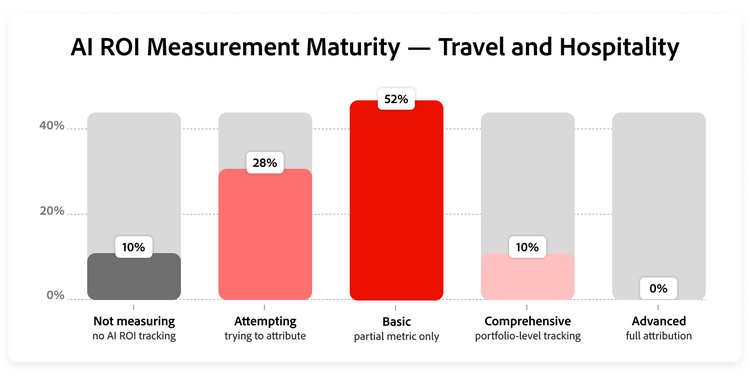
As AI becomes part of marketing and customer experience work, teams need to measure outcomes more than activity. Teams may track tool use, audience segmentation, content production, or personalization workflow execution. These measures confirm execution, but they do not show whether AI improved engagement, loyalty, conversion, or customer value.
Stronger measurement begins before launch. Teams define the intended outcome, record a baseline, and agree on how results will be assessed. Once a campaign or experience is in market, seasonality, pricing, channel activity, and other factors can make AI's contribution difficult to separate. Reconstructing the baseline later may not provide a reliable comparison.
Clear pre-deployment measurement gives marketing leaders credible evidence for planning and budget discussions. It also gives business and technology partners a shared basis for reviewing performance. When measurement is added only after deployment, teams may struggle to compare use cases, defend continued investment, or decide which initiatives should expand.
PART TWO

AI initiatives can cross marketing, loyalty, customer experience, data, technology, and operations. Each function may control part of the budget, information, system access, or workflow. When accountability rests with part-time owners, committees, or project leads, they may coordinate activity without having authority to resolve priorities or commit resources.
Leaders are more likely to appoint a named AI owner with a formal title, clear mandate, and budget authority. That person can make decisions when commercial, technical, or operational priorities conflict. Formal ownership also appears alongside collaborative business and information technology relationships and comprehensive measurement. These patterns are connected, but research does not establish that ownership alone causes other behaviors.
The named owner needs a mandate that extends across participating functions. A chief marketing officer, head of loyalty, or customer experience executive can fill the role when the appointment includes authority beyond one team or campaign. Organizations can establish this mandate within reporting lines, provided decision rights, budgets, and escalation paths are explicit.
44% of Leaders report a comprehensive return-on-investment framework, compared with 10% of travel and hospitality respondents.
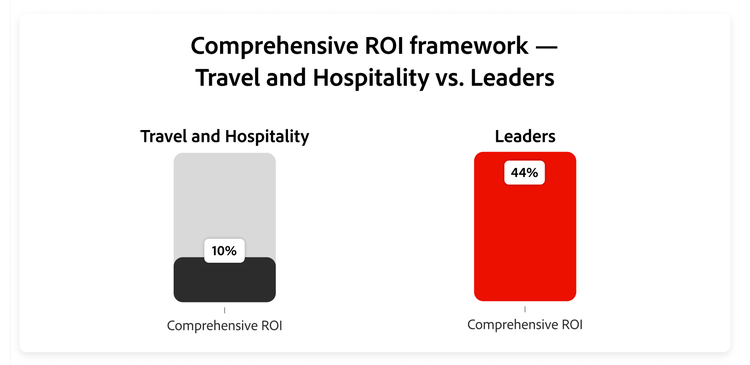
Marketing and customer experience leaders need evidence early enough to guide funding and expansion decisions. Leaders build measurement into the design of an AI use case rather than adding it after deployment. 44% of Leaders report a comprehensive return on investment framework, compared with 10% of travel and hospitality respondents.
Before launch, Leaders define the intended customer or commercial outcome and agree on how it will be assessed. Depending on the use case, possible measures may include engagement, direct-booking share, repeat-booking rate, loyalty activity, conversion, or operational efficiency. Marketing, loyalty, revenue, data, and technology partners align on the attribution approach and the evidence needed for review.
Timing matters when campaigns, offers, or customer experiences can change behavior. Once an initiative is in market, the original baseline may be difficult to reconstruct because seasonality, pricing, channel activity, and other factors also affect performance. Recording current performance before launch and assessing the same measures afterward provides a clearer basis for investment and expansion decisions.
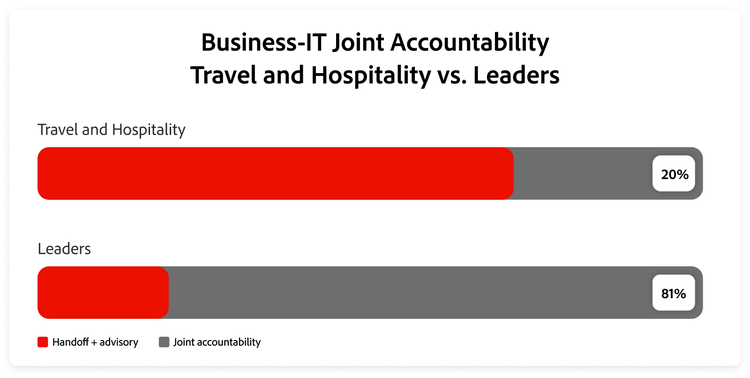
AI-supported marketing work can depend on customer data, booking and loyalty systems, measurement capabilities, and technology support. Sequential handoffs create friction whenever information, decisions, or approvals must move between teams. In siloed, transactional, or consultative relationships, technology may advise the business without sharing accountability for the outcome.
Across the 342 Leaders, collaborative and integrated relationships are more common. 81% of Leaders report collaborative or integrated relationships, compared with 20% of travel and hospitality respondents. Business and technology partners are involved when an initiative is defined, rather than after a request has been handed over. This allows objectives, data requirements, integration constraints, privacy considerations, and measurement plans to be aligned.
Shared accountability continues through delivery and evaluation. When marketing and technology leaders share the same customer or commercial objective, the brief, build decisions, and measurement can follow one agreed direction. Leaders establish this partnership through shared objectives and key results within existing reporting lines. Reorganization is not required, but both sides must remain accountable for the agreed outcome.
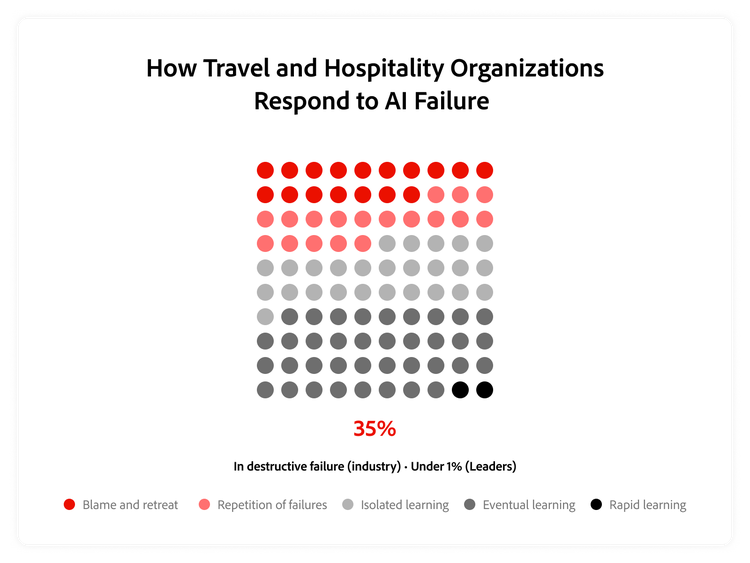
Travel and hospitality marketing often operates around seasonal booking periods, campaign calendars, and demand. When an audience model or personalized offer underperforms, teams may feel pressure to move ahead without fully examining the underlying cause. The next scheduled campaign proceeds while the assumptions underlying the result remain untested.
That response can affect other teams and future interactions. Marketing, loyalty, customer experience, technology, and operations teams may carry the same assumptions into subsequent work. An underperforming segmentation or personalization model contains information the organization can use. Without a shared learning process, the lesson may remain within one team, and another group may repeat the mistake.
A learning culture becomes visible in operating reviews. The named AI owner creates time for the team to examine what underperformed, why it happened, and what should change. Leaders reinforce the practice by discussing results without assigning blame and ensuring lessons are documented and shared. This turns underperformance into information that teams can apply when designing, evaluating, and governing future AI initiatives.
42% of Leaders identify empowering internal champions as their most effective culture action, ahead of executive sponsorship at 16% and formal training at 11%.
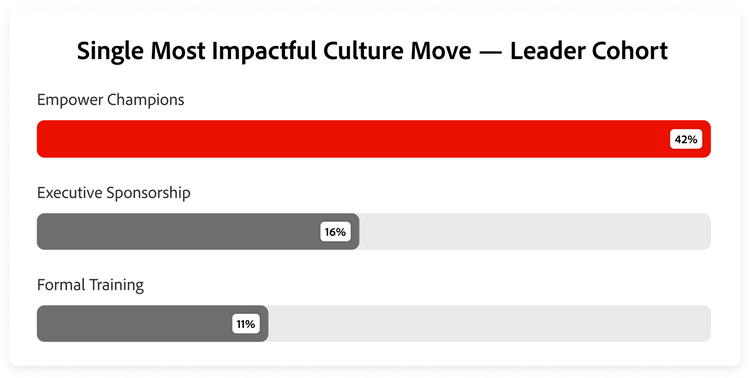
People may be willing to adopt AI when they see a colleague use it in familiar work. In travel and hospitality, that practitioner might apply audience insights to loyalty engagement, improve content production, or refine a journey. An example can make the value and limitations of the approach easier to understand.
Leaders identify practitioners with demonstrated results and give them recognition, budget, and permission to extend their approach to an adjacent team. Champions build influence by showing how a workflow performs in a context, not by promoting AI in the abstract. Documenting the method and outcome helps others evaluate whether it can be adapted.
Empowerment does not mean allowing practices to spread without oversight. Champions need access to data, technology, customer experience, privacy, security, and governance partners. A center of excellence can provide reusable evaluation methods, guidance, and controls, while practitioners adapt the workflow within their functions. This combination can extend proven practices without turning the central team into an approval bottleneck.
These actions translate the Leader behaviors into practical steps for travel and hospitality executives. They strengthen marketing, customer experience, data, technology, and operational capabilities rather than requiring reorganization.
CONCLUSION
AI is changing how travelers discover, evaluate, and engage with brands. Capturing that opportunity takes more than access to models or isolated deployments. It requires connected customer data, coordinated content and experiences, clear governance, and an operating model that gives teams the confidence to act.
The research points to where that work should begin. Among active travel and hospitality respondents, 59% are at the piloting or deploying stage. Yet only 16% report that their organization has a formal AI owner, 10% report comprehensive AI measurement, and 80% report siloed, transactional, or consultative relationships between business and information technology teams. Together, these findings describe the Frozen Middle: meaningful AI activity without the structures needed for repeatable deployment.
The global cross-industry Leader cohort provides a benchmark for more mature execution. Leaders are 5.7 times more likely to report a formal AI owner with defined authority. Comprehensive measurement and Collaborative or Integrated business and technology relationships are also more common among Leaders. They are more likely to establish accountability early, learn from underperformance, and support experienced practitioners in extending proven approaches.
These changes do not necessarily require a major reorganization. Executives can start with one marketing or customer experience initiative and build the right conditions around it. Assign an accountable owner, define the customer and commercial outcomes before launch, involve data and technology partners when the brief is created, and establish how results and lessons will be assessed. This creates a practical path from individual AI activity to coordinated execution and measurable value.
Adobe empowers organizations to create impactful digital experiences. Our portfolio of customer-experience products and services helps businesses put every interaction in context, understand what each customer needs right now, and design and deliver digital experiences that build loyalty and drive growth. Visit adobe.com to know more.
Incisiv is an industry insights and strategy firm combining close to a decade of industry trend data with primary research, messaging architecture, and content development to help enterprises navigate transformation, evaluate solutions, and unlock growth. Visit incisiv.com to know more.
© 2026 Adobe and Incisiv. All rights reserved.