Upskill and find inspiration in 200+ sessions. Join us online or in Miami. November 10-12.
Upskill and find inspiration in 200+ sessions. Join us online or in Miami. November 10-12.


Brand Intelligence is built on a structured brand ontology that goes beyond static guidelines. It learns from your design systems, approved assets, briefs, and from the signals most systems never capture, including reviewer decisions, annotations, and feedback accumulated over time. The result is a system that understands your brand the way your most experienced teams do, and applies that knowledge automatically across creative, marketing, and brand compliance at any scale.

Validate content against more than documented guidelines. Brand Intelligence learns from every approval, rejection, and annotation your teams make in practice, turning that collective judgment into a structured, continuously updated record of your brand standards that every team and tool can act on consistently.
Translate a campaign brief into production-ready assets without the inefficiencies of multiple handoffs, tools, and review cycles. Brand Intelligence provides deep brand knowledge to interpret briefs, select the right creative elements, and instruct to assemble final assets at scale, across whichever surface your team works in.


Gain insights into how your target personas think and react at every stage of creative development, from early concepts to finished assets.

“This partnership with Adobe allows us to embed brand intelligence into every step of our marketing workflows so our teams can spend less time managing work and more time crafting the standout storytelling that defines the Xfinity brand.”
Jon Gieselman, Chief Growth Officer
Connectivity & Platforms
Unlike generic generative AI that is highly reliant on prompt expertise to create usable assets, and often drifts off-brand due to lack of brand context, Adobe Brand Intelligence builds a deep, nuanced understanding of your brand when validating and assembling new content It encodes your brand voice, visual identity, compliance rules, and audience insights into a persistent knowledge layer that can be invoked across apps. Key differences:
Adobe Brand Intelligence addresses common enterprise challenges such as inconsistent brand execution, slow content production, and risk of off-brand or non-compliant assets. By acting as a centralized brand intelligence system, Brand Intelligence helps global teams produce on-brand content at scale, maintain brand consistency across channels, and automate brand validation across a fragmented content supply chain.
Common enterprise problems solved by Adobe Brand Intelligence:
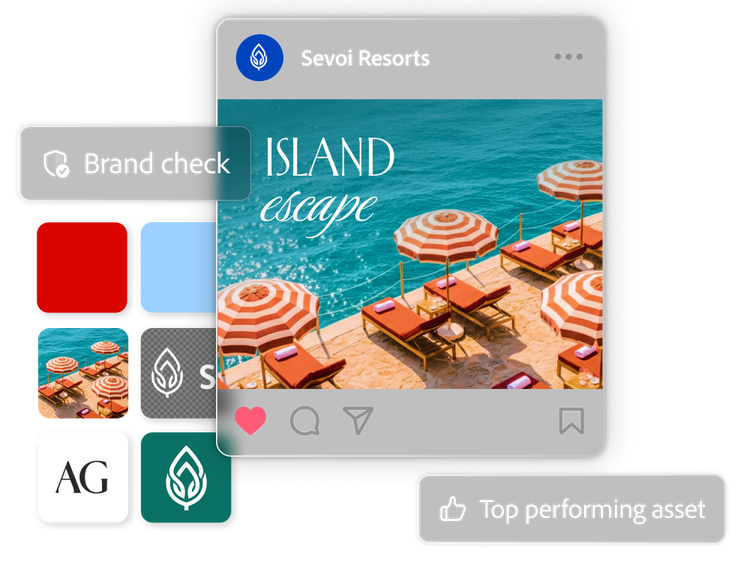
Adobe Brand Intelligence keeps generative AI on-brand and compliant by using your unique brand ontology, guidelines, and compliance rules as guardrails for every creative action. Leveraging the Validate skill, Brand Intelligence checks assets against your brand governance and brand compliance standards before they are published or distributed.
Brand Intelligence can:
This gives decision makers confidence that brand-safe generative AI is applied consistently across teams, agencies, and channels.
Adobe Brand Intelligence uses both explicit and implicit first-party brand data: brand books, design systems, messaging documents, past campaigns, and approved content libraries. It organizes this information into a brand knowledge graph and brand ontology, making it accessible to AI agents.
Typical data sources include:
Deployment timelines for Adobe Brand Intelligence depend on the complexity of your brand portfolio, data sources, and integrations. Adobe will work with your organization to test a pilot and scale from there. The key requirement is access to your brand assets, guidelines, and systems of record so that the brand intelligence layer can be properly configured.
General steps to activate Brand Intelligence include:
This process typically involves marketing leadership, brand governance, creative operations, and IT for integrations and security approvals.
A brand ontology is a structured, machine-readable representation of a brand’s identity, standards, and relationships. It can capture visual identity, voice and tone, messaging, audience and channel context, design systems, approved assets, and compliance requirements.
Unlike a static brand-guidelines document, an ontology is designed to be used across content workflows and updated as the brand evolves. Adobe Brand Intelligence builds this ontology from explicit sources—such as brand guidelines, design systems, campaign briefs, and approved assets—and implicit signals, including, reviews, approvals, and human feedback.
It translates this knowledge into signals that AI-powered workflows can use to evaluate and assemble content consistently across channels.
Decision traces are the review signals created as people evaluate and refine content, including comments, edits, redlines, approvals, and rejections. They capture how brand standards are applied in real situations—not just how they are documented. Decision traces are the mechanism to actually capture institutional knowledge often trapped in the minds of a few experts, and the way to understand what final decisions were made in oftentimes ambiguous contexts.
Adobe Brand Intelligence uses these signals alongside guidelines and approved assets to enrich its brand ontology and improve the consistency of validation and assembly workflows.
An Xfinity campaign using Adobe Brand Intelligence assembled 500 personalized display and email variants in minutes, compared with one week in the existing process. The variants were tailored by tier, audience, and market and validated against Xfinity’s brand, all in one workflow.
This example illustrates how Adobe Brand Intelligence can help enterprise teams increase creative scale, accelerate production, and build brand validation into the workflow.
Agentic marketing is an approach in which AI agents autonomously execute multi-step marketing work—such as interpreting briefs, assembling content, validating brand compliance, and preparing outputs—while people set goals, provide context, review results, and handle exceptions.
At enterprise scale, these agents need reliable, current brand knowledge. Adobe Brand Intelligence provides that knowledge layer by structuring brand guidelines, approved assets, and human review signals into a brand ontology that Agents can use across campaigns, channels, and markets.
The result is a way to scale content operations while keeping human teams in control of brand and business decisions.
Adobe Brand Intelligence is best suited for large, multi-brand or multi-market enterprises that need to manage brand governance and on-brand content at scale. Brand Intelligence is especially valuable if your organization navigates many agencies and teams, complex compliance requirements, and a high volume of content that must stay on-brand across channels.
Brand Intelligence is a fit if:
To get started, fill out the form to be contacted by the Adobe account team. Adobe will help define priority use cases and design an implementation plan that connects Brand Intelligence to your content supply chain and marketing tech stack.