Increase ROI
Understand what visual elements drive action and use that data to inform content strategy.





Content Analytics empowers organizations to uncover insights faster, reduce analyst workloads, and lessen reliance on specialist data teams, all while delivering meaningful reporting to leaders, marketers, and creators to drive smarter, quicker decisions. By surfacing performance trends, audience behaviors, and ROI impact, it enables more effective content strategies, optimization, segmentation, and personalization at scale. Read on to explore the major use cases for Content Analytics for analysts.
As demand for personalized content continues to surge, marketing analysts are struggling to measure what’s working and why. The challenge is clear: Content analysis remains fragmented across teams, with disconnected reporting leading to delayed, incomplete, and inconsistent insights. Manual tagging and reporting prove time-consuming and costly, and create bottlenecks. And without clear insight into which assets resonate, teams are left guessing how to improve experiences and drive stronger business outcomes.
Adobe Content Analytics changes that.
Built for analysts, powered by AI, and integrated across your content supply chain, Adobe Content Analytics helps analysts move from fragmented measurement to end-to-end insights. With a centralized view of asset performance and customer engagement across all owned channels, you can now provide real-time answers to questions marketers, content teams, and business leaders care most about: What’s working? What’s not? And how can we streamline content creation to cut costs and increase impact?
Adobe Content Analytics is a unified analytics application that unlocks a new layer of content intelligence. With automated tagging, AI-powered insights, and intuitive dashboards, analysts can:
By eliminating time-consuming workflows, delivering enriched content data, and providing a single source of truth, Content Analytics helps analysts find insights faster — and deliver valuable insights to marketers and creatives across their organization — driving stronger content strategy, optimization, and personalization.
Use case 1
Most marketing teams lack visibility into how their digital assets are influencing how a customer moves through their journey. Without data on which assets convert and why, there are too many variables on a webpage or in an ad to accurately base decisions or prove ROI.
Understand what visual elements drive action and use that data to inform content strategy.

Eliminate manual work and speed up reporting with AI-generated tags.

Tie creative performance to conversions, revenue, and business impact.
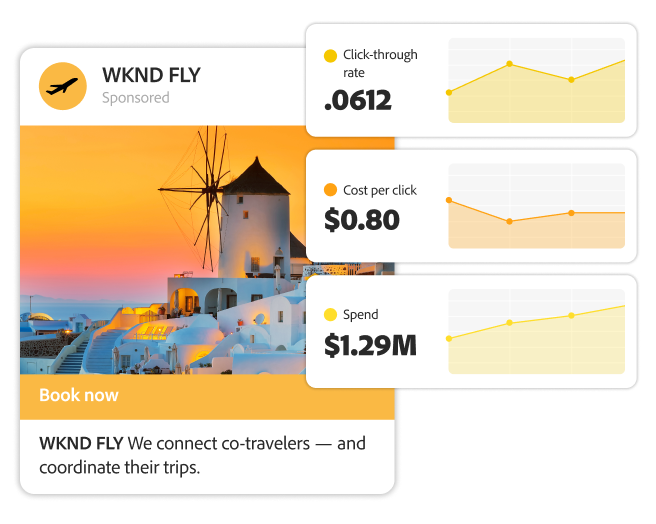
A travel company uses Content Analytics to understand impressions on their offer promotions — running on their home and destination pages — and how they ultimately impact click-through rates for booking. With an insight into which specific keywords and images perform better, they can maximize their content for conversion and prove ROI.
Use case 2
Personalization efforts can be slow and lack relevancy due to disconnected data, resource-heavy workflows, and blind spots around what content resonates with different segments.

AI services automatically process and categorize assets across large datasets.

Focus production efforts on high-performing assets and retire underperformers.

Centralized dashboards empower content creators, marketers, and executives to align on strategy.
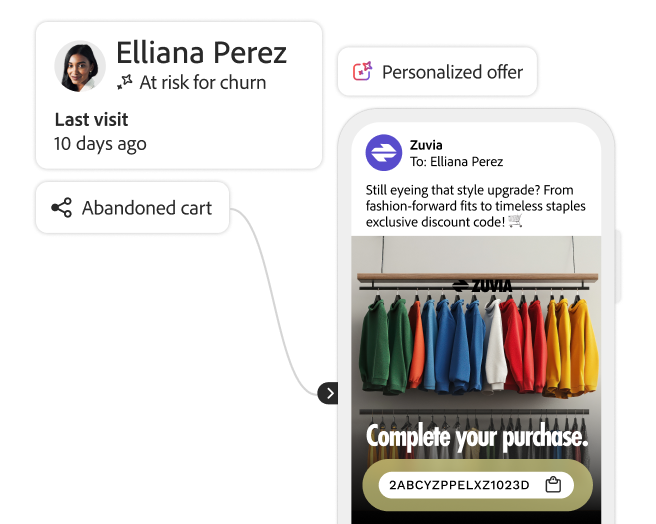
A retail website with extensive fashion photography uses Content Analytics to measure what content has been seen and how it impacts purchase decisions. It correlates specific product images as well as image attributes, like clothing color, to different conversion metrics including ‘add to cart’ and order value.
Analysts play a crucial role in connecting content strategy to business performance. With Adobe Content Analytics, they finally have the tools to do it — without the manual lift.
It’s time to leave fragmented measurement behind and elevate your content strategy with real intelligence — not assumptions.