Connie Sprinkle
Senior Vice President
Head of Marketing Risk and Operations
City National Bank


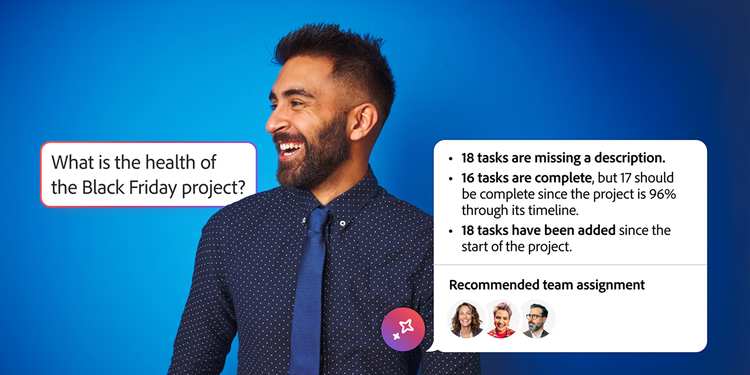
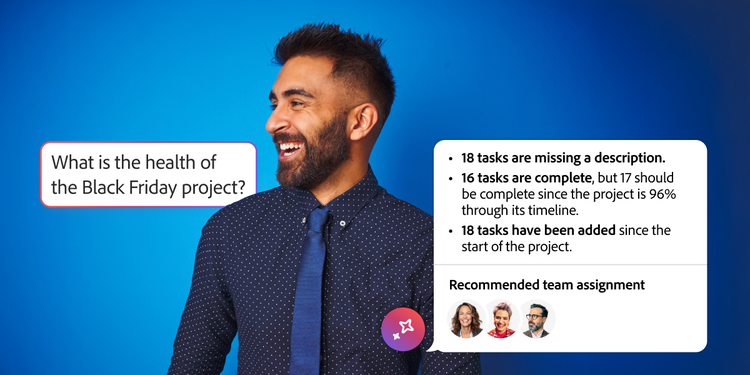
In today's complex business landscape, how you work is as important as what you produce. Yet many organizations are held back by disconnected workflows, redundant processes, and a lack of visibility.
This guide provides insights and practical strategies from leaders at City National Bank, Coca-Cola, Marriott, and Adobe to connect strategy with execution, improve collaboration, automate manual processes, and empower your teams to deliver better, faster, and more accurate results.
Today’s organizations are battling a growing challenge: work chaos. Disconnected systems, manual processes, and siloed visibility slow teams down, create unnecessary risk, and make it harder to deliver results. As complexity grows, companies need more than project management — they need a connected work management system that streamlines the entire system of work, from ideation through planning, production, and distribution.
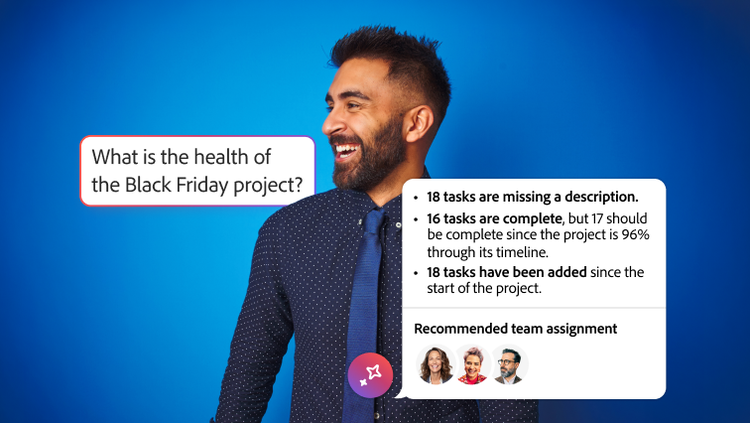
Now with a whole new era of automation and AI, the right systems can help teams view, manage, and automate end-to-end workflows — freeing them to focus on high-value, strategic work.
To put this into perspective, we heard from six work management professionals to learn more about their strategies:
Connie Sprinkle
Senior Vice President
Head of Marketing Risk and Operations
City National Bank

Jennifer Jeffrey
Resource Manager
Coca-Cola

Katie Calver
Integrated Strategy and Activation Lead
Marriott

Frank Biggerstaff
Marketing Operations and Workfront COE Lead
Marriott

Richard Whitehead
Director of Product Marketing, Workfront
Adobe

Etienne Bosch
Product Manager, GenStudio
Adobe
While project management is typically limited to one project or campaign, work management is about organizing and strategizing work across multiple teams and departments at every level in an organization. The work people do and the way they get it done are just as critical as the products or services their company provides.
When organizations focus on work management, they gain a clearer, connected view of how work happens across the business. Without a connected system, most teams juggle disconnected tools and manual workflows. This slows them down, creates blind spots, and leads to duplicated effort and wasted time. Effective work management addresses these challenges by providing:
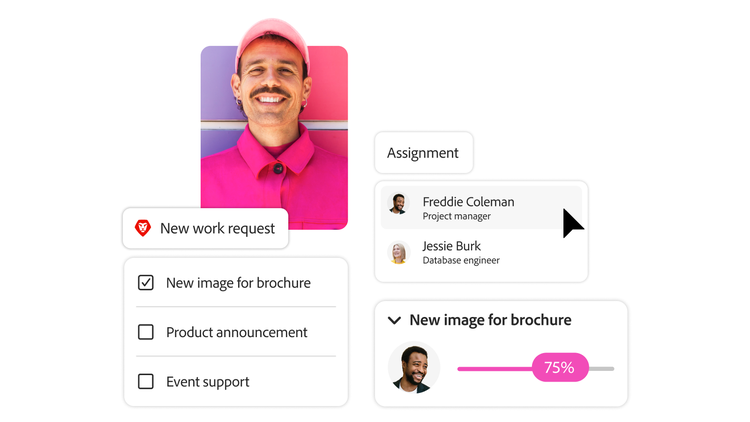
This can help them prioritize the most important work, track progress, and create reports. By connecting the dots between strategy and outcomes, and getting rid of redundancies and wasted time, companies can achieve their desired results faster.
Take it from Connie Sprinkle, SVP, head of marketing risk and operations at City National Bank. “We needed to report on and track what we were working on, and at that time we couldn't do that,” says Sprinkle. “We needed to prioritize our work, and we couldn’t do that. We needed to be efficient about how we got work out the door, and we needed to be strategic and make sure we were covering risk. If you don’t have the system that you need in place, you’re really adding to your risk. You’re slowing down how you get the work out the door. And you can’t answer your executives’ important questions, which is not a fun place to be in.”
Katie Calver, integrated strategy and activation lead at Marriott, had a similar experience. “If you're like us, getting something into the market can be unnecessarily hard. We have too many manual steps, too many documents, too many handoffs, which introduce friction, risk for error, and, ultimately, a lot of extended timelines. To accelerate our speed to market, we needed to address those activities and make significant changes.”

“Why is it critical to streamline your workflows? To create a stronger connection between your strategy, plans, and execution. To leverage that centralized data to resource, execute, and report on work.”
Richard Whitehead
Director of Product Marketing, Workfront, Adobe
Work today looks very different from what it did even a few years ago, and AI is accelerating that transformation. According to McKinsey’s global survey The state of AI in 2025, redesigning workflows is a key success factor among organizations seeing significant value from AI — referred to as “AI high performers.” These high performers are nearly three times more likely than others to say they’ve fundamentally redesigned individual workflows — a shift that contributes considerably to business impact.
Research in Adobe’s The scale imperative guide also shows that AI transformation can yield up to 8.5x ROI over three years — with roughly 25% of that value driven by efficiency and productivity gains.
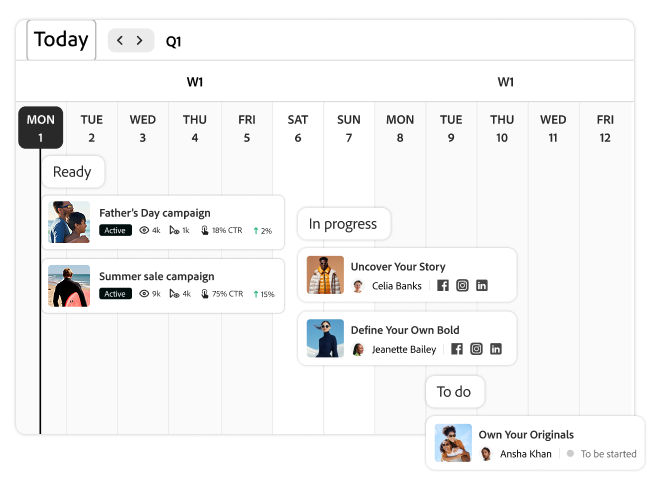
Adobe partnered with Accenture to understand the ROI of AI adoption for content production. Get a three-step framework to break through bottlenecks and achieve enterprise-scale production with AI in this guide.
AI-powered work management enables individuals to see what they’re responsible for and why it matters, while giving leaders real-time visibility into progress and performance. Emerging agentic AI technologies will take this further by intelligently anticipating needs and helping organizations adapt work dynamically.
Agentic AI is the next frontier. It augments teams by understanding goals and taking appropriate actions to progress work automatically — coordinating steps across tools and functions. This evolution is already underway, with Adobe leaders describing agentic AI as a fundamental change in every aspect of work — from the tools teams use to the way they work.
Etienne Bosch, product manager, GenStudio, at Adobe, says, “We see an evolution toward the agentic AI, moving beyond just traditional generative AI and into an agentic era where AI systems can understand actual human intent. It can understand your goals. It can take autonomous actions. Agentic AI isn't just about automation. It's about orchestrating these various processes and aligning them with your user-defined objectives.”
With more distributed teams across the globe, and an explosion of digital content demands, there is unprecedented pressure on systems and teams. The right work management tools and systems are a crucial component of keeping work connected, tracked, and collaborative — no matter where it’s happening. AI amplifies this opportunity. It helps organizations automate end-to-end workflows — from ideation and exploration to insights, production, and delivery — empowering teams to move faster and tie execution back to strategy. This allows companies to make better decisions from the beginning, avoid churn, and deliver great experiences to their customers.
Richard Whitehead captures the scale of the challenge. “We see that the content landscape is in extreme crisis. You might start with 8 assets, then you have 15 channels, and you want to grow that to other languages. Those languages then need to be distributed into a lot of different variations… and very quickly, we're up to thousands of assets that we have to produce.” He adds, “This isn't slowing down. By 2026, each enterprise is expected to have 155 exabytes of content.”
This content crisis makes traditional, manual approaches unsustainable — while centralized, collaborative environments become imperative. By automating end-to-end workflows, AI eliminates hours of manual work and enables teams to tie execution back to strategy.
And whether you’re reporting up the executive chain or out to external partners, without effective work management you are less likely to be able to share clear insights.
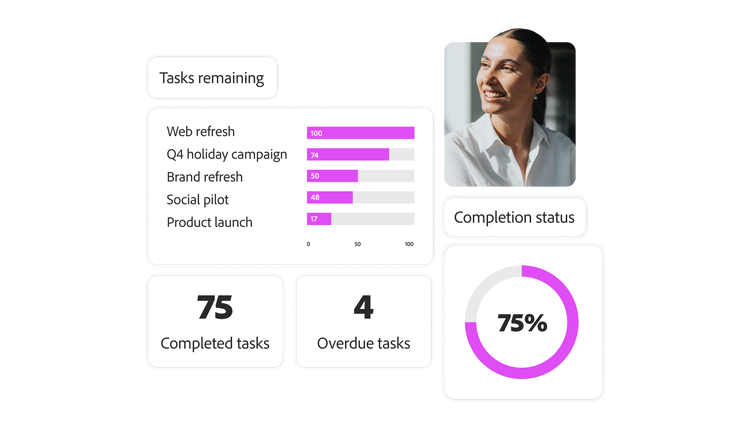
An exponentially increasing need for personalized experiences has made many projects and workflows staggeringly complex. Work management helps organizations keep everything organized. It also streamlines complex processes, allowing teams to work quickly and effectively. With technologies that then integrate work into an organization’s core systems, work is pushed where it needs to go at every step.
“There’s also an increasing need for an ability to quickly pivot, quickly change,” says Whitehead. “We’re in a moment-based world now. You have to be able to react in the moment, and you can’t do that effectively through email and spreadsheets and sneakernet. You need a good work management system.”
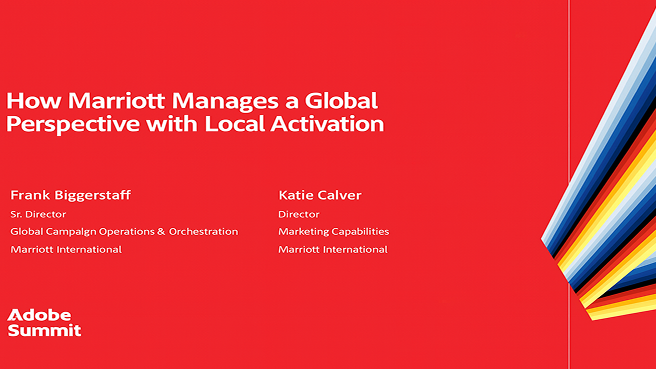
Marriott, for instance, supports more than 3000 stakeholders — from their properties to their HQ teams — to develop and deliver over 350 campaigns annually. This showcases their ability to scale marketing operations globally while maintaining personalization and efficiency.
“We settled on three areas that emphasized foundational improvements — the standardization of our campaign details, automation of manual process via a workflow management solution, and centralization of campaign information — ensuring our teams have what they need to start their work,” recalls Calver.
Jennifer Jeffrey, resource manager at Coca-Cola, had a similar experience. “More than 5,000 people — between our agencies and our partners — bring projects to life across the organizations, not only marketing. We've got our technical people that we need to communicate with to deliver on these projects. Becoming a network to deliver our top priorities requires us to work together, collaborating and co-creating our projects. And we had to have visibility into who were working on what projects,” says Jeffrey.
“We needed a transformative solution that brought standardization, raised visibility, and automated our processes. We needed to make sure that there is a single source of truth.” With this, Coca-Cola was able to manage all their projects and resources across regions from a common platform.
Work management isn’t just about efficiency — it’s also about the people who do the work. When employees understand how their day-to-day work connects to strategic goals, they’re more engaged and motivated. By reducing repetitive manual tasks and providing real-time visibility into progress, the right systems help employees focus on the work that matters the most.
“People do their best work when they know their role, when they know their work matters, and they can be proud of it,” says Whitehead. “And you can't do that unless you have something to help manage the work.”
And while the right tools are key, work management fortifies strategy, processes, and alignment across the organization.
Sprinkle agrees, “In terms of capacity planning, we actually implemented a quarterly planning process where we’re two quarters ahead on all the work that we’re going to do. And it was a huge change management effort — not just within our own organization — because all our lines of business had to get on board with this. And that was very transformative for us. We plan up to 80%–90% capacity in that quarterly planning. And then we have a weekly forum for unexpected things that come in. We live in the real world, so if people have new things that come up, they can present those and then we can look at what we already have planned and make decisions. Having a whole system and process around how we do that has completely transformed the way that we plan and prioritize our work.”
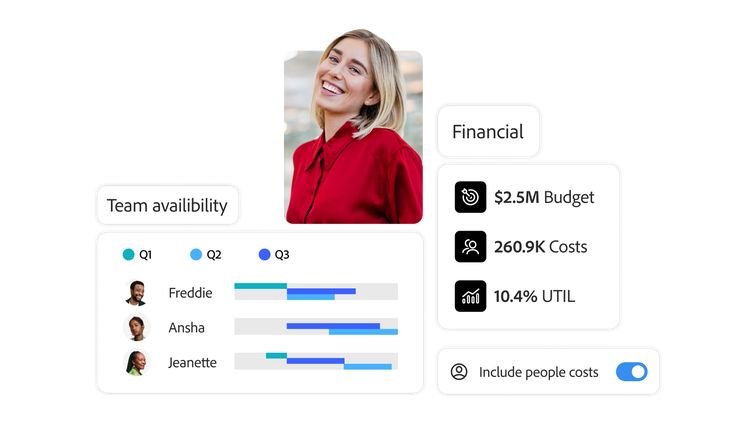
Building on that thought, Jeffrey highlights how a connected work management system enhances both visibility and engagement. “The main value of this process is giving people time back to allocate that to valuable projects. So, having one unique source of truth where all projects are — no matter where you are working, no matter what operating unit you are — if you are launching a project that might need resources from different geographies, you can do it through the same tool. And the people will be immediately connected by being notified in real time. So really, time saving and visibility were the powers of the tool, but also scalability. That’s the power of a work management tool — helping teams raise engagement and motivation as they lead the projects.”
“Tereza is handling 120 marketers throughout Europe for more than 200 programs,” Jeffrey explains, using the example of one of her team leads. “She can quickly see which projects have been allocated…and how to work toward it. She can also look at specific roles available to take up any tasks…easily assign, filter out all the projects where resourcing is required. The tool is not eliminating those conversations…but it's helping us visualize all this in real time, in the same database.”
Crafting an effective work management strategy and choosing the right technology can seem like a daunting task. But the experts we’ve talked to have found it to be more than worth the effort. Sprinkle’s advice for companies getting started on their work management journey is to make sure that there is consensus — and that you’ve done your homework.
“You have to have buy-in,” she says. “Your executives need to be all in. Everybody needs to agree that this is the way it’s going to work. And you have to do your homework before you do anything with the tool. We did almost an entire year of re-engineering our process — or rather, taking our 20 processes and reengineering them down to one.”
Calver says, “Change management is critical. That is one of the biggest lessons I learned, and it should be at the forefront of everything you do. It should be the first thing you talk about. If you lead with vulnerability and empathy with your teams, and you guide them through the pit of change despair — as we call it in some of our meetings — and you help them see what they'll have on the other side, you'd be surprised at who becomes your biggest adopter and advocate in the organization.”
Jeffrey says, “Starting with a small team helps to run it faster; it's easier. The second one is about flexibility. Everything we design is to make it easier for the user, for the leader, for the organization to have a clear visibility, but also be able to adjust as needed.”
Whitehead adds, “There's definitely a curve, and in the case of work management, you start out almost euphorically creative — and then you start doing it, and you go through this period of disillusionment. It can get difficult. But you have to stick with it in order to get those outcomes that you’re looking for. It’s a process in and of itself, and it requires everyone to get behind it and say, ‘We're going to get through it. And then we're going to be in a better place.’”
Adobe’s Top 10 Generative AI Capabilities to Accelerate Your Content Supply Chain, Adobe Summit 2025 session.
The Future of Adobe Workfront, Adobe Summit 2025 session.
How Marriott Manages a Global Perspective with Local Activations, Adobe Summit 2025 session.
Optimizing Resource Management with Workfront: A Coca-Cola Case Study, Adobe Summit 2025 session.
The Scale Imperative, Adobe for Business guide.
The State of AI in 2025, McKinsey & Company, November 5, 2025.
Unlock Your Creative Team’s Capacity with the Right Work Management System, Adobe for Business Blog, October 14, 2025.
Workflow and Planning, Adobe for Business Solutions page.