Centralize all work in one place.



Learn how Adobe Workfront empowers teams to eliminate pain points to efficiently collaborate, communicate, find resources, track progress, create workspaces, and reduce turnaround times for content delivery.
Read more to find solutions for work challenges.
Regardless of the industry, team, or role, work is at the core of what keeps enterprises moving. This means it’s imperative not only to ensure work gets done, but also that the people doing it find the experience meaningful and fulfilling.
One crucial way to achieve this is by eliminating the pain points that create challenges for modern workstreams. Enterprises often overcomplicate processes due to lack of visibility into work, results not tied to strategy, disconnected systems, and siloed collaboration.
Collaborative work management is the solution for these issues.
The demand for content is rising, but workflow inefficiency is a critical blocker. 58% of marketers report that nearly half of their time is spent managing reviews and approvals — not creating content. Teams are dealing with persistent challenges that slow down delivery and collaboration, including:
In this guide, we’ll cover four main steps to help your teams work more effectively, not harder.
Centralize all work in one place.

Plan and track work.

Enhance cross-functional collaboration.

Intelligently automate workflows.
With so much work being done across your enterprise, it’s not always easy to get a clear view of completed tasks and pending activities. Bringing all work into a central hub establishes a single source of truth — the operational system of record (OSR) — for everything your employees focus on.
Centralizing work helps eliminate duplicate efforts and provides all stakeholders with visibility into enterprise activities. This approach makes it easier to align work with strategy, ensuring everyone is focused on the most important projects or initiatives.
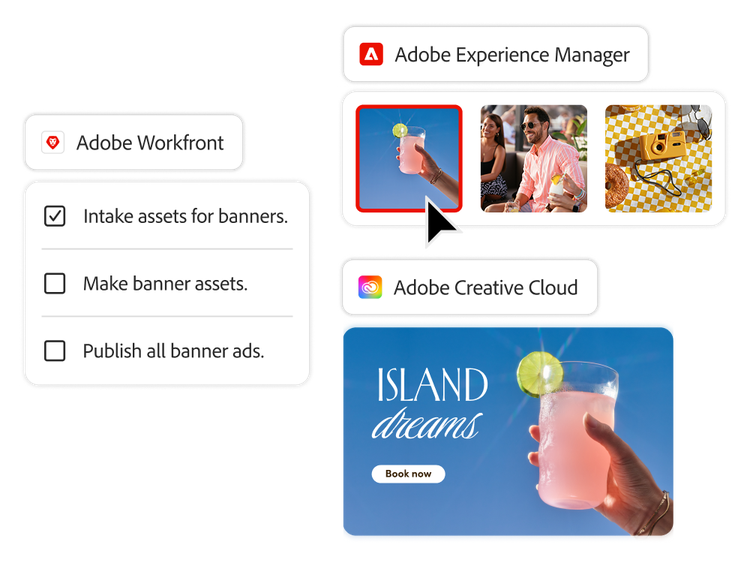
Xfinity Creative, an in-house agency, needed to scale content production across an entirely remote workforce while eliminating administrative work that kept them from creating. By implementing Adobe Workfront as a single source of truth, they built a robust toolkit that integrated their content lifecycle management. A seamless integration with Adobe Creative Cloud for Business and Adobe Experience Manager Assets was crucial in automating repetitive tasks and alleviating administrative burdens from the creative team. Within the first year, this transformation boosted project delivery velocity by 700% and reduced employee onboarding time by over 50%.
To learn more about Xfinity Creative’s journey and how they built a high-powered toolkit, read the full story.
Once work has been centralized, you’re ready to start looking to the future.
With all projects and initiatives in one place, you can easily define goals and map incoming project requests against them. Plus, project managers have visibility into team capacity, can identify available resources, and plan resources needed. Above all, your teams will have high visibility into their work, which means they’ll be able to track it all from start to finish and understand key details, such as who has contributed, upcoming resource needs, and estimated timelines for completion.
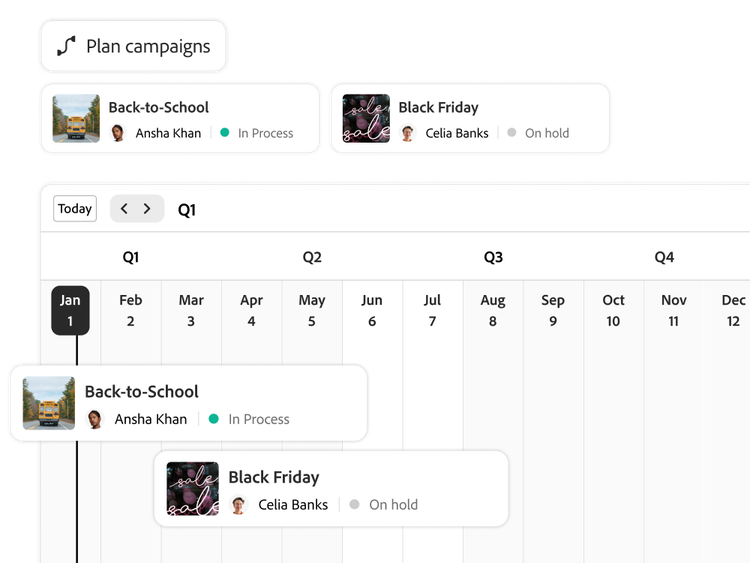
Adobe’s internal team needed a central hub to plan and execute critical digital promotions, such as Black Friday and Back-to-School — requiring strict alignment across multiple global regions. By using Workfront, the team eliminated unwieldy spreadsheets and established a standard, pre-configured project plan for all promos. This centralization of planning reduced service-level agreements (SLAs) for promotions from 10 weeks to 6 weeks — leading to a 40% acceleration in time-to-market. Additionally, the team achieved 97% faster promo plan development by leveraging campaign management templates.
To get more details about how Adobe accelerates digital promotions, read the full story.
Once work is centralized, and planning and tracking are in place, ensure employees collaborate across teams and departments to break down silos.
Unifying work in a centralized workspace helps teams collaborate seamlessly. This naturally eliminates common silos that slow down and complicate work, like searching for the correct versions to review or assets for content creation. Version control for reviews is handled within Workfront, while asset management is supported through integration with your digital asset management (DAM) system. To maximize these benefits, ensure that your teams are adequately onboarded and understand what this centralized space can do for them.
Once your teams understand the benefits of a centralized workspace, you can streamline how they review and approve projects. Teams can easily collaborate on all aspects of work, including status updates, feedback, project changes, decisions, and everything in between. What’s more, as you integrate your work management solution with other core applications — like delivery and analytics solutions — teams get to stay in their preferred tools while collaborating in a single space.
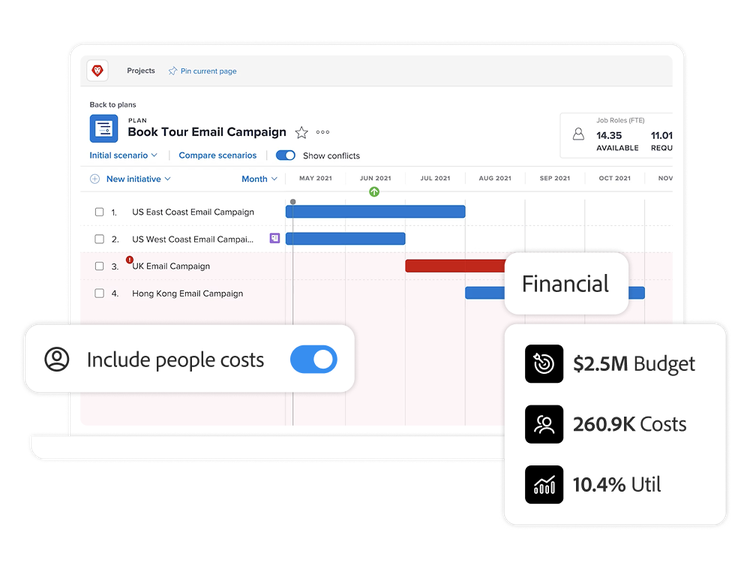
BNY Mellon Investment Management operates in a highly regulated financial environment. They faced challenges with slow, manual email creation and compliance reviews — often taking up to 16 hours per email. By integrating Workfront with their marketing automation platform, the demand operations team created automated, compliant workflows. This digital environment provided a clear audit trail for strict regulations and supported a unified process across marketing and compliance teams. The efficiency gained allowed BNY Mellon to bring more email creation in-house, saving 6 hours per email and thousands of hours annually.
To learn more about BNY Mellon’s boosted engagement and efficiency, read the full story.
Once you’ve established ways to centralize the work, plan and track projects, and encourage team collaboration — it’s crucial to focus on automation. This systematic approach will keep all projects on track and ensure the work flows smoothly.
Using established processes, you can start automating and connecting workflows between people and systems, pushing every project through, and automating each step of the workflow. For example, prebuilt templates can save time when setting up projects. Once a request form is created and filled out, it immediately alerts your teams to a brand-new project. As each task within that project is completed, data automatically syncs between systems and platforms like Adobe Experience Platform (AEP). The team or individual in charge of the next task receives an automatic notification when it’s ready to proceed.
This kind of workflow allows everyone to know exactly where projects are, when they can expect to work on a task, and when that task is due. As all this data is shared across the enterprise and other integrated systems, team members are empowered to make informed, data-driven decisions.
Completing work efficiently is only half the battle. If that work isn't connected to your core enterprise objectives, you're just busy, not productive. A critical function of a true work management solution is to provide a single place to plan and track enterprise projects that align with your strategic goals.
This addresses the persistent challenge of results not being tied to strategy — providing leaders with real-time visibility to make data-driven decisions.
When work is centralized, you finally have a single source of truth. Instead of chasing status updates, leaders can view real-time data on project performance, resource capacity, and budget allocation.
Modern work management platforms offer user-friendly, visual tools, such as canvas dashboards and customizable widgets, that gather insights across all projects. Chief marketing officers can see high-level progress against enterprise goals, while managers can monitor team workloads, ensuring everyone is focused on the right priorities.
An effective work management system moves beyond simple task tracking to a single solution for connecting strategic plans to execution. You can model your entire marketing lifecycle, from ideation to delivery, and link every project back to the high-level enterprise objective it supports.
This provides a clear, auditable line of sight from a top-level goal, like "increase market share,” to the individual task. Leaders can then review plans holistically and ensure all work aligns with enterprise objectives.
With all your work data in one place, you can export it to a data lake and combine it with other enterprise data, such as sales, finance, or web analytics, in the business intelligence tools of your choice. This enables you to transition from merely tracking work to accurately measuring its actual impact on the enterprise.
Furthermore, the auditable review and approval cycle features not only reduce risk but also streamline audits. This helps to reduce time-to-market and provides you with measurable data on process efficiency.
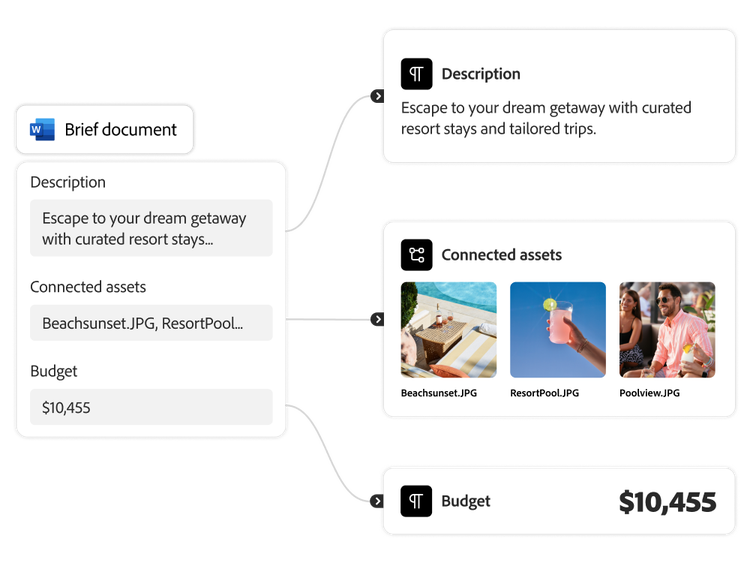
Lloyds Banking Group needed to replace a rigid, legacy workflow system to handle the increasing demand for marketing content while maintaining strict regulatory compliance. By implementing Workfront, the team was able to automate data entry and other repetitive tasks through 76 custom scenarios.
This strategic automation enabled the digital team to reduce its process steps by 50% and cut time to market for new campaigns in half. As a result, campaign managers, content creators, and compliance teams can now work together seamlessly in a flexible, audited environment.
“The solution enables the marketing team to maintain flexibility, supporting diverse content creation and review demands of campaign managers working with the enterprise’s brands, channels, and media.”
You can get more details around Lloyds Banking Group’s journey, and the benefits of automation, in the full story.
These four steps are the foundation for building a culture of collaborative work. At the core of each is the solution that makes it all possible.
Workfront is designed to drive cross-functional collaboration within enterprise-specific ecosystems. But more importantly, it’s designed for the people who make your brand what it is — and tailored to the way they work.
Because it can integrate with other essential applications, Workfront keeps all your teams within their preferred applications while they collaborate in real time, from anywhere. Above all, everybody’s day-to-day work is tied back to your core strategies. As you define goals and map projects to those goals, you can easily compare plans side-by-side. Then, tap into the power of real-time reporting to get the right insights for the right decisions.
“Adobe Workfront’s enterprise capabilities are among the strongest in the collaborative work management market.”
The Forrester Wave™: Collaborative Work Management Tools, Q2 2025
For the third consecutive year, Workfront is a Leader in collaborative work management — a position reinforced by its focus on strategic planning and enterprise delivery. The Forrester Wave™ report notes that Workfront best suits larger enterprises with cross-functional planning needs. It’s also ideal for those ready to upgrade to enterprise planning from initial marketing use cases. Adobe is also recognized as a "Customer Favorite" in this evaluation. We understand precisely what it takes to elevate work to the next level — and we’re here to help.
Learn more about the features and benefits of Adobe Workfront and see for yourself why our application is the best in business.
2025 AI and Digital Trends Report, Adobe, 2025.
“Accelerating Content Time to Market”, Adobe customer story for Lloyds Banking Group, July 2023.
“Award-Winning Creativity from the Cloud”, Adobe customer story for Xfinity Creative, December 2022.
“BNY Mellon Investment Management Reaches More Clients with More Relevant Messages Using Marketo Engage and Workfront,” Adobe customer story for BNY Mellon, April 2023.
Growing Business with Faster Digital Promos, Adobe, 2025.
How Workfront Uses AI to Support Work Planning and Delivery for Enterprise, Forrester and Adobe, 2025.