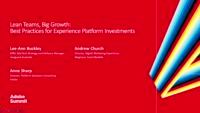
[Music] [Anne Sharp] Hello, everyone. Welcome to our session today, Lean Teams, Big Growth Best Practices for Your Experience Platform Investments. My name is Anne Sharp, and I'm a director of Solutions Consulting at Adobe. And today, I'm joined by Lee-Ann Buckley from Vanguard Australia and Andrew Church from Wegmans Food Markets to talk about a topic that clearly generates a lot of interest, and that is to answer the age-old question, what is the overlap between 401ks and produce? And my hope is that by the end of the session today, you'll come to learn that the answer is actually quite a lot. But before we do that, I want to start out talking about how this session came to be. So I sit within the technical presales organization here at Adobe. And we are the people who come to you with our custom demos all queued up, our presentation decks ready. Really excited to talk to you all about the value of Adobe Experience Platform. And one of the things that I love most about my job is the variety of questions that I get from folks like you. In one breath, I could be asked about how to summarize Experience Platform in 10 words or less. And then in the next breath, I'm being asked about message payloads in Adobe Journey Optimizer.
Now ignoring the fact that I actually enjoy being in this constant fight or flight mode, which is a tad concerning, I am constantly leaning on my product knowledge of Adobe Experience Platform to answer your questions and speak to the value of AEP and what it can do for your organizations.
But one thing I realized over the last couple of years is that the way people were asking questions when they evaluated new tech started to change. And while the questions themselves were still rooted in will this solution meet my need, they started to take on a bit of a different tone. Questions around real-time segmentation started to focus on reusability and scale. Calls for references started to focus on organizational models and measuring success. And instead of asking about setup time, people wanted to know about best practices for success before implementation had even begun. In other words, people were really excited and eager to learn about the enablers of success outside of the capability itself. And the more we got these questions in the field, the more we realized we needed a forum like this to share our insights and recommendations, making sure that those are rooted in real life client examples.
And that's what we'll be focusing on today, answering the questions, what do lean teams lean on? Best practices to maximize your experience platform investment. And to do that, we'll hear from two individuals that are very familiar driving digital transformation within their organizations. We'll ask them how they did it using Adobe solutions and their investment in AEP. And we'll end by giving you tangible takeaways to apply within your teams to deliver meaningful results and impact. So with that, I'd like to hand it off to Lee-Ann Buckley, Martech's strategy and delivery manager at Vanguard Australia. She'll be introducing herself, her company, her team, and some of the initiatives they're launching with their hyper personalization program. Lee-Ann. [Lee-Ann Buckley] Thanks, Anne.
It's my time to go. Hi, everyone. So I'm Lee-Ann Buckley, and I lead the marketing technology function at Vanguard in Australia.
My career has been centered around bridging the gap between marketing, technology, and data, and driving-- Sorry. And my role as I used to lead the digital marketing function was to transition into IT, to build the engineering team, to bring a business lens to the engineering outcome, and we've been successful at implementing an integrated marketing stack leveraging Adobe solutions. And I'm really excited to be here, my first Summit on stage, but being my first Summit. I had to share some key learnings and best practices that we've learned along the way and potentially help you with your solutions. At Vanguard, in Australia and globally, we focus on delivering innovative investment solutions to our customers to help them grow their wealth and navigate the evolving markets. So whether that's through an ETF, a managed fund, or a listed stock or share, our mission remained the same. It's to take a stand for all investors to give them the best chance for success, to treat them fairly, and give them the best chance of investment success. And it was about two years ago, in Australia, we launched a brand new business line to this, so superannuation or what you would like to call a 401k product. And so our Vanguard Australia journey has been one of a rapid transformation.
We were originally a B2B focused business, and we made this decision to a strategic shift to redefine how we allow our retail customers to access our products. And it's a funny story, but just about four years ago, as an investor in Australia from a retail perspective, you had to send us a fax to instruct us to do your investment. I don't even know the last time I saw a fax machine in a store, so you were really dedicated to want to invest in Vanguard.
And so that's why our investments in a modern marketing infrastructure was so critical. We needed to deliver this digital access to our customers, and we needed to be in a channel that they were engaging in. We needed to give them relevant content that could help them along their journeys. And so, yeah, our investment in Adobe products has really helped us along that journey.
And when you think about digital transformation, it is really easy to get caught up in the technology. Believe me, I'm in IT.
But at the core, it's really about enabling people and empowering your teams to work smarter, not harder, and just ensuring that we can get the most relevant content in the most timely fashion and personalized experiences to our customers. And our vision was really ambitious. Deliver real-time content to every customer in every channel they engage in. Go forth and conquer. It was, like, yeah, so simple.
And at the time, our data was completely fragmented and siloed. Our campaigns were extremely resource intensive and personalization was impossible at scale. With just two engineers in our team, we knew that we needed some product expertise and a partner to help bridge the knowledge gap and enable this implementation for us more effectively.
And our challenges, as you're all here today facing, they weren't uncommon or may still not be uncommon. Campaign execution being really siloed, everything being done manually for us, we had our teams creating manual lists and having to automatically try and upload them into an email platform only to send a single sent email. And this required extensive deduplication and cleansing. So again, just really multiple teams doing countless preparations to send this single-touch campaign. So we had limited reusability and just no scale. So our approach was really stagnant. There was no way that we could think about optimizing or even personalizing at scale just because of these manual processes. So we knew that to move to this hyper-personalized goal, we would need a fundamental shift. And for us, it was the Adobe Customer Data Platform.
[Andrew Church] Thanks, Lee-Ann. And I have to say it's been really fun getting to know you through this process and sort of swapping war stories, and my kids were super excited to hear that I was giving a presentation with Louie's mom.
So excited. I have to finish the bubble. I'm from South Africa, so you have to come back and tell them. I won't tell them.
Hi, everyone. I'm Andrew Church. I oversee the MarTech team and function within Wegmans. Unlike Lee-Ann, I actually sit within our marketing organization, and I'll talk a little bit about how we got to that point in our journey.
Quick show of hands, anyone been into Wegmans in one of our stores? Oh, great. Wow. Quite a few of you. Awesome.
Many of you may not know that we are family owned and operated, and we've been in business over 100 years. We started as a just a fresh produce cart in Rochester, New York.
And since then, we've grown to over 100 stores across 9 states with over 50,000 employees. And our mission has always been to help our customers live healthier, better lives through exceptional food. And we believe that the way that we can do that is through getting to know our customers almost as friends. And for the majority of that history, we've been doing that with these really personal interactions in our stores at the cheese counter, at the sushi counter.
But we knew as digital would continue to evolve, we needed to evolve with it. We just weren't exactly sure how. So we started with just simple tools that would carry through that mission and help our customers.
Really starting with the debut of our first mobile app in 2010.
And it was really just about helping customers build a more effective shopping list to plan their trip in our stores.
But then immediately after that, we were like, "Well, how do we talk to them in the app? How do we deliver a personalized message in the app?" So we started looking to best-in-class partners, and then really started the conversation with Adobe, which led to this point in 2016 where we said to Adobe, okay, we feel like we need to catch up here, so what we'd like to do is implement all the tools you have all at once.
The sales team was ecstatic, and they said, "We can absolutely help you with that." The professional services team, on the other hand, looked at us and said, "Are you guys crazy?" We said, "Yeah, a little bit, but can we do it in six months?" So we got through the implementation, and we thought, oh, okay, how hard could-- We launched a website on AEM. We implemented on-site content optimization with Target, implemented Adobe Analytics, Data Workbench, Adobe Campaign, everything you could ask for all at once. And what we didn't realize at the time was the practicality of actually doing that work, and I think Anne referenced this, just like the organizational readiness of that. We had one power user in the organization, sat with an IT.
We just weren't ready. So, unfortunately, it kind of became this internal dialog around the Ferrari that's sitting in the garage that we haven't been able to take out for laps. My gosh. Yeah. That's so similar at Vanguard.
So we can be looking out on the track here. Apparently, the Ferrari was a common metaphor.
And that was kind of the way we operated. We were sending a weekly email newsletter, publishing content on the site, but none of it was all super personalized. And we were measuring a little bit, but none of it was tying back to our sales, which at the time were still mostly happening in store. Fast forward to 2020, and that was really the pivotal moment for our journey when it came to ecommerce. Thankfully, we had been investing in launching our own ecommerce platform on our own website. So we launched that in January of 2020, and then we all know what happened in March. So we were there to catch it.
What also came out of that was the analysis about the omnichannel customer and what the impact to the Wegmans business was.
We didn't have a CDP yet, so the analysis took about six months. But when the numbers came back and we saw that customers that are engaging with our app and also shopping in store actually shop, on average, one more trip a year with us, which is actually a pretty big impact.
And as a result, we sort of leapt from that and started to rethink how we were approaching getting the value out of the Adobe tools, how we were investing in tech as a whole. I'm excited to share that next month we'll actually be launching a newly reenvisioned digital store platform for us that's all about being extensible and open so that we can kind of help our customers transact on any surface that makes sense to them, and a lot of it powered by the Adobe platform. So quick stats on where we've landed to date. So last year, we took over 12 million orders strictly ecommerce. A million customers are building shopping lists in our app as they plan their trips with us.
And about 30% of our overall business can be attributed to digital activity at this point, which is pretty big shift for us, after 100-year lifespan.
Some of the key challenges, again, this hopefully is not new to all of you, but these are some of the challenges that we faced.
The first one being just unifying the measurement and being just that 30% number that I threw out there. Without the Adobe platform and before we implemented that, we couldn't even tell that story. So it was really hard to connect the investment we were making in our app and our site and our experience to how's it actually impact an in-store sale in a grocery store.
The second was perfection over progress. A lot of you have been in our stores. We are incredibly meticulous about the design, the merchandising, the floor plans, every aspect, every detail. So the idea of an A/B test where either option A or option B is going to fail, it was a little bit hard to have a conversation about internally until we just had to get through it and kind of show people how that worked.
And lastly, it was something, if I'm being honest, we still are working through as an organization, and that's being product-centric versus customer-centric. And the idea that, at any given season, we typically will have a handful of new items or new programs that we're really, really excited, we want to make sure everybody knows about. Well, that's a little bit intention with one to one communication and the right message for the right customer at the right time.
So we're starting to make the shift to thinking more about the customer and their journey and putting the right things in front of them.
But it's been a journey, and we're still on it.
As I'm sure a lot of you are as well. So first off, thank you for sharing your struggles. It's not easy sitting up here and talking so candidly about some of the challenges you face within your organizations. If you want to go to the next slide, Andrew, so this next section, I'm calling ask me anything. And you can think about this as a Fireside chat. As you can see, our plush chairs equal Fireside chat, really meets presentation mode. So what I'm going to do is I'm going to ask Andrew or Lee-Ann a follow-up question based on what we just heard, and they're going to answer using a slide or two to talk about how they use Adobe solutions to overcome a lot of those challenges. The goal with this, and even as we were talking about designing this session, is to bring candor back. Like, speak truthfully, speak honestly about some of the challenges, and hopefully helps you all and the audience understand and see and recognize the value that AEP and the investments can provide to you. So, Andrew, my first question is for you. You mentioned challenges unifying measurement of digital at Wegmans. Can you walk me through how Adobe solutions helped you align on a common definition of success and how that alignment drove ongoing prioritization and investment in digital? So if our goal was to help customers live healthier, better lives, we have always believed we would need a best-in-class digital experience as that evolved.
And that really became crystal clear after our push into ecommerce when we have some stores where more than half of the sales are coming from a purely ecommerce customer, meaning they're not setting foot in our stores ever. So we really have to deliver on the magic from the stores and bring it to life digitally. The challenge is really starting with measurement. We had separate teams doing separate measurement. We had a customer analytics team over here that is pulling insights from our loyalty program. Our online account database was over here tied to the website. We didn't have a common identity framework.
Logistically, it was a huge lift to even try to measure the impact on digital, let alone iterate on the metrics with our leadership and report on it on a regular cadence.
So as we started talking about that, started talking about that challenge with Adobe, it was really our implementation of the CDP, which started for us internally and the way we kind of sold it was it's going to help us know our customers better, but we really used it to lean into, first and foremost, what's the real data here? What's the impact on all this activity on our business? So we came up with this notion of digital sales, and that's what we call it internally. And that turned into a metric that we poured on every week, and it's a combination of the sales that are attributed to people using our app and then following up in store, as well as our ecommerce orders. And it really helped our leadership team understand the true impact of our digital investments and help them feel comfortable that we are making progress. Yeah, I think a lot of the meetings that I've had at Summit, especially yesterday and the day before, there have been questions around how do I sell the value internally or how do I sell the notion of an investment and the value that it will provide internally? It sounds like measurement was your anchor in a lot of that. Yeah. Measurement was huge. I think also, if I'm being candid, translating the value prop from Adobe language into internal Wegmans' language. Because our leadership team, they're not marketing practitioners. They understand the concepts, but putting it in Wegmans terms and then plug Alex, our account manager, he would always be texting me like, "Okay, what's next? What are the meetings? Can I help with the presentation?" And I'm like, "No. Just give me a month. I'll come back. I promise. I just need to translate this." For sure. For sure. Yeah. I think, in even in talking about that, it provides a lot of value and context for the folks in the audience to be able to say I can relate to that. That's a good piece of advice to bring back to my businesses and teams. - Awesome. - Awesome. So transitioning to Lee-Ann, if we want to go to that. Perfect. You mentioned difficulties maintaining standardization when launching hyper personalization and really how that impacted speed to market. So my question for you is twofold. The first is, how would you say Adobe solutions have helped you to drive automation and scale? And the second is more following this theme, of the announcements that you've heard here at Summit, especially around AI, which of those are you most looking forward to applying within your teams? Yeah. Sure.
I guess our goal for us was really to drive automation to scale and to get those efficiencies. Those manual processes were-- Yeah. They were really holding us down. And that strategic shift. So moving away from this one time list into this one-time use campaign to really dynamic multi-use audiences so that we could power our personalized engagement across multiple channels, and to allow our teams to be able to move smarter and faster. So for us, the CDP, and I know this term has been said multiple times across the couple of days, but it was a game changer. Like, there was no other option, like that's the word for it.
These challenges and I guess we're all facing the same things. It's just that lack of audience centralization and just being able to having to create these lists every time. It's not, it's not conducive and it just slows the teams down. And, Andrew, you mentioned, 50% of your customers, they don't come into your store, right? They just purchase online. At Vanguard, we don't have a physical store, so there is no way you can come to-- Your interaction is with us online through a digital channel of some sort. So it's really critical for us to show up in that moment and to be able to provide you relevant contextual information that is part of your journey, and it will help you with your next best action in that critical moment.
And so for us, the Customer Data Platform and the audience portal really helped solve for that. So solving for that unification of a customer profile, really creating that 360 degree view, that utopia, it did it. We can have our customers-- It can include their transactional history, the products that they potentially purchased, or their online behavior where they've been on our sites, and it was all centralized in this central location, not on some analyst's machine that we needed to magically get to a marketing system.
So it automated our segmentation, and it freed up our marketers and analysts so they could do the strategy. They didn't need to do this manual creation of lists. We could just define the rules and our customers would move through their segments based on their engagement with us. And that's really important, so that's how you show up with the relevant content for that customer and help them along their journey.
And it's removed our campaign silos, so we can activate multiple audiences. We can reuse our audiences across multiple touchpoints.
And to plug one of my colleagues here who reminds us constantly of her favorite F word, which is our fiduciary responsibility.
Being a financial institution, we have really high compliance and regulatory, and especially in Australia with our superannuation product, the 401k alike, there are really strict regulations around that.
And so the Adobe solution has allowed us to be able to label our data, to permission our data. So we have confidence that our marketing teams have the right access to the right pieces of data, and they can activate it safely so that we know that we're using the right data.
And this has been really extremely impactful not just for our marketing and insights teams but for our business. Like, as you can see from the stats, we've increased our speed to market. So things that would take us months for a single campaign can now take us a day, maybe even hours. It's a click of a button, and it's out the door.
And our campaign reusability has increased.
And instead of starting from scratch every time, we can now reuse, we can refine, and we can optimize our audiences and our content.
So about three years ago was our first automation of an email. So it was our most well regarded email, a weekly newsletter to our entire customer database in Australia. And just the automation of that one email saved one of our crew members 25 hours a month. So you can imagine every Monday coming to work thinking, "I've got to get that email,” as I told. Like, that just doesn't generate innovation or a drive for somebody to do more.
And since then, we've scaled our emails 65% in volume, not with increasing. We've had 0% increase in resource, so this is a testament to the automations and the integrations that we've set up to be able to get to our mark to our customers. And it sounds like centralization is core to that, not only of audiences but being able to scale those audiences as a result. We see customers all the time creating what we call seed audiences and then continuing to build on those seed audiences with different attributes or different elements of the profile for further personalization. And even talking to you both before this, it sounds like both of you have been able to do that. Yeah. Yeah. Absolutely. - Yeah, we call them base audiences. - Yeah. So, yeah, we've been able to create these base audiences that are reusable. So, again, our teams don't have to sit and create that every time. Right. You're just really defining your goal for the campaign and measurement as well. I don't know it was something you were talking about, but introducing something where we can actually measure a campaign effectiveness and not take six months post that single-sent campaign to understand our click through rates and grade. But what did it mean for our bottom line in that funnel? And I'll talk about our superannuation product for us. We launched superannuation to our Australian market two, three years ago, so superannuation and pension. And we were really challenged to use our marketing technology stack. How could we look at our existing customers who had investment products with us, and how could we target them? So this enabled us to do things as simple as we just want to create the segment, and we want to send them content about this new product. We can tell you've never searched anything about superannuation. You never expressed any interest in learning more. So we're coming in cold, and we can send you something completely different to the customers who had expressed that interest. Or perhaps you'd engaged in content on our side. You'd searched for something that was retirement related, we could go to you with this information and try and help you, nudge you to become a member because biased, but it is the best product in Australia.
And so it's, yeah. We we're through this process. We were able to provide 185% uplift, to the campaign conversion of this. And one, to be able to measure it is amazing, but two, to be able to see the impact of marketing for these campaigns is incredibly impactful for us. Exactly. As Andrew was mentioning before. Yeah, I was going to say we had a couple similar examples. I mean, one, our big focus on digital engagement that started with how can we properly welcome customers who create a membership with us, a Shoppers Club membership, and make sure that they have a hyper-focused onboarding, understand the benefits of that.
And we use the Adobe tools to isolate them for the first few weeks of the membership, and they're only getting really, really focused benefit communication. And through doing it, we were able to see that those customers that started after we implemented the welcome journey, they were much more likely to reengage digitally after that.
If we kept them focused and then layered in the other marketing later, and it's all automated. I feel like a lot of the conversation that I have are around, like you said before, getting to the right channel with the right person, right time, right, right, right, and starting small. And just with that initial, okay, I want to target somebody who isn't made a one-time purchase and putting them into a segment of the goal being second-time purchasers, even just starting with that, starting very small with that binary value can even create a lot of value. Yeah, we've started to call them micro moments internally. And, like, one example, we've got a very, very small focused journey that looks at purchase behavior. And if you look like you are beginning to follow a gluten-free diet, for example, we've got a couple follow-up communications that just share, "Hey, here are the resources at Wegmans. There's the recipes. Here's some of our items." Not a huge extensive journey, but it's like we've tried to start attacking these little niches and just using automation to keep scaling it. That's great. Yeah. A click of a button, right? That's right.
We didn't talk about the last stat on here, which I think is great. It's 0% increase in resources as the audience likely has lean teams as you both do. Can you talk a little bit about that? Yeah. Exactly. I think for us, the core to this technology implementation was about creating that efficiency. We knew we couldn't scale by growing our teams, so how can we implement solutions that drive internal efficiencies but also have a customer impact, at the end of the day, the customers who we're trying to speak to. So, I'm incredibly proud of the fact that we've implemented what we have. We do have partners and we have got a great back by the global Vanguard US team, but we didn't need to scale. We just needed to stay focused. Yeah. That's great insight. Yeah. It was the same for us. I mean, we've got a pretty lean, mean team. Shout out to the team back at home. Four engineers are incredibly talented.
And we used to rely pretty heavily on Adobe professional services up until a couple of years ago when we really built out the team. And, again, to your point, kept it focused and small, and I've really been able to see some success. Also, having it housed within our marketing organization has helped the team stay really, really close to the needs of the marketing side of things in the business, which is really translated into not having to have such a huge team because they're so close and they know what the needs are. Or to constantly be needing to go back to IT and IT and marketing, that type. I'm sure everyone in the audience can really do that at some point in time, so that's great.
Lee-Ann, you spoke a little bit about measurement before. And, Andrew, as you were saying with the A/B test, so you spoke also earlier about overcoming the progress versus perfection mindset. I want to drill into that a little bit more. So since then, I'm curious how you and your teams have become more experimental in the way that you operate and how that's driven more focus around KPIs. Sure. So with most of our history being in brick and mortar as I've mentioned, we had a lot to learn about digital and how it was going to impact our business and how we could use it to communicate effectively with our customers. And while the initial notion of A/B testing was a little bit scary for some in the organization, the goal-- We came to the conclusion that to learn, really, we're going to have to test into this.
But as I mentioned, and we've talked a little bit about just activating a simple test audience before we introduced the platform was, like, okay. Customer analytics has to build a list for us and then ship the list file or email to somebody and then program it into the activation platform.
But once we implemented CDP and some of the tools in CJA, not only can we activate the audiences really quickly but then see the same audience in the dashboard and measure what the impact of the test was on them.
So it's been really, really helpful, to just effectively execute all of the tests that we're trying to do. For sure. For sure. And so that capability that you just talked about is something that came out, I believe, around two years ago, right? The ability to take an audience from CDP and be able to understand the impact of that audience across channels and measure that in CJA. And time is back to your first point around core metrics. I bet that fed a lot of the reports that you were bubbling up to leadership also. It did, I mean, the other piece too, we started playing around pretty early on with customer AI and using those scores to build out audiences rather than try to take the time to analyze purchase behavior and build an audience. Let's just see what the model can come up with, and we'll send to 10% of that AI generated audience and see what the impact is, right? And some of you may be picked up during the Keynote. We've actually seen some pretty good performance, especially when we do mobile campaigns, just using those propensity based audiences. And it's really, really simplified the execution work for the team. And a lot of that is out-of-the-box capabilities with customer AI to be able to predict propensity to convert, however you define conversion or propensity to churn, and that's actually how-- Oh, I was going to say, however, trying to explain that to leadership and traditional targeted marketing folks was pretty challenging. You're right. That's Adobe lingo. Well, thankfully, it was right around the time that ChatGPT and all of those tools started to come about, and everyone just trusted those. So we were reinvigorated the conversation. Just trust the model. And it's math, and it works. Yep. Makes sense. Great. So my next question is for both of you. So I'm sure a lot of the folks in the audience are very excited about the new announcements they've heard at Summit, especially around AI. So I want to get a little tactical for a second. So how would you go from I just learned about this new feature on main stage at Summit all the way through to implementing that feature within my businesses? What are some of the steps taken in between? Yeah, I guess I'll blend it into this around our approach, and I guess my advice would be embed a culture of learning and experimentation. In my team and at Vanguard, it's core to how we operate, but it's incredibly empowering for our teams, we talk about fail fast. Like, this is a real space to do that. We've got sandboxes. You've got environments where you can do this. You can practice and learn. So that would just be my core advice, and to start small. We at Vanguard Australia, we started with our CDP implementation.
I'd just come back from mat leave, and I remember reading through this brief that I'd received from our head of MarTech saying we're going to get this thing called a CDP, and I was reading the brief, and I was like, "Oh, my god. This is like gold. How do I get onto this?" And I was on those 2am calls new mom. I was like I got this. We can get this done, and I was jumping at the bits because I really knew what the impact would be, and they'd test it. Let's just get it in. And so we did that. We started with the CDP. We call it our heart, and we actually look at it. It's now called a butterfly because we've got this beautiful stream of sources going into this customer unification and multiple data destinations that it goes to. So we constantly refer to the heart and the butterfly within our team, and it was pretty successful. So for us, my guess, my advice and our use case was we thought, gosh, we're going to-- I'm going to lift our entire data lake, and we're going to plunk it in this customer data platform because that's what it's going to do, right? I'm going to get all of these 20 sources, and Bob's your uncle. We're going to be twin, we're going to go all destinations real time every channel.
Like, let's do this.
And we realized pretty quickly that wasn't going to work. And so again, we scaled it right back, and we chose one line of business of the three, and we took a subset of it, and we started with that. And our goal was also to look at introducing a brand-new channel. So for us, email was our main channel. So how could we look at introducing web personalization as an example? And that was really our use case. So we took one of our websites, public websites, and we took a homepage banner, and we did what we wanted to test. We wanted to test, could the CDP at its core, could it combine multiple sources into one location, could it dynamically create these segments based on signals or behaviors, and could it activate to another channel? That was the test case. And so from a capability perspective, it was successful. But if you look at a marketing metric, it was a failure. Yeah. We did not drive our ROI from that simple use case. You know, it got engagement, and that was really great. But for us, it really solidified the use cases of, hey, we didn't have to have all of those resources create that list. We can reuse this, and we can now do a channel in real time when a customer's coming to the site. So, again, just start really, really small. And it was this use case approach that we set as kind of like our-- We call it our blueprint. It's our blueprint use case approach to how we think about all of the next evolution.
And so for thinking of that superannuation use case, in January of this year, Vanguard Australia launched one of our biggest ever marketing campaigns. So do you not like money? It's brilliant. And for finance, it's really meant to cut through the industry of the noise that sits in finance. And for our business, it's incredible to see how that shift has moved from, hey, how do we think about creating these campaigns and multi segments? And that's become the norm and the culture. The shift now is how do we measure. So we are going to be spending money on advertising and reaching customers in all of these multiple channels. How do we measure which channel is most effective or driving the biggest engagement? And how can we optimize in the moment so that our customer-- We can build upon this campaign. And so our shift is now looking at things like Customer Journey Analytics and journey orchestration as that next evolution to really help these use cases along. And, again, starting really, really small. Yeah, and what I loved most about what you said there is, you're really using the CDP and the successes. I would say successes and learnings as fuel for exploring new ways of using that data and using those experiences for further use. Yeah. Absolutely. We started with just that one simple segment, but we now have all the lines of business, multiple data sources, and multiple, destinations, personalizations across our website, our mobile app, in our email, in our portals. It's incredible to see how far and what it's enabled for our teams, and teams actually get really excited about it. The innovation and experimentation comes by having the tech at your hands, and yes, so that would I guess be my advice.
You asked about the AI solutions and what we're most excited about. I think for me and hearing some of these announcements is agentic AI. And I'm actually really excited, and my team's going to kill me. I'm going to go back and be like imagine having this AI assistant in our AEP platform that it's not this human led interaction. It's actually AI assisted orchestration. It's telling you, hey, this is how you can do it, and it's automating it for us. Like, that's the power. So we can sit back and think about the strategy and the messages we want our customers to get. I'm glad you said that because it's augmenting. It's not replacing. It's augmenting. Yeah. Right. Exactly. Andrew, would you say, did you have any advice for those? Yeah. Absolutely. I think I would not only echo what you just described on starting small. I think we started with a similar use case. One banner led to our whole app homepage now is sometimes targeted.
I think it was probably I had heard the Ferrari metaphor one too many times, and I said we can target this stuff, so let me show you. Yeah. But the other piece that we've focused on fairly recently in our evolving relationship with Adobe is just, one, having consistent long-term ownership organizationally. And that's been me for the last really since 2016 in partnering with Adobe on our key initiatives and being willing to dedicate time within the team to lean in on the betas and the alphas that they approach you with. Whether that's going to turn into an ROI out of the gate or not, our team has found success with even the early versions of AI Assistant just in troubleshooting problems they're finding, and we're super excited for what's coming with the agents and the Copilot integration and all that. But it's also given us a direct line to many of the product teams, and we've seen feedback that we've shared turn into functionality sometimes within a few months. And then talk about engaging for the team. It's super exciting for them to say, hey, Adobe, we really would like it if this worked this way.
And all those conversations tend to happen during these alpha periods. So we've really leaned in on all of those activities. That's great to hear, right? I think that there's this assumption that, okay, I have to bring a big brand name to the table to influence product. And I think that there's a lot of power in that feedback. And like you said, it's energizing for the teams to see that being taken into account and really built in for the benefit of other customers also. The quote that you see on the slide there is actually one that I found a couple of weeks ago when going through previewing some of the announcements we would make at Summit around AI support assistant. And I asked Andrew, I said, "Is this a quote that we could use in the presentation?" Because I think it's great around how AI has helped in troubleshooting, and this is based on your team's participation in a lot of the alphas and betas with support AI. Yeah. I know they seem super excited. The same individual I asked them, what's some other feedback that you have that I can share with Adobe when there's someone that I got like a book of all of the different changes they would make to the AI. I was like, okay, maybe I'll summarize that. Have AI summarize that. - Yeah. Exactly. - Yeah. That's great. That's great.
Okay. Well, thank you for sharing that advice. I think that a lot of the folks in the audience really resonate, and some exciting avenues on the horizon for both of your organizations in adopting that. So before we start our Q&A, I do want to summarize what we talked about today that to drive outcomes and impact with a lean team, these are the things you should lean on. The first is core metrics. We heard from Andrew how Wegmans uses Customer Journey Analytics to unify measurement to align on a common definition of success and how that's really allowed them to improve the value of personalization internally. We heard from Lee-Ann talk about centralization strategies being the second one around her team using Experience platform and particularly an audience portal to increase audience reusability, drive consistency, and enable faster activation as a result. The third is constant testing and learning. When Andrew talked about overcoming the progress versus perfection mindset, the experimentation tools that Adobe offered really allowed for an easy delineation between what's working and what's not and quickly make changes as a result. And then the fourth is actually leaning on a core team. And this is where a lean team actually, it sounds, can be an advantage in streamlining not only collaboration and coordination with Adobe but also increased partnership as well.
So I do want to leave you all before we wrap with a fun little saying that Andrew-- And he told me about it a few weeks ago. And it's one that his team, his leadership actually uses internally to talk about digital transformation. And that is if you want to mow the lawn, you have to buy a lawnmower.
And I really like this quote because I feel like it brings back a level of simplicity to the conversation, especially when we're talking about embracing AI as an enabler of success in itself. AI really is the next frontier as we continue to hear here at Summit. And the sooner we can harness that power, the sooner we can deliver more value for our customers. Thank you.
[Music]