[Music] [Jeff Coyle] Welcome in, everyone.
I think we're ready to go. All right.
Thanks for being here today.
You have a choice.
You have a choice of what you bring home from Vegas with you.
You have a choice of what you bring to your teams from Adobe Summit. What do you bring home? You're seeing a lot of new technology. There's a lot of new vendors. There's a lot of old vendors with new stickers on them. A lot of things that you could bring back that would require you to be a change agent at work...
And make major disruptions to your organization. There's also going to be a lot of things that are pretty basic. You already had it in your Q1 review and it's going to be very validating to your teams.
Today, what we're going to be discussing with you is today's world, March 2025, the state of content.
The state of content is that of infinite content. Infinite mediocre content.
Right? So you can go home and you can be part of that. You can find vendors. You can find vendors at The Palazzo or the Mega Center or whatever they call it right now. You can find vendors who will help you get on a path to generating thousands of articles every month that we would all classify as mediocre.
Or you can take that tougher path. And that tougher path is saying, "I'm going to establish rubrics, I'm going to establish standards for quality, I'm going to make sure that every content item that I have on my site represents my business with expertise...
Exhibits the standards that I hold for my brand...
And gives us the right to win every time we hit Publish." That's the harder path, but guess what? It's not as hard as it was just a few years ago. There's paths to be thinking about every stage of that content lifecycle and how we can involve more teams, get more buy-in, get more budget, and get more accountability throughout our organization.
And when we do that, magic things happen.
And it's not just about assessing our content and giving diagnoses of those content items 'cause we can do that and that's required. That's the standard for us to understand, is our content accessible? Is it findable? Is our site crawlable? But we can also, with technology, understand where we have great coverage. Where do we have wonderful breadth of coverage, depth of coverage? New technology allows us to do on the fly journey mapping, understand our target markets better so we can say, "Yeah, we were a little bit top of the funnel heavy with the content we created on that." Maybe we need to be more comprehensive and go along the awareness consideration purchase, post-purchase, troubleshooting, customer content journey, or if you're in IBM care consider choose, or if you're in pharma, we're going all the way to adherence, right? We're going to make sure that we know what our journeys are before we ever start typing the first letter on a key that goes into our drafts.
That's what we're going to be talking about today. How do we use data to our advantage at every stage of that content lifecycle, so that we can make sure that everything we publish is successful? And I was talking to yesterday where when I got in, going to a head editor in chief and, she's been doing this for about 35 years.
Print magazines, all everything. And she was telling me, "I never thought in a million years that AI would be the thing that brought our teams together." She's like, "I know you've been saying this for a long time," but it did. It finally did. I had my executive leadership team come in and they wanted to contribute to our content plan because they knew they could do it with interviews, and we would translate those interviews and use that as data as part of our personalized content plans.
They invested more in their data studies because they knew it wasn't just going to be one PDF, one time with from one landing page, right? It was involved. The data was integrated. It was woven into the fabric of every article they wrote. And when more teams are getting those thumbprints on the various stages of the lifecycle, they feel more ownership, and the content on the site represents all of the teams, not just one of the teams.
Because artificial intelligence, as you've probably seen and as you've probably experienced, can give us a false sense of jumping the line.
And we don't want to jump the line of that AI and of that editor-in-chief's standards. They've been doing this in editorial for 100 plus years. These standards are required. These are good practices. If you're skipping the developmental edit and you're going from content to draft and then you're hoping that you're going to go into that draft and clean it up, and it's going to be good, that narrative's going to work, you're not involving any of your brand style, tone, and voice in that picture, you're not integrating any of your expertise in that process, well, first of all, you've alienated everybody on your team. Second of all, that's going to be a really, really hard edit process. And that's why they have developmental editing standards. That's why they have rubrics for qualifying content before it's written on most editorial teams. And now all of those steps, all of the steps from understanding whether your content is accessible, whether your content's findable, whether it's technically appropriate from an SEO perspective. Is it fast? Does it have intrusive ads on it? Is it awkward for a reader on a screen reader or any other device? Those are now equally similarly easy for you to get information about quality, comprehensiveness, expertise, and whether the content you're creating touches the right moments in that client journey or that patient journey or that student journey or whatever journey you're trying to approach.
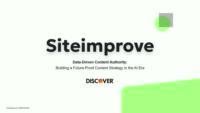
And so what we want to talk about today gets into the details of how we can influence the buyer journey, how we can influence and personalize the content that we create and use data all along the way. And I'm joined here by somebody who is amazing. He's somebody who is truly exhibits a team and structure of what it would mean to take a team, was in silos, and bring them together. Someone I admire in the SEO space, Stu Schisgall. - Thanks for joining us today. - [Stuart Schisgall] Thanks, Jeff. Hi, everyone. Stu Schisgall from Discover. So thanks to be up here with you, Jeff, and Siteimprove. Thanks. And I'm Jeff Coyle. I'm the Co-founder of MarketMuse. I'm also the SVP of Strategy for Siteimprove. MarketMuse is a content strategy platform. We were acquired by Siteimprove, last year in November, and we're now leading an integration effort to bring all of the things technical search, all of the things analytics, all of the things accessibility, along with content strategy for our customers. And Stu is one of them that really can look at the situation and say, "What was SEO before? What was content before? And what should it be?" And so how many people have ever heard of the concept of SEO content? How many people say that? Okay. That was just like an industry thing, 10 plus years ago, people made up to mean content that's not really that great, right? It was debasing of that. Well, the new trend, I'm sure you've all heard it is, "Hey, that's our AI content." Has anyone heard of that? Anyone using that? They're kind of bucketing those two things together to say that's not going to be good enough. But worse here, standing here, say, "Our AI content is not only...
Monumentally better than what we could have possibly built, but we're able to build it faster and we're able to do it in a way that breaks silos." That's the key. You want, when someone says, "Hey that's your AI content." You want to say, "Yes." And you should be very proud of it because it is actually exhibiting the signals of expertise that we want, and it's involving all of our teams, and it's garnering buy-in from everybody who we work with. Because, like I mentioned, we are in this new era. The new era of content has given us the signals and it's given us the path to start to skip steps. We don't want to do that. We want to make sure that we're setting up rubrics, we're setting up standards, we're setting up scores and metrics along the way, so that we know that we're crossing every T and dotting every I and the thing that we publish is going to have the impact that we needed to have.
Those traditional editorial workflows shouldn't be forgotten. Whether you're selling socks, whether you're selling shoes, whether you're selling $300,000 farm equipment, or you're in highly regulated industries like finance.
And when I'm talking about finance industry regulations, Stu, talk about the risks that you experienced walking in the door at Discover and how you've gone to where you are today. Sure. So I'm not the compliance or legal expert, so I'm going to try to avoid talking about specific risks so I don't get in trouble myself. But in terms of Discover itself, let me just start off. We don't create mediocre content. We're one of the few ones. Now we did for a while.
I've been at Discover for five years just in the credit card business, Discover's a large bank. We have different lines of business. But our other lines of business are following a similar pattern that credit cards is today. And when I joined, I was hired to be just an SEO lead. And it was really a shocking day two. I got there. They said, "Hi. Welcome to Discover. Here's your laptop." The second day, they said, "Hi. We're now taking the content team, and we're taking it away from SEO." And then I thought that was a precursor to me not having a job on day three because I don't know how to do SEO without having an effective content machine. So it was something that was unexpected. It was something that was a challenge for Discover, and it was something that was not unique to the credit card business. But historically, what was being done and for the few years where the two teams were separate, they were relying on these outdated strategies, keyword research in terms of that driving the content in terms of instead of what's the user journey? What are people looking for? How do we get them to move down the funnel? And a lot of the content that was being done, that was being created was actually only being done, I would say, Jeff, at a mediocre level because there were so many regulatory requirements that we had to work through. So that was part of the challenge coming to Discover and then working, moving forward. It was something that as we grew, we brought on Siteimprove or MarketMuse by Siteimprove. And that was something that was definitely helped the content quality increase, but also allowed us to help improve the entire content, the supply chain, which we'll go into in terms of how we were able to meet those requirements. So Discover, as a brand, wouldn't suffer in any way. Right. And so the differentiation was a key. I remember us speaking about that where how can we identify situations on topics that we want to own. And how can we use technology to say this is relevant to our journey. This is relevant to our customers. If you were an expert, you would know how to cover this topic, but no one in our competitive landscape was covering it. - That was a key for Discover, right? - Yeah. Yeah. Exactly. I think what we ultimately did when the blog came back was we just kept on answering every question under the sun based on these unbranded topics 'cause we already ranked number one for brands. So I think that ties to your point. Yeah. Absolutely. And so when we go through these processes now, we're able to bring in human-in-the-loop artificial intelligence, right? And you may have heard that said in a lot of different ways. What does it mean? How can we make sure that we use human-in-the-loop artificial intelligence at all stages of the content lifecycle? That's the real differentiator for teams. A lot of times what you're seeing people describe as human-in-the-loop AI is prompt engineering, right? But what it can be when you're using it as part of your research process is context to what you've already covered. So why forget? Why forget about all of the work that you've already done that's on your site when you start to do keyword research? That's what you're being coached to do. You just start, "Keyword research, okay, search volume, great." Well, shouldn't I be doing that keyword research in the context of my own existing site? Shouldn't I be doing that with my editorial team's goals and strategy in mind? Shouldn't I be able to understand where I have strengths and weaknesses so that I can make accurate level of effort estimates? Or even identify content that doesn't instill greatness. It doesn't match my brand, my style, my tone, and voice. We don't have brand consistency throughout this section of the site, but we do over here. Well, that's not how it works anymore. The search engines and humans have had to evolve to this situation, this unlimited supply of mediocre content. The infinite mediocrity, I've called it also, is we've had to say when we're reading content, "Is this actually trustworthy?" We say that more often naturally as humans. Well, the search engines have had to make those same choices. They're starting to evaluate our entire site more frequently to understand, is this a great site? Is this even topically appropriate for them to cover? And that's when you started to really do some damage with the human-in-the-loop AI implementation because you had the right to win already by having great technical SEO, by having great accessibility, but now you are able to make accurate level of effort estimations on whether you had a good chance to win. We're in Vegas, so we all want a really good chance to win. So how about being able to say, "I got to publish four articles and I got to update these 16, and that's going to give me my best chance to win on this unbranded topic." We're getting that prescriptive with Discover. And how did you do that and implement that at every stage of the process? Yeah. So I think our content process is...
Much more, cumbersome than I would ideally like because we got a lot of legal reviewers. And AI is something, just to be clear is Discover as a bank has been very conservative in terms of how we leverage AI. So AI in this context is not creating content. It's basically using a tool like Siteimprove to help us identify and save time in terms of doing that keyword research and putting together these content plans. If you have an SEO background, you probably realize and you're responsible for handing over a content outline to a teammate or a writer. You realize how much time that takes. And from an AI perspective, Siteimprove was able to save a lot, dozens of hours in terms of putting that research together. What's also been helpful in terms of the rest of the content supply chain, I would say, is we have to work with multiple people in this process, writers, designers, we've got our developers, and we've got our attorneys that need to review everything. What was really helpful in terms of allowing us to scale our content program while not losing any integrity was ensuring that we're meeting with each of these partners in each of these steps to basically coach them. This is what SEO is. This is why I want to write it this way. Our attorneys have one perspective. Our SEO team had a little bit of a different perspective. And it was finding that middle ground in terms of where were we able to get published without us putting our brand in any risk. So I think that that's something from a content supply chain, which was very helpful. Going in, giving clear evidence. And over the five years we've been doing this, now we're working at a pace which we never thought was possible. We used to publish maybe one or two articles a month. Now we publish five a day. So I think it's something that's really led to a huge result in terms of the work we're doing. Right. And I think that you said, so just this is couple a month to five a day. - Yeah. - Right? And they're all exhibiting the signals of expertise. We're winning more on unbrand. And we'll get more into it when you get in-- Yeah. I've asked Stu to give us a full case study of where he saw risks and rewards with this. The big thing for you was we had a situation where we knew where we had authority, right? But you were requiring your goals were not just rankings, right? - You were-- - Right. You had specific journeys that you had to map against, right? Exactly. Yeah. At Discover, I don't know, we don't our KPI is new business. Now we need revenue, right? So I could rank for a million new keywords, rank number one for everything, but at the end of the day, I'm evaluated on new business. So that is our key and really only KPI for SEO, which I think may be a little unique compared to my previous experiences in SEO. But what ended up happening with that goal was how do we create an experience, not just by creating content and high-quality content that ranked well, but how do we get people who are now using MarketMuse, which allowed us to create and we had the confidence on the SEO side to know that everything we published was going to rank really well really quickly. The next step was now we're getting all of these extra visits, right? We're seeing 30, 40% increases. It was from a much lower number to where we were getting over the five years to our site. How do we now move people down the funnel? And that was like that's been our main focus now, Jeff, because now we're not really worried about the content quality as much as how do we get people to see if they're preapproved or apply for a credit card. And I think that's what we're doing. Now we're thinking more and beyond ranking 'cause we already have that. And what's been nice about the content and the quality of the work that we're doing is that, if you're in the SEO space, you may have heard of backlinking or people reaching out, "Hey, I could sell you backlinks or something like that." We don't do anything like that at Discover. I've never thought that that's been an effective strategy. That is something that has been if you go to an SEO conference, you may meet a lot of these folks. But what's nice about working for a big brand is that people trust and believe in the authority of Discover, and they will naturally link back. What's nice now is that the quality of content we're ranking for, it's for these unbranded topics, and we're generating around 10,000 to 15,000 links a month just because we're putting content that ranks well and people trust. So it's been a really nice combination of knocking both the on page, the conversion component, and also the off page part of SEO, by just making sure our content met certain standards. And how have you gotten validation 'cause throughout organizations you're seeing when you put a brief out there? Yep. Are your writers able to use those brief effectively and give you the-- - Yep. - Confident drafts? And then how are you measuring that? Are you looking at heatmaps session? Yeah. Yeah. Of course. So originally, when we started using the tool, it was something where we didn't have the option to create the brief. So you put it into the tool and spit out something. And if it was garbage, then I have to go complain to market, decide and prove and say, "Please fix this." But it wasn't. It was always something that was good. But sometimes there was something that was had to be tweaked a little bit. But in terms of the, what is able to do, where we are in 2025 is that our content writers have the ability to modify these briefs and customize them for every topic they write, which is great. Because as the SEO strategist, I don't need to go and create this at every level. So this allows us to scale at a pace that we've never been able to. And it gives the independence to people across the entire supply chain. Our writers have the confidence to make sure that their outlines are doing what we need to do, and they're able to modify it in case anything's out of our brand style voice. So it's really been a empowering feeling across the entire supply chain at Discover. That's awesome. And I think that when you think about having the brief act as an artifact, it's something you can go back to and say, "Did the brief represent a narrative that was created with our brand in mind--" - Yeah. - Right? - Yeah. - It was this brief built. Did it tell us a narrative that would speak to our target audience, to the stages of the funnel that we're focused on and/or to the journey that we're focused on? And so always being able to go back and say, "How was this generated?" This did really, really well. What do we want to learn from? What do we want to do again in our future content strategy? Where can we see situations where we had a great breadth of coverage? We had a lot of pages. Well, maybe we didn't go deep enough. And now with our next content strategy, we want to make sure that we go deep. How do we build and optimize those journeys so that we can produce the actions that we want? And I think that that's where you start to win more consistently when you're building with an understanding of where you are today, where you want to be, and then how do you fill that gap. And that's where I think that your focus has been, right? - That's where we've been now. - They're going downhill. Yeah. Yeah. Yeah. We're definitely in a space now that because in each part of the supply chain in terms of writers to our developers, to the content, to the strategist team, each person in that supply chain has the ability and the authority to make those decisions on their own-- Right. And they don't necessarily have to wait on the SEO team to give that feedback. Right. And a lot of times, when we're getting into this types of motion, things have evolved, right? We've had search engines are changing dramatically. So they've had to adapt to a world of unlimited content too, right? So where they might have just been thinking about strings, now they have to think about things. Where they were just thinking about pages, they have to think about collections of pages and sites. So they're trying to think, "How do I do that more effectively?" What they're thinking through is ways of understanding, is this site worthy of ranking? Does it even deserve an invite to the party? And it's doing that, they're doing that with things like core web vitals, which are speed and various things about the way that the page performs. They're doing that with an understanding of accessibility and inclusivity on sites. This is giving you the right to be there, but the content is what's giving you the way to follow through and win. And this even applies to AI search, right? I'm sure you've heard the word AI search said about 80 times, so far this week at Adobe Summit. Well, there's two major types of AI search. We have one where it's a re-ranking and a distillation of the search results, right? So it is, you probably heard it as RAG, Retrieval-Augmented Generation. Google AI Overviews would be an example where you're seeing results on the page and it's re-ranking those and it's building somewhat of a book report with citations from the pages that it ranked or the sites that were ranked in that results. How do we make sure that we're equipped for that outcome? - Yeah. - Right? And that's what we've been focused on together at Discover. Yeah. Yeah. Exactly. Yeah. So I think, obviously, we're talking about content right now, but there's a lot more that goes into pages ranking than content. So which may be a little bit in terms of outside of the scope of this. But for the pages to rank, Discover has an approach where we think about technical SEO being at the top of the game, and we also ensure that content and the user experience. So those three areas are our main focuses at Discover. And what's been really wonderful about this expansion of content at a high-quality level is basically this. If we're able to publish 5 to 10 articles a day compared to 5 or 10 articles a year where we were 3 years ago, that is a huge impact in terms of we call it the snowball impact on this slide. But basically, other websites are able to say, "Hey, wait. Discover's publishing regularly. Let's take a look at these sites. Let's link back to these sites." They're linking back to our product pages. They're linking back to our articles. They're linking back to pages that historically never received any backlinks. So it's been really authoritative to see. From the beginning, it took a long time. I would say it took about three years, Jeff, from where we are at today. And the big difference is that...
We've created a system that now we're not just hoping that people link back, but we expect to almost get 10,000 to 15,000 links each month just by doing the work we do. Now it does help, like I said earlier, to have an authoritative brand. Discover is authoritative. But when you're able to combine a very good user experience with great content quality, is we've seen a tremendous growth in the past few years. Yeah. And that's really where we're seeing the most successes where there's complete team unity. They're getting more investment in content.
These processes are easy to understand. We're able to bring in the inputs from the writers and the editors throughout the process, but also maybe the product team, the customer success team. I mean, how frequently in your current workflows do the product team, the CX team, and executive leadership influence what you write very infrequently. But now bringing those people into your processes can be easy, and it can also, I mean, you were talking about, and you'll get into this later, about having being able to roll this out across product lines now too-- - Right. Right. - And across groups. And so by having a situation where the content you publish is acting as not only outreach in the form of driving links, but also internal outreach, breaking silos, and getting you to the point where it's saying, "Wow, if they can do it, we can do it." That's the type of thing that you can set your watch by. Yeah. And when we're looking at-- Oops. Hey. How are you? When we're looking at the evolution and content quality, we've talked about it a lot today.
But the key takeaway here is setting up your own standards. What is exceptional for my brand? How are we going to measure this throughout the process? And what is going to be good enough for us to publish? Setting that standard of excellence and expertise and say, "If we're going to cover this topic, we're not just doing it with one week landing page. We are not doing that anymore." Right? And why? It's because the entire site matters. I don't care if it's long pages, short pages, product pages, landing pages, your pages, my pages. I don't care what kind of pages it is. It matters. It influences how that site performs. I like to also think about it as a hot-air balloon. If you've got problematic content over there, maybe you've got a low-quality glossary or you've got a knowledge base that's under-optimized, it's dragging everything down. It's acting as a sandbag on that hot-air balloon. So but it's beyond just speed, its quality. You have what is referenced as topic authority or topicality. You have the right to correct, right to write about these things. You can write about this topic and win, but to write about this other topic, you've got to lay major foundational work. That type of information exists and you can use it with predictive AI right now. You can say, "I've got to write 20, 30 articles in order to own this space." And the winners throughout this process are the ones that are thinking about every stage in that lifecycle. From research, to planning and prioritization, to briefing, writing, editing, publishing, measuring, optimizing, and then going back to content and saying, "Hey, is this still aligned with my customers? Is this up-to-date?" I need to make sure that I have an update cycle, or over time, I'm going to struggle. And that's really been a big thing, breaking barriers at Discover as well. The things you want to be looking for. Do you have situations in your organization where maybe even teams own keywords and other teams aren't even allowed to write about them, right? How do we make sure that there is representation from every one of our teams, every one of our organizations in the content that we publish? So that they can go and say, "Wow, my thumbprint's on that." The expertise of my organization is involved with the content on our sites. We're transforming our company thought leaders into content creators even though they don't have to type, right? This is bringing sales leadership, this is bringing customer success leadership, and this can be done very, very easily with artificial intelligence if you bring it into the process. If you bring it into your briefing process, if you make sure that all of the data that you have is involved when you're building, when you're building that content. And by doing that, you're going to have a higher standard of quality, performance, and a lot less risk, involved in the process. And the king of risk and understanding it-- - Wow. - Is just-- So walk through how you got through this in more detail. - Yeah. - I know that. Yeah. True thing. And thanks, Jeff, for the intro there as well and being part of this conversation. So it's been an evolution. It's been slow. I wish I could tell you.
Here are three things specifically you could take back and change your SEO program if you work at a big bank, and then you'll see all of these great successes. It's been a real team effort.
But basically, I think that it does come down to three key things. One is ensuring that SEO and content at Discover, this was a big challenge and I alluded to it, is seen as one entity. If you separate the two, how is anything you write going to be seen by anybody at the end of the day? So that's one thing that I think from my experience and perhaps, it's also happening in other lines of business like Discover today in some capacity. But if you have those two teams separate, you're going to be limited at the end of the day. The second thing is from a content supply chain, I alluded to it. You have to do a lot of coaching. If you have an SEO background, if you're an SEO professional and you're going to talk to someone who has no SEO background, we have weekly meetings with each of these non-SEO teams just so they're never surprised. If we want to get articles published, we need to meet with them, tell them this is what's in the pipeline. This is what you're going to see. Before they actually review it, we do all of that hard work upfront so we know we're going to have about 95% approval rate. Historically, we were actually getting closer to 67, 70% approval rates, and then we'd have to wait two weeks to start it over. So what's really helped us accelerate is having intentional meetings with each person in this content framework. And then additionally, what was really helpful was ensuring that all of the content and I think this is where Siteimprove came in, was at a level that didn't really need much scrutiny from the rest of the SEO team, right? It really opened up myself and the rest of the team's opportunity to look for other technical issues, other SEO items that really have made a big impact on top of the content work. So what's been great is that content isn't no longer-- I wouldn't say content's no longer a concern in terms of quality. We have a process in place that's repeatable, that people understand, they expect what to get, and it's really made life a lot easier, Jeff.
So where we're going to, I would say, in terms of Discover right now is there's a lot of changes going on in terms of AI Overviews and these ChatGPTs and Perplexitys. I'm not sure what's going to be I don't personally use Google nearly as much as I had, but I'm not sure about yourselves. I don't know what's going to happen in terms of how this content's going to be scraped and people getting conversions. But what I have to say is a lot of the content that we are creating, and we have this system in place that allows us to publish high-quality content regularly. I feel like we've never had a big shift in terms of an algorithm update or even when some of these larger changes happen. We see a dip or maybe we see an increase, but I think we've got a program in place that allows us to publish confidently regardless of the situation. Yeah. And that's an awesome story. I think it's to speak to future-proofing. The future of getting AI search integrated into your strategy now is thinking about it a little bit differently than just citations. You're going to start to see tools roll out to just show you whether your page was cited with a link, but that's not the whole story. And with Stu, what we're often looking at is how frequently is Discover the entity or one of the products mentioned in the text of AI search. That brand mention requires us to have authority on our site. How else are we going to be in that conversation? And how else are we going to be in control of that conversation? We want to own the story. We want to control that narrative so that when those predictive analytics are displaying that text, we have a chance to be in that vendor discussion. So brand mentions, topic mentions that we care about that are associated to our brand, and then the third is citations, right? So if we're building great content that covers the entire buyer journey, no matter how weird the query is that's going into our favorite AI solution or how long that prompt is, we're putting ourselves with the best position to succeed in getting one, two, or all three of those KPI for AI search, right? Whether it's a RAG-based search like a Google AI Overview or it's just a standard ChatGPT query.
And so for to takeaway here, we've talked about a lot. We talked about how we can get humans-in-the-loop with any AI process that we have and how we can set specific rubrics and set specific standards for our business. So we can go forth and say, "If we're going to do keyword research, we want to make sure that everything we've already built is accounted for, so that we don't build duplicate content, so we don't build content that has no chance to succeed or could have other impacts on our, overall topic authority of our business." When we're doing our planning and we're prioritizing, we want to know exactly why we're prioritizing this particular topic effort, where we have strengths, where we have weaknesses, maybe where we have some technical challenges that we need to clean up before we can truly have the predicted success that we want. When we're building our briefs, we want to make sure we're bringing in information from as many groups as we can, so that we can represent our company's expertise in that final draft or even in that first draft. And we don't have to go through some massive edit that's going to pull the hearts out of our writers and our editors. We're going to be doing that early in the process and to ensure that level of expertise to represent our brand and to have the best right to win in organic search.
The best way you can do that is to do a process inventory today. What are we doing manually? What are we doing manually in our content workflow, right? We can have an AI amnesty as well. If you don't have a sanctioned AI solution or technology in-house, give everybody the right to say, "We know you're using this stuff, but you're probably using it wrong." You're probably using it in a way that's not putting our best foot forward. Let's make sure everybody knows that if they're using these AI processes, they're using technology, let's talk about it, if it's part of the content lifecycle today. Let's get that standardized, let's get that in a situation so that every stage of that content lifecycle can give us the opportunity to win. Because right now, we're probably putting ourselves at risk. I know that's something that we are constantly talking about with that is we got to make sure that if especially if we're in a regulated market, especially if we're type writing to a very specific target audience, that generic outcomes are not part of that process. And getting started can be as simple as a basic pilot, right? Let's build a few briefs. Let's build a few briefs using artificial intelligence. Make sure that it has the tone, style, and voice, make sure that it represents our business, and that everybody in our team who we want to have eyeballs on this, when it publishes, feels great about it. They're proud of it. It's a whole lot different than that SEO content they used to hide in the footer of your site. And that's possible today. It's possible today, at scale. - Thanks again, Stu. - Yeah. Of course. And this is a special conversation today. If you'd like to check out a free Digital Insights Report, we will evaluate your entire site and give you some insights from a technical search engine optimization perspective, inclusivity, accessibility. And then also, please reach out to me if you have any questions specifically about AI search, organic search, content strategy, jcoy@siteimprove.com And if you have any questions specifically about financials, financial industry, and those types of things related to SEO, please reach out to Stu. Thank you so much for joining us, and hopefully this was informative and gives you something to bring back from Vegas. - Cheers. - Thank you.
[Music]